SENKAN!
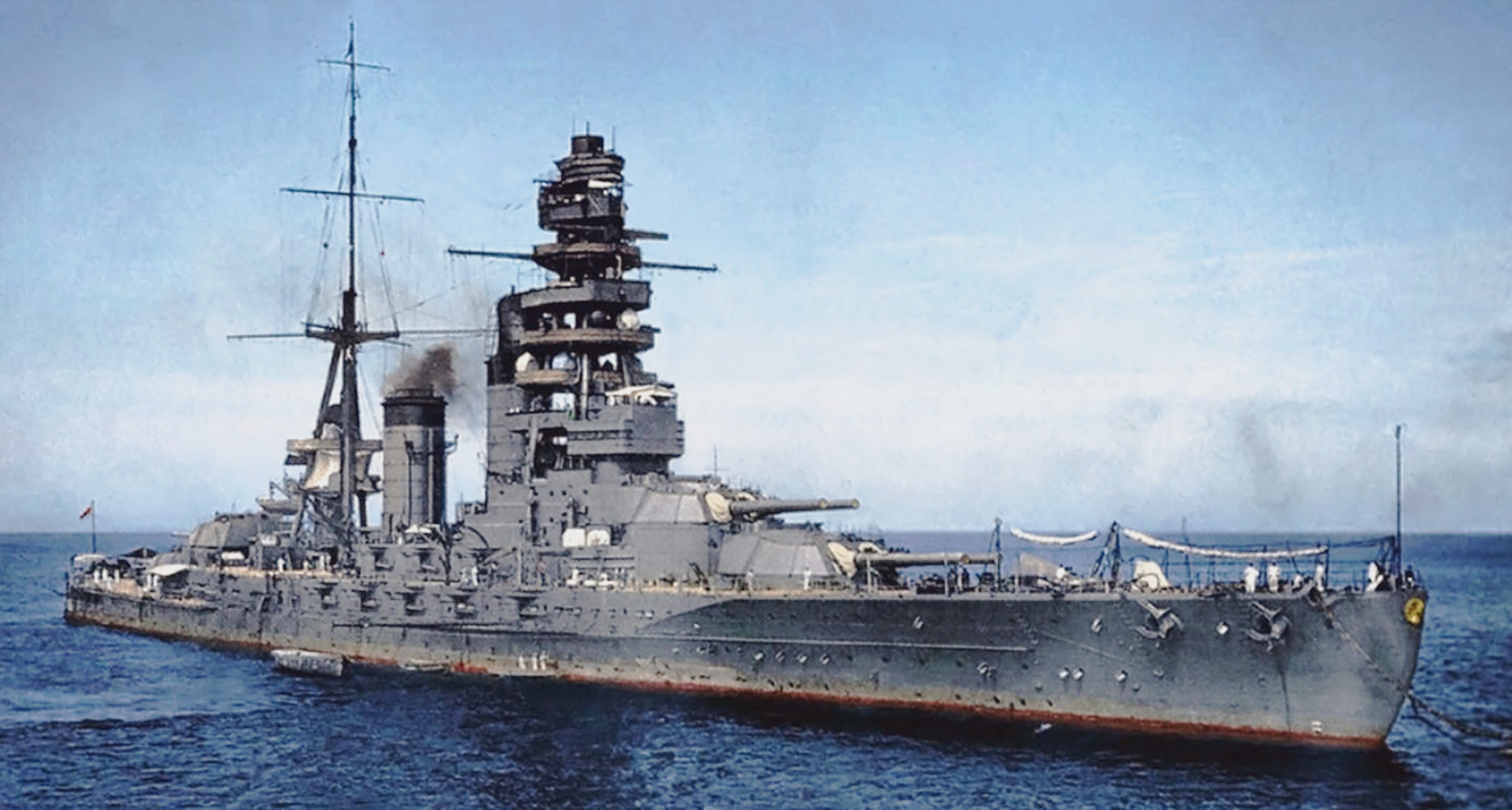 (NAGATO at Yokosuka, 1924 -colorization by Irootoko, Jr)
IJN Battleship NAGATO:
Tabular Record of Movement
© 2000-2016 Bob Hackett, Sander Kingsepp and Lars Ahlberg.
Revision 11
28 August 1917:
Kure Navy Yard. Battleship NAGATO is laid down.
9 November 1919:
Kure. NAGATO is launched by the Minister of the Navy,
Admiral (later Fleet Admiral/Baron/Prime Minister) Kato Tomosaburo. The ceremony
is also attended by Vice Admiral, Prince (later Fleet Admiral) Fushimi Hiroyasu
of the Naval General Staff. NAGATO is assigned to the Yokosuka Naval District.
20 November 1919:
Kure. Captain (later Vice Admiral) Iida Nobutaro
(former CO of BB SHIKISHIMA) is posted as the Chief Equipping Officer.
6 October 1920:
Sukumo Bight, Shikoku. During speed trials, NAGATO
beats the world record for a battleship of and makes 26.443 knots.
23 November 1920:
Sukumo Bight. During speed trials, NAGATO sets a new
record of 26.7 knots.
24-25 November 1920:
NAGATO completes test firing of her main
batteries.
25 November 1920:
NAGATO is completed and commissioned in the IJN. She
is the first battleship in the world equipped with 16.1-inch (410-mm) guns.
Captain Iida is her Commanding Officer.
1 December 1920:
Attached to BatDiv 1, First Fleet, as flagship of
Rear Admiral (later Admiral) Tochinai Sôjiro (former CO of AC AZUMA).
13 February 1921:
Hemi Wharf, Yokosuka. In the morning, Crown Prince
Hirohito (later Emperor Showa) arrives at the base and boards the NAGATO during
a short inspection tour.
1 December 1921:
Captain (later Vice Admiral) Kabayama Kanari (former
CO of BC IKOMA) assumes command.
1922:
A smoke deflector is fitted to fore funnel to keep the bridge
clear of funnel smoke at high speeds. A captive balloon is embarked on the
fantail.
18 February 1922:
Etauchi Bay, Inland Sea. Former Marshal of France
Joseph Joffre boards NAGATO during his visit to Japan to return from Etajima
Island to Miyajima.
12 April 1922:
Yokohama. Edward VIII, Prince of Wales (later Duke of
Windsor) arrives aboard battlecruiser HMS RENOWN on a state visit to Japan.
RENOWN is moored near NAGATO.
Early in the morning, NAGATO and all remaining vessels of the First Fleet
anchored at Yokohama hoist the White Ensigns. A 21-gun salute is fired from
76-mm/40 AA guns. The Prince of Wales and his ADC, (Lt later Admiral of the
Fleet) Lord Louis Mountbatten visit MUTSU and NAGATO, both flying royal
pennants. The guests inspect NAGATO’s machinery spaces and have a dinner in the
staff mess room, followed by degustation of several boxes of specially imported
Johnnie Walker Scotch whiskey.
6 February 1922: The Washington Treaty:
Washington, DC. Japan, United
States, Britain, France and Italy agree to limit the displacement and main
armament of their capital ships, aircraft carriers and cruisers and to limit the
total tonnage and age of their capital ships and carriers. Battleships and
aircraft carriers are set at a ratio of 5:5:3 for the navies of Great Britain,
the United States and Japan. Japan's Plenipotentiary at the conference is her
Minister of the Navy, Admiral, the Baron, Kato Tomosaburo.
28 August 1922:
BatDiv 1 (NAGATO, MUTSU, KONGO, HIEI, KIRISHIMA and
ISE) depart Kure for a flag-showing mission, combined with maneuvers, off the
Siberian coast, preceding the withdrawal of Japanese troops.
10 September 1922:
Arrives at Otaru, Hokkaido.
10 November 1922:
Captain (later Rear Admiral) Takahashi Setsuo
(former CO of YAMASHIRO) assumes command.
1 September 1923:
Changshan archipelago, Korea Bay. A 1500, while
preparing for post-maneuvers inspection, a radio message is received by NAGATO
about the Great Kanto Earthquake, one of the worst earthquakes in history, that
hit the Kanto plain destroying Tokyo, Yokohama and the surroundings. About
140,000 people are killed by the earthquake and the fires caused by it.
2 September 1923:
The battleships of the First Fleet depart Changshan
for Kyushu.
3 September 1923:
In the afternoon, the fleet steaming at 20 knots
enters a typhoon area. The starboard casemate battery on NAGATO is swamped and a
dangerous list appears.
4 September 1923:
NAGATO and MUTSU arrive at Uchinoura Bay, Kyushu,
to embark food, provisions and medical supplies. Both battleships depart on that
same day. Enroute to Yokosuka, a foreign cruiser (possibly armored cruiser USS
HURON (CA-9) is briefly sighted.
5 September 1923:
Arrives at Yokosuka, disembarks the supplies.
1 December 1923:
Captain (later Vice Admiral) Sakonji Seizo (former CO
of CL YAHAGI) assumes command.
January 1924:
Yokosuka. NAGATO enters dock. NAGATO, out of drydock for nine months, has acquired very heavy marine growth. IJN policy is to dock a ship every 10 months, clean the hull’s sides and bottom and repaint with anticorrosive and anti fouling paint. U. S. Naval Intelligence learns the maximum elevation of NAGATO and MUTSU’s main guns is 25 degrees. She has one 10-meter range finder on her foretop. The power of NAGATO’s radio is 5 kilowatts and 25 kilowatts using undamped wave.
30 March 1924:
Amami O-Shima, 8 miles NW of Sotsu-Takasaki. During
towing exercises, Captain Sakonji misjudges the drift of his vessel, so that it
grazes MUTSU. Thanks to last-minute maneuvers undertaken by both battleships
there are no casualties, but NAGATO looses one of her anchors and her hull
plating receives minor damage.
August 1924:
Saeki Bight. During the maneuvers NAGATO is hit by an
exercise torpedo from the submarine SS-62 (later renamed RO-28). The explosion
of the ruptured air flask damages one of NAGATO’s propeller blades.
Late 1924 to March 1925:
Kure. The top of the fore funnel is swept
back.
6-7 September 1924:
S of Nojima Island. Participates in the sinking
of the battleship AKI with MUTSU.
1 November 1924:
Crown Prince (later Emperor) Hirohito's (Showa)
younger brother Prince Takamatsu Nobuhito, a Midshipman (later Captain) and
graduate of the Etajima Naval Academy, takes up duty aboard NAGATO until 1
May 1925.
1 December 1924:
Gunnery training vessel at Yokosuka. Captain (later
Rear Admiral) Nakajima Susumu (former CO of HIEI) assumes command.
August 1925:
German aircraft designer Ernst Heinkel and several
German engineers arrive at Yokohama to present a custom-built take-off platform
NAGATO. They also deliver the prototypes of Heinkel HD-25 (two-seat) and HD-26
(single-seat) floatplanes built for the use from NAGATO. After the plaftorm is
mounted atop the No. 2 main turret, several launch tests are carried out in Boso
Bight, off Tateyama, using HD-25 and Yokosho Ro-Go floatplanes. During the tests
the HD-25 is piloted by Carl Clemens Bücker, another future aircraft
manufacturer. The take-off platform is later removed and a modified version is
used on FURUTAKA class heavy cruisers.
22 August 1925:
Captain (later Rear Admiral) Ozoekawa Masaharu former
CO of AG FUJI) assumes command.
1 December 1925:
Reattached to BatDiv 1, First Fleet, as the flagship
of the Combined Fleet, flying the flag of C-in-C, Admiral Okada Keisuke.
Summer 1926:
A German Hansa-Brandenburg W-33 monoplane is tested
aboard, but soon replaced with a Yokosho E1Y2 (Type 14).
1 December 1926:
Captain (later Admiral/Governor of Formosa) Hasegawa
Kiyoshi (former CO of AC NISSHIN) assumes command.
1 August 1927: Tokiwa Mine Explosion Incident:
Saeki Bay, Kyushu. At
0939, while a staff conference is being held aboard NAGATO, a number of No.
5 mines explode on minelayer TOKIWA (former armored cruiser), anchored nearby.
NAGATO and several other vessels send over their firefighting teams to quell the
raging fires. [1]
1 December 1927:
Captain (later Vice Admiral) Matsushita Shigeru
(former CO of OI) assumes command.
10 December 1928:
Captain (later Vice Admiral) Inoue Tsugumatsu
(former CO of IZUMO) assumes command. Training ship. Visits Hong Kong.
29 May 1929:
Becomes the guest ship for the Emperor during his return
from the Imperial Cruise to Hachijo Jima island.
30 November 1929:
Captain (Vice Admiral) Hamada Kichijiro (former CO
of CL KISO) assumes command.
22 April 1930: The London Treaty:
London. The Treaty for the
Limitation and Reduction of Naval Armament is signed by Japan, Great Britain and
the United States. It is an extension of the Washington Naval Treaty of 1922.
The signatories agree not to build new capital ships until 1937. A number of
existing capital ships are to be scrapped.
1 December 1930:
Attached to BatDiv 1, First Fleet. Captain (later
Vice Admiral) Nakamura Kamezaburo (former CO of CA KAKO) assumes command.
10 October 1931:
Captain (later Vice Admiral) Hara Keitaro (former CO
of BB ISE) assumes command.
1 December 1931:
Reserve ship. Captain (Vice Admiral) Sugisaka Teijiro
(former CO of BB FUSÔ) assumes command.
4 March 1932:
Captain (later Rear Admiral) Sonoda Minoru (former CO of
BC HARUNA) assumes command.
1 December 1932:
Captain (later Rear Admiral) Uno Sekizo (former CO of
BC KIRISHIMA) assumes command.
1932:
Four twin (4x2) dual purpose 5-inch (127-mm) HA guns are
installed. The existing 3-inch (76-mm) AA guns are landed. Four 40-mm/62 Vickers
AA guns (2 x 2) are also added to the weather deck.
25 February 1933:
Geneva, Switzerland. Japan withdraws from the League
of Nations and decides she will no longer abide by restrictions such as the
Washington of 1922 and the London Treaty of 1930 that impose limitations on the
number and size of her warships.
Summer 1933:
A Kure Type No. 2 Model 3 catapult, collapsible crane
and rails are installed between the mainmast and the No. 3 turret.
16-21 August 1933: Special Great Maneuvers:
Departs Tateyama as the
flagship of the Red Fleet to operate N of Marshall Islands, then returns to
Kisarazu Bight.
1 April 1934: First Modernization :
Kure Navy Yard. NAGATO’s hull is
lengthened aft, anti-torpedo bulges are added and all torpedo tubes removed. A
clipper bow is retrofitted. Additional horizontal armor is fitted over the
magazines and machinery spaces. An armor strake is fitted to hull bottom in the
vicinity of the turn of the bulges.
New main caliber turrets taken from unfinished battleships KAGA and TOSA
are installed. Her 16-inch (406-mm) guns' elevation is increased to 43 degrees,
increasing their maximum range to 41, 448 yards or 23.5 miles. Additional armor
is fitted to turret faces, sides and tops. The barbette armor is likewise
strengthened. The secondary battery 5.5-inch (140-mm) guns' elevation is
increased to 35 degrees. Two upper deck secondary caliber guns are landed.
The NAGATO’s forward funnel is removed. All of her 20 original steam
boilers are removed and replaced with four large Kampon oil-fired boilers in
addition to six rebuilt small boilers. As a result of increase in displacement,
the NAGATO’s maximum speed drops to 25 knots. Three Nakajima E4N2 floatplanes
are embarked.
15 November 1933:
Captain (later Rear Admiral) Sada Kenichi (former CO
of BC HIEI) assumes command.
15 November 1934:
Captain (later Rear Admiral) Yukishita Katsumi
assumes command.
15 July 1935:
Captain (later Rear Admiral) Saito Jiro (former CO of CA
FURUTAKA) assumes command.
15 November 1935:
Attached to BatDiv 1, First Fleet.
31 January 1936:
Kure. NAGATO’s modernization is completed. Her
standard displacement is now 39,130-tons.
26 February 1936:
1,400 young Army officers launch a coup d’etat in
Tokyo, storming the Diet and several other key buildings. For the next few days
the better part of the capital remains under rebel control. As a part of efforts
to quell the riot, the NAGATO is directed into Tokyo Bay. She berths at Odaiba
pier, Shinagawa, training her main battery guns at the Diet building. An ad hoc
Rikusentai landing force is formed of the junior sailors.
1 December 1936:
Captain (later Vice Admiral), the Baron, Samejima
Tomoshige (former CO of HAGURO and ADC to Prince Nobuhito) assumes command.
7 July 1937: The Marco Polo Bridge (The First "China") Incident:
Lugouqiao, China. Japanese troops are on night maneuvers at the bridge. They
fire blank cartridges. Chinese troops fire back, but do not cause injuries. At
morning roll call, the Japanese discover a soldier missing and assume the
Chinese captured him. The Japanese demand entry to Beijing to look for the
soldier. The Chinese refuse. The Japanese then shell the city. An undeclared war
on China begins.
21 August 1937:
Departs Komatsu Shima, Shikoku, carrying 1,749 men of
the 1st and 2nd Battalion, 43rd Infantry Regiment, 11th Infantry Division to
Shanghai. The submarines I-1 through I-6 provide distant cover.
23 August 1937:
Off Saddle Islands. The soldiers are transferred to
light cruisers and destroyers. During the operation, NAGATO collides with light
cruiser OI. The damage is minor. 25 August 1937:
Returns to Sasebo.
1937:
A new catapult (Kure Type No. 2 Model 5) is fitted.
1 December 1937:
Training ship at Yokosuka. Captain (later Vice
Admiral) Nakajima Torahiko (former CO of SENDAI) assumes command.
15 November 1938:
Captain (later Vice Admiral) Kakuta Kakuji, (former
CO of IWATE) CO of YAMASHIRO, assumes temporary command.
1938:
Three Nakajima E8N1 Type 95 ("Dave”) floatplanes are embarked.
15 December 1938:
Attached to BatDiv 1, First Fleet, and flagship of
the Combined Fleet. Captain (later Vice Admiral) Fukudome Shigeru (former Vice
Chief of Staff, China Area Fleet) assumes command.
1939:
20 Type 96 1-inch (25-mm) AA guns are fitted instead of the
40-mm AA guns.
1 September 1939:
The Commander-in-Chief of the Combined Fleet Vice
Admiral (later Fleet Admiral, posthumously) Yamamoto Isoroku (former CO of
AKAGI) boards the ship at Wakanoura.
October 1939: Annual Fleet Exercises:
S of Shikoku Island. Flagship NAGATO and fleet carrier AKAGI participate in the fleet exercises.
Upon completion of the exercises, NAGATO and AKAGI steam to Tokyo Bay, then drop anchor in the Tsurumi Sea.
The IJN’s Meguro Tokyo research laboratory, in co-operation with the Japanese Wireless Company, conduct a test of a trial radar
apparatus. The radio wave transmitting device is positioned on the roof of the Toshiba factory and the receiver was located
separately on a wharf. The target is AKAGI, her vast rectangular appearance made her perfect for the job. The experiments are
judged successful. [2]
15 November 1939:
Captain (later Vice Admiral) Tokunaga Sakae (former
CO of CL YURA) assumes command.
1940:
A Kure Type No. 2 Model 5 catapult and aircraft handling crane
are fitted.
11 October 1940: Imperial Naval Review:
Yokohama Bay. An Imperial
review is held in celebration of the 2, 600th anniversary of the Emperor Jimmu's
enthronement. Ninety-eight of the Combined Fleet's warships led by its flagship,
NAGATO, are spread across the bay ready for inspection. NAGATO's entire crew
mans the sides of their ship. Emperor Hirohito and the fleet's
Commander-in-Chief, Vice Admiral (Fleet Admiral, posthumously) Yamamoto Isoroku
(former CO of AKAGI) pass by the fleet's ships aboard battleship HIEI
escorted by the cruisers TAKAO, KAKO and FURUTAKA.
15 October 1940:
Captain (later Vice Admiral) Onishi Shinzo (former CO
of CL TONE) assumes command.
Spring 1941:
Koumi Basin, Yokosuka. NAGATO undergoes her last pre-war
refit. Her main caliber gun barrels are exchanged and an external degaussing
coil is fitted. Her anti-torpedo bulges are filled with crushing tubes.
11 August 1941:
Captain (Vice Admiral, posthumously) Yano Hideo
(former CO of MYOKO) is posted as the Commanding Officer. NAGATO is assigned
to the Combined Fleet's BatDiv 1 with her sister-ship, MUTSU at Hashirajima in
Hiroshima Bay.
9 October 1941:
Wargames are conducted aboard.
1 November 1941:
Anchored at Saeki in readines.
10 November 1941:
Arrives at Iwakuni.
17-18 November 1941:
Departs Hashirajima for Saeki.
18 November 1941: Operation "Z":
Arrives at Saeki. Admiral Yamamoto
departs NAGATO by motor launch for carrier AKAGI anchored nearby where he hosts
a farewell for the Commander of the Carrier Strike Force ("Kido Butai"),Vice
Admiral (Admiral, posthumously) Nagumo Chuichi (former CO of YAMASHIRO).
19 November 1941:
Yamamoto returns to Hashirajima aboard NAGATO. AKAGI
departs Saeki for the Kuriles to join the Carrier Strike Force.
2 December 1941:
At 1730, NAGATO sends the coded signal No. 676:
"Niitakayama nobore (Climb Mt. Niitaka) 1208" to the Carrier Strike Force, then
940 miles north of Midway Island. The signal means that hostilities will
commence on 8 December (Japan time).[3]
6 December 1941:
An anti-torpedo net is fitted experimentally on NAGATO's
starboard side.
8 December 1941: Operation "Z" – The Attack on
Pearl Harbor:
BatDiv 1 sorties from Hashirajima to the Bonin Islands
with the First Fleet's BatDiv 2's ISE, FUSO, YAMASHIRO, HYUGA, CarDiv 3's light carrier
HOSHO, escorted by DesDiv 21's WAKABA, NENOHI, HATSUHARU and HATSUSHIMO and DesDiv 27's ARIAKE, YUGURE,
SHIRATSUYU, SHIGURE, MIKAZUKI and YUKAZE.
13 December 1941:
BatDiv 1 returns to Hashirajima.
21 December 1941:
New battleship YAMATO arrives at Hashirajima from Kure
and joins BatDiv 1 with NAGATO and MUTSU.
20 January 1942:
Proceeds to Kure. Loads material.
24 January 1942:
Returns to Hashirajima
12 February 1942:
At Hashirajima. The Combined Fleet's flag is
transferred from NAGATO to YAMATO. During February through May, BatDiv 1
conducts training and gunnery practice in the Inland Sea area. Minor repairs are
carried out at Kure.
Late February 1942:
NAGATO serves as the floating
HQ for Prince Takamatsu and his staff.
15 March 1942:
At Kure. Dry docked. Type 91 anemometers are exchanged for
Type 91, Mod 2.
9 April 1942:
Undocked.
5 May 1942:
BatDiv 1's NAGATO and MUTSU depart Hashirajima for gunnery
practice in the Iyo Nada with BatDiv 2. HYUGA's No. 5 turret gun blows up.
She departs for Kure with FUSO as escort. NAGATO and the other battleships
return to Hashirajima.
11 May 1942:
BatDiv 1 departs Hashirajima for
gunnery and AA practice in the Iyo Nada. Returns that night.
13 May 1942:
Proceeds to Kure. Loads ammunition.
15 May 1942:
BatDiv 1 departs Kure for exercises with CruDiv 7's MOGAMI,
MIKUMA, KUMANO and SUZUYA in the Inland Sea.
17 May 1942:
Returns to
Hashirajima.
19 May 1942:
BatDiv 1 departs Hashirajima with the First and the Third
Fleets for maneuvers at sea.
23 May 1942:
The fleets return to Hashirajima.
29 May 1942:
Departs Hashirajima with the First Fleet's Main Body: BatDiv
1's YAMATO, NAGATO and MUTSU, light carrier HOSHO, seaplane tenders CHIYODA and
NISSHIN, Supply Group No. 1 oilers and DesRon 3's light cruiser SENDAI and
destroyers.
4 June 1942: Operation
"MI" - The Battle of Midway:
The Main Body remains 300 miles behind
Vice Admiral Nagumo's First Carrier Striking Force. Does not engage American
forces.
5-6 June 1942:
After the Main Body joins up with retiring Striking Force,
NAGATO takes aboard the survivors from carrier KAGA picked up earlier by DesRon
10's destroyers. Refuels from oiler TOEI MARU. Later refuels DesRons 3, 10 at
sea.
14 June 1942:
The Main Body returns to Hashirajima.
3 July 1942:
Proceeds to Tokuyama in a practice sortie.
6 July 1942:
Returns to Hashirajima.
13 July 1942:
Proceeds to Kure. Maintenance and refueling.
14 July 1942:
At Hashirajima. The First Fleet is reorganized. NAGATO and
MUTSU are transferred from the Combined Fleet's BatDiv 1 to Vice Admiral Shimizu
Mitsumi's (former CO of ISE) First Fleet in BatDiv 2 with YAMASHIRO, FUSO, ISE
and HYUGA. NAGATO becomes flagship of the First Fleet. BatDiv 2 performs
'standby alert' and training missions.
18 July 1942:
At Kure. Dry-docked.
22 July 1942:
Undocked.
1 September 1942:
Poceeds to Kure. Maintenance work. Loads material.
5 September 1942:
Returns to Hashirajima.
6 October 1942:
Arrives at Kure. Fuels and maintenance work.
13 October 1942:
Proceeds to Hashirajima.
1 November 1942:
Captain Yano is promoted to Rear Admiral.
10 November 1942:
Captain Hisamune Yonejiro (former CO of AOBA) assumes
command. Captain Yano is promoted to Rear Admiral and reassigned to the Naval
General Staff's Third Bureau (Intelligence).
29 November 1942:
Proceeds to Tokuyama in an exercise sortie.
1 December 1942:
Proceeds to Murotsu in an exercise sortie.
3 December 1942:
Returns to Hashirajima.
December 1942:
In the western Inland Sea. In air training exercises with
MUSASHI, FUSO and YAMASHIRO and carrier ZUIKAKU.
3-5 January 1943:
Departs Hashirashima on training drill.
5 January 1943:
Returns to Hashirashima. NAGATO resumes 'standby
alert'.
11 January 1943:
Departs Hashirashima for Kure. Disembarks cadet interns.
Resumes 'standby alert'.
25 January 1943:
At Kure. Dry-docked for repair of the main fresh water
tanks and minor boiler repairs.
2 February 1943:
Undocked. Proceeds to Hashirajima.
4 March 1943:
Returns to Kure. Maintenance work and refueling.
24 March 1943:
Returns to Hashirajima.
10 April 1943:
Participates in exercises. Arrives at Agenosho Bay, Inland
Sea.
11 April 1943:
Returns to Hashirajima.
13 April 1943:
Proceeds to Kure. Refuels. Leave and liberty.
17 April 1943:
Returns to Hashirajima.
26 April 1943:
Proceeds to Tokuyama. Battle exercises.
28 April 1943:
Returns to Hashirajima.
4 May 1943:
Proceeds to Yashima. Battle exercises.
5 May 1943:
Arrives at Hashirajima.
11 May 1943:
Departs Hashirajima to test a jury rudder.
12 May 1943:
Proceeds to Kure.
13 May 1943:
Arrives Hashirajima.
26 May 1943:
Proceeds to Kure. Refuels. Crew leaves and liberty.
31 May 1943:
Kure. Drydocked at No. 4 drydock. A Type 21 radar set and two
25-mm AA guns (twin mount) are fitted.
6 June 1943:
Undocked.
8 June 1943:
Departs Kure for Hashirajima. MUTSU, at anchor, explodes
suddenly and sinks at Hashirajima.
25 June 1943:
Iyo Nada. After an accident investigation, the loss of MUTSU
is blamed on a disgruntled seaman who had brooded over theft charges. The fleet
resumes normal activities. NAGATO conducts a towing exercise by destroyers
TAMANAMI and WAKATSUKI in which NAGATO simulates that her rudder is jammed over
at 35 degrees.
26 June 1943:
Proceeds to Yashima. Battle exercises.
27 June 1943:
Returns to Hashirajima.
28 June 1943:
Proceeds to Yashima.
30 June 1943:
Returns to Hashirajima.
6 July 1943:
Proceeds to Agenosho. Battle exercises.
7 July 1943:
Departs Agenosho.
8 July 1943:
Arrives Kure. Fuels and maintenance work.
29 July 1943:
Returns to Hashirajima.
29 July 1943:
Proceeds to Yashima. Battle exercises.
31 July 1943:
Proceeds to Tokuyama. Battle exercises.
1 August 1943:
Returns to Hashirajima.
2 August 1943:
Captain (later Rear Admiral) Hayakawa Mikio (former CO of
CA CHOKAI and YAMASHIRO) assumes command from Captain Hisamune.
5 August 1943:
Proceeds to Yashima. Battle exercises.
6 August 1943:
Returns to Hashirajima.
7 August 1943:
Departs Hashirajima to prepare for the Solomon Islands
operations.
11 August 1943:
Arrives Kure. Refuels and maintenance work.
16 August 1943:
NAGATO departs Kure with YAMATO, FUSO and DesDiv 16's
AMATSUKAZE and HATSUKAZE. Stops that night at the Yashima anchorage near
Takamatsu on Shikoku.
17 August 1943:
NAGATO departs Yashima via Yokosuka for Truk carrying army
troops, naval personnel including the 958 Naval Aeronautical Squadron, some survivors of MUTSU and supplies in
a task group with battleships YAMATO, FUSO, escort carrier TAIYO, cruisers ATAGO, TAKAO,
DesDiv 7's USHIO, DesDiv 10's AKIGUMO, YUGUMO, DesDiv 16's AMATSUZAKE and
HATSUKAZE.
20 August 1943:
The task group encounters a Typhoon, but safely escapes the area and continues south.
23 August 1943:
Task group arrives at Truk. NAGATO assumes standby alert and participates in battle exercises.
MUTSU's survivors are sent ashore. The 958 Naval Aeronautical Squadron is later transported to Rabaul aboard cruiser TAKAO.
18 September 1943:
Rear Admiral Charles A. Pownall's (former CO of
RANGER, CV-4) Task Force 15's carriers USS LEXINGTON (CV-16), PRINCETON (CVL-23)
and BELLEAU WOOD (CVL-24) launch raids on Tarawa, Makin and Abemama atolls in
the Gilberts.
In response to TF 15's raids, Vice Admiral Ozawa Jizaburo, in
tactical command, sorties from Truk to Brown Atoll, Eniwetok.
Ozawa leads the fleet's first section's BatDiv 1's YAMATO and NAGATO,
CarDiv 1's SHOKAKU, and ZUIKAKU, (followed by ZUIHO on 19 September), CruDiv 5's
MYOKO and HAGURO, CruDiv 8's CHIKUMA and TONE, light cruisers AGANO, NOSHIRO and
destroyers.
Vice Admiral Kurita Takao leads the second section with his Advance
Force: CruDiv 4's ATAGO, TAKAO, MAYA and CHOKAI. The Commander-in-Chief of the
Combined Fleet Admiral (Fleet Admiral, posthumously) Koga Mineichi (former CO of
ISE) remains at Truk in the fleet's flagship, MUSASHI with BatDiv 2's FUSO and
BatDiv 3's KONGO and HARUNA.
25 September 1943:
The fleet returns to Truk.
5-6 October 1943:
Rear Admiral (later Vice Admiral) Alfred E.
Montgomery's (former CO of RANGER, CV-4) Task Force 14 carriers USS ESSEX
(CV-9), YORKTOWN (CV-10), LEXINGTON (CV-16), INDEPENDENCE (CV-22), BELLEAU WOOD
(CVL-24) and COWPENS (CVL-25) launch raids on Wake Island and the Marshall
Islands.
17 October 1943:
The Japanese intercept radio traffic that suggests the
Americans are planning another raid on Wake. Admiral Koga sorties from Truk to
Brown Atoll, Eniwetok to intercept the enemy task force with the fleet: BatDiv
1's YAMATO, MUSASHI and NAGATO, BatDiv 2's FUSO, Bat Div 3's KONGO and HARUNA,
CarDiv 1's SHOKAKU, ZUIKAKU and ZUIHO, CruDiv 4's ATAGO, TAKAO, MAYA and CHOKAI,
CruDiv 7's SUZUYA, MOGAMI, CruDiv 8's CHIKUMA and TONE and light cruisers AGANO,
NOSHIRO and OYODO and destroyers.
During the sortie, NAGATO carries ground personnel of the 932nd NAG, a
seaplane unit, from Truk to Eniwetok.
19-23 October 1943:
Brown. The 932nd’s ground personnel are disembarked.
23 October 1943:
Departs Brown and sorties to a position 250 miles SW of
Wake; returns after no enemy forces are detected.
26 October 1943:
The fleet arrives back at Truk. Remains there for three
months.
1 November 1943:
At Truk. Captain Hayakawa is promoted to Rear Admiral.
He is the first Commanding Officer of NAGATO to attain flag rank while serving
as her skipper.
25 December 1943:
At Truk. Captain (later Rear Admiral) Kobe Yuji (former
CO of CA TONE) assumes command. Rear Admiral (Vice Admiral posthumously)
Hayakawa is reassigned as ComDesRon 2 (KIA on destroyer SHIMAKAZE in Nov
44).[4]
1 February 1944: The Evacuation of Truk:
NAGATO departs Truk for Palau
with BatDiv 2's FUSO, CruDiv 7's SUZUYA, KUMANO and TONE, DesDiv 17's ISOKAZE,
TANIKAZE, HAMAKAZE and URAKAZE and DesDiv 61's AKIZUKI. At 1000, USS PERMIT
(SS-178) sights the FUSO group leaving Truk but the submarine is unable to
attack.
4 February 1944:
Arrives at Palau.
16 February 1944:
Departs Palau with the FUSO group in anticipation of an
air raid. NAGATO's crew sights an enemy submarine at 08-00N, 131-00E.
17
February 1944:
Another submarine is sighted at 05-30N, 125-40E.
20 February 1944:
South China Sea. N of Singapore. After sunset, USS
PUFFER (SS-268) sights the 10-ship FUSO group, but the submarine is unable to
attack. The NAGATO's lookouts sight an enemy submarine at 04-16N, 108-40 E,
probably PUFFER.
21 February 1944:
Arrives at Lingga (near Singapore). Participates in
battle exercises thereafter.
25 February 1944:
Vice Admiral Ugaki Matome (former CO of HYUGA),
Commander, BatDiv 1, Third Fleet, arrives aboard the NAGATO and his flag is
hoisted.
6 March 1944:
At Lingga in the Third Fleet.
11 March 1944:
BatDiv 1 conducts battle exercises off Lingga.
14 March 1944:
Individual battle exercises off Lingga.
17 March 1944:
Departs Lingga. Returns after battle exercises.
28 March 1944:
Departs Lingga to carry out flight exercises. Returns.
29 March 1944:
Departs Lingga. Practice sortie. Returns.
30 March 1944:
Departs Lingga for the Naval Base at Seletar, Singapore.
Dry-docked in the No. 1 Drydock, (the former King George VI Drydock) of the No.
101 Repair Facility. Lignum vitae changed.
13 April 1944:
Undocked. Takes on fuel, supplies.
16 April 1944:
Departs Singapore for Lingga.
16 April 1944:
Training at Lingga with Vice Admiral Ozawa Jisaburo's
(former CO of HARUNA) Mobile Fleet.
19 April 1944:
Participates in air defense exercises. Experiences
difficulty in maintaining 24 knots.
22 April 1944:
Departs Lingga and arrives at Garan.
25 April 1944:
Departs Garan and returns to Lingga.
28 April 1944:
Departs Lingga. Battle exercises.
29 April 1944:
Returns to Lingga, then departs again for more battle
exercises.
1 May 1944:
Carries out damage-control training at anchor.
5 May 1944:
Vice Admiral Ugaki transfers his flag to YAMATO. Battle
exercises cease.
5 May 1944:
Departs Lingga.
6 May 1944:
Returns to Lingga.
7 May 1944:
Departs Lingga.
11 May 1944: Deployment to Tawi Tawi:
At 0300, the Mobile Fleet (except
CarDiv 1, CruDiv 5, and DesRon 10) redeploys from Lingga to the old U.S.
anchorage at Tawi Tawi in the Sulu Sea.
12-13 May 1944:
At sea. Fleet deployment, firing practice.
14 May-11 June 1944:
At Tawi Tawi.
10 June 1944: Operation "Kon" - The
Relief of Biak:
Vice Admiral Ugaki's detaches from the fleet with BatDiv 1's
YAMATO and MUSASHI, CruDiv 5's HAGURO and MYOKO, DesRon 2's light cruiser
NOSHIRO and destroyers. The Kon task group departs Tawi Tawi for Batjan.
10 June 1944: Operation "KON" - The Relief of Biak:
Vice Admiral Ugaki's KON task group detaches from the fleet with Bat Div 1’s YAMATO and MUSASHI, DesRon 2's
light cruiser NOSHIRO and destroyers OKINAMI and SHIMAKAZE. The KON task group departs Tawi Tawi for Batjan.
13 June 1944: Operation "A-GO" - The Battle of the
Philippine Sea:
In Tokyo, the CINC, Combined Fleet, Admiral Toyoda Soemu, (former CO of HYUGA), sends out a signal that activates
the A-GO plan for the Defense of the Marianas.
The Mobile Fleet departs Tawi Tawi for Guimaras near Panay, Philippines with Force "B"'s NAGATO, CarDiv 2's JUNYO,
HIYO and RYUHO, cruiser MOGAMI and eight destroyers. Force B sorties with Force "A"'s Car Div 1's TAIHO, SHOKAKU
and ZUIKAKU, DesRon 10's light cruiser YAHAGI and seven destroyers.
At 1000, on station nearby, LtCdr Marshall H. Austin's USS REDFIN (SS-272) sights and reports the Mobile Fleet departing the anchorage.
14 June 1944:
Guimaras, Philippines. Vice Admiral Ozawa's Mobile Fleet's Main Body arrives and the 2nd Supply Force's oilers GENYO and
AZUSA MARUs begin refueling operations.
15 June 1944:
Guimaras. At 0800, refueling is completed and the Mobile Fleet's Main Body departs through the Visayan Sea. At 1622, LtCdr
Robert Risser's USS FLYING FISH (SS-229) sights the Mobile Fleet in the San Bernardino Strait.
16 June 1944:
At 1650, Vice Admiral Ugaki's aborted Operation Kon task
force from Batjan rejoins Ozawa's force.
17 June 1944:
LtCdr Herman J. Kossler 's USS CAVALLA (SS-244) sights the
Mobile Fleet in the Philippine Sea and reports later that evening after
surfacing.
18 June 1944:
At 2100, Ozawa splits his Mobile Fleet. Forces "A" and "B"
proceed southward. Force "C" Vanguard proceeds due east in the Philippine Sea
towards Saipan.
19 June 1944:
At 1030, Ozawa launches a strike against Task Force 58, but
his aircraft are unable to locate TF 58, so most return to Guam. Destroyer
HAYASHIMO provides close escort for NAGATO, who in turn protects carriers JUNYO,
HIYO and RYUHO.
20 June 1944:
NAGATO fires at the attacking torpedo planes from her main
caliber guns, claiming two Grumman TBF "Avenger” torpedo planes from the USS
BELLEAU WOOD's (CVL-24) that are attacking JUNYO and forces the other planes to
retreat. NAGATO, stationed at JUNYO's starboard bow, is strafed during the
attack, but suffers no casualties.
At about 2030, HIYO explodes and sinks two hours after she is hit by
torpedoes by Grumman TBF "Avenger" torpedo planes from BELLEAU WOOD. NAGATO and
cruiser MOGAMI stand by as destroyers rescue most of HIYO's crew. That night,
NAGATO retires with the Mobile Fleet to Nakagusuku Wan (Bay), Okinawa.
22 June 1944:
At Okinawa. Battleships refuel destroyers. Destroyers
transfer HIYO's survivors to ZUIKAKU.
23 June 1944:
The Mobile Fleet departs Nakagusuku for Hashirajima.
24 June 1944:
Arrives at Hashirajima.
27 June 1944:
NAGATO departs Hashirajima for Kure. At Kure, she is fitted
with Type 22 and 13 radars (2 sets each). Two 140 mm. (5. 5-in.) guns are
removed and ninety-six (16 triple mount, 10 twin mount, 28 single) 25-mm AA guns
are added. All portholes located below the upper deck are covered over.
NAGATO is also fitted with Type 2 infrared (IR) Identification Friend-or-Foe
(IFF)/signaling device mounted midway up on each side of the bridge. They are
built around a telescopic sensor that receives light-waves in the IR range and
registers a readout in the radio shack. The system also includes a pair of
20-mm. binoculars coaxially mounted with the transmitting IR lamp on the bridge
so that another ship can use the IR detector for elementary signaling or as a
formation light for station keeping.
All portholes located below the upper deck are covered over. NAGATO is
also loaded with materials for transport.
8 July 1944:
Undocked. Departs Kure with Group B's KONGO, CruDiv 7's
MOGAMI, DesRon 10's YAHAGI and destroyers and Group A's YAMATO and MUSASHI,
CruDiv 4's ATAGO, TAKAO, MAYA and CHOKAI, CruDiv 7's KUMANO, SUZUYA, TONE and
CHIKUMA, DesRon 2's light cruiser NOSHIRO and destroyers.
9 July 1944:
At Usuki Bay, Kyushu. After taking aboard one regiment of
the 28th Division, the NAGATO departs for Nakagusuku, Okinawa.
10 July 1944:
Arrives at Okinawa. Group A detaches for Lingga (near
Singapore). The NAGATO and Group B remain at Okinawa unloading troops and
material.
12 July 1944:
Group B departs Okinawa for Manila.
14-17 July 1944:
Group B at Manila.
17 July 1944:
Group B departs Manila for Lingga.
19 July 1944:
About midnight, Group B is attacked by an unknown
submarine. It fires four torpedoes that miss KONGO. Group B arrives at Singapore
that day.
20 July-1 October 1944:
At Lingga. Participates in main battery day
exercises, including firings while using radar guidance.
1 September 1944:
Lingga anchorage. NAGATO receives fresh provisions replenishment from supply
ship KITAKAMI MARU.
1-6 October 1944:
Makes two trips from Lingga to Seletar Naval Base,
Singapore and return carrying fleet liberty parties. On one trip, is refueled by tanker YUHO MARU at Seletar.
6-18 October 1944:
Training at Lingga.
15 October 1944:
Captain Kobe is promoted to Rear Admiral.
18 October 1944:
The fleet departs Lingga for Brunei Bay, Borneo to
refuel.
22 October 1944: Operation "SHO-I-GO"(Victory) -
The Battle of Leyte Gulf:
At Brunei. Before departure, NAGATO's
Mitsubishi F1M2 "Petes" are transferred to YAMATO. Her conning tower, compass
bridge, casemate guns, directors and ammunition hoists are protected with
hammock "mantles". Her AA guns are protected with steel cables and her
searchlight positions with manila ropes as makeshift splinter protection. Her
rudder engine fuel tanks are covered with judo mats.
NAGATO sorties from Brunei towards the Philippines with Vice Admiral Kurita
Takeo's First Mobile Striking Force, First Section, Force "A" (Center Force):
BatDiv 1's YAMATO, MUSASHI and NAGATO, CruDivs 4, 5 and DesRon 2.
23 October 1944: The
Battle of the Palawan Passage:
Force "A" is attacked by two American
submarines. DARTER (SS-227) sinks cruiser ATAGO. DARTER also damages cruiser
TAKAO. DACE (SS-247) sinks cruiser MAYA. NAGATO is not damaged.
24 October 1944: The
Battle of the Sibuyan Sea:
1015: A B-24 "Liberator" bomber is sighted
to port, bearing 130. An air alert is ordered and speed is increased to 22
knots. The B-24 does not attack and disappears.
1016: A large group of
incoming aircraft is sighted to starboard, bearing 85, range 19 miles.
1027: NAGATO opens fire with her main guns firing "sanshikidans".
1029: Four "Helldivers" score two near hits on starboard bow.
1047: The last planes of the first wave disappear on the horizon. End of
the air alert.
1204: Thirty-one planes of the second wave are sighted to starboard,
bearing 88, range nine miles. An air alert is ordered and NAGATO opens fire with
"sanshikidan" rounds.
1208: A Helldiver drops a 1000-lb AP bomb on NAGATO, but it misses.
1218: The air alert is cancelled. The fleet's speed is reduced to 16
knots to conserve fuel and the course is changed to due east.
1321: A large group of aircraft from USS ESSEX (CV-9) is sighted, bearing
255, range 22 miles. The fleet commences a sharp turn to starboard to evade
detection.
1331: About 40 aircraft are sighted on starboard bearing 5, range 6
miles.
1345: Twenty of ESSEX's Grumman TBM-1C "Avengers" are sighted at a range
of 9 miles. Four attempt a torpedo attack, but it fails because of violent
maneuvering and AA fire.
1353: Attacked by four bomb-carrying Avengers from the ESSEX. Their
pilots claim three hits.
1412: Eighteen planes from ESSEX are sighted approaching on bearing 30,
range 15 miles.
1416: NAGATO is attacked by seven SB2C-3 Helldivers from FRANKLIN
(CV-13) and eight F6F "Hellcats" from CABOT (CVL-28).
NAGATO is hit by two bombs and suffers three near misses. The first bomb
explodes on the boat deck, damages the air intake of No. 1 boiler room, wrecks
casemate guns Nos. 2, 4, disables three more guns and jams 127-mm AA gun No. 2.
Due to the damage to the boiler room's air intake, it is shut down and causes
one propeller shaft to stop. NAGATO's speed drops to 22 knots until 1440 when
the boiler is put back on.
1426: Four Hellcats drop four 500-lb GP bombs and score three near hits
in the starboard bow area causing splinter damage.
1456: End of the air alert.
1503: Nine dive-bombers, seven torpedo planes
and five fighters are sighted to port bearing 130, range 17 miles. A new air
alert is ordered.
1516: The air alert is cancelled. During the day' Force A has endured
raids by over 250 U.S. carrier aircraft. MUSASHI, hit by numerous torpedoes and
bombs, sinks in the Visayan Sea. YAMATO takes direct hits by bombs. HARUNA is
damaged by five near -misses. Force A reverses course back through Sibuyan Sea.
1530: Force A reverses course back through Sibuyan Sea.
1534: End of air alert.
1714: Admiral Kurita again orders the fleet to reverse course.
2330: Force A enters San Bernadino Strait hours in single file.
25 October 1944: The
Battle off Samar:
0035: Force A exits San Bernardino Strait and
proceeds towards Leyte Gulf.
0548: Four planes are sighted to port, bearing
59, range 11 miles. An air alert is ordered. NAGATO opens fire at the aircraft.
0551: NAGATO ceases fire.
0558: Force A opens fire at escort carriers of "Taffy 3": USS ST. LO
(CVE-63), WHITE PLAINS (CVE-66), KALININ BAY (CVE-68), FANSHAW BAY (F) (CVE-70),
KITKUN BAY (CVE-71) and GAMBIER BAY (CVE-73). The carriers are screened by
destroyers USS HOEL (DD-533), JOHNSTON, (DD-557), HEERMANN (DD-532) and the
destroyer escorts USS SAMUEL B. ROBERTS (DE-413), DENNIS (DE-405), RAYMOND
(DE-341) and JOHN C. BUTLER (DE-339).
0601: NAGATO fires four salvos through a squall at three enemy carriers
that are barely visible to port, bearing 63, range 20 miles. This is the first
time in her career that NAGATO has fired on enemy ships. (She acts with YAMATO
throughout the day's action). Her first two salvos fired are Type 3 AA shells.
The following salvos are fired with AP rounds. NAGATO may have achieved some
near misses on the starboard bow of escort carrier USS SAINT LO (CVE-63).
NAGATO's gunners report one carrier hit and smoking.
0641: Lookouts spot masts on the horizon.
0654: Destroyer HEERMANN fires three torpedoes at HARUNA. The torpedoes
miss HARUNA, but head toward YAMATO and NAGATO. YAMATO's crew spots their tracks
to starboard. YAMATO and NAGATO turn away to port and steam northward for 10
miles until the torpedoes run out of fuel.
0755-0910: Force A sinks GAMBIER BAY, HOEL, ROBERTS and JOHNSTON. NAGATO
aggressively tries to engage the American carriers, but Rear Admiral Kobe is
reprimanded by Vice Admiral Ugaki. He advises Kobe to follow in the wake of
YAMATO. During the morning's battle, NAGATO fires 45 rounds from her main
armament and ninety-two 140-mm. rounds claiming one cruiser as heavily damaged.
Kurita orders all ships to head north.
1020: The Force reverses course southward and again heads towards Leyte
Gulf.
1030-1320: CHOKAI, CHIKUMA and SUZUYA are disabled by battle damage, drop
out of formation, and are subsequently lost.
1230: Seventy aircraft from Task Force 38's escort carriers attack the
Center Force.
1236: Kurita orders a course reversal northward.
1243: Two bombs hit NAGATO in the bow; one ruptures her anchor deck, the
other strikes a roller and explodes in the sea alongside, holing her bow.
1330: NAGATO's F1M2 Pete floatplanes that have returned from YAMATO
report 40 enemy transports in Leyte Gulf.
1656: Attacked by a group of dive-bombers. While making a sharp evasive
maneuver, four quarterdeck AA gunners are washed overboard. Destroyer AKISHIMO
is detached to pick them up but fails to locate any survivors.
2100: Force A retires through the San Bernardino Strait.
26 October 1944:
0800: Tablas Strait off Panay. Force A is attacked by
about 30 Grumman TBM Avengers from WASP (CV-19) and COWPENS (CVL-25).
1040:
The Force is attacked by about 30 Army Far Eastern Air Force B-24 "Liberators"
based at Morotai. Aboard YAMATO, bomb fragments wound Rear Admiral (later Vice
Admiral) Koyanagi Tomiji (former CO of KONGO), Chief of Staff, Second Fleet and
about 60 others. NAGATO and YAMATO open fire with their main armament using Type
3 'sanshikidan" shells. They claim several bombers shot down.
1100: About 60 aircraft from Task Groups 38.2 and 38.4 attack the Force.
Light cruiser NOSHIRO is sunk.
During today's and the previous day's battles, NAGATO fires ninety-nine
410-mm. (16.1-inch) shells and 653 140-mm. (5.5-inch) shells. She suffers 38
crewmen killed and 105 seriously wounded.
27 October 1944:
No attacks.
28 October 1944:
The remnants of Force "A" arrive at Brunei and refuel.
6 November 1944:
Carrier JUNYO and light cruiser KISO, escorted by DesDiv
30's YUZUKI and UZUKI arrive at Brunei from Sasebo with ammunition resupply for
Kurita's force.
8 November 1944:
To avoid air raids, NAGATO sorties from Brunei to Pratas
Islands with YAMATO, HARUNA, KONGO, light cruiser YAHAGI and four destroyers.
JUNYO, cruisers TONE and ASHIGARA and two destroyers follow. ASHIGARA detaches
back to Brunei. JUNYO, TONE, KISO, DesDiv 30 detach to Manila. Near Pratas, the
remainder of YAMATO group turns around and returns to Brunei.
11 November 1944:
YAMATO group arrives back at Brunei and refuels from
oiler HAKKO MARU.
15 November 1944:
NAGATO is reassigned to BatDiv 3 in Second Fleet.
16 November 1944:
At Brunei Bay. The fleet is attacked by 40 Army Air
Force B-24 bombers and 15 P-38 fighters.
17 November 1944:
NAGATO departs for Kure with YAMATO, KONGO, light
cruiser YAHAGI and DesDiv 17's HAMAKAZE, ISOKAZE, URAKAZE and YUKIKAZE. The
YAMATO group's escort is also joined by DesDiv 43's KIRI and UME from Spratly
Island.
21 November 1944:
YAMATO group is attacked by LtCdr (later Vice Admiral)
Eli Reich's USS SEALION II (SS-215). Reich sinks KONGO and destroyer
URAKAZE.
22 November 1944:
YAMATO group's escort is joined by destroyers FUMITSUKI
and SUZUTSUKI sent from Kure.
23 November 1944:
Refuels destroyers in Inland Sea.
24 November 1944:
NAGATO detaches for Yokosuka Naval Base with DesDiv
17.
25 November 1944:
Arrives at Yokosuka. Drydocked that day. Begins battle
damage repairs. Forward secondary guns removed. Two 127-mm and thirty (10 triple
mount) 25-mm AA guns are added and one older triple mount is removed.
NAGATO
serves as a floating AA battery. Her funnel and mainmast are removed to improve
her guns' arcs of fire. Moored alongside a pier at Yokosuka's Koumi Base, she is
camouflaged and protected by anti-torpedo nets.
20 December 1944:
At Yokosuka. Captain Shibuya Kiyomi (former CO of CV
JUNYO) assumes command from Rear Admiral Kobe who is reassigned to the Naval
General Staff.
The former Vice Chief of the Naval
General Staff, Vice Admiral (Admiral, posthumously) Ito Seiichi (former CO of
HARUNA) assumes command of the Second Fleet. Vice Admiral Kurita is reassigned
as President of the Etajima Naval Academy.
1 January 1945:
BatDiv 3 is disbanded. NAGATO is reassigned to reactivated
BatDiv 1 in Second Fleet.
10 February 1945:
BatDiv 1 is deactivated once again. NAGATO is reassigned
to the Yokosuka Naval District as a coastal defense vessel. NAGATO's crew
continues to live aboard and she remains operative, although without adequate
fuel for getting underway (a coal-burning donkey boiler is installed for
furnishing steam to the galley, heating, etc.). NAGATO's AA battery, without
full power, is only partially operative.
20 April 1945:
Reassigned as reserve ship due to lack of fuel.
27 April 1945:
At Yokosuka. Rear Admiral Otsuka Miki, recalled from
retirement when the war began to skipper merchant ships, assumes command from
Captain Shibuya. As a LtCdr in the mid-1920s, Otsuka had served as NAGATO's
communications officer.
1 June 1945:
ISE, HYUGA, NAGATO and HARUNA are assigned to the Special
(Coast) Guard Fleet.
All of NAGATO's remaining secondary, most AA guns and
one catapult are moved ashore. Her AA guns are installed on the top of the
nearby Urayama mountain. Her secondary guns protect Yokosuka's pier zone against
future landings. NAGATO's main guns point at the mouth of the Sagami Bay to fire
on any landing ships at point-blank range. NAGATO's rangefinders and all her
searchlights are moved ashore and installed on nearby Okusuyama mountain. NAGATO
is heavily camouflaged and her main gun turrets are covered with elaborate
scaffolding. Potted pines and cryptomerias are set on her upper decks. Her crew
is reduced to 1,000 men.
18 July 1945:
At Yokosuka. After 1540 attacked by some hundred SB2C-4
"Helldiver” dive-bombers from TF 58’s USS ESSEX (CV-9), RANDOLPH (CV-15) and
SHANGRI-LA (CV-38), followed by F6F-5 "Hellcat” fighter-bombers from BELLEAU
WOOD (CVL-24). Some of NAGATO's former AA guns fire from nearby Urayama. Her
main guns do not fire.
At 1552 a 500 or 1000-lb GP bomb hits the bridge and
demolishes the wheelhouse. Rear Admiral Otsuka, XO Captain Higuchi Teiji (former
gunnery officer of KIRISHIMA) and eleven more officers are killed. Cdr Okuda
Takeshi, 8th Division Officer assumes temporary command of the ship. Another
500-lb GP bomb hits the shelter deck aft of the mainmast on the port side and
explodes against the base of No. 3 main caliber turret barbette. Its blast kills
some 25 men in nearby officers’ wardroom and destroys four 25-mm mounts on the
upper deck. One 11.75-in "Tiny Tom” rocket (dud) hits NAGATO’s fantail, exiting
from the starboard side. After this attack, all her remaining AA armament is
moved ashore.
Rear Admiral Otsuka is promoted Vice Admiral, posthumously.
24 July 1945:
Captain Sugino Shuichi (former CO of CVE TAIYO) is assigned
as CO, but at this time Sugino is at Port Arthur, Manchukuo.
28 July-9 August 1945:
During the absence of Sugino, Rear Admiral Ikeuchi
Masamichi (former CO of CVS CHITOSE) is recalled from retirement and assigned
temporary duty as NAGATO's CO.
15 August 1945:
At noon, Admiral Ikeuchi assembles the whole crew on
afterdeck to listen to the Emperor's radio transmission of his Imperial Rescript
that calls for an end to hosilities.
20-30 August 1945:
Yokosuka. Captain
Sugino arrives and assumes command. Soon thereafter, NAGATO is relocated to No.
1 buoy in Yokosuka's harbor.
29 August 1945:
USS MISSOURI (BB-63) and IOWA (BB-61) and numerous
minesweepers and destroyers enter Tokyo Bay and anchor at Yokosuka. IOWA serves
as flagship of Admiral (later Fleet Admiral) William F. Halsey's (former CO of
SARATOGA, CV-3) Third Fleet.
30 August 1945:
At 1030, USS SAN DIEGO (CL-53) ties up at the Yokosuka
Naval Base's waterfront. Rear Admiral (later Admiral/CNO) Robert B. Carney
(former CO of REID (DD-369), Chief of Staff, Third Fleet, Rear Admiral (later
Admiral) Oscar C. Badger II (MOH '14/former CO of NORTH CAROLINA, BB-55),
Commander Tokyo Bay Occupation Force and Marine Brigadier General William T.
Clement, Commander Fleet Landing Force, disembark ashore. Vice Admiral Totsuka
Michitaro (former CO of CA NACHI), Commander, Yokosuka Naval District, then
surrenders the facility to Admiral Carney.
A party of men from Task Force
31's ships board and secure NAGATO anchored in Yokosuka. The "capture" of NAGATO
symbolizes the unconditional surrender of the IJN.
2 September 1945:
The official surrender of the Japanese Empire is held
aboard MISSOURI. The ceremonies are presided over by the Supreme Commander
Allied Powers, General of the Army Douglas MacArthur. Fleet Admiral Chester W.
Nimitz, CINCPOA, signs the surrender document on behalf of the United
States.
Other Allied battleships present in Tokyo Bay include Admiral Nimitz'
flagship USS SOUTH DAKOTA (BB-57), the Pearl Harbor veteran WEST VIRGINIA
(BB-48) and old battleships NEW MEXICO (BB-40), MISSISSIPPI (BB-41), IDAHO
(BB-42), COLORADO (BB-45). HMS KING GEORGE V and DUKE OF YORK, sisters of PRINCE
OF WALES, sunk off Malaya on 10 December 1941, are also in attendance.
15 September 1945:
Removed from the Navy List.
30 December 1945:
At Yokosuka. USS NEW JERSEY (BB-62) anchors a few
hundred yards off NAGATO.
1-14 March 1946:
NAGATO makes three test runs
in Tokyo Bay.
18 March 1946:
NAGATO departs Yokosuka for Eniwetok under the command of
Captain W. J. Whipple with a US Navy crew of about 180 men. She is accompanied
by relatively new (1944) light cruiser SAKAWA, also under an American crew. Only
two of NAGATO's four screws are in operation and her best speed is but 10 knots.
26 March 1946:
NAGATO's hull proves unseaworthy because damage resulting
from near misses received during the air raid on 18 July was never repaired by
the Japanese, nor the Americans. Her pumps cannot keep up with the intake of
seawater. NAGATO ships about 150 tons of seawater in the forward compartments.
The stern compartments have to be counter-flooded with 260 tons of water to
maintain the balance.
28 March 1946:
The SAKAWA breaks down and goes dead in the water. NAGATO
sets a tow-line to SAKAWA, but then NAGATO blows out a boiler, and runs out of
fuel. Both ships are stopped in bad weather. NAGATO's crew radioes to Eniwetok
for help.
30 March 1946:
Two USN tugboats arrive from Eniwetok. NAGATO is taken in
tow by USS CLAMP (ARS-33). Without power or pumps NAGATO takes on more water and
a seven degree list to port. NAGATO is towed at 1 knot.
4 April 1946:
Arrives at Eniwetok where the flooded compartments are
pumped out. Undergoes repairs to hull and machinery.
May 1946:
Steams at 13 knots for 200 miles to Bikini Atoll.
1 July 1946: Operation Crossroads:
At Bikini. NAGATO and SAKAWA are target
ships in the atomic bomb air burst detonation test "Able"organized by the USAAF
. NAGATO is joined by the American target battleships ARKANSAS (BB-33), NEW YORK
(BB-34), NEVADA (BB-36), PENNSYLVANIA (BB-38) and other ships. NAGATO is moored
400 yards to the starboard of NEVADA, the target ship for the test. The bomb
misses NEVADA. NAGATO, 1,640 yards from Ground Zero, sustains only moderate
damage - wrinkled superstructure plating, non-watertight doors blown off and
overall paint scorching, but SAKAWA capsizes and sinks the next day.
16 July
1946:
Salvage vessel USS CURRENT (ARS-22) moors alongside NAGATO for two
hours and forty-seven minutes to hoist NAGATO's anchor aboard CURRENT.
24 July 1946:
At Bikini. The underwater atomic bomb detonation test
"Baker", organized by the US Navy, destroys NAGATO. NEW YORK, NEVADA and
PENNSYLVANIA survive both bomb tests.
After the explosion, NAGATO is
reboarded. No. 7 boiler is reactivated for the next 36 hours.
29 July 1946:
At Bikini. NAGATO capsizes and sinks at night. She comes to
rest upside down in about 160 feet of water. Her pagoda superstructure is broken
away but its stump still supports the hull.
Authors Notes:
[1] According to some sources, the explosion took place in
Sagami Bay; however, numerous Japanese sources state it happened at Saeki.
[2] The Japanese continue to develop the apparatus which is later designated the Type 22 surface search radar.
[3] Mt. Niitaka, located in Formosa (now Taiwan), is then the highest
point in the Japanese Empire.
[4] See The TA
Operations to Leyte, Part II
For those interested in further details concerning NAGATO see NAGATO's Last
Year: July 1945 - July 1946
Thanks for assistance in preparing this TROM go to Mr. Ching-Chung Cheng
of Ohio and Mssrs. Yutaka Iwasaki, Kuroyama Kazuo and Nakagawa Tsutomu of Japan.
Special thanks also go to Mr. Fred Herschler, former RM/2, USN, a former
crewman aboard the Bikini-bound NAGATO, for the information about her in 1946.
Thanks go to Johm Whitman of Virginia and Gengoro Toda of Japan for info about supply ship KITAKAMI MARU.
– Bob Hackett, Sander Kingsepp and Lars Ahlberg.
Back to Battleship
Page

