SENSUIKAN!
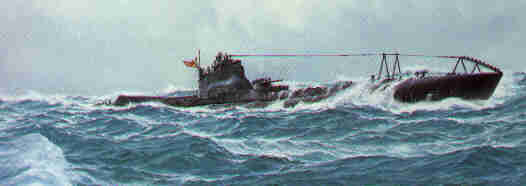
IJN Submarine I-48: Tabular Record of
Movement
© 2001-2019 Bob Hackett & Sander Kingsepp
Revision 6
19 June 1943:
Laid down at Sasebo Navy Yard as the C2 class
Submarine No. 378 (the last unit of that class).
12 December 1943:
Launched and numbered I-48.
10 June 1944:
LtCdr (Cdr, posthumously) Toyama Zenshin (59)(former CO
of I-38) is appointed the Chief Equipping Officer (CEO).
5 September 1944:
Sasebo. Completed and attached to Yokosuka Naval
District. Assigned to Rear Admiral Ishizaki Noboru's (42) SubRon 11, Sixth
Fleet. LtCdr Toyama Zenshin is the Commanding Officer.
I-48 is configured to carry four kaiten human torpedoes on
her afterdeck (only two are fitted with underwater access tubes). She carries
a Type 13 air-search radar and an E27 Type 3 radar detector.
7 December 1944:
I-48 is reassigned to SubDiv 15 in Vice Admiral Miwa
Shigeyoshi's (39) Sixth Fleet.
8 December 1944:
I-48 is assigned to "Kongo" (Steel) kaiten unit.
26 December 1944:
Inland Sea. I-48 finishes working-up and heads for
the Otsujima base to embark her human torpedoes.
9 January 1945: The Second Kaiten Mission:
I-48 departs Otsujima with
four kaitens embarked as the last unit of the "Kongo" group for a planned 21
January dawn attack on the USN Third Fleet anchorage at Ulithi, Carolines. No
messages are received from I-48 after her departure.
21 January 1945:
18 miles W of Ulithi. At 1930, Lt (later Cdr) Frank
A. Yourek, piloting a Martin PBM-3D "Mariner" of VPB-20 based at Tinian, makes
a radar contact with a surfaced submarine heading for Ulithi at 18 knots. He
attempts to establish the nationality of the sub, which immediately
crash-dives. Lt Yourek attacks the submarine with two depth charges and then
releases a Mk.24 "Fido" acoustic torpedo. I-48 (probably with some kaitens
already manned) is forced to abort the attack.
Lt Yourek reports his sighting to Ulithi. A three-strong hunter-killer
group is formed of CortDiv 65 destroyer escorts with LtCdr Edmund L. McGibbon,
CO of USS CONKLIN (DE-439), in tactical command. McGibbon assumes that the
damaged submarine would head directly for the Japanese-held Yap Island at an
estimated submerged speed of 3 knots during the first night and day.
22 January 1945:
After no contacts are made, McGibbon decides to
expand the search all the way to Yap.
23 January 1945:
15 miles NE of Yap Island. At 0310, USS CORBESIER
(DE-438) makes a radar contact at about 9,800 yds. The target is heading 210
degrees at 18 kts. After CORBESIER closes to investigate, I-48 dives. At 0336,
CORBESIER obtains a sound contact and fires a salvo of Mk.10 "Hedgehog"
projector charges but misses. CONKLIN and RABY (DE-698) join the chase.
CORBESIER makes five more "Hedgehog" attacks, all with negative results,
finally losing the contact.
At 0902, CORBESIER regains contact and executes another "Hedgehog"
attack, again with negative results. At 0912, CORBESIER reestablishes sound
contact with the sub, but loses it before an attack can be made. CONKLIN makes
a new "Hedgehog" attack at 0934, from a distance of 550 yds. Seventeen seconds
later, four or five explosions are heard from an estimated depth of 175 ft. At
0936, a violent explosion occurs, temporarily disabling CONKLIN's engines and
steering gear. Huge air bubbles come up alongside; soon thereafter oil and
debris surface. Large quantities of human remains are likewise sighted.
17 miles N of Yap. A motor whaleboat from CONKLIN picks up pieces of
planking, splintered wood, cork, interior woodwork with varnished surfaces, a
sleeve of a knitted blue sweater containing flesh, chopsticks and a seaman's
manual. I-48 is sunk with her 118-strong crew and four kaiten pilots at 09-55N,
138-17.30E. [1][2]
31 January 1945:
HQ, Sixth Fleet attempts to contact I-48 and orders
her to return to Kure.
10 May 1945:
Removed from the Navy List.
Authors' Notes:
[1] This was CONKLIN's second submarine kill. The first
(I-37, another kaiten carrier) was shared with USS MCCOY REYNOLDS (DE-440).
[2] Sources disagree on the exact location of I-48's loss. An alternative
location is 09-45N, 138-20E.
[3] The Kongo group's Action Report credits I-48's kaiten pilots with the
sinking of four ships, including a cruiser and an oiler. None of the claims is
substantiated, since no launches were made.
Special thanks go to Dr. Higuchi Tatsuhiro of Japan and to fellow IJN
submarine enthusiast Steve Eckhardt of Australia.
– Bob Hackett and Sander Kingsepp.
Back to Submarine
Page

