© 2006-2017 Bob Hackett, Sander Kingsepp and Peter Cundall
Revision 5
9 October 1943:
Tsurumi. Laid down at Nihon Kokan K. K.’s shipyard.
15 May 1944:
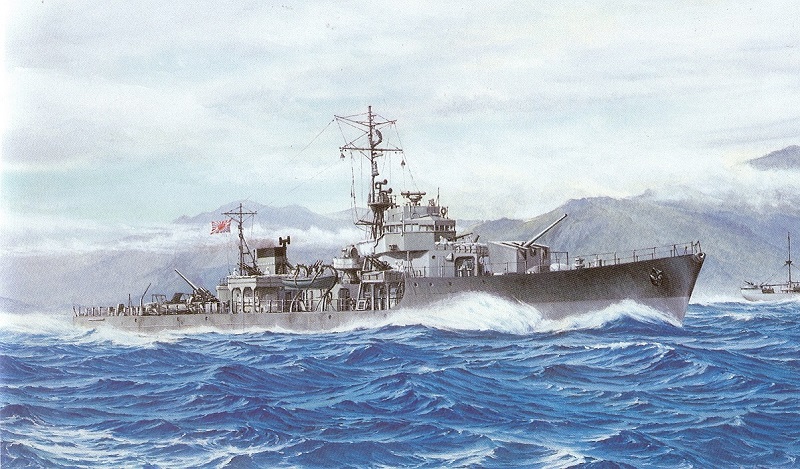
Launched and named UKURU.
31 July 1944:
Completed and registered in the Sasebo Naval District. Attached to the Kure Guard Unit. Reserve LtCdr Kuwahara Tadao (former CO of CH-33) is posted as Commanding Officer. Works up while based at Saeki.
5 August 1944:
At 0918, departs Tsurumi and at 0930, arrives at Yokosuka. Remains working up at Yokosuka for next 6 weeks.
19 September 1944:
At 1547, departs Yokosuka. At 1823, arrives at Takeoka.
20 September 1944:
At 0220, departs Takeoka. At 1510, arrives at Irako.
21 September 1944:
At 0505, departs Irako.
22 September 1944:
At 1805, arrives at Tokuyama.
23 September 1944:
At 0525, departs Tokuyama. At 1250, arrives at Saiki.
11 October 1944:
At 0725, moves to nearby Uzuki Bay.
12 October 1944:
At 0535, departs Uzuki Bay. At 1522, arrives back at Saiki.
13 October 1944:
At 1957, departs Saiki.
14 October 1944:
At 1737, arrives at Sasebo.
16 October 1944:
Assigned to the General Escort Command’s First Surface Escort Division. Transferred to Moji.
23 October 1944:
At 0615, departs Sasebo. At 1650, arrives at Moji.
26 October 1944:
At 1800 UKURU departs Moji for Singapore with light cruiser KASHII (F) with Rear Admiral Yoshitomi Setsuzo (39), CO, 5th Escort Group embarked and kaibokan NOMI and minelayer NIIZAKI escorting convoy HI-79 consisting of TENEI, MATSUSHIMA, KAGU, MELBOURNE, ARIMASAN MARU and fleet supply ship MAMIYA.
27 October 1944:
Kaibokan CD-17 joins the escort.
28 October 1944:
Minesweeper W-21 joins the escort.
29 October 1944:
UKURU and CD-17 are detached from the convoy to escort MELBOURNE MARU close to Kirun, then both rejoin the convoy at 2250.
30 October 1944:
At 1950, anchors off Takao.
31 October 1944:
At 1530, departs Takao.
2 November 1944:
E of Hainan. At 1432, the convoy is bombed by one Consolidated B-24 "Liberator" heavy bomber from high altitude. No damage is done to the convoy.
8 November 1944:
At 0640 ARIMASAN MARU suffers an engine breakdown but was able to rejoin convoy at 0830. At 1230 arrives off Singapore.
9 November 1944:
At 0811, departs Singapore anchorage and at 1010 arrives Singapore.
15 November 1944:
Reassigned to the General Escort Command’s 101st Escort Squadron with light cruiser KASHII, kaibokan DAITO, CD-23 and CD-51.
17 November 1944:
At 1800 UKURU departs Singapore with light cruiser KASHII (F), kaibokan MANJU, NOMI, KASADO, MIYAKE, CD-17 and CD-51 and minelayer NIIZAKI escorting convoy HI-80 consisting of TENEI, MATSUSHIMA, RYOEI, MUNAKATA, ARIMASAN, KUROSHIO, NICHINAN and KAIHO MARUs.
20 November 1944:
At 0600 CD-23 joins the convoy from St Jacques. At 1240, CD-17 is detached for Saigon.
27 November 1944:
At 0930, RYOEI and ARIMASAN MARUs escorted by NIIZAKI are detached for Takao.
2 December 1944:
At 1710 arrives Imari Bay.
3 December 1944:
At 0400 departs Imari Bay. At 1500, anchors off Mutsure. At 2201, UKURU is detached at 1025.
4 December 1944:
HI-80 arrives at Sasebo.
14 December 1944:
At 1004, departs Sasebo. At 2200, arrives at Mutsure.
15 December 1944:
At 1229, departs Mutsure. At 2000, anchors off Himejima.
16 December 1944:
At 0700, departs Himejima. Arrives at Moji at 1402.
19 December 1944:
At 1330, UKURU departs Moji with light cruiser KASHII, kaibokan DAITO, CD- 23, CD- 27 and CD- 51 escorting convoy HI-85 consisting of tankers SERIA and SHINYU MARUs and convoy MOTA-38 consisting of Army landing ship carriers HYUGA, KIBITSU and SHINSHU MARUs and Army transport AOBASAN MARU. HYUGA, KIBITSU, SHISHU and AOBASAN MARUs. The convoys hugs the littoral coast on the way south.
23 December 1944:
At 2310, anchors outside Takao port.
24 December 1944:
At 0030, departs Takao port entrance later returns and, at 2010, enters Takao port.
27 December 1944:
At 1000, UKURU departs Takao for Singapore with light cruiser KASHII and kaibokan DAITO, TSUSHIMA, CD-23, CD-27 and CD-51 escorting convoy HI-85 consisting of TEIHOKU, DAINAN, ENKEI, YAMAZAWA, ENGEN, ENCHO, DAIGYO, OTSUSAN, FUEI, OEI, SERIA MARUs and cargo ship SHINYU MARU.
28 December 1944:
TSUSHIMA and TEIHOKU MARU are detached from the convoy and makes for Yulin, Hainan Island.
29 December 1944:
South China Sea. At 1725, minesweeper W-101 joins HI-85’s escort.
30-31 December 1944:
On both days, sporadic attacks by B-24s are beaten off without loss.
1 January 1945:
At 1720, convoy arrives at Qui Nhon Bay.
2 January 1945:
Departs Qui Nhon Bay. At 0020, the convoy anchors at Nha Trang Bay, Indochina.
3 January 1945:
At 0050, anchors off Nha Trang. At 0730, the convoy departs. While proceeding south, near the east entrance of Hainan Straits, the convoy is attacked by one PB4Y (B-24) which approaches from astern in a glide with its motor cut. One bomb hits TEIHOKU MARU, the last ship in the west column. TEIHOKU (ex-French PERSEE) MARU and escort TSUSHIMA are detached to Yulin for repairs. While enroute to Yulin, they are bombed again and TSUSHIMA is damaged by a near miss.
4 January 1945:
At 1030, convoy HI-85 arrives at Cape St. Jacques. At 1425, departs and at 1820 arrives at Saigon where it is ordered dissolved.
6 January 1945:
At 0925, departs Saigon. At 1300, arrives at St Jacques.
9 January 1945:
UKURU departs Cape St. Jacques for Moji with light cruiser KASHII, kaibokan DAITO, CD-23, CD-27 and CD-51 escorting convoy HI-86 consisting of fleet tanker SAN LUIS MARU and TATSUBATO, OTSUSAN, SHOEI (2764 grt), KYOKUUN, EIMAN, TATEBE, YOSHU and YUSEI MARUs and BANSHU MARU No. 63.
11 January 1945:
At 0230 arrives at Ban Phong Bay. At 0800, departs and at 2120 arrives and anchors at Qui Nhon Bay.
12 January 1945: Operation "Gratitude"- Task Force 38's Strikes on Indochina:
Convoy HI-86 departs Qui Nhon. From 1100 to 1700, Curtiss SB2C "Helldiver" dive-bombers and Grumann TBF "Avenger" torpedo-bombers from Rear Admiral (later Admiral) Frederick T. Sherman's (USNA ’17)(former CO of USS LEXINGTON, CV-2) Task Group 38.3's USS ESSEX (CV-9), USS TICONDEROGA (CV-14), USS LANGLEY (CVL-27) and USS SAN JACINTO (CVL-30) attack the convoy.
They sink YOSHU (45 crewmen and five soldiers KIA) and EIMAN (with bauxite and raw rubber. 19 crew and 13 gunners KIA) MARUs, CD-23 and CD-51 and damage fleet tanker SAN LUIS MARU, UKURU and kaibokans DAITO and CD-27. OTSUSAN (loaded with 7,100 tons of crude oil, 500 tons of aviation gasoline, 1,250 tons of rubber. 28 crew KIA), TATEBE (with gasoline, rubber, etc. No casualties), KYOKUUN (loaded with 12,200 tons of crude oil. 40 crew and 8 gunners KIA), YUSEI (one crewman KIA) and TATSUBATO (full of raw pigeon, tin, bauxite, crude rubber, tin and general cargo. 10 crewmen KIA) MARUs and BANSHU MARU No. 63 (with oil products. Eight crewmen KIA) are so damaged by bombs and fires they have to be beached and become constructive total losses.
At 1408, KASHII is hit starboard amidships by a torpedo. Then an SB2C hits her with two bombs aft that set off her depth charge magazine. KASHII sinks at 13-50N, 109-20E. 621 sailors go down with her. Only 19 are rescued.
Aboard KASHII, convoy HI-86's commander, Rear Admiral Shibuya Shiro (44) (former CO of NACHI) of the 101st Escort Group is KIA. He is promoted Vice Admiral posthumously. UKURU attempts to rescue survivors of KASHII's crew, but at about 1430 an air attack develops and prevents her from rescuing more than 19 men. UKURU escapes several attacks by maneuvering into rain squalls. Only three escorts survive the air attacks. UKURU's total casualties are 12 KIA and 29 injured.
13 January 1945:
At 1500, arrives at Samah (Sana). At 1648, departs port and at 2138, arrives at Yulin.
14 January 1945:
At 2200, UKURU, DAITO and CD-27 arrive at Samah, Hainan Island.
15 January 1945:
Off Yulin, Hainan Island. Between 1100 and 1240, Task Force 38's planes dive-bomb and sink empty tanker HARIMA MARU with eight airplanes on deck and also damage kaibokan DAITO. UKURU and the other escorts are closely grouped for protection along the shore near the mountains. They shoot down an F4U "Corsair“ from USS ESSEX (CV-9) as it pulls up from a strafing attack. The pilot is seen bailing out. A search is mounted, but the pilot is not found.
16 January 1945:
About 30 or 40 SB2C "Helldiver" dive-bombers and F6F fighters make another attack on shore targets and no serious damage is done to the escorts or the freighters.
17 January 1945:
Three fighters attack, but do no serious damage.
21 January 1945:
At 0300, UKURU departs Yulin for Moji with kaibokan DAITO, TSUSHIMA and CD-27 escorting convoy YUTA-15 consisting of TEIHOKU (ex-French PERSEE) MARU and AKISHIMA MARU. At 0500 anchors off Basuo until 2000.
22 January 1945:
At 0912 anchors off northeast Hainan Island.
23 January 1945:
At 0130, a night attack is made by a four-engine plane on TSUSHIMA, the leading escort at 25-N and 119-E. A bomb drops close by, but no damage is sustained. At 0930, the convoy is attacked at l 21-N, 111-E by a single B-24 with no damage. A message is intercepted from this B-24 reporting the exact position and composition of the convoy in plain language.
26 January 1945:
At 1305, arrives at Nanji Tao. Army landing ship carrier KIBITSU MARU joins the convoy.
27 January 1945:
At 0630 departs Nanji Tao.
29 January 1945:
At 2315, arrives at Ssu Chiao Shan (Hsu Kung Tao).
30 January 1945:
At 1535 departs Ssu Chiao Shan.
1 February 1945:
At 1900 arrives at Seito (Tsingtao).
6 February 1945:
At 1950 departs Tsingtao for Moji.
7 February 1945:
At 1800 arrives at Daito Wan.
8 February 1945:
At 0600 departs Daito Wan. At 1800 arrives at Kogunsan Gunto.
9 February 1945:
At 0700 departs Kogunsan Gunto.
10 February 1945:
At 0200 arrives at Kyosai To (Koje Island) and departs at 0700. At 1600 arrives at Moji.
11 February 1945:
At 1000 departs Moji. At 1800, arrives at Imari Bay.
12 February 1945:
At 0700, departs Imari Bay. At 1350, arrives at Sasebo and is drydocked for repairs.
March 1945:
Repairs are completed. UKURU escorts convoys between Japan and Shanghai and Tsingtao, China.
8 March 1945:
LtCdr Kuwabara is reassigned. Reserve LtCdr Shimada Suetsugu assumes command. At 0800, departs Sasebo. At 2040, arrives at Mutsure.
9 March 1945:
At 0840 arrives at Moji.
10 March 1945:
At 0620, UKURU departs Moji with kaibokan DAITO escorting convoy MOSHI-01 consisting of ABUKUMAGAWA MARU.
11 March 1945:
At 1800 CD-27 departs Sasebo and catches up with the convoy.
15 March 1945:
At 1225, arrives at Shanghai.
18 March 1945:
UKURU departs Shanghai with kaibokan DAITO and CD-27 escorting convoy SHIMO-01 (part 1) consisting of of general requisitioned cargo ship YUKIKAWA MARU, auxiliary transport TATSUWA MARU, ex auxiliary gunboat KAZAN (HUASHAN) MARU and Army transport AZUSA MARU.
23 March 1945:
At 0900 arrives at Katoku Suido. At 1025, arrives at Chinkai (Jinhae), Korea. The escorts and KAZAN (HUASHAN) MARU detach.
24 March 1945:
UKURU departs Chinkai at 1025 and steams ahead to meet the “Hosho Maru” convoy consisting of tanker HOSHO MARU escorted by kaibokan DAITO and CD-27 and auxiliary subchaser CHa-27. The kaibokan relieve the previous escorts CD-8, CD-32 and CD-52.
25 March 1945:
Reassigned to the First Escort Fleet. At 1800 arrives at Kokusan Gunto, Chosen.
26 March 1945:
At 2200 departs Kokusan Gunto.
E 2 April 1945:
Arrives at Yulin.
20 April 1945:
Departs Shanghai for Maizuru with kaibokans DAITO, OKINAWA, CD-27 and CD-57 escorting refloated KOTOBUKI MARU (ex-Italian passenger liner CONTE VERDE). [1]
22 April 1945:
KOTOBUKI MARU and her escorts are attacked by ten Consolidated B-24 "Liberator" heavy bombers, but they score no hits. One bomber is damaged and later forced to ditch. The convoy arrives at Tsingtao, China the same day.
25 April 1945:
Arrives at Chinkai harbor, Korea. That same day, UKURU and DAITO are reassigned to Captain Abe Tokuma's (50) 22nd Coast Defense Group.
8 May 1945:
SW of Mokpo, SW coast of Korea. Enroute to Japan, KOTOBUKI MARU hits a mine laid by USAAF 20th Air Force B-29 “Super Fortress” heavy bomber at 34-30N, 126-09E. [2]
May 1945:
KOTOBUKI MARU arrives at Maizuru under tow. The identity and number of her escorts are unclear.
22 July 1945:
At 1900 training cruiser KASHIMA and kaibokans CHIKUBU, UKURU and TAKANE depart Maizuru. Later CHIKUBU and UKURU are detached.
15 August 1945:
Vicinity of Ominato, Honshu. UKURU is underway en route from Akita to Ominato harbor when notification of the termination of war is received.
23 August 1945:
Arrives at Sasebo.
30 November 1945:
Removed from the Navy List.
1 December 1945:
Employed as a minesweeper by Allied Forces.
10 July 1946:
Reassigned as a minesweeper tender.
2 December 1947:
Discarded by the Allies.
26 December 1947:
Transferred to the Japanese Maritime Transport Bureau as a Central Meteorological Observatory weather survey ship. Renamed UKURU MARU. Participates in summer season typhoon patrols with former kaibokan CHIKUBU, IKUNA and SHINNAN.
1 January 1954:
Transferred to the Japanese Maritime Safety Agency as a patrol ship and renamed SATSUMA (PL-104).
24 November 1965:
Discarded by the JMSA for scrapping.
Authors' Note:
[1] On 8 Sep ’43, after the surrender of Italy, CONTE VERDE was scuttled by her Italian crew in the Whangpoo River, Shanghai. From 1943-44, the Japanese carried out several salvage attempts. CONTE VERDE was intended for conversion to an escort aircraft carrier, but on 8 Aug ‘44, a B-24 bomber sank her in the Whangpoo River for a second time. In Dec ‘44, the hulk was refloated. She was later repaired enabling her to steam by own power. After hitting a mine enroute to Japan, she was towed to Maizuru where she was bombed on 25 Jul ’45 and beached in Nakata Bay, Higashi-Maizuru. On 13 Jun ‘49, the wreck was refloated and began scrapping.
[2] Sources vary as to the date and place where KOTOBUKI MARU hit a mine.
Thanks for assistance go to Dr. Higuchi Tatsuhiro of Japan. Thanks also go to Gilbert Casse of France, Jeff Donahoo of Iowa, Matthew Jones of Mississippi, USA and Mr. Aki of Japan for help in identifying kaibokan COs.
-Bob Hackett, Sander Kingsepp and Peter Cundall
Back to
Escort Page