
RIKUGUN-SEN

Stories and Battle Histories of Selected Imperial Army Vessels

5 May 2012

By Bob Hackett with Gilbert Casse


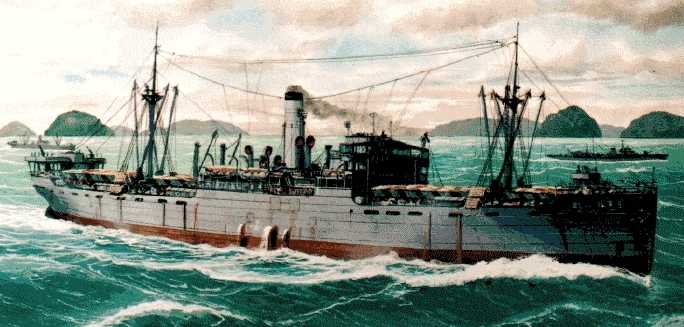
(LISBON MARU by Ueda Kihachiro)


Just as the Imperial Japanese Navy requisitioned and operated some of Japan's merchant fleet's former cargo, passenger-cargo, liners and tankers prior to and during the Pacific War, the Imperial Army also followed the same practice. Some former cargo, passenger-cargo, liners, and tankers used by the IJA have already been, or will be, covered on our Ryoshokusen Prisoner of War Relief Supply Ships and Yusosen IJN (and Other) Oilers and Tankers pages.


RIKUGUN YUSOSEN

The Army's requisitioned vessels were converted to military use and became Rikugun Yusosen (IJA Transports)(A) used to transport troops and military equipment including tanks, weapons, munitions, crated aircraft, parts and stores. Many other Army's requisitioned vessels were given other wartime roles.

There were also Army/Civilian (A/C) shared employments. These ships were called Haitosen. Normally, this meant that on its outbound journey the vessel was under Army Navy control carrying troops, military supplies, etc., and on its return voyage carried cargo for the benefit of its civilian owner(s). Haitosen also received Army transport numbers like Army requisitioned vessels (A). Employments could also be expanded, meaning that the ship was used by Army for one full turn (outward and homeward voyage) or even a series of voyages.

Coverage of the Imperial Army's transports on this page is not meant to be as comprehensive as that of our Zatsuyosen IJN Auxiliary Transport Fleet page; however, we will cover some interesting IJA transports.


Tabular Records of Movement (TROMs):
Rikugun Yusosen - IJA Auxiliary Transports
(Classes link to specifications summaries)

LISBON
MARU
Class

Lisbon Maru
(posted 9/17/2011)

TAIYO
MARU
Class

Taiyo Maru
(posted 10/15/2011)

TAKACHIHO
MARU
Class

Takachiho Maru
UYO
MARU
Class

Shinanogawa
Maru

CANBERRA
MARU
Class

Canberra Maru
(posted 5/5/2012)

CALCUTTA
MARU
Class

Calcutta Maru
(posted 12/10/2011)
YOSHIDA
MARU No. 1.
Class

Yoshida Maru No. 1


HAWAII
MARU
Class

Hawaii Maru


RIKUGUN BOKU KIKANSEN

By the end of 1941, Allied aircraft were considered a major threat to Japanese shipping, so to provide more protection for their invasion convoys, the IJA fitted some transports with additional anti-aircraft guns. These ships were officially called Boku Kikansen (anti-aircraft ships), but were commonly known as Bokusen. Each ship was armed with Army guns, generally consisting of six IJA Type-88 75-mm AA guns and six to ten IJA Type-98 20-mm AA machine-cannons.

Bokusen played an important role in the first phase invasions providing escort for the troop transports. However, in 1942, all transports were gradually fitted with additional AA guns. All Bokusen reverted to their original wartime tasks.

One IJA Bokusen has already been covered on our Tetsusei Dai Hatsudotei Landing Craft Depot Ships page (SHINSHU MARU). This page will cover the other seven Bokusen.


Tabular Records of Movement:
Rikugun Bokusen -Auxiliary Anti-Aircraft transports
(Classes link to specifications summaries)

ZENYO
MARU
Class

Zenyo Maru
(posted 9/24/2011)
SAKITO
MARU
Class

Sakura Maru
(revised 10/29/2011)
Sado Maru
(posted 4/6/2012)
YASUKAWA
MARU
Class

Yasukawa
Maru

(posted 4/6/2012)
KAMIKAWA
MARU
Class

Hirokawa Maru
AOBASAN
MARU
Class

Aobasan Maru
(posted 2/4/2012)
Atsutasan Maru
HAWAII
MARU
Class

Arizona Maru
(posted 3/3/2012)


RIKUGUN BYOINSEN

The Japanese never constructed purpose-built hospital ships (Byoinsen), but before and during the Pacific War, they requisitioned 19 merchant ships and had them converted. In accordance with the Geneva Convention, Japan declared these ships as hospital ships. They were painted white overall and bore large red crosses on their decks and funnels that were illuminated at night. They also bore large red crosses amidships on both their port and starboard sides. Additionally, a green band was painted around the full length of their hulls.

The Imperial Army operated at least 20 hospital ships, many of which, during the Sino-Japanese and Pacific Wars, served alternatively as troop transports and hospital ships. In their troop transport role, most were armed, painted overall dark grey, but some were given a camouflage pattern and others, from Jun '44, were repainted in two tones of green and steamed in convoys.

Coverage of the Imperial Army's hospital ships on this page is not meant to be as comprehensive as that of our Byoinsen IJN Auxiliary Hospital Ships page; however, we will cover some interesting IJA hospital ships.


Tabular Records of Movement:
Rikugun Byoinsen - Auxiliary Hospital Ships
(Classes link to specifications summaries)


BUENOS AIRES
MARU
Class

Buenos Aires Maru
(posted 4/6/2012)
URAL
MARU
Class

Ural Maru

TACHIBANA
MARU
Class

Tachibana Maru
(revised 4/16/2011)

SIBERIA
MARU
Class

Siberia Maru
(posted 5/5/2012)

TACOMA
MARU
Class

Chicago Maru


MANILA
MARU
Class

Manila Maru


RIKUGUN TETSUSEI DAI HATSUDOTEI

The Imperial Army's SHINSHU MARU was the world's first landing craft carrier ship. She could carry a total of 2,200 assault troops and was purposely designed to transport landing vessels and troops to a landing area. She launched Daihatsu landing craft quickly from a gate at her stern or from gates at the side. AKITSU and NIGITSU MARUs were under construction as passenger liners, but taken over by the IJA before completion. Both ships were fitted with flight decks, but had no hangars. Aircraft were stored below the flight decks on the main deck. Conventional aircraft were to be able to fly off, but not land aboard. AKITSU and NIGITSU MARUs were essentially aircraft ferries.

MAYASAN and TAMATSU MARUs were also converted to landing craft depot ships while under construction on the ways. Both ships were fitted with stern ramp gates for launching large landing craft stored in the holds. The ships were used effectively as troop transports. KIBITSU, HYUGA and SETTSU MARUs were Standard Type M cargo ships converted to landing craft depot ships on the ways. They launched their landing craft through stern doors. Their tonnage varied about 200 tons between ships of the class.

TAKATSU (KOZU) MARU was another cargo ship converted to a landing craft depot ship while under construction. Her Daihatsu landing craft were stored on an upper deck and handled by cranes. KUMANO MARU was also converted from a cargo ship while under construction. She was fitted with a flight deck, but had no hangar and the deck was not large enough to allow landing of aircraft.


Tabular Records of Movement:
IJA Landing Craft Depot Ships:
(Classes link to specifications summaries)

Shinshu Maru Class

Shinshu Maru (revised 9/17/2011)

Akitsu Maru Class

Akitsu Maru(posted 1/8/2011)

Nigitsu Maru (posted 4/23/2011)

Mayasan Maru Class

Mayasan Maru (posted 1/22/2011)

Tamatsu Maru (posted 6/4/2011)

Kibitsu Maru Class

Kibitsu Maru (posted 2/5/2011)

Hyuga Maru (posted 4/2/2011)
Settsu Maru (posted 6/17/2011)

Takatsu Maru Class

Takatsu Maru (posted 2/19/2011)

Kumano Maru Class

Kumano Maru (posted 3/19/2011)


RIKUGUN KIJUKISEN

In 1927, the purpose-built Kijukisen (crane ship) SEISHU MARU was completed for the Imperial Army designed to transport and handle 10-in (250-mm), 12-inch (305-mm) and 16.1-inch (410-mm) turrets of old battleships disarmed in accordance with the Washington Treaty. After removal and overhaul, the turrets were transported from the breakers’ yards to various locations for use in coast defense.

Tabular Record of Movement:
Rikugun Kijukisen - Auxiliary Crane Ship
(Class links to specification summary)


SEISHU MARU.
(posted 10/30/2010)


Bibliography of Sources

About the Authors

Mr. Robert Hackett is a military historian and researcher. Retired from the United States Air Force and later from the aerospace industry, he resides on the coast of Florida.

Mr. Gilbert Casse is a maritime historian and researcher. Retired from aerospace industry, and later from managing Le Mans racing cars and drivers, his avocation is ship modeling, maritime photos and paintings. He resides on the SW coast of France.

Questions to the authors concerning these TROMs should be posted on the Discussion and Questions board.

Discussion & Questions