SENSUIKAN!
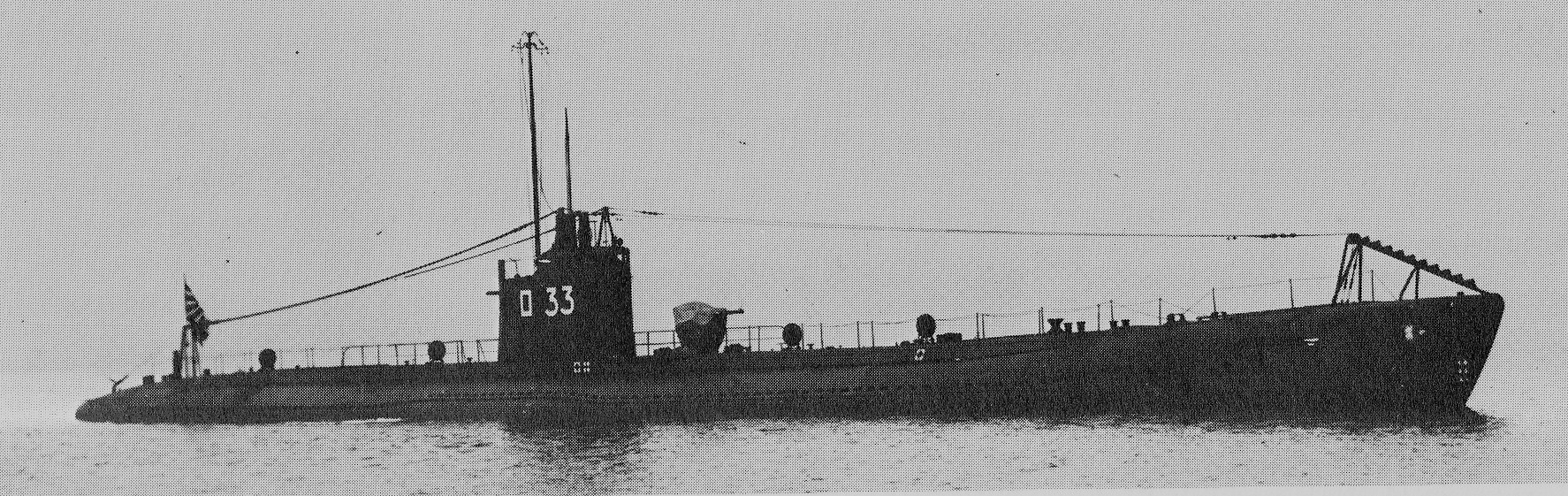 (RO-33)
IJN Submarine RO-33:
Tabular Record of
Movement
© 2001-2016 Bob Hackett & Sander Kingsepp
Revision 2
8 August 1933:
Kure. Laid down at Kure Navy Yard.
10 October 1934:
Launched and designated RO-33 as a 960-ton type K5 submarine.
7 October 1935:
Completed and attached to Maizuru Naval District.
LtCdr (Captain, posthumously) Ishikawa Nobuo (49)(former torpedo officer of
I-57) is appointed Commanding Officer.
15 February 1936:
LtCdr (later Captain) Ageta Kiyotake (50)(former
torpedo officer of I-52) is appointed Commanding Officer.
20 March 1937:
LtCdr (later Cdr) Shibuya Tatsuwaka (52)(former
navigating officer of RO-57) is appointed Commanding Officer.
20 June 1938:
LtCdr (Rear Admiral, posthumously) Ariizumi
Tatsunosuke (51)(former torpedo officer of I-70) is appointed Commanding Officer.
15 October 1939:
LtCdr Ichikawa Akira (52)(former torpedo officer of
I-8) is appointed Commanding Officer.
1 November 1939:
LtCdr Ichikawa is appointed Commanding Officer of
RO-68 until 20 November.
20 March 1940:
LtCdr (Captain, posthumously) Ohira Masajiro (52)
(former CO of RO-63) is appointed Commanding Officer.
30 October 1940:
LtCdr (Captain, posthumously) Watanabe Katsuji
(55)(former CO of RO-67) is appointed Commanding Officer.
15 November 1940:
Reassigned to SubDiv 21, SubRon 4.
15 May 1941:
Placed in 3rd reserve at Sasebo with RO-34.
21 May 1941:
The flag of SubDiv 21 is transferred from RO-34 to
RO-33.
1 July 1941:
LtCdr Watanabe is appointed CO of RO-34 as an additional
duty.
31 July 1941:
LtCdr (Cdr, posthumously) Sakamoto Eiichi (57) is
appointed Commanding Officer of RO-33 and RO-34 as an additional duty.
Mid-October-early November 1941:
Undergoes repairs and refit at
Maizuru Navy Yard.
18 December 1941: Operation "E"- The Invasion of Malaya:
RO-33 and
RO-34 are in Rear Admiral Yoshitomi Setsuzo's SubRon 4 in Captain Iwagami's
SubDiv 21 as a part of Malaya Invasion Force. At 1600, SubDiv 21 departs Sasebo
for Camranh Bay, Indochina. LtCdr Sakamoto Eiichi is the Commanding Officer.
21 December 1941:
Departs Camranh to patrol E of Singapore on her
first war patrol.
5 January 1942:
Departs her patrol area to return to Camranh.
7 January 1942:
Returns to Camranh.
13 January 1942:
Departs Camranh to patrol SE of Anambas and W of
Java on her second war patrol.
30 January 1942:
Returns to Camranh.
8 February 1942:
Departs Camranh to patrol in the same area as I-53.
9 February 1942:
The RO-33 is attached to the "A" Unit with RO-34.
10 February 1942:
Patrols off Anambas.
13 February 1942:
Departs the patrol area to support the invasion of
Java. Patrols S of Sunda and Lombok Staraits, off Bali and Tjilatjap.
Dutch Rear Admiral Karel W. F. M. Doorman's Striking Force departs
Parigi Bay, Sumatra, to intercept a Japanese convoy heading for Palembang.
15 February 1942:
At 0920, Doorman's Striking Force, now with HMS
EXETER and HMAS HOBART attached, is sighted by an Aichi E13A1 "Jake" launched
from cruiser CHOKAI. RO-33, I-53 and I-55 are ordered to intercept the
returning force at the northern entrance of the Sunda Strait. No contacts are
made as Doorman's force turned back after being attacked by Nakajima B5N2 "Kate"
torpedo-bombers from the light carrier RYUJO.
20 February 1942:
Transits the Lombok Strait, Java into the Indian
Ocean.
1 March 1942:
Around 2200, RO-33 sights and attacks an Allied
destroyer SSE of Christmas Island, but her torpedo misses the target apparently
as a result of a last-minute evasive maneuver. In all likelihood, this was
destroyer USS WHIPPLE (DD-217), in the midst of rescuing the survivors of the
fleet oiler PECOS (AO-6), sunk at 14-27S, 106-11E. WHIPPLE likewise reported a
submarine sighting at that time.
8 March 1942:
Arrives at Staring (now Teluk) Bay, Celebes.
10 March 1942:
SubRon 4 is disbanded. RO-33 and RO-34 are reassigned
to SubRon 6 of Vice Admiral (later Admiral) Inoue Shigeyoshi's (former CO of
HIEI) Fourth Fleet.
22 March 1942:
Departs Staring Bay in company of RO-34.
26 March 1942:
Arrives at Palau with RO-34.
30 March 1942:
Departs Palau for Truk with RO-34.
3 April 1942:
Arrives at Truk.
4 April 1942:
SubDiv 21 is reassigned to the South Seas Force.
10 April 1942:
SubRon 6 is disbanded. SubDiv 21 is reassigned to
SubRon 7, Fourth Fleet.
15 April 1942:
Departs Truk with RO-34.
18 April 1942:
RO-33 arrives at Rabaul.
20 April 1942:
RO-33 departs Rabaul to reconnoiter Port Moresby, New
Guinea on her third war patrol. SubDiv 21, under the South Seas Force, is
ordered to search the Jomard Passage for convoy routes and to reconnoiter the
Russell and Deboyne Islands for suitable anchorages prior to the planned assault
on Port Moresby. RO-33 and RO-34 are later ordered to blockade Port Moresby and
guide Japanese shipping into the area.
23 April 1942:
Returns to Rabaul.
1 May 1942:
Departs Rabaul to support the capture of Port Moresby.
4 May 1942: Operation "MO" - The Invasions of Tulagi, Solomons and Port
Moresby, New Guinea:
Rear Admiral (Vice Admiral, posthumously) Kajioka
Sadamichi's (former CO of KISO) Attack Force departs Rabaul towards the Jomard
Pass in the Louisiade Archipelago with DesRon 6's light cruiser YUBARI, four
destroyers and a patrol boat escorting Rear Admiral (later Vice Admiral) Abe
Koso's Transport Force of 12 transports and a minesweeper.
4 May 1942: The Battle of the Coral Sea:
Rear Admiral (later Admiral)
Frank J. Fletcher's Task Force 17 attacks Rear Admiral (later Vice Admiral)
Shima Kiyohide's (former CO of OI) Tulagi Invasion Force at Tulagi. Douglas SBD
dive-bombers and TBD torpedo-bombers from YORKTOWN (CV-5) sink a destroyer,
three minesweepers and damage four other ships. The next day, Fletcher's force
engages Vice Admiral (Admiral, posthumously) Takagi Takeo's (former CO of MUTSU)
Carrier Strike Force. SBDs and TBDs from YORKTOWN and LEXINGTON (CV-2) sink
Rear Admiral (Vice Admiral, posthumously) Goto Aritomo's (former CO of MUTSU)
light carrier SHOHO. In turn, Japanese planes damage oiler USS NEOSHO (AO-23)
and sink the destroyer SIMS (DD-409).
5 May 1942:
Arrives off Port Moresby.
8 May 1942:
Aircraft from LEXINGTON sight the Carrier Strike Force
Main Body (SHOKAKU and ZUIKAKU). SBDs from YORKTOWN and LEXINGTON damage SHOKAKU
and force her retirement. ZUIKAKU's air group suffers heavy losses. Takagi's
planes damage YORKTOWN and LEXINGTON that is further damaged by gasoline
explosions. She has to be abandoned and later scuttled by destroyer PHELPS
(DD-360).
10 May 1942:
Departs her patrol area.
19 May 1942:
The Battle of the Coral Sea halts the Japanese thrust
toward Port Moresby and they are forced to cancel Operation MO. Returns to
Rabaul.
23 May 1942:
Departs Truk in company of RO-34.
30 May 1942:
Arrives at Sasebo for overhaul and repair.
5 June 1942:
LtCdr (Cdr, posthumously) Kuriyama Shigeyuki (58)(former
CO of RO-57) is appointed Commanding Officer.
9 July 1942:
Departs Sasebo with RO-34.
17 July 1942:
Arrives at Truk with RO-34.
23 July 1942:
Departs Truk for Rabaul.
29 July 1942:
Departs Rabaul on her fourth war patrol to operate in
the Coral Sea in the Port Moresby area and SE coast of New Guinea.
6 August 1942:
Gulf of Papua, NE of Murray Island. The Australian
300-ton motor vessel MAMUTU is sailing independently from Port Moresby to Daru,
Papua, carrying 103 passengers, a crew of 40, and general cargo.
At 1034, 30 miles W of Bramble Bay, MAMUTU is spotted from RO-33. The
submarine surfaces and commences a chase, shelling the fleeing vessel from her
3-inch deck gun. The first shell destroys the radio room; the second shot hits
the bridge, killing MAMUTU's Master J. McEachern.
By 1100, the blazing wreck goes dead in the water at 09-11S,
144-12E. The submarine passes the sinking MAMUTU, firing a machine gun and
killing a number of survivors struggling in the water. The Master, 31 sailors
and 82 passengers are lost. [1]
7 August 1942: American Operation "WATCHTOWER" - The Invasion of
Guadalcanal, British Solomon Islands: Rear Admiral (later Admiral) Richmond K.
Turner's Amphibious Task Force 62, covered by Vice Admiral (later Admiral) Frank
J. Fletcher's Task Force 61 and Rear Admiral (later Admiral) John S. McCain's
Task Force 63's land-based aircraft, lands MajGen (later Gen/MOH/Commandant)
Alexander A. Vandegrift's 1st Marine Division on Florida, Tulagi, Gavutu,
Tanambogo and Guadalcanal opening the campaign to take the island.
Vice Admiral Mikawa Gunichi (former CO of KIRISHIMA), CINC, Eighth Fleet,
orders SubRon 21's RO-33, then off New Guinea, and RO-34 and SubRon 7's I-121,
I-122 and I-123 to Indispensable Strait off Guadalcanal to reconnoiter the
landing area and contact Japanese shore patrols on the island.
11 August 1942:
Arrives off Lunga Point, Guadalcanal.
12 August 1942:
At 1200, arrives off Cape Hunter and contacts the
Japanese shore patrol. According to them, an enemy task force consisting of two
carriers, two battleships, five cruisers and several transports was spotted
leaving Guadalcanal. LtCdr Kuriyama relays this information to his headquarters.
[2]
13 August 1942:
Delivers food to Japanese shore patrol at Cape
Esperance.
27 July 1942:
Arrives at Rabaul in company of RO-34.
15 August 1942:
RO-33 reconnoiters the American positions on Savo
Island. She reports that the enemy has established an observation station in the
NW part of the island, near the location identified as "P.C. Mission."
16 August 1942:
Returns to Rabaul.
22 August 1942:
Departs Rabaul on her fifth war patrol to patrol off
Port Moresby.
25 August 1942:
Patrols S of Samarai.
26 August 1942:
LtCdr Kuriyama sends a regular situation report after
arriving in his prescribed area. It is the last signal received from RO-33.
29 August 1942:
At 1134, the 3,310-ton merchant MALAITA, escorted by Cdr
James C. Morrow's destroyer HMAS ARUNTA, leaves Port Moresby for Cairns, Australia
to escape bombing raids. At 1210, in the Gulf of Papua, W of Port Moresby.
MALAITA is torpedoed by RO-33 at 09-50S, 144-55E. The torpedo hits MALAITA below
the bridge on her starboard side and she takes on a heavy list to starboard. By
1245, the crew abandons ship fearing that she is about to capsize, but later
returns aboard. MALAITA is taken under tow back to Port Moresby.
10 miles SE of Port Moresby. ARUNTA makes a sonar contact on RO-33. At
1305, Cdr Morrow makes four attacks with Mk.VII depth charges and the ARUNTA's
crew sees a large oil slick. RO-33 sinks at 09-36S, 147-06E with all 70 officers
and men.
1 September 1942:
Presumed lost off Port Moresby.
5 October 1942:
Removed from the Navy List.
Authors' Notes:
[1] Different sources provide different data about the
number of people aboard the MAMUTU, as well as those who were lost.
[2] Some post-war Japanese accounts apparently confuse the actions of
RO-33 during her fourth war patrol off Guadalcanal with those of her sister
RO-34.
Thanks for assistance in researching the IJN officers mentioned in this
TROM go to Mr. Jean-François Masson of Canada.
Special thanks for help in preparing this TROM go to Dr. Higuchi
Tatsuhiro of Japan. – Bob Hackett and Sander Kingsepp.
Back to Submarine
Page

