YUSOSEN!
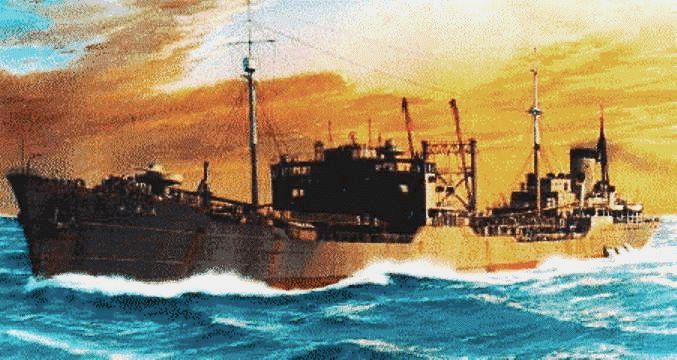 (NIPPON MARU by Ueda Kihachiro)
IJN NIPPON MARU:
Tabular Record of Movement
© 1998-2018 Bob Hackett and Peter Cundall.
Revision 12
30 June 1936:
Kobe. Completed as merchant tanker NIPPON MARU by the Kawasaki Dockyard for the Yamashita Kisen (Steamship) K.K. [1]
July 1936-August 1941:
Completes numerous peacetime voyages for her owners to North Sakhalin, Borneo and Los Angeles.
8 August 1941:
Kobe. Undergoes conversion to a Naval Auxiliary Tanker at Kawasaki Heavy Industries shipyard.
7 September 1941:
Requisitioned by the IJN.
20 September 1941:
Registered in the Kure Naval District as a auxiliary transport (oil supply), (Ko) Category under internal order No. 1093. Captain Ueda Hironosuke (42) is appointed Supervisor of NIPPON MARU.
15 October 1941:
The conversion is completed.
18 November 1941: - "The Hawaii Operation":
Departs Saeki. Seven oilers are assigned to the Hawaii Operation, but the IJN’s practical experience in refueling at sea is almost nil. Earlier in the month, three refueling exercises were held in Sukumo Bay and the Ariake Sea.
That same day, NIPPON MARU refuels destroyer AKIGUMO and other destroyers for training purposes. While enroute to the Kuriles, all units in the carrier formation are refueled ten times.
26 November 1941:
Etorofu Island, Kuriles. NIPPON MARU departs Hitokappu Bay with Captain (Rear Admiral posthumously) Niimi Kazutaka's (40) (former CO of light cruiser TAMA) Supply Group No. 2's oilers TOHO (F) and TOEI MARUs and Captain Ota Masanao's (39) Supply Group No. 1's oilers KOKUYO, KYOKUTO, KENYO and SHINKOKU MARUs. Provides fuel for Vice Admiral (Admiral, posthumously) Nagumo Chuichi's (36) Carrier Striking Force ("Kido Butai") CarDiv 1's AKAGI, KAGA, CarDiv 2's HIRYU and SORYU, CarDiv 5's SHOKAKU and ZUIKAKU and the Support Force.
The Support Force consists of Vice Admiral Mikawa Gunichi's (38) BatDiv 3/1's HIEI and KIRISHIMA, Rear Admiral (later Vice Admiral) Abe Hiroaki's (39) CruDiv 8's TONE, CHIKUMA and Rear Admiral (later Vice Admiral) Omori Sentaro's (41) (former CO of battleship ISE) DesRon 1's light cruiser ABUKUMA and DesDiv 17's ISOKAZE, URAKAZE, TANIKAZE and HAMAKAZE, DesDiv 18's ARARE, KASUMI, KAGERO and SHIRANUHI and CarDiv 5's AKIGUMO and Captain (later Rear Admiral) Konishi Kaname's (44) Midway Bombardment Unit's DesDiv 7's SAZANAMI and USHIO and oiler SHIRIYA.
Nagumo's orders from Admiral (Fleet Admiral, posthumously) Yamamoto Isoroku (32), CINC, Combined Fleet, are that if refueling proves impossible in the stormy winter waters of the Northern Pacific, Nagumo is to detach AGAKI, SORYU and HIRYU and his destroyers and make the attack with only KAGA, SHOKAKU and ZUIKAKU that need no refueling.
2 December 1941:
940 miles N of Midway Island. Nagumo’s Force receives the coded signal "Niitakayama nobore (Climb Mt. Niitaka) 1208" from the Combined Fleet. It signifies that X-Day hostilities will commence on 8 December (Japan time).
That same day, the oilers refuel battleships HIEI and KIRISHIMA.
4 December 1941: [2]
N Pacific. Weather conditions worsen. Rough seas cause the Striking Force's destroyers to roll up to 45 degrees. Refueling is cancelled.
5 December 1941: [2]
600 miles N of Oahu, Hawaii. NIPPON MARU provides destroyer AKIGUMO with 10-tons of fuel. At about 1130, after fleet refueling is completed, the 2nd Supply Group's oilers TOHO, NIPPON and TOEI MARUs and destroyer ARARE are detached from the Striking Force and turn towards a designated rendezvous point with the carriers for the retrurn trip to Japan.
6 December 1941: [2]
400 miles N of Oahu, Hawaii. At 0810, after refueling the Carrier Force, the 1st Supply Group's oilers SHINKOKU, KENYO, KOKUYO and KYOKUTO MARUs and destroyer KASUMI are detached and turn towards a designated rendezvous point with the carriers for the retrurn trip to Japan. The Striking Force increases speed to 24 knots and proceeds to Hawaiian waters to launch the attack.
Vice Admiral Nagumo dispatches ABUKUMA and DesDiv 17's TANIKAZE to Supply Group No. 1 at the rendezvous point following final refueling before the attack. At about 2100, the two warships reach the oilers, refuel and return with the oilers to the First Air Fleet.
7 December 1941: Operation "Z" - The Attack on Pearl Harbor: [2]
At 0618, the Carrier Striking Force launches attacks that later sink battleships USS ARIZONA (BB-39), USS OKLAHOMA (BB-37) and USS CALIFORNIA (BB-44) and damage USS NEVADA (BB-36), USS PENNSLYVANIA (BB-38), USS TENNESSEE (BB-43), USS MARYLAND (BB-46), USS WEST VIRGINIA (BB-49) and other smaller ships. 2,335 American servicemen die in the attack, most on USS ARIZONA. After recovering all but 29 of its aircraft lost in the attack, the Striking Force departs Hawaiian waters NNW towards Japan.
14 December 1941:
Arrives at the designated rendezvous point located at 30-00N, 165-00E.
21 December 1941:
The 2nd Supply Group's oilers NIPPON, TOHO and TOEI MARUs rendezvous with, and refuel, the Striking Force. That same day, seven destroyers of DesDiv 21 and DesDiv 27 from Tokoyama rendezvous with the 1st Air Fleet to provide additional ASW protection.
23 December 1941:
Arrives at Hashirajima. Departs later and arrives that same day at Kure.
7 January 1942:
Departs Kure. Later joins with tanker SHINKOKU MARU and battleships HIEI and KIRISHIMA and departs Kure area the following day escorted by DesDiv 17 and 18.
14 January 1942:
At 1036 arrives at Truk. Refuels battleship KIRISHIMA.
17 January 1942:
Departs Truk.
23 January 1942:
Arrives at Tokuyama. Loads fuel oil.
28 January 1942:
At 1630 departs Kure with tanker KENYO MARU (from Hashirajima).
4 February 1942:
Arrives at Truk.
9 February 1942:
At 1630 departs Palau inner harbour.
10 February 1942:
At 0730 due to depart Palau Atoll west channel.
15 February 1942:
Arrives at Tokuyama. Loads fuel oil.
16 February 1942:
Departs Tokuyama.
17 February 1942:
Likely off Kanogawa meets with tankers KYOKUTO and KENYO MARUs and proceeds south.
24 February 1942:
Departs Staring Bay with tankers KENYO, KYOKUTO and TOEI MARUs escorted by 27 DesDiv.
2 March 1942:
At 03-46S 97-20E tanker NIPPON MARU transfers 700 tons of fuel oil to battleship KONGO, while tanker KENYO MARU transfers 600 tons to KIRISHIMA and tanker SHINKOKU MARU transfers 599 tons to HIEI.
10 March 1942:
KENYO, KYOKUTO and NIPPON MARUs arrive back at Staring Bay.
15 March 1942:
Between 0800 and 1830 in 06-32N 109-38E Staring Bay, tanker KENYO MARU transfers 1500 tons fuel oil to battleship HIEI; tanker KOKUYO MARU from 0800 and 1614 transfers 1045 tons fuel oil to battleship KONGO; tanker NIPPON MARU, from 1503 to 1100 the following day, transfers 1100 tons fuel oil to battleship KIRISHIMA; and tanker KOKUYO MARU, from 1735 to 0300 the following day, transfers 1520 tons fuel oil to battleship HARUNA.
E 21 March 1942:
Arrives at Mako.
24 March 1942:
Departs Mako.
31 March 1942:
Arrives at the Operation "C" refueling point A (09-00S,106-00E). Refuels carrier HIRYU.
2 April 1942: Operation “C” – The Raids into the Indian Ocean:
NIPPON MARU refuels Bat Div 3's KONGO with 700 metric tons of fuel oil. That same day, NIPPON MARU refuels the Striking Force's AKAGI, CarDiv 2, CarDiv 5, BatDiv 3, CruDiv 8, DesRon 1 plus destroyers ARARE, KAGERO, MAIKAZE, HAGIKAZE and AKIGUMO.
9 April 1942:
After the air attacks on the British naval bases at Columbo and Trincomalee, Ceylon (Sri Lanka), the Striking Force departs the Indian Ocean Area.
11 April 1942:
At sea KENYO MARU refuels the Striking Force's ZUIKAKU with 1000 tons fuel oil, TOEI MARU refuels SHOKAKU with 1000 tons fuel oil and NIPPON MARU refuels AKAGI with 2000 tons fuel oil.
14 April 1942:
NIPPON MARU refuels carrier HIRYU.
15 April 1942:
NIPPON MARU refuels BatDiv 3's KIRISHIMA with 1,100 metric tons of fuel oil.
22 April 1942:
Transits the Bungo Straits in a convoy also consisting of tankers SHINKOKU, KOKUYO and TOEI MARUs. Arrives at Kure.
20 May 1942:
Assigned to Supply Group No. 1 for the upcoming Operation “MI” – The Invasion of Midway.
26 May 1942: Operation “MI” – The Battle of Midway:
Departs Hashirajima with Captain Ota's Supply Group No. 1’s also consisting of oilers KOKUYO MARU, KYOKUTO MARU, KENYO MARU, SHINKOKU MARU escorted by the destroyer AKIGUMO.
27 May 1942:
At 0600 (JST), Vice Admiral Nagumo's First Mobile Force, Carrier Strike Force consisting of CarDiv 1 AKAGI and KAGA, CarDiv 2's HIRYU and SORYU, BatDiv 3/2’s HARUNA and KIRISHIMA, CruDiv 8's TONE and CHIKUMA, DesRon 10's light cruiser NAGARA with DesDiv 4’s NOWAKI, ARASHI, HAGIKAZE and MAIKAZE, DesDiv 10’s KAZAGUMO, YUGUMO and MAKIGUMO and DesDiv 17’s URAKAZE, ISOKAZE, TANIKAZE and HAMAKAZE departs Hashirajima.
28 May 1942:
At 1430 (JST), the Carrier Strike Force rejoins the Supply Group. Cruising speed is maintained at 14 knots.
4 June 1942:
At 0307 (JST), the Supply Group concludes its refueling activities and is detached from the Carrier Strike Force.
13 June 1942:
Arrives at Yokosuka.
22 June 1942:
At 0500 departs Yokosuka in a convoy also consisting of tanker SHINKOKU MARU escorted by destroyer YAMAKAZE and minelayer UKISHIMA bound for Ominato. Later UKISHIMA detaches.
23 June 1942:
At 1130 the tankers arrive at Ominato.
4 July 1942:
Departs Ominato.
10 July 1942:
Assigned to the Northern Area Naval Forces.
14 July 1942:
Arrives at Kure.
16 July 1942:
At 1840 departs Hashirajima, Hiroshima Bay. Transits the Bungo Straits in a military task force (7th Fleet movement) consisting of heavy cruisers KUMANO and SUZUYA and also consisting of oiler KYOKUTO MARU escorted by destroyers SAMIDARE, OYASHIO, MURASAME, YUDACHI and KUROSHIO.
25 July 1942:
At 1840 arrives in the Singapore Straits.
28 July 1942:
At 2000 NIPPON MARU departs Singapore Straits with heavy cruisers KUMANO and SUZUYA escorted by destroyers OYASHIO, HAYASHIO, YUDACHI, MURASAME and SAMIDARE.
30 July 1942:
At 1640 arrives at Mergui.
1 August 1942:
From 0855 to 1220 transfers 402 tons heavy fuel oil to heavy cruiser KUMANO. From 1220 to 1500 transfers 410 tons heavy fuel oil to heavy cruiser SUZUYA. From 1540 to 1650 transfers 153 tons fuel oil to destroyer OYASHIO and 140 tons fuel oil to destroyer HAYASHIO.
2 August 1942:
From 1150 to 1315 refuels destroyer KUROSHIO. From 1400 to 1535 transfers 104 tons heavy fuel oil to destroyer HARUSAME.
3 August 1942:
From 1100 to 1220 transfers 176 tons fuel oil to destroyer SAMIDARE.
7 August 1942: American Operation “Watchtower” – The Invasion of Guadalcanal, British Solomons:
Rear Admiral (later Admiral) Richmond K. Turner's (USNA ’08) Amphibious Task Force 62, covered by Vice Admiral (later Admiral) Frank J. Fletcher’s (USNA ’06) Task Force 61 and Rear Admiral (later Admiral) John S. McCain's (USNA ’06) Task Force 63’s land-based aircraft, lands Maj Gen (later Gen/MOH/Commandant) Alexander A. Vandergrift’s 1st Marine Division on Florida, Tulagi, Gavutu, Tanambogo and Guadalcanal opening the campaign to retake the island.
8 August 1942:
At 1937 departs Mergui, Burma with oiler KYOKUTO MARU, Heavy cruisers KUMANO and SUZUYA, destroyers MURASAME, YUDACHI, HARUSAME, SAMIDARE, OYASHIO, KUROSHIO and HAYASHIO initially then later SHIKINAMI and URANAMI via Macassar, Celebes and Tarakan, Borneo to load oil, then joins the fleet N of the Solomons.
E August 1942:
Refuels the destroyers SHIKINAMI and URANAMI at sea.
13 August 1942:
NIPPON MARU and KYOKUTO MARU are detached from 7th Squadron.
18 August 1942:
Both tankers arrive at Davao escorted by 19 DesDiv.
22-28 August 1942: The Battle of the Eastern Solomons:
Departs Truk to join the fleet with destroyers MINEGUMO and URANAMI.
26-27 August 1942:
Refuels destroyer HAYASHIO.
16 September 1942:
Refuels destroyer HAYASHIO.
17 September 1942:
At sea in 02-30N 161-16E refuels cruisers HAGURO and MYOKO.
18 September 1942:
Refuels destroyers HAYASHIO and MAKINAMI.
27 September 1942:
Arrives at Kure.
1 October 1942:
Departs Kure.
2 October 1942:
Transits the Bungo Straits heading south.
7 October 1942:
At 1400 NIPPON MARU escorted by destroyer NAGANAMI departs Truk but only proceed as far as the north pass of the Atoll.
8 October 1942:
At 1000 NIPPON MARU and NAGANAMI arrive at north pass. Later NIPPON MARU returns to Truk.
9 October 1942:
At 0810 refuels destroyer KAGERO and repair ship AKASHI. At 1045 refuels destroyer ISONAMI.
10 October 1942:
At 1250 NIPPON MARU and KENYO MARU depart Truk escorted by destroyer SUZUKAZE.
12 October 1942:
At 1305 at sea in 02-08N 158-23E from 1300 oilers KENYO MARU and NIPPON MARU refuel destroyers and cruiser ISUZU until 0330 the following day. Specifically NIPPON MARU refuels destroyers TAKANAMI and INAZUMA.
16 October 1942:
Refuels destroyers from 15 DG and 31 DG from 1140-1700.
17 October 1942:
At 0600 again refuels 5S vessels and destroyers from 15 DG and 31 DG and destroyer SUZUKAZE. At 2330 undertakes more refuelling operations. During the day refuels destroyers KAGERO, INAZUMA, KUROSHIO, HAYASHIO, OYASHIO and ISONAMI and heavy cruiser TAKAO.
18 October 1942:
From 0630 to 0738 transfers 420 tons fuel oil to heavy cruiser ATAGO. At 0749 refuels destroyers from 15 DG.
7 November 1942:
Transits the Bungo Straits in a convoy also consisting of tankers GENYO, KENYO and TOEI MARUs. Arrives at Kure.
2 October 1942:
Transits the Bungo Straits heading south.
7 November 1942:
Transits the Bungo Straits enroute to Kure in a convoy also consisting of tankers GENYO, KENYO and TOEI MARUs.
10 November 1942:
Captain Ueda is relieved as supervisor of NIPPON MARU. Captain Hiratsuka Shiro (40)(former CO of KUMA) is appointed Commanding Officer.
12 December 1942:
Departs Kure.
10 February 1943:
At 0900 oilers NIPPON MARU and KENYO MARU escorted by destroyer SUZUKAZE arrive at Truk.
16 February 1943:
Departs Truk for Singapore.
21 March 1943:
At 2350 arrives at Surumi, New Britain. [NB dubious- may have been smaller unit]
28 March 1943:
At 0600 departs Truk escorted by destroyer SHIGURE.
19 April 1943:
NIPPON MARU departs Truk bound for Balikpapan, escorted by destroyer OYASHIO.
20 April 1943:
After detaching, OYASHIO arrives back at Truk.
12 May 1943:
Arrives at Ominato. [Dubious]
17 May 1943:
At 1200 NIPPON MARU departs Truk escorted by destroyer ONAMI.
18 May 1943:
After detaching, at 1300, ONAMI arrives back at Truk.
23 May 1943:
NIPPON MARU and NAMINOUE MARU are met by three unknown auxiliary subchasers off Fukajima and escorted south.
24 May 1943:
Arrives at Hiro.
28 May 1943:
Departs Hiro.
2 June 1943:
At 1730 arrives at Paramushiro.
7 July 1943: Operation “KE” - The Evacuation of Kiska.
NIPPON MARU departs Paramushiro, Kuriles with Rear Admiral (later Vice Admiral) Kimura Masatomi's (41) Evacuation Task Force's light cruisers TAMA and ABUKUMA, DesDiv 10's YUGUMO, KAZAGUMO and AKIGUMO, light cruiser KISO, DesRon 9's ASAGUMO and USUGUMO, DesDiv 6's HIBIKI, Guard Unit No. 1's DesDiv 21's WAKABA and HATSUSHIMO, DesDiv 32's NAGANAMI, Guard Unit No. 2 DesDiv 11's SHIMAKAZE, DesDiv 27's SAMIDARE, Supply Force's converted cruiser AWATA MARU and kaikoban KUNASHIRI.
11 July 1943:
At Paramushiro transfers 97 tons of fuel oil to destroyer SAMIDARE.
13 July 1943:
Again refuels destroyer SAMIDARE at Paramushiro.
18 July 1943:
The mission is aborted due to weather. Returns to Paramushiro.
21 July 1943:
NIPPON MARU is supplemented with 1,600-tons of L1 and 3,873-Tons of L2 fuel oil by auxiliary fleet oiler TEIYO MARU.
22 July 1943:
Departs Paramushiro.
26-27 July 1943:
Refuels the Evacuation Task Force on the second run to Kiska.
29 July 1943:
The evacuation is successful.
1 August 1943:
Returns to Paramushiro with destroyer HATSUSHIMO.
3 August 1943:
Departs Paramushiro for Maizuru with destroyers NAGANAMI and HIBIKI.
7 August 1943:
Arrives at Maizuru.
8 August 1943:
Arrives at Sasebo.
13 August 1943:
Departs Sasebo.
9 September 1943:
At 0630, arrives at Truk South Channel escorted by WAKAZUKI.
30 September 1943:
Departs Truk. [3]
8 October 1943:
Departs Tarakan in a convoy consisting of NIPPON and TOA MARUs escorted by subchaser CH-5.
9 October 1943:
At 1700, arrives Balikpapan.
15 October 1943:
Recalled Captain-Ret Takehara Kuichiro (35) assumes command.
26 October 1943:
Arrives at Truk in a convoy consisting of NIPPON and TOA MARUs.
30 October 1943:
Departs Truk in a convoy consisting of NIPPON and TOA MARUs escorted some of the way (200 Ri) by destroyer SHIMAKAZE.
6 November 1943:
Arrives in convoy at Tarakan.
8 November 1943:
At 0900, departs Tarakan in an unnumbered convoy consisting of the NIPPON and TOA MARUs escorted by destroyer HIBIKI.
9 November 1943:
At about 0122, LtCdr Edward S. Hutchison's (USNA ’26) USS RASHER (SS-269) attacks the convoy. At 1,500 yards, Hutchison fires four torpedoes at TOA MARU in a submerged attack made at 00-34N, 118-59E. Hutchinson is not sure if he gets a hit and claims possible damage. In fact, one torpedo runs deep and passes under TOA MARU without exploding; another hits but is a dud. NIPPON and TOA MARUs proceed to Balikpapan, Borneo arriving at 1700 that day.
14 November 1943:
Departs Balikpapan in convoy No.2611 also consisting of tankers SHINSHU, TOA, SHINKOKU and NAMPO MARUs, transport KOYU MARU and one unidentified merchant ship escorted by old destroyer WAKATAKE and auxiliary submarine chaser CHa 37. En route destroyers HIBIKI and HAMAKAZE arrive and NIPPON, TOA, SHINKOKU and NAMPO MARUs all detach and head for Truk.
20 November 1943: American Operation “Galvanic” – The Invasion of the Gilberts:
Forces under Vice Admiral (later Admiral) Raymond A. Spruance (USNA ’06) , Commander, Central Pacific, invade Tarawa and Makin Islands. The invasion fleet of 200 ships includes 13 battleships and 11 carriers.
21 November 1943:
At 0530, arrives at Truk.
24 November 1943:
Cruisers SUZUYA, KUMANO and CHOKAI screened by destroyers HATSUZUKI, SUZUTSUKI, HAMAKAZE, FUJINAMI and HAYANAMI departs Truk for the Marshalls in response to the invasion of Tarawa.
25 November 1943:
In a further response to the invasion of Tarawa, NIPPON and TOA MARUs Refueling Group departs Truk for the Marshalls escorted by DesDiv 4’s YAMAGUMO, MAIKAZE and NOWAKI and DesDiv 10's AKIGUMO. At 1231, N of Ponape, LtCdr (later Captain) Melvin H. Dry's (USNA ’34) SEARAVEN (SS-196) torpedoes and sinks TOA MARU. 15 crewmen and three gunners are KIA. AKIGUMO rescues survivors, then returns to Truk.
29 November 1943:
Marshall Islands. Alerted by an "Ultra" signal, in a submerged attack at about noon, LtCdr (later Rear Admiral) Robert H. Rice (USNA ’27) in USS PADDLE (SS-263) fires five torpedoes at NIPPON MARU at 11-30N, 162-15E. Rice and his crew hear and claim two hits, but they are most probably duds. Captain Takehara reports NIPPON MARU sustained no damage in the attack.
During the day at sea 325 tons heavy fuel is transferred to heavy cruiser CHIKUMA.
4 December 1943:
Departs Kwajalein with destroyers MAIKAZE and NOWAKI as escorts.
7 December 1943:
Arrives at Truk.
11 December 1943:
At 0500 departs Truk for Balikpapan in convoy No. 7111 consisting only of NIPPON MARU escorted by destroyer HAYANAMI.
14 December 1943:
At 1355 arrives at Palau still escorted by destroyer HAYANAMI.
23 December 1943:
At 0900 departs Palau in convoy 2516 consisting of fast oilers NIPPON and KENYO MARUs and naval oiler IRO with destroyers HAYANAMI and WAKATAKE as escorts.
25 December 1943:
At dawn, HAYANAMI is detached.
28 December 1943:
Arrives at Tarakan.
8 January 1944:
At 1700, after taking on 10,200-tons of heavy oil and 2,000 drums of aviation fuel, NIPPON MARU departs Balikpapan for Palau at 1700 escorted by destroyers SHIMAKAZE and HAYANAMI and patrol boat No. 102 (ex-USS STEWART, DD-224) at the start of the journey.
14 January 1944:
Departs Palau for Truk in convoy with oiler KENYO MARU, another oiler and a destroyer. NIPPON MARU is carrying 80 IJN Special Naval Landing Force (SNLF) troops and about 50 Army civilians. Joins destroyers SAZANAMI and AKEBONO that sortie from Rabaul.
180 miles S of Sorol Island. At about 1300, the convoy is sighted by LtCdr (later Rear Admiral) Norvell G. Ward's (USNA ’35) USS GUARDFISH (SS-217). Ward sets up on a destroyer, but is unable to shoot. SAZANAMI spots LtCdr (later Rear Admiral-Ret) James W. Blanchard's (USNA ’27) USS ALBACORE (SS-218) and makes for her at high speed. Blanchard fires four stern torpedoes at the charging destroyer. Two hit and sink SAZANAMI at 05-30N, 141-34E. Nearby, Ward's USS GUARDFISH takes a periscopic photograph of SAZANAMI sinking.
AKEBONO attacks USS ALBACORE and drops 59 depth charges. While the destroyer is occupied with USS ALBACORE, Cdr (later Rear Admiral-Ret) Walter G. Ebert's (USNA ’30) USS SCAMP (SS-277) attacks NIPPON MARU. At 1256, Ebert gets hits with two of six torpedoes he fires in a submerged attack. One torpedo hits the aft engine room and one amidships. Fire breaks out and NIPPON MARU burns, then sinks in just two minutes at 05-02N, 140-50E. Of the 80 SNLF aboard, 27 are killed as are 16 crewmen including the CO, Captain Takehara. He is promoted Rear Admiral, posthumously.
10 March 1944:
Removed from the Navy List under internal order No. 427.
Authors' Note:
[1] NIPPON MARU was also known as NIHON MARU by various sources.
[2] Hawaiian Time.
[3] Data from an unconfirmed General Intelligence comment indicates NIPPON MARU may have been at Singapore on 30 Sep '43.
Thanks for assistance goes to Sander Kingsepp of Estonia, Matthew Jones of Mississippi, USA, Gengoro Toda of Japan, Gilbert Casse of France and Allan Alsleben of Oregon.
Photo Credit U.S. National Archives via Ron Wolford.
- Bob Hackett and Peter Cundall.
Back to Auxiliary
Oilers Page

