SENSUIKAN!
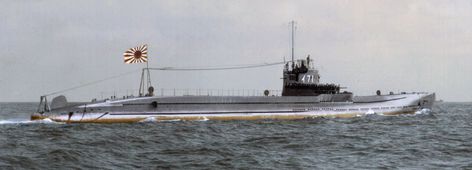 (Type KD6 submarine-colorized photo by Irootoko Jr)
IJN Submarine I-168: Tabular Record of
Movement
© 2001-2017 Bob Hackett & Sander Kingsepp
Revision 4
18 June 1931:
Laid down at Kure Navy Yard.
26 June 1933:
Launched as I-68.
15 November 1933:
Cdr (later Rear Admiral) Tsuruoka Nobumichi
(43)(former CO of I-66) is appointed the Chief Equipping Officer (CEO).
31 July 1934:
I-68 is completed, commissioned in the IJN and attached
to Kure Naval District. Assigned to SubDiv 12. Cdr Tsuruoka Nobumichi is the CO.
15 November 1934:
LtCdr (Rear Admiral, posthumously) Ota Nobunosuke
(47)(former CO of FUYO) is appointed the CO.
15 November 1935:
LtCdr (Rear Admiral, posthumously) Kayabara
Yasuchika (49)(former CO of I-124) is appointed the CO.
1 December 1937:
Lt (later Captain) Hatanaka Sumihiko (49)(former
torpedo officer of MIKUMA) is appointed the CO.
15 December 1938:
Cdr (later Captain) Uchino Shinji (49)(former CO of
I-5) is appointed the CO.
1 September 1939:
LtCdr (Captain, posthumously) Muraoka Tomiichi (52)
(former CO of I-65) is appointed the CO.
19 October 1940:
Placed in reserve at Kure.
25 July 1941:
LtCdr (later Captain) Nakamura Otoji (52)(former CO of
RO-60) is appointed the CO.
11 November 1941: Operation Z:
I-68 is in Vice Admiral Shimizu
Mitsumi's (former CO of ISE) Advance Expeditionary Force (Sixth Fleet) with Rear
Admiral (later Vice Admiral) Miwa Shigeyoshi's (former CO of KINU) SubRon 3 in
Captain (later Rear Admiral) Nakaoka Nobuki's SubDiv 12 with I-69 and I-70.
Admiral Shimizu convenes a meeting of all his commanders aboard his
flagship, light cruiser KATORI. The commanders are briefed on the planned attack
on Pearl Harbor. I-68 departs Saeki for Kwajalein.
23 November 1941:
Departs Kwajalein for Hawaii on her first war
patrol.
2 December 1941:
The coded signal "Niitakayama nobore (Climb Mt.
Niitaka) 1208" is received from the Combined Fleet. It signifies that
hostilities will commence on 8 December (Japan time). Mt. Niitaka, located in
Formosa (now Taiwan), is then the highest point in the Japanese Empire.
7 December 1941: The attack on Pearl Harbor:
SubRon 3 is deployed S of
Oahu. Its mission is to reconnoiter and attack any ships that try to sortie from
Pearl Harbor. I-68 is assigned to patrol from 25 to 50 miles SW of Oahu with
I-69, I-70, I-72 and I-73.
8 December 1941:
I-68 and I-69 are ordered to lay off the entrance to
Pearl Harbor to rescue midget submarine crews (none return). Returns to her
former station thereafter.
13 December 1941:
SW of Oahu. I-68 is subjected to 21 separate
depth-charge attacks on this and later days. The last attack wrecks many of her
battery cells and causes flooding in her aft torpedo room.
17 December 1941:
LtCdr Nakamura decides to terminate his patrol and
heads for Kwajalein.
28 December 1941:
Returns to Kwajalein.
31 December 1941:
Departs Kwajalein for Kure.
9 January 1942:
Arrives at Kure for repairs.
17 January 1942:
Hashirajima. LtCdr Nakamura pays a call on the
battleship YAMATO. He briefs the CINC, Combined Fleet, Admiral (Fleet Admiral,
posthumously) Yamamoto Isoroku (former CO of AKAGI), and his staff on I-68's
depth-chargings during the Hawaii operation.
31 January 1942:
LtCdr (later Cdr) Tanabe Yahachi (56)(former CO of
RO-59) is appointed the CO.
26 April 1942:
ComSubRon 3 Rear Admiral Miwa is relieved by Rear
Admiral (later Vice Admiral) Kono Chimaki (former CO of FUSO).
20 May 1942:
I-68 is renumbered I-168.
23 May 1942:
Departs Kure on her second war patrol to reconnoiter Kure
Atoll and the Midway Island prior to its capture.
31 May 1942:
Reconnoiters Kure Atoll.
2 June 1942:
At dawn, LtCdr Tanabe arrives NW of Midway and conducts
the first periscope reconnaissance of Sand Island. Tanabe reports "unusually
frequent patrol aircraft launches".
3-4 June 1944:
I-168 circumnavigates Midway, providing weather data to
Headquarters, Combined Fleet.
4 June 1942: Operation "MI":
Early in the morning, LtCdr Tanabe, his
navigator and the gunnery officer witness the air attack on Midway through the
periscope. At 1025, American dive-bombers reduce carriers AKAGI, KAGA and SORYU
to burning wrecks, but HIRYU is not damaged. At 1054, she launches 18 D3A1 "Val"
dive-bombers and six A6M2 "Zeke" fighters that follow the American planes and
find their carriers.
HIRYU's dive-bombers attack USS YORKTOWN (CV-5). A bomb hits the flight
deck aft of the island and sets afire three planes in the hangar below. A second
delayed action bomb penetrates three decks and explodes in the uptakes of the
stack, snuffing out the boilers. YORKTOWN's speed falls to six knots. A third
bomb hits her forward elevator. Damage control crews fight the fires, but at
1220 she is brought to a full stop for repairs. She has to work up steam to get
underway again.
Six Japanese planes survive and radio that the American carrier is
burning and that two more carriers are present. At 1245, HIRYU launches a second
strike of 10 "Kate" torpedo planes and six fighters. Under orders from ComCarDiv
2, Rear Admiral (Vice Admiral, posthumously) Yamaguchi Tamon to engage only an
undamaged carrier, the Kates attack what appears to be one; but it is, in fact,
YORKTOWN whose fires have been put out and steam restored.
By 1440, the Kates launch Type 91 torpedoes from both sides of YORKTOWN's
bow. YORKTOWN, making 19 knots, dodges two torpedoes, but two others hit her
port side, cut all electrical power and jam her rudder 15 degrees to port. She
comes to a stop and takes on a list that increases to 26 degrees. At 1455,
YORKTOWN heels over and her flight deck almost touches the sea. Captain Elliott
Buckmaster orders his 3,000 men to abandon ship. Destroyers pick up the
survivors.
From his flagship battleship YAMATO, Admiral Yamamoto issues orders for a
submarine bombardment of the airfield on Eastern Island, Midway until 0100 when
I-168 is to be relieved by CruDiv 7's MOGAMI, MIKUMA, KUMANO and SUZUYA. Later
the cruisers' orders are canceled. Additionally, ComSubRon 3 orders Tanabe to
remain in vicinity of Midway in order to report about the subsequent aircraft
traffic.
Around 2154 I-168 surfaces 4,500 yds E of the eastern tip of Eastern
Island and proceeds to Sand Island surfaced.
5 June 1942:
At 0124, I-168 surfaces within 1,100 yds SW of Midway and
opens fire with her 10-cm deck gun. I-168 fires six shells but inflicts no
damage. The Marine shore batteries snap on searchlights and their return fire
forces I-168 to submerge. The submarine is briefly chased and depth-charged by a
patrol vessel.
At 0652, cruiser CHIKUMA's No. 2 floatplane discovers the damaged
YORKTOWN. The plane's signal vectors I-168 to the carrier. CHIKUMA's No. 4 Aichi
E13A1 "Jake" scout of Vice Admiral (Admiral, posthumously) Nagumo Chuichi's Kido
Butai, radioes that it has sighted an enemy carrier 150 miles NNE of Midway. At
1055 LtCdr Tanabe receives an order from ComSubRon 3 to pursue and sink the
carrier.
While running on the surface towards the carrier's reported position,
I-168 is attacked by a PBY "Catalina" patrol plane. Tanabe dives and escapes
undamaged.
6 June 1942:
At 0410, one of I-168's lookouts spots YORKTOWN about 12
miles away. At 0600, Tanabe spots the first destroyers. He submerges and slows
to three knots. As he closes, he sees six destroyers circling a mile away. The
minesweeper VIREO has YORKTOWN in tow. At 0605, USS HAMMANN (DD-412) puts a
salvage party aboard the carrier. HAMMANN is secured to YORKTOWN's starboard
side and provides power for the carrier's pumps and foam to fight the fires.
I-168 arrives and sights the carrier and her screen. For seven hours,
Tanabe skillfully makes his approach, steering by chart and sound with only a few
periscope sightings. Undetected, he penetrates the destroyer and cruiser screen.
At 1331, from 1,900 yards, he fires two torpedoes at the overlapping formation,
followed by two more three seconds later. The first torpedo hits HAMMANN, breaks
her back and sinks her in about four minutes. As she goes down, her depth
charges explode and kill 81 of her 241-strong crew. At 1332, the next two
torpedoes strike YORKTOWN starboard below the bridge. The fourth torpedo misses
and passes astern.
At 1336, American destroyers commence a counterattack. A destroyer passes
directly overhead and drops two depth charges. After more attacks the forward
torpedo room and maneuvering room flood. After battery cells are extensively
damaged and all crew dons gas masks. The outer and inner doors of torpedo tube
No. 1 spring and admit water. The lights go out and the emergency lights come
on.
At 1640, with his batteries nearly exhausted, Tanabe battle surfaces
determined to go down fighting, but three destroyers USS GWIN (DD-433), HUGHES
(DD-410) and MONAGHAN (DD-354) are about five miles away. Tanabe sets off at the
best speed I-168 can now make - only 14 knots. Tanabe signals to the flagship of
the Combined Fleet YAMATO that he has attacked and sunk the YORKTOWN. One
destroyer closes within 5,470 yards, firing intermittently. After the emergency
repair of an electric engine is completed, Tanabe submerges again. I-168 stays
down until 2000 and then resurfaces. During 13 hours of chase, she has been
attacked with some 40 depth-charges.
Contrary to Tanabe's report, YORKTOWN has not yet sunk. The two torpedo
hits corrected her list from 26 to 17 degrees. Captain Buckmaster removes the
salvage party and plans to resume work in the morning.
Admiral Yamamoto suspends the invasion of Midway.
7 June 1942:
At 0458, the 19,875-ton YORKTOWN rolls over to port and
sinks in about 3,000 fathoms of water. LtCdr Tanabe has made the biggest kill
yet by any submarine in the Pacific. [1]
19 June 1942:
Arrives at Yokosuka with nearly dry tanks. Refuels and
proceeds to Kure. A big crowd greets Tanabe on I-168's arrival at Kure. Music
plays and speeches are made.
26 June 1942:
I-168 is transferred to Sasebo.
30 June 1942:
Cdr (later Captain) Tonozuka Kinzo (50), the CEO of
I-34, currently under construction at Sasebo, is appointed the CO of I-168 "on
paper" while she undergoes battle-damage repairs.
7 August 1942: American Operation "Watchtower" - The Invasion of
Guadalcanal, British Solomon Islands:
Rear Admiral (later Admiral) Richmond
K. Turner's Amphibious Task Force 62, covered by Vice Admiral (later Admiral)
Frank J. Fletcher's Task Force 61 and Rear Admiral (later Admiral) John S.
McCain's Task Force 63's land-based aircraft, lands Maj Gen (later
Gen/Commandant) Alexander A. Vandegrift's 1st Marine Division on Guadalcanal
opening a seven-month campaign to take the island.
31 August 1942:
Repairs to I-168 are completed. LtCdr (Captain,
posthumously) Watanabe Katsuji (55)(current CO of I-169) is appointed the CO of
I-168 as additional duty. Departs Sasebo.
15 October 1942:
LtCdr (Cdr, posthumously) Nakajima Sakae (56)(former
CO of I-157) is appointed the CO.
16 November 1942:
Truk. Vice Admiral Komatsu convenes a meeting of his
submarine captains. He announces that the submarine force has been ordered by
Admiral Yamamoto to organize a supply system for the IJA's 17th Army garrison on
Guadalcanal.
18 November 1942:
Returns to Kure. Drydocked for repairs.
15 December 1942:
Departs Kure for Truk.
22 December 1942:
Arrives at Truk. Participates in supply missions to
Guadalcanal while directly attached to the Sixth Fleet HQ.
1 January 1943:
Arrives at Guadalcanal with 15 tons of cargo but is
chased away by two patrol boats after 60 per cent of the cargo is unloaded.
3 January 1943:
Arrives at Shortland, departs the next day for Truk.
7 January 1943:
Arrives at Truk, departs the next day for Kure.
14 January 1943:
Arrives at Kure.
1 February 1943:
Assigned to Northern District Force.
22 February 1943:
Departs Kure for Yokosuka.
25 February 1943:
Arrives at Yokosuka.
5 March 1943:
Departs Yokosuka for Paramushiro.
10 March 1943:
Arrives at Paramushiro.
13 March 1943:
Departs Paramushiro on her first supply run to Attu and
Kiska, carrying ammuniton.
15 March 1943:
Arrives at Holtz Bay, Attu, unloads a part of her
cargo, then departs for Kiska.
At 1727 (Y), the surfaced I-168 is attacked by USS S-32, patrolling off
the entrance to Holtz Bay. LtCdr Maximilian G. Schmidt (USNA '32) fires a
three-torpedo spread at 52-54N, 173-13E; all miss. A muffled explosion is heard
and S-32's soundman reports that enemy's propeller noises have stopped, but the
CO of S-32 observes the "I-1 class submarine" until 1736 when the visual contact
is lost. [2]
17 March 1943:
Arrives at Kiska, unloads her ammunition cargo and 6
tons of provisions, then departs to patrol in an area S of Amchitka.
1 April 1943:
Returns to Kiska in company of I-169. Takes aboard sick
personnel of the Kiska garrison and the ground personnel of the 452nd Naval Air
Group.
4 April 1943:
Returns to Paramushiro.
10 April 1943:
Departs Paramushiro on her second supply run to Attu
and Kiska, carrying ammunition and mail.
12 April 1943:
Arrives at Attu, unloads a part of her cargo, then
departs for Kiska.
14 April 1943:
Arrives at Attu, embarks several staff officers.
16 April 1943:
Departs Attu for Kiska.
19 April 1943:
Arrives at Kiska, unloads her cargo.
9 May 1943:
Returns to Yokosuka. Reassigned to SubRon 3.
12 July 1943:
Departs Kure, still under LtCdr Nakajima.
22 July 1943:
Arrives at Truk.
25 July 1943:
Departs Truk for Rabaul.
27 July 1943:
I-168 sends a regular situation report while negotiating
the Isabel Strait. This is the last message from I-168.
At dusk around 1754, I-168 sights a surfaced enemy submarine in the
Steffen Strait between New Ireland and New Hanover. LtCdr Nakajima fires a
torpedo at the submarine, but misses. Lookouts on LtCdr Walter E. Ebert's USS
SCAMP (SS-277) spot the incoming torpedo. Ebert goes ahead full and crash dives.
He levels off at 220 ft, lets the torpedo pass overhead and returns to periscope
depth. At 1812, Ebert fires four torpedoes at I-168 that sink her 60 miles off
New Hanover at 02-50S, 149-01E.
10 September 1943:
Presumed lost with all 97 hands in the area N of
Rabaul.
15 September 1943:
SubRon 3 is disbanded.
15 October 1943:
Removed from the Navy List.
Authors' notes:
[1] On 19 May 1998, Dr. Robert D. Ballard, with a National
Geographic Society-sponsored Midway deep-sea expedition, finds YORKTOWN sitting
upright, virtually intact, in 16,650 feet of water. See http://www.nationalgeographic.com/midway
[2] S-32's target has been erroneously identified as RO-103, operating
off Rabaul at that time.
Thanks go to Dr Higuchi Tatsuhiro of Japan, Jean-Francois Masson of
Canada and Andrew Obluski of Poland.
- Bob Hackett and Sander Kingsepp.
Back to Submarine
Page

