© 2007-2016 Bob Hackett, Sander Kingsepp and Peter Cundall
Revision 6
16 October 1920:
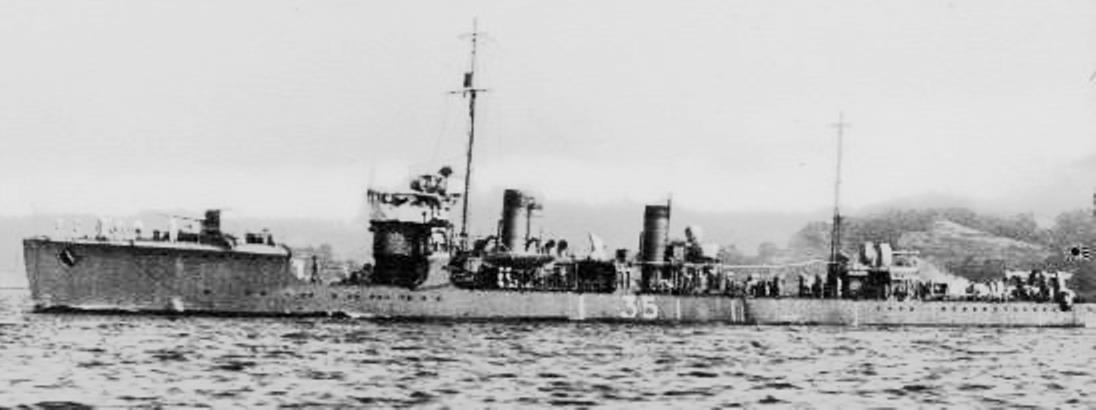
Kobe. Laid down as a MOMI-class destroyer at Kawasaki Heavy Industries shipyard.
9 May 1921:
Launched and named TSUTA.
30 June 1921:
Completed. Attached to Kure Naval District.
1 December 1921:
LtCdr (later Vice Admira) Okuma Masakichi (37)(former CO of MIKAZUKI) is appointed the CO. Assigned to DesDiv 15.
1 June 1923:
LtCdr (Rear Admiral, posthumously) Takeshita Shigeri (35) assumes command with joint duty as an instructor at the naval torpedo school.
15 October 1923:
LtCdr (later Rear Admiral) Sakura Takeo (37) assumes command.
10 May 1924:
LtCdr (Vice Admiral, posthumously) Goto Aritomo (38) assumes command.
1 December 1925:
LtCdr (later Vice Admiral) Tada Takeo (40) assumes command.
20 April 1926:
An unknown officer assumes command.
1 December 1926:
LtCdr Miyatake Shigetoshi (39) is appointed the CO.
10 December 1928:
LtCdr (later RAdm) Hayakawa Mikio (44) is appointed the CO.
30 November 1929:
LtCdr Katsuhara Mitsuko (45) is appointed the CO.
1 December 1930:
LtCdr (Rear Admiral, posthumously) Murakami Chonosuke (44) (current CO of SUSUKI) assumes joint command of TSUTA until 2 November 1931.
2 November 1931:
An unknown officer assumes command.
21 January 1932:
DesDiv 15 departs Kure in company of light cruiser OI and others to patrol off Shanghai.
24 January 1932:
Arrives at Shanghai. Commences patrols on lower Yangtze River.
15 October 1937:
LtCdr (later Captain) Aoki Kyuji (50)(former CO of ASAGAO) is appointed the CO.
21 February 1938:
LtCdr (later Captain) Iwagami Jiichi (50)(former CO of HAGI) is appointed the CO.
1939:
One of three Kampon boilers is removed reducing speed to 18 knots. Additionally, her torpedo tubes, aft 4.7-inch/45 cal main gun and minesweeping gear are removed. 25mm AA guns and depth charge racks and throwers are fitted. Extra ballast is added to compensate for the loss of topside weight and to increase stability. The changes increase her displacement to 935-tons.
1 April 1940:
Reserve LT Imamura Kiyoshi is appointed the CO. Reclassified as a patrol boat and renumbered 35.
18 October 1940:
Reserve LT Tsuchitori Suguru is appointed the CO.
30 September 1940:
Subchaser CH-8, PB-35, minelayers ASHIZAKI and KUROZAKI and tugs No. 1 and No. 2 all depart Ominato on Naval manuevers returning in October.
20 November 1940:
PB-34, PB-35 and minelayer KUROSAKI depart Ominato for Mutsu Wan on a training exercise.
26 November 1940:
PB-34, PB-35 and minelayers KUROZAKI, SHIRAKAMI and Tug No. 3 depart Ominato for Mutsu Wan and the Tsugaru Straits on a training exercise.
28 November 1940:
Returns to Ominato.
7 December 1940:
PB-34, PB-35 and minelayers KUROZAKI, ASHIZAKI, SHIRAKAMI and Tugs No.1, No. 2 and No. 3 depart Ominato for Mutsu Wan on a training exercise.
27 January 1941:
PB-34, PB-35 and minelayers KUROZAKI, ASHIZAKI, SHIRAKAMI and auxiliary patrol boats BUNZAN and MIZUKAMI MARUs depart Ominato for Mutsu Wan and Tsugaru Straits on a training exercise.
31 January 1941:
Returns to Ominato.
5 February 1941:
PB-34, PB-35 and minelayers KUROZAKI, ASHIZAKI, SHIRAKAMI, Tug No. 1 and auxiliary patrol boat MIZUKAMI MARU depart Ominato for Mutsu Wan and Tsugaru Straits on a training exercise.
7 February 1941:
Returns to Ominato.
9 February 1941:
PB-34, PB-35 and minelayers KUROZAKI, ASHIZAKI, SHIRAKAMI and auxiliary patrol boats BUNZAN and MIZUKAMI MARUs depart Ominato for Mutsu Wan on a training exercise.
12 February 1941:
PB-34, PB-35 and minelayers KUROZAKI, ASHIZAKI and SHIRAKAMI depart Ominato for Mutsu Wan and Tsugaru Straits on a training exercise.
15 February 1941:
Returns to Ominato.
18 February 1941:
PB-34, PB-35 and minelayers KUROZAKI, ASHIZAKI and Tug No. 2 and Tug No. 3 depart Ominato for Mutsu Wan on a training exercise.
19 February 1941:
Returns to Ominato.
21 February 1941:
PB-34, PB-35 and minelayers KUROZAKI, ASHIZAKI and Tug No. 2 and Tug No. 3 depart Ominato for Mutsu Wan on a training exercise.
22 February 1941:
Returns to Ominato.
27 February 1941:
PB-35 alone departs Ominato on a training exercise in Mutsu Wan.
3 March 1941:
PB-34, PB-35 and minelayers SHIRAKAMI, KUROZAKI, ASHIZAKI and Tug No. 2 and Tug No. 3 depart Ominato for Mutsu Wan and Tsugaru Straits on a training exercise.
5 March 1941:
Returns to Ominato.
10 March 1941:
PB-34, PB-35 and minelayers SHIRAKAMI, KUROZAKI, ASHIZAKI and Tug No. 1 depart Ominato for Mutsu Wan and Tsugaru Straits on a training exercise.
15 March 1941:
Returns to Ominato.
24 March 1941:
PB-35 alone departs Ominato on a training exercise in Mutsu Wan.
28 March 1941:
PB-34, PB-35 and minelayers KUROZAKI, ASHIZAKI, SHIRAKAMI, Tug No. 1 and auxiliary patrol boats BUNZAN and MIZUKAMI MARUs depart Ominato for Mutsu Wan on a Naval exercise.
3 April 1941:
The ships return to Ominato.
6 May 1941:
PB-35 and minelayers KUROZAKI, ASHIZAKI and auxiliary patrol boats CHOYO MARU and CHOYO MARU No. 2 depart Ominato for Mutsu Wan and Tsugaru Straits on a training exercise.
9 May 1941:
The ships return to Ominato.
10 May 1941:
Departs Ominato towing a target for No.1 Subchaser Group.
26 May 1941:
Departs Ominato.
27 May 1941:
Returns to Ominato.
10 June 1941:
PB-34, PB-35 and minelayers KUROZAKI, ASHIZAKI, SHIRAKAMI, Tug No. 3 and auxiliary patrol boat BUNZAN MARU depart Ominato for Tsugaru Straits on a Naval exercise.
13 June 1941:
The ships return to Ominato.
17 June 1941:
PB-34, PB-35 and minelayers KUROZAKI, ASHIZAKI, SHIRAKAMI, and auxiliary patrol boat MIZUKAMI MARU depart Ominato for Moura area on training exercises.
23 June 1941:
The ships return to Ominato.
26 June 1941:
PB-34, PB-35 and minelayers ASHIZAKI and SHIRAKAMI depart Ominato for Mutsu Wan on a Naval exercise.
12 July 1941:
PB-34, PB-35 and minelayers ASHIZAKI and KUROZAKI and auxiliary patrol boats BUNZAN and MIZUKAMI MARUs depart Ominato for Mutsu Wan on a training exercise.
14 July 1941:
PB-34, PB-35 and minelayers ASHIZAKI, KUROZAKI and SHIRAKAMI and auxiliary patrol boats BUNZAN and MIZUKAMI MARUs depart Ominato for Mutsu Wan on a training exercise.
15 July 1941:
The ships return to Ominato.
21 July 1941:
PB-34, PB-35 and minelayers ASHIZAKI, KUROZAKI and SHIRAKAMI adepart Ominato for Tsugaru Straits on a training exercise.
26 July 1941:
The ships return to Ominato.
1941:
PB-35 undergoes reconstruction. Her aft funnel is removed and the stem is cut down to form a ramp. She is fitted to carry and launch two 46-ft Daihatsu landing craft. Her forward interior spaces are modified to accommodate up to 150 troops. Her 25mm AA suite is increased.
17 September 1941:
Reserve LT Kumai Zentaro is appointed the CO.
13 October 1941:
PB-35 and minelayer SHITAKAMI depart Ominato to Mutsu Wan on a training exercise.
14 October 1941:
The ships return to Ominato.
22 November 1941:
At 1130, anchors in Kaneda Wan (Bay).
23 November 1941:
At 0630, departs Kaneda Wan.
25 November 1941:
At 0850, arrives at Kure.
27 November 1941:
At 0615, departs Kure.
4 December 1941:
At 1627, arrives at Palau.
8 December 1941:
P-35 is in Vice Admiral Takahashi Ibo’s (35)(former CO of YAMASHIRO) Third Fleet assigned to Rear Admiral (later Vice Admiral) Irifune Naosaburo’s (39)(former CO of MIKUMA) Special Base Force 32 in Captain Nishikawa Hayami's (34) Patrol Boat Squadron 1 with PB-1, PB-2, PB-32, PB-33, PB-34, PB-36, PB-37, PB-38 and PB-39. At 0819, departs Palau.
12 December 1941:
At 0555, arrives at Albay Gulf with PB-34. Departs at 1752.
14 December 1941:
At 1752, arrives at Cabucao. At 2130 departs and anchors off Legapi/Albay Gulf.
16 December 1941:
At 1047, while anchoring at 3,500 m northeast of Legaspi Lighthouse PB-35 touches with her bow the starboard rear deck of the oiler HAYATOMO. Both ships are only lightly damaged. Later this day HAYATOMO supplies PB-35 with fresh food.
18 December 1941:
At 1700, departs Albay Gulf with PB-34.
22 December 1941:
At 1059, arrives at Palau.
29 December 1941:
At 0730, departs Palau.
1 January 1942:
At 1314, arrives at Palau escorting SHINKO MARU.
7 January 1942:
At 1626, departs Palau escorting auxiliary seaplane tenders SANUKI and SANYO MARUs.
12 January 1942:
At 1805, arrives at Tarakan.
20 January 1942:
At 2400 departs Tarakan.
22 January 1942:
Arrives at Sangkulirang Bay with auxiliaries KUREHA MARU No. 3, EIKO MARU and TAIEI MARU.
25 January 1942:
At 1921, departs Sangkulirang Bay.
26 January 1942:
At 0921, arrives at Balikpapan.
30 January 1942:
At 1930, departs Balikpapan.
1 February 1942:
At 1440, departs Sangkulirang Bay.
2 February 1942:
At 1900, arrives at Tarakan and at 2245 departs.
4 February 1942:
At 1540, arrives at Davao.
5 February 1942:
At 0700 departs Davao.
10 February 1942:
At 1400, arrives at Camranh Bay.
15 February 1942:
At 1400, departs Camranh Bay.
18 February 1942: Operation “J” - The Invasion of Java, Netherlands East Indies:
Camranh Bay. PB-35 is in the Third Fleet's Netherlands East Indies Force. She provides distant cover for Vice Admiral Ozawa Jisaburo’s (37) Western Java Seizure Force with light cruisers NATORI and YURA and seaplane tenders SANYO and KAMIKAWA MARUs. She helps cover 46 troop transports carrying the IJA’s 2nd Infantry Division for the invasions of Bantam Bay and Merak, Java. At 1908, arrives at Muntok.
20 February 1942:
At 1015, departs Muntok. At 2245 arrives at Toboali.
28 February 1942:
At 1910 departs Toboali.
1 March 1942:
At 0848, arrives at Bantam Bay. PB-35 goes alongside oiler TSURUMI and is refuelled.
2 March 1942:
At 0715, departs Bantam Bay. At 1917 departs on patrol.
5 March 1942:
At 1200, arrives at Bantam Bay.
6 March 1942:
At 0700 departs Bantam Bay on patrol.
7 March 1942:
At 1200, arrives at Bantam Bay.
8 March 1942:
At 1330, departs Bantam Bay on patrol.
9 March 1942:
At 1015, arrives at Bantam Bay.
10 March 1942:
At 0710, departs Bantam Bay escorting auxiliary seaplane tender SANYO MARU.
12 March 1942:
At 1750, arrives at Singapore.
14 March 1942:
Repair ship ASAHI starts repairing the twelve centimeter binocular lens.
16 March 1942:
The repair of the binocular lens is completed. PB-35 moors alongside of SANYO MARU. Provisoned with water and fresh food.
17 March 1942:
At 0800, departs Singapore escorting SANYO MARU with auxiliary submarine chaser SHONAN MARU No. 12. Arrives at Batu Pahat later that day.
18 March 1942:
Departs Batu Pahat.
19 March 1942:
At 1120, arrives at Penang. Moors alongside NICHIEI MARU.
20 March 1942:
Departs Penang escorting SANYO MARU.
22 March 1942:
At 1700, arrives at Mergui.
27 March 1942:
At 1700, departs Mergui escorting NICHIEI MARU and SURUGA MARU.
29 March 1942:
At 0745, arrives at Phuket. Departs later that day.
31 March 1942:
At 1700, arrives at Seletar, Singapore.
15 April 1942:
At 1500, departs Seletar and arrives at Keppel Harbour at 1824.
16 April 1942:
At 1215, PB-35 departs Singapore with kaibokan SHIMUSHU, torpedo boats OTORI and HIYODORI and auxiliary gunboat DAIGEN MARU No. 7 escorting a convoy transporting the 3rd Tank Corps to Dairen, Manchuria. The convoy consists of MYOKO, ATLAS, TSUYAMA, MOMOYAMA, FRANCE, HEIAN, RYUNAN, GLASGOW, TOKIWA, HAVRE and SANKO MARUs. The escorts protect the convoy up tolatitude 16N, from where the convoy is escorted by units of the IJN's North China Area Fleet.
19 April 1942:
The convoy is joined by SYDNEY, GENKAI and CALCUTTA MARUs from Bangkok. PB-35 probably is detached.
24 April 1942:
At 1018, arrives at Hong Kong and departs at 1655.
1 May 1942:
At 1200, arrives at Chinkai.
3 May 1942:
At 1700, departs Chinkai.
4 May 1942:
At 1550, arrives at Kure.
15 May 1942:
PB-35 and PB-34 depart Kure for Guam escorting transports ARGENTINA and KIYOSUMI MARUs.
18 May 1942:
Arrives at Guam, then departs for Saipan.
20 May 1942:
Arrives at Saipan.
21 May 1942:
At 1750, arrives at Guam.
23 May 1942:
At 0450, departs Guam.
24 May 1942:
At 0600, arrives at Saipan, Marianas.
28 May 1942: Operation “MI” - The Battle of Midway:
At 1730, PB-35 departs Saipan with destroyer HAYASHIO escorting Rear Admiral (later Vice Admiral) Fujita Ruitaro's (38) (former CO of FUSO) 11th Seaplane Tender Division’s CHITOSE and KAMIKAWA MARU of Vice Admiral (later Admiral) Kondo Nobutake's (35) (former CO of KONGO) Midway Invasion Force. PB-35 carries troops.
5 June 1942:
At 0255, the Combined Fleet's Commander-in-Chief Admiral (Fleet Admiral, posthumously) Yamamoto Isoroku (32) (former CO of AKAGI), aboard his flagship YAMATO, orders Operation MI cancelled.
13 June 1942:
At 1550, arrives at Guam, Marianas with Vice Admiral (later Admiral) Kondo Nobutake's (35)(former CO of KONGO) Midway Invasion Force's Transport Group that disembarks LtCol Ichiki Kiyonao's detachment.
26 June 1942:
At 1345, departs Guam escorting ZENYO and NANKAI MARUs.
7 August 1942: American Operation "Watchtower" - The Invasion of Guadalcanal, British Solomons:
Rear Admiral (later Admiral) Richmond K. Turner's (USNA ’08) (former CO of USS ASTORIA, CA-34), Amphibious Task Force 62, covered by Vice Admiral (MOH/later Admiral) Frank J. Fletcher's (USNA ’06) (former CO of USS VERMONT, BB-20) Task Force 61 and Rear Admiral (Admiral posthumously) John S. McCain's (USNA ’06) (former CO of USS RANGER, CV-4) Task Force 63's land-based aircraft, lands MajGen (later General/MOH/Commandant) Alexander A. Vandegrift's 1st Marine Division on Florida, Tulagi, Gavutu, Tanambogo and Guadalcanal opening the campaign to retake the islands.
That same day PB-34 and PB-35 depart Kure for Moji and then Truk.
8 August 1942:
At 0400 PB-34 and PB-35 depart Moji escorting fast Army transports ASAKASAN and SADO MARUs carrying soldiers from the Kawaguchi Detachment destined for Guadalcanal.
13 August 1942:
The convoy arrives at Palau and takes on additional troops. Meanwhile PB-34 and PB-35 apparently detach and sail on to Truk.
16 August 1942:
Truk. At 0500, DesDiv 4's ARASHI and HAGIKAZE, DesDiv 15's KAGERO and DesDiv 17's HAMAKAZE, TANIKAZE and URAKAZE depart Truk for Guadalcanal as the first echelon of a reinforcement convoy carrying 917 men of LtCol Ichiki's 28th Infantry Regiment.
PB-35 and PB-34 depart Truk with light cruiser JINTSU escorting the second echelon of the reinforcement convoy consisting of BOSTON and DAIFUKU MARUs carrying 1,100 men of Ichiki's Regiment. Rear Admiral (later Vice Admiral) Tanaka Raizo (41) in JINTSU is in command of the convoy. The third echelon follows consisting of armed merchant cruiser KINRYU MARU carrying about 1,000 troops of the Yokosuka No. 5 SNLF escorted by PB-1 and PB-2.
18 August 1942:
About noon, DesDiv 24's KAWAKAZE, SUZUKAZE and UMIKAZE join the second and third echelons still enroute to Guadalcanal.
19 August 1942:
Cape Taivu, E of Lunga Point, Guadalcanal. At 0100, the first echelon lands LtCol Ichiki's troops.
20 August 1942:
At midnight, Ikki's troops storm Guadalcanal's "Henderson Field" to retake the airfield, but almost all of Ichiki's men are cut down by U. S. Marines. Ichiki commits suicide.
21 August 1942:
That evening, Tanaka receives a signal from Headquarters, Eighth Fleet that Vice Admiral Kondo's Second Fleet and Vice Admiral Nagumo's Third Fleet will support Tanaka's reinforcement convoy consisting of the second and third echelons.
24 August 1942: The Battle of the Eastern Solomons.
At 1230, Tanaka's force sights light carrier RYUJO, covered by CruDiv 8's TONE and DesDiv 16's AMATSUKAZE and TOKITSUKAZE. Later, RYUJO launches two strikes against Henderson Field. At 1357, RYUJO is attacked by aircraft from Vice Admiral Fletcher's Task Force 61's USS SARATOGA (CV-3). RYUJO is hit by four bombs and a torpedo hit that floods her starboard engine room. At 1800, RYUJO capsizes and sinks.
CarDiv 1's SHOKAKU and ZUIKAKU launch aircraft that find and damage USS ENTERPRISE (CV-6). That evening, aircraft from USS SARATOGA damage seaplane carrier CHITOSE. The same night, DesDiv 15's KAGERO, DesDiv 17's ISOKAZE, DesDiv 24's KAWAKAZE and DesDiv 30's MUTSUKI and YAYOI shell Henderson Field, then race northward to join Tanaka's convoy.
25 August 1942:
150 miles N of Guadalcanal. At 0600, six USMC Douglas SBD "Dauntless" dive-bombers attack the convoy. KINRYU MARU is hit and begins to sink. Her embarked troops are evacuated by DesDiv 30's MUTSUKI and YAYOI and PB-1 and PB-2.
BOSTON MARU is damaged by a near-miss by the SBDs. A bomb hits JINTSU's forecastle and starts fires causing her forward magazines to be flooded. Rear Admiral Tanaka is injured. He shifts his flag to KAGERO.
B-17 "Flying Fortresses" arrive and sink MUTSUKI still evacuating troops from sinking KINRYU MARU.
25 August 1942:
The convoy returns to Shortland, Bougainville that night.
2 September 1942:
Rear Admiral Jojima Takatsugu’s (40) (former CO of SHOKAKU) "R" Area Air Force based at seaplane bases around the Shortland Islands plans to establish a new permanent base at Rekata Bay off Santa Isabel Island, 135 miles NW of Lunga Point on Guadalcanal. PB-35 departs Shortland transporting the base staff of auxiliary seaplane tender SANYO MARU to Rekata Bay.
At 1100, that same day, PB-35 is attacked by an 11th Bomb Group Boeing B-17 “Flying Fortress” 20 miles NW of the tip of Santa Isabel Island at 07-16S, 158-03 E. Hit by bombs or near-misses, PB-35 goes dead 'in the water. Fifty-two of her passengers and crew aboard PB-35 survive, but Reserve LT Kumai and 92 other men are KIA. LT Kumai is promoted LtCdr, posthumously. [1]
10 February 1943:
Removed from the Navy List.
Authors’ Notes:
[1] Sources conflict on the loss of PB-35: Japanese sources indicate PB-35 was by sunk by aircraft on 2 Sep 1942. Author Richard Frank cites COMSOPAC 032231 Sep 42, in COMSOPAC War Diary 3 Sep 1942, that indicates
that an 11th Bomb Group B-17 hit a tanker or seaplane carrier on 2 September and left it stopped in the water. Other western sources indicate USS GREENLING (SS-213) torpedoed and sank or damaged PB-35 on 22 Dec 1942,
but the location given is nowhere near Santa Isabel Island, seemingly ruling out USS GREENLING's involvement.
Thanks go to J-aircraft.com contributors Mssrs. Mark Gurdy, Gengoro Toda and Jim Broshot for helping to sort out confusion about PB-35's sinking. Thanks also to Gilbert Casse of France and Berend van der Waal of the Netherlands.
-Bob Hackett, Sander Kingsepp and Peter Cundall
Back to Patrol Boat Page