JUNYOKAN!
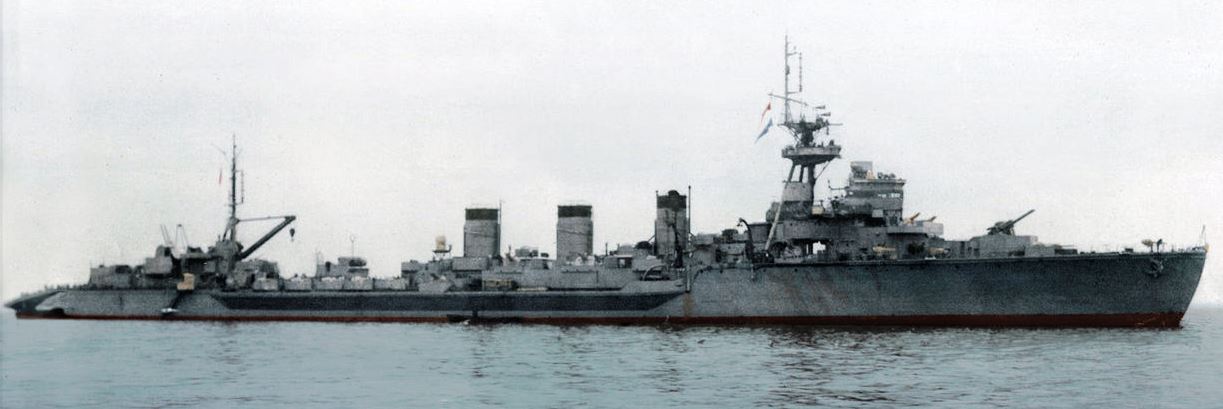
(KITAKAMI in 1945 - colorized by Irotooko,
Jr)
IJN KITAKAMI: Tabular Record of Movement
© 1997-2020 Bob Hackett and Sander Kingsepp
Revision 9
1 September 1919:
Laid down at Sasebo Navy Yard.
11 June 1920:
Captain (later Rear Admiral) Sakamoto Teiji (28)(former
CO of MISHIMA) is appointed the Chief Equipping Officer (CEO).
3 July 1920:
Launched and named KITAKAMI.
15 April 1921:
Completed and registered in the IJN. Attached to
Yokosuka Naval District. Captain Sakamoto is the Commanding Officer.
15 March 1922:
Captain Yamazaki Shosaku (27)(former CO of TSUGARU) is
appointed the CO.
3 November 1922:
E of Izu-Oshima Island. At 1840, during a gunnery
exercise, KITAKAMI, towing a target for the battleship YAMASHIRO, receives a
6-in hit from her secondary battery to her starboard side abreast her fore
turret. MM2c Yamazaki is killed, another machinist slightly injured.
1 December 1922:
Designated the flagship of DesRon 2. Captain (later
Rear Admiral) Takahashi Ritsuto (28)(former ComDesDiv 1) is appointed the CO.
1 December 1923:
Captain (later Vice Admiral) Kawano Togo (31)(former
Military Attaché to Brazil) is appointed the CO.
1 November 1924:
Cdr (promoted Captain 1 December) Yoshikawa Masakiyo
(32)(former CO of SATA) is appointed the CO.
1 December 1924:
The flag of DesRon 2 is transferred to ISUZU.
15 April 1925:
Cdr (later Captain) Matsui Risaburo (34)(former CO of
KATSURIKI) is appointed the CO of KITAKAMI and fleet oiler SUNOSAKI as
additional duty.
15 June 1925:
Captain Hirayama Sakae (31)(former CO of NARUTO) is
appointed the CO.
20 November 1925:
Captain Furukawa Ryoichi (31)(former ComSubDiv 26)
is appointed the CO.
1 December 1926:
Captain Seimiya Yoshitaka (33)(former XO of NAGATO)
is appointed the CO of KITAKAMI and ASO (ex-BAYAN, until 10 January 1927) as
additional duty.
1 December 1927:
Captain Kohiyama Shinji (33)(former CO of KAMOI) is
appointed the CO.
4 December 1928:
Cdr (promoted Captain 10 December; later Vice
Admiral) Shimomura Shosuke (35)(former XO of ISUZU) is appointed the CO.
5 October 1929:
Captain Saito Naohiko (34)(former ComDesDiv 22) is
appointed the CO.
5 December 1929:
Captain (later Rear Admiral), the Baron, Sonoda
Minoru (34)(former staff officer at NGS Third Division/Intelligence) is
appointed the CO.
18 October 1930: IJN Special Great Maneuvers:
Participates in the
maneuvers with the Third (Red) Fleet.
20 October 1930:
S of Omae Zaki, Honshu (31-02N, 138-17E). At 0301,
KITAKAMI is rammed by ABUKUMA between her Nos. 2 and 3 funnels. ABUKUMA
loses her bow up to the fore turret. KITAKAMI sustains only limited damage
to her port side.
21 October 1930:
Arrives at Yokosuka Navy Yard for repairs.
1 December 1930:
Captain (later Vice Admiral) Horie Rokuro
(36)(former CO of NOJIMA) is appointed the CO.
14 September 1931:
Captain Horie is appointed the CO of ISUZU as
additional duty.
14 November 1931:
Captain (later Vice Admiral) Kusaka Jinichi
(37)(former NGS staff officer) is appointed the CO.
1 December 1932:
Captain (later Vice Admiral) Samejima Tomoshige
(37)(former Third Fleet staff officer) is appointed the CO.
1934:
The IJN's development of long-range oxygen-propelled Type 93
"Long Lance" torpedoes causes a revision of their Night Battle Tactics. The
Naval General Staff now plans to commence battle with the presumed enemy - the
American fleet - by launching night torpedo attacks followed by a decisive
daylight gunnery action by the IJN's main battle line.
To whittle down the opposing American fleet's numbers, the NGS plans for
a special Night Battle Force to carry out these attacks. This force is to be
made up by destroyer squadrons, heavy cruiser squadrons, a torpedo-cruiser
squadron, and a battlecruiser squadron. The Night Battle Force will have the
firepower of several hundred Type 93 torpedoes that outrange the American
battleships' main guns. The next day, after the previous night's attacks have
delivered crippling blows, the IJN's battleships will attack the remnants of the
American fleet.
14 March 1934:
Captain (later Vice Admiral) Takeda Moriji (38)(former
CO of the Ad Hoc Defense Unit) is appointed the CO.
15 November 1934:
Captain (later Vice Admiral) Inoue Yasuo (38)(former
staff officer of the Mako/Makung Guard District) is appointed the CO.
10 October 1935:
Captain (later Rear Admiral) Matsuyama Mitsuharu
(40)(former CO of SUNOSAKI) is appointed the CO.
1 December 1936-20 February 1937:
Captain Matsuyama is appointed the
CO of light cruiser NAGARA as additional duty.
1 December 1937:
Captain Horiuchi Kaoru (40)(former CO of MUROTO) is
appointed the CO.
15 December 1938:
Captain (later Rear Admiral) Count Ueno Masao
(40)(former CO of SAGA) is appointed the CO.
19 October 1940:
Captain (later Rear Admiral) Nishioka Shigeyasu
(40)(former ComDesDiv 22) is appointed the CO.
1 November 1940:
Captain (later Rear Admiral) Nabeshima Shunsaku
(42)(former CO of KASHIMA) is appointed the CO.
19 January 1941:
Off Tosa Bay, Shikoku. During the naval exercises
KITAKAMI collides with DesDiv 20's destroyer YUGIRI. Both vessels receive slight
damage.
15 March 1941:
Captain Ura Koichi (46)(former staff officer of Port
Arthur Guard District) is appointed the CO.
25 August 1941:
KITAKAMI is ordered to Sasebo for conversion to a
"torpedo cruiser" with ten quadruple 61-cm Type 92 Model 3 torpedo mounts, for
a total of 40 tubes.
1 September 1941:
Captain (later Rear Admiral) Araki Tsutau
(45)(former ComDesDiv 18) is appointed the CO.
30 September 1941:
Sasebo. The modifications are completed.
20 November 1941:
Assigned to Rear Admiral (later Vice Admiral) Kishi
Fukuji's (40)(former CO of FUSO) CruDiv 9 attached to the First Fleet.
28 November 1941:
Captain (Rear Admiral, posthumously) Norimitsu Saiji
(46)(former ComDesDiv 12) is appointed the CO.
27 December 1941:
Departs Sasebo for Kure. Undergoes training.
December 1941:
Western Inland Sea. Guardship for the battleship force.
16 January 1942:
Departs Kure, escorting transports.
22 January 1942:
Arrives at Mako (Makung), Pescadores.
1 February 1942:
Departs Mako for Hashirajima anchorage.
4 February 1942:
Arrives at Hashirajima. Remains in training for the
next two months.
22-27 March 1942:
Refit at Kure Navy Yard.
14 April 1942:
Departs Hashirajima.
16 April 1942:
Arrives at Sasebo.
20 April-3 May 1942:
Drydocked at Sasebo Navy Yard.
11 May 1942: Operation "MI":
CruDiv 9 is assigned to the Guard Force
of the Main Body.
29 May 1942: Operation "MI" - The Battle
of Midway:
CruDiv 9's KITAKAMI and the OI sortie with Vice Admiral
(later Admiral) Takasu Shiro's (35)(former CO of ISUZU) Aleutian Screening
Force's BatDiv 2's HYUGA, ISE, FUSO and YAMASHIRO, DesDiv 20's AMAGIRI, ASAGIRI,
YUGIRI and SHIRAKUMO, DesDiv 24's KAWAKAZE, YAMAKAZE, SUZUKAZE and UMIKAZE,
DesDiv 27's ARIAKE, YUGURE, SHIGURE and the SHIRATSUYU and the 2nd Supply Unit's
oilers SAN CLEMENTE and TOA MARUs.
17 June 1942:
Arrives at Yokosuka.
22 June 1942:
KITAKAMI and OI depart Yokosuka.
24 June 1942:
Arrives at Hashirajima.
9-24 July 1942:
Refit at Kure Navy Yard.
August-September 1942:
Kure and Yokosuka. KITAKAMI and OI are
converted to fast transports. The number of quadruple torpedo mounts is reduced
to six, for a total of 24 tubes. Four "Daihatsu" barges and two 25-mm Type 96
triple AA mounts are added. Depth charge launching rails are also installed.
5 September 1942:
Captain (later Rear Admiral) Tsuruoka Nobumichi
(43)(former CO of ISUZU) is appointed the CO.
9 September 1942:
KITAKAMI and OI depart Kure for Yokosuka.
10 September 1942:
CruDiv 9 arrives at Yokosuka to embark the 4th
Maizuru Special Naval Landing Force.
12 September 1942:
Depart Yokosuka for Truk.
17 September 1942:
Arrives at Truk.
4 October 1942:
KITAKAMI departs Truk.
6 October 1942:
Arrives at Shortland. Disembarks troops and departs.
9 October 1942:
Arrives at Truk.
21 November 1942:
CruDiv 9 is disbanded. KITAKAMI and OI are assigned
directly to the Combined Fleet. That day they depart Truk for Manila.
26 November 1942:
Arrive at Manila. Embarks troops.
27 November 1942:
Departs Manila.
3 December 1942:
Arrives at Rabaul. Disembarks some of the troops.
4 December 1942:
Departs Rabaul for Truk.
6 December 1942:
En route to Truk KITAKAMI and OI are sighted by LtCdr
Lucius H. Chappell's (USNA '27) USS SCULPIN (SS-191), but Chappell is unable to
gain an attack position. The fast moving cruisers arrive safely at Truk.
19 December 1942: Operation "C" (HEI-GO) - The Reinforcement of New
Guinea:
Orders for Operation "C" are issued. The objective of this transport
operation is to rush the 20th and 41st Army Division to Wewak. The operation
consists of three separate operations, two of them divided into sub-echelons,
sailing at different dates: The first operation "C-1" (HEI-ICHI-GO) is to land
the main strength of the 20th Army Division consisting of 9,443 men, 82 vehicles,
arms and 12,267 bundles of provisions at Wewak. [1]
That same day, KITAKAMI and OI depart Truk.
24 December 1942:
KITAKAMI arrives at Sasebo.
28 December 1942:
Drydocked at Sasebo.
2 January 1943:
Undocked. On that day, codebreakers at the USN Fleet
Radio Unit, Melbourne (FRUMEL), Australia, provide the translation of a radio
message transmitted by an unidentified unit at 1850 on 31 December 1942:
"Request arrangements be made for installation of radar in KUMA, OI, KITAGAMI
and 19th Destroyer Division (URANAMI and SHIKINAMI). Perhaps this could be done
at Singapore."
4 January 1943:
Departs Sasebo. Arrives the same day at Chinkai (now
Jinhae), Korea.
5 January 1943:
OI joins KITAKAMI at Chinkai.
7 January 1943:
KITAKAMI and OI arrive at Pusan, Korea.
9 January 1943: Operation "C" (HEI-GO) - The Reinforcement of New
Guinea:
At 0800, KITAKAMI and OI depart Pusan with ex-seaplane tenders SANUKI
and SAGARA MARUs. Their first transport echelon in operation "C-1" embarks the
IJA's 20th Infantry division.
14 January 1943:
At 1030, arrives at Palau.
16 January 1943:
At 1600, departs Palau.
19 January 1943:
At 1530, arrives at Wewak, New Guinea. Disembarks
troops.
20 January 1943:
At 0200, KITAKAMI and OI and the convoy depart
Wewak.
23 January 1943:
Arrive at Palau.
24 January 1943:
Departs Palau.
31 January 1943:
Arrives at Tsingtao, China. Embarks the IJA's 41st
Infantry Division.
4 February 1943:
At 1600, KITAKAMI and OI depart Tsingtao with SANUKI
and SAGARA MARUs in the first transport echelon transport echelon of operation
"C-3".
10 February 1943:
At 1100, arrive at Palau.
17 February 1943:
Depart Palau.
20 February 1943:
Arrives at Wewak. Disembarks troops.
21 February 1943:
At 0100, KITAKAMI and OI depart Wewak followed at
0200 by the two transports.
24 February 1943:
At 0800, arrives at Palau.
28 February 1943:
Depart Palau.
3 March 1943:
Arrive at Truk.
15 March 1943:
KITAKAMI and OI are attached to Admiral Takasu's
Southwest Area Fleet.
20 March 1943:
Departs Truk.
29 March 1943:
Arrives at Surabaya.
3 April 1943:
KITAKAMI and OI depart Surabaya on a troop transport
run.
7 April 1943:
Arrive at Kaimana, New Guinea. Disembark troops and
supplies.
12 April 1943:
Arrive at Surabaya.
19 April 1943:
KITAKAMI and OI depart Surabaya on a second transport
run.
20 April 1943:
Arrives at Makassar, Celebes (modern Sulawesi).
Refuels.
24 April 1943:
Departs Makassar.
27 April 1943:
Arrive sat Kaimana, New Guinea. Disembarks troops and
supplies.
2 May 1943:
Arrives at Surabaya.
7 May 1943:
KITAKAMI and OI depart Surabaya on a third transport run.
11 May 1943:
Arrive at Ambon. Disembarks troops and supplies and
departs.
12 May 1943:
Arrives at Kaimana, New Guinea. Disembarks troops and
supplies.
15 May 1943:
Arrive at Makassar.
16 May 1943:
KITAKAMI departs Makassar.
17 May 1943:
Arrives at Surabaya. Captain (later Rear Admiral) Nomura
Tomekichi (46)(former staff officer at Sasabo Naval District) is appointed the
CO.
21 May 1943:
KITAKAMI departs Surabaya.
22 May 1943:
Arrives at Makassar.
12 June 1943:
Arrives at Makassar from Surabaya.
23 June 1943:
Makassar. KITAKAMI, OI, KINU and KUMA are bombed by 18
Consolidated B-24 "Liberators" of the 5th Air Force's 90th and 380th Bomb Groups
based at Fenton, Australia. None of the cruisers is hit, but KINU sustains
slight hull damage from near-misses. KITAKAMI and OI depart that day.
30 June 1943:
Arrive at Balikpapan, Borneo.
1 July 1943:
KITAKAMI and OI are assigned to CruDiv 16, Southwest
Area Fleet.
4 July 1943:
KITAKAMI and OI depart Balikpapan.
5 July 1943:
Arrives at Surabaya, Java. Remain as guardships.
30 July 1943:
KITAKAMI and OI depart Surabaya.
1 August 1943:
Arrive at Singapore.
10-24 August 1943:
Drydocked at Seletar Naval Base for a refit.
30 August 1943:
KITAKAMI and OI depart Singapore on a troop transport
run.
2 September 1943:
Arrives at the Nicobar Islands. Disembark troops.
3 September 1943:
Departs Nicobar Islands.
4 September 1943:
Arrives at Penang, Malaya and refuel.
6 September 1943:
Departs Penang.
7 September 1943:
Arrives at Singapore.
11 September 1943:
Departs Singapore. Arrive at Lingga.
10 October 1943:
Departs Singapore.
20 October 1943:
Departs Penang. Embark troops.
22 October 1943:
Indian Ocean. Arrive at Port Blair, Andaman Islands.
Disembark troops.
22 October 1943:
Depart Port Blair.
25 October 1943:
Arrive at Singapore.
29 October 1943:
Embarks troops. Depart Singapore.
31 October 1943:
Indian Ocean. Arrives at Port Blair. Disembarks
troops.
2 November 1943:
Arrives at Penang. Loads supplies.
3 November 1943:
Departs Penang.
4 November 1943:
Arrives at Singapore. Unload supplies.
7 November 1943:
Departs Singapore. Arrive at Lingga for training.
21 November 1943:
Captain (Rear Admiral, posthumously) Tanaka Jo
(47)(former DesRon 1 staff officer) is appointed the CO.
26 November 1943:
Departs Lingga. Arrives at Singapore.
16 December 1943:
Refit. Drydocked at the Seletar Naval Base.
23 December 1943:
Undocked.
4 January 1944:
Departs Singapore. Arrives at Lingga for training with
OI.
21 January 1944:
KITAKAMI and OI depart Lingga. Arrive at Singapore.
23 January 1944:
Embark troops. KITAKAMI and OI accompany AOBA and
light cruiser KINU, escorted by destroyer SHIKINAMI, on a troop transport run to
the Andaman Islands in the Indian Ocean.
25 January 1944:
Arrives at Port Blair. Disembarks troops.
27 January 1944:
Malacca Strait, SW of Penang, Malaya. KITAKAMI is hit
aft by two torpedoes fired by Royal Navy Lt Denis J. B. Beckley's submarine HMS
TEMPLAR (P316), based at Trincomalee, Ceylon. Twelve sailors are KIA, four injured.
USN codebreakers intercept and decrypt a message that reads: "While heading north,
KITAGAMI received torpedo attack from enemy SS 04-54N, 98-28E. Unable to make way,
but no danger of sinking." [2]
Later, Captain (later Rear Admiral) Itakura Tokushi's (42) KINU takes
KITAKAMI in tow, escorted by SHIKINAMI.
30 January 1944:
KITAKAMI puts into Angsa Bay, Malaya for emergency
repairs.
On that day, codebreakers at the FRUMEL provide the translation of a radio
message transmitted by KINU at 1341 on that day:
"Began towing at 1200, speed 12 knots. Expect to enter harbour at 1900 on
31st. Request arrangements for a tug to take over the tow outside harbour
entrance."
Comment: H.M. Submarine P-316 reported 1 hit on a cruiser or a destroyer in
North Malacca Strait on 27th. This is it.
31 January 1944:
Destroyer URANAMI arrives from Singapore to to help
escorting KINU towing KITAKAMI.
1 February 1944:
KITAKAMI is towed into Seletar Naval Base, Singapore.
Begins extensive emergency repairs at the No. 101 Repair Facility.
19 March 1944:
On that day, codebreakers at the FRUMEL provide the
translation of an old radio message transmitted at 1345 on 27 January:
"At 0125 on 27th an enemy submarine hit KITAGAMI with 2 torpedoes in 4-54N,
098-28E. She is in no danger of sinking and temporary repairs are made 135
degrees 50 miles from Diamond Point."
10 June 1944:
Captain (Rear Admiral, posthumously) Kase Saburo
(44)(former CO of GOSHU MARU) is appointed the CO.
21 June 1944:
Repairs are completed.
2 July 1944:
Departs Singapore, escorting the repaired tanker KYOKUTO
MARU. En route, KITAKAMI begins to take on water in the area of her repairs.
9 July 1944:
Arrives at Manila.
12 July 1944:
Arrives at Cavite Navy Yard. Drydocked. Begins repairs at
the No. 103 Repair Facility.
26 July 1944:
Undocked, but starts to flood again.
30 July-6 August 1944:
Drydocked again.
8 August 1944:
Departs Manila for Sasebo, joining convoy HI-70 en
route.
14 August 1944:
Arrives at Sasebo Navy Yard. Begins repairs and
modification to a "kaiten" human-torpedo carrier with a capacity of eight
"kaitens". A 20-ton crane, removed from seaplane tender CHITOSE during her
conversion to a carrier, is fitted to handle the "kaitens". All 14-cm guns are
landed and replaced by two 12.7-cm Type 89 AA guns and sixty-seven Type 96 AA
guns (in twelve triple and thirty-one single mounts). One Type 22 surface-search
radar is fitted. Two depth charge rails and two depth charge throwers are also
installed.
29 August 1944:
Captain Shimizu Masamoto (43)(current chief of Sasebo
Navy Yard port office) is appointed the CO of KITAKAMI as additional duty.
15 November 1944:
Assigned directly to the Combined Fleet.
1 December 1944:
Captain Kanaoka Kunizo (48)(former ComDesDiv 22) is
appointed the CO.
20 January 1945:
Repairs and modification are completed. Departs
Sasebo for Kure.
21 January 1945:
Arrives at Kure. Later, operates in the Western
Inland Sea, training "kaiten" pilots, but fuel shortages limit her sorties.
19 March 1945:
Vice Admiral (later Admiral) Marc A. Mitscher's (USNA
'10)(former CO of HORNET, CV-8) Task Force 58 carriers USS ESSEX (CV-9),
INTREPID (CV-11), HORNET (CV-12), WASP (CV-18), HANCOCK (CV-19), BENNINGTON
(CV-20) and BELLEAU WOOD (CVL-24) make the first carrier attack on the Kure
Naval Arsenal. More than 240 aircraft (SB2C "Helldivers", F4U "Corsairs" and F6F
"Hellcats") attack the battleships HYUGA, ISE, YAMATO, HARUNA, carriers AMAGI,
KATSURAGI, RYUHO, KAIYO and other ships. KITAKAMI, moored in the Hayase Passage,
sustains no damage.
July 1945:
Kurahashi Jima. KITAKAMI is moored near Kure. Twenty-seven
single 25-mm AA mounts are installed.
24 July 1945: The Final Destruction of the Imperial Japanese
Navy:
Kurahashi-jima. From 0915 to 1630, about 200 aircraft of Vice
Admiral (later Admiral) John S. McCain's (USNA '06)(former CO of RANGER, CV-4)
Task Force 38's USS ESSEX (CV-9), TICONDEROGA (CV-14), RANDOLPH (CV-15), HANCOCK
(CV-19), MONTEREY (CVL-26) and BATAAN (CVL-29) attack the Kure area. KITAKAMI is
damaged by strafing and near misses. Thirty-two crewmen are killed.
15 August 1945:
Captain Kanaoka is reassigned and later appointed the
CO of the light carrier HOSHO. No new CO is appointed immediately thereafter.
2 September 1945: The Surrender of Japan:
Kure. After the war,
KITAKAMI is assigned to the Allied Repatriation Service as a repair tender for
ships on repatriation duties. By the end of the year she is transferred to
Kagoshima.
30 November 1945:
Removed from the Navy List.
17 January 1946:
Ex-Captain Sakuma Hidechika (50)(former ComDesDiv 43)
is appointed the CO.
1 February 1946:
Ex-Captain Onitsuka Takeji (47)(currently employed at
Sasebo Repatriation Assistance Office) is appointed the CO.
10 February 1946:
Designated Special Service transport vessel,
attached to Sasebo Repatriation Assistance Office. Continues service as repair
tender.
21 April 1946:
Inspected at Kagoshima by Prince Takamatsu Nobuhito, a
younger brother of Emperor Hirohito (Showa).
July 1946:
Towed to Nagasaki for scrapping.
22 August 1946:
Ex-Captain Inada Susumu (52)(former damage control
officer of NAGATO) is appointed the CO.
October 1946-31 March 1947:
Scrapped at Mitsubishi's Nagasaki
Shipyard. A section of her double bottom is later used as floating jetty. [3]
Authors' Notes:
KITAKAMI's name is misspelt in some sources as KITAGAMI.
[1] The second of the three planned movements, Operation "C-2"
(HEI-NI-GO), the transport of the 208th (light bomber) Sentai, was cancelled.
[2] CNO developed that information saying: "While heading north, KITAGAMI
(CL) received torpedo attack from enemy SS 04-54N, 98-28E. Unable to make way,
but no danger of sinking." CNO noted that KITAGAMI was towed into Singapore on
31 January.
[3] According to older sources the hull of KITAKAMI was scrapped at
Nanao, Ishikawa Prefecture.
Thanks for assistance in researching the IJN officers mentioned in this
TROM go to Mr. Jean-François Masson of Canada. Thanks for assistance also go to
Aldert Gritter ("Adm. Gurita") of the Netherlands.
Thanks also go to the late John Whitman for CNO info and to Donald M.
Kehn, Jr.
Special thanks go to Hans Mcilveen of the Netherlands for info on FRUMEL
intercepts and Erich Muehlthaler of Germany for his assistance concerning
"Operation C".
-Bob Hackett and Sander Kingsepp.
Back to
Cruiser Page

