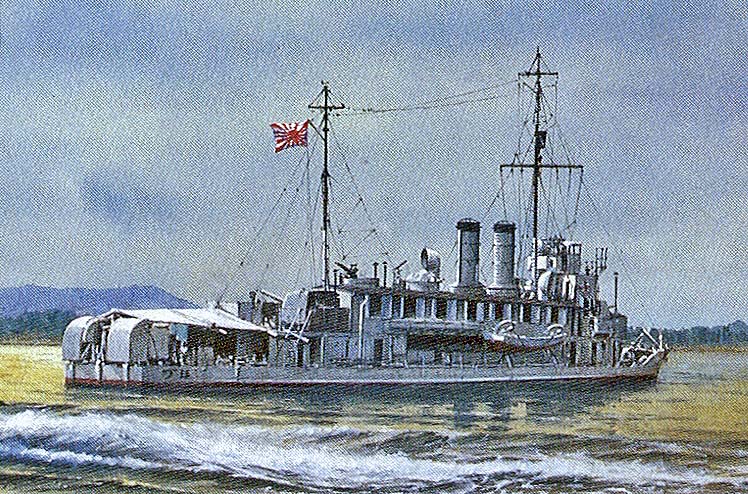
©2007-2016 Bob Hackett, Sander Kingsepp and Peter Cundall
Revision 2
20 November 1926:
Shanghai, China. Laid down as a gunboat by Kiangnan Dock & Engineering Works.
12 September 1927:
Launched and named and designated USS LUZON (PG-47).
1 June 1928:
Commissioned in the USN.
15 June 1928:
Redesignated PR-7. Serves as flagship of the Yangtze River Patrol (YangPat).
1932-1938:
LUZON is based at various ports along the Yangtze including Chungking, Ichang, Nanking, Kiukiang, Hankow and Shanghai.
7 July 1937: The Marco Polo Bridge (The"First China Incident") Incident:
Hun River, Peking (now Beijing), China. Japanese troops on night maneuvers at the bridge fire blank cartridges. Chinese troops fire back, but do not cause injuries. The Japanese discover a soldier missing and assume the Chinese captured him. They demand entry to a suburb of Peking, but the Chinese refuse. The Japanese shell the city and an undeclared war on China begins.
3 August 1937:
Nanking. As Japanese forces approach, USS LUZON and gunboat USS TUTUILA (PR-4) evacuate American ambassador Nelson T. Johnson and his staff to Chungking.
9 October 1937: The Conquest of Shanghai:
Shanghai is occupied by Japanese forces.
December 1938:
USS LUZON arrives off Shanghai to relieve USS AUGUSTA (CA-31) as station ship. She remains off Shanghai.
7 November 1941:
President Franklin D. Roosevelt orders all river gunboats and the 4th United States Marines to leave China, except those Marines assigned to protect diplomatic posts.
18 November 1941:
In response to deteriorating political conditions in China, Admiral (later Senator) Thomas C. Hart, CINC, U. S. Asiatic Fleet orders Rear Admiral (later Vice Admiral) William A. Glassford, CO of the Yangtze River Patrol (ComYangPat), to return to Manila with five of his larger gunboats.
26 November 1941:
LtCdr George M. Brooke's USS LUZON departs Hankow with Admiral Glassford aboard.
27-28 November 1941:
The 4th United States Marines are evacuated from Shanghai aboard SS PRESIDENT MADISON and SS PRESIDENT HARRISON, but six men fail to board and are left behind. [1]
LtCdr Andrew E. Harris' USS WAKE (PR-3) arrives at Shanghai from Hankow. USS WAKE is not seaworthy enough to undertake a crossing of the Formosa Straits, so Harris and most of his crew are transferred to USS OAHU (PR-6) and USS LUZON (PR-7).
29 November 1941:
At 0027, USS LUZON, carrying Admiral Glassford, and USS OAHU (PR-6) depart Shanghai for Manila.
30 November 1941:
LUZON and OAHU rendezvous with minelayer USS FINCH (AM-9) and submarine rescue vessel USS PIGEON (ASR-6) . They remain in company until 3 December.
1 December 1941:
Formosa Straits. USS FINCH, USS PIGEON, USS LUZON and USS OAHU encounter a large Japanese convoy headed southward. An IJN floatplane circles the Americans, followed by seven Japanese warships of various types.
2 December 1941:
Formosa Straits. Glassford's flat-bottomed river boats encounter a typhoon. In Manila, Admiral Hart, concerned for the gunboats' safety, directs USS FINCH and USS PIGEON to tow them or, if necessary, take off their crews.
3 December 1941:
Mountainous seas damage USS PIGEON's rudder and she loses an anchor. USS FINCH loses both of her anchors, but manages to take unnavigable USS PIGEON under tow.
5-10 December 1941:
USS LUZON and USS OAHU reach Manila followed by USS FINCH and USS PIGEON. After 22 years of operations, Glassford is forced to dissolve ComYangPat. All the other gunboats arrive over the next few days.
8 December 1941:
Philippines. At 1015, the 21st and 23rd Air Flotillas launch all available Mitsubishi G3M "Nell"
and G4M Betty" bomber aircraft to attack air bases in Luzon. Because of bad weather the attack is not made until 1220, nine hours after the attack on Pearl Harbor. The Japanese are surprised to find MajGen (later LtGen) Lewis H. Brereton's Far East Air Force's Boeing B-17 "Flying Fortress" bombers, Seversky P-35 "Guardsman" and Curtiss P-40 "Kittyhawk" fighters still on the ground and destroy many. [2]
30 December 1941:
LtCdr Brooke's USS LUZON conducts patrol operations assisting the defense of Bataan and Corregidor.
2 January 1941:
Japanese forces capture Manila and occupy Cavite. American and Filipino forces retreat to the Bataan Peninsula. MacArthur establishes his headquarters on Corregidor in Manila Bay.
12-17 March 1942:
After sunset, Lt (later Vice Admiral/MOH) John D. Bulkeley's PT-41 evacuates General (later General of the Army) Douglas MacArthur and his party from Corregidor reaching Mindanao at daybreak of the 14th. From there, MacArthur leaves by B-17 and arrives at Darwin, Australia at 0900 on the 17th. Before leaving Corregidor, MacArthur does not appoint another commander
for the Philippines. MacArthur decides to continue to exercise command and control from Australia through his G-4, Colonel Lewis C. Beebe, who is given a brigadier's star and designated Deputy Chief of Staff of USAFFE. [3]
6 April 1942:
At about 1900, USS LUZON and USS MINDANAO (PR-8) are ordered into Manila Bay to investigate intelligence reports that the Japanese intend to infiltrate troops in small boats behind the lines on Bataan.
7 April 1942:
At 0200, eleven small boats are silhoutted against the moonlit sky heading for Bataan. USS LUZON and USS MINDANAO open fire. Japanese shore batteries return fire on the gunboats. USS LUZON and USS MINDANAO retreat, but not before sinking four of the small boats.
10 April 1942:
Fort Hughes, Caballo Island near Corregidor. After the fall of Bataan on 9 April, men from USS LUZON take over Battery Gillespie, two 14-inch disappearing naval guns that lift above a parapet to fire, then sink out of sight for reloading.
6 May 1942:
LtGen Jonathan M. Wainwright is forced to surrender Corregidor and the Manila Bay forts to the Japanese. From Australia, MacArthur repudiates Wainwright's authority to surrender. USS LUZON, USS OAHU and minesweeper USS QUAIL (AM-15) are scuttled in Manila Bay at 14-23N, 120-35E to
prevent their capture and use by the Japanese.
8 May 1942:
Struck from the U.S. Navy List.
Late May 1942:
USS LUZON is refloated and salvaged by the Japanese. Her repairs commence at the 103rd Repair Facility at Cavite. Her forward 3-inch AA gun is replaced by a built-up superstructure and her bow is adorned with two imperial crests, one on each side.
1 August 1942:
USS LUZON is renamed KARATSU, attached to Sasebo Naval District and assigned to Vice Admiral Takahashi Ibo's (36)(former CO of KIRISHIMA) Southwest Area Fleet's Third Southern Expeditionary Fleet. LtCdr (Cdr, posthumously) Wakasugi Chikazu (56)(formerly assigned to 3rd Southern
Expeditionary Fleet HQ) is appointed the CO. Begins repairs.
28 September 1942:
At 0840 departs Cavite for trials. Returns to Cavite at 1146.
30 September 1942:
At 0913 departs Cavite on further trials, returning at 1103.
6 October 1942:
At 0830 departs Cavite for trials in Manila Bay. Returns at 1801.
8 October 1942:
At 0856 departs Cavite for trials in Manila Bay. Returns at 1610.
13 October 1942:
At 0839 depart Cavite for Manila Bay.
14 October 1942:
At 1035 retruns to Cavite from Manila Bay. Repairs are deemed completed.
15 October 1942:
Reassigned to the Cebu Guard Unit. At 0827 departs Cavite for Manila Bay.
16 October 1942:
At 1540 arrives at Manila.
19 October 1942:
At 0755 departs Manila.
21 October 1942:
At 1640 arrives at Cebu. Lands Special Naval Landing Force (SNLF) troops near a small island to inspect a sailing ship.
24 October 1942:
At 0830 departs Cebu and at 1800 arrives at Ormoc Bay, Leyte Island.
26 October 1942:
At 0822 departs from off Ormoc. At 1729 arrives at Bacsal Islands.
27 October 1942:
Explores the Bacsal Island area.
28 October 1942:
At 0725 arrives at Numing Island. At 1825 arrives at Calbayog.
29 October 1942:
At 0757 departs Calbayog and at 1133 arrives off southern Masbate Island.
30 October 1942:
At 0553 departs the area and at 1525 enters the Biliran Straits.
31 October 1942:
At 0452 departs the Biliran Straits and at 1515 arrrives at Cebu.
2 November 1942:
At 0800 departs Cebu. At 1030 arrives at Siquijor Island and departs there at 1705.
3 November 1942:
At 1355 arrives at Iloilo.
9 November 1942:
At 1016 departs Iloilo.
11 November 1942:
At 0847 arrives at Cebu.
19 November 1942:
At 1755 departs Cebu with Vice Admiral Sugiyama Rokuzo (38)(former CO of HYUGA), CINC, Third Southern Expeditionary Fleet, aboard.
20 November 1942:
At 0711 arrives at Guindulman. Departs at 1152.
22 November 1942:
At 1419 KARATSU arrives at Manila.
24 November 1942:
Transfers to Cavite.
26 November 1942:
At 0659 departs Manila. Operates with IJN units from Manila to mop up guerrilla units in that area.
27 November 1942:
At 1831 arrives at Iloilo.
1 December 1943:
At 0757 arrives at Capiz Bay, Panay Island, and departs from there at 1432.
2 December 1942:
At 0811 arrives at Barotac Bay, Panay Island, and departs there at 1755.
3 December 1942:
At 0748 arrives at Iloilo and departs again at 1635.
4 December 1942:
At 0757 arrives at Barotac Bay, Panay Island.
5 December 1942:
At 0748 departs area. At 1721 arrives off Masbate.
6 December 1942:
At 0454 departs anchorage and at 1427 arrives at Cebu.
10 December 1942:
At 0856 departs Cebu.
11 December 1942:
At 1311 arrives at Iloilo.
12 December 1942:
At 0826 departs Iloilo. Later anchors in the Apiton Pass, Panay.
13 December 1942:
At 0706 departs Apiton Pass and at 1511 arrives at Iloilo.
14 December 1942:
At 1742 departs Iloilo and at 1948 arrives at nearby Oton.
15 December 1942:
At 1518 departs Oton and soon after arrives at Iloilo.
16 December 1942:
At 1145 departs Iloilo.
17 December 1942:
At 1138 arrives at Cebu.
19 December 1942:
At 1448 departs Cebu.
21 December 1942:
At 1011 arrives at Manila.
22 December 1942:
At 0811 departs Manila and at 1734 arrives at Grande Island.
23 December 1942:
At 0658 departs Grande Island and at 1822 arrives at Manila.
28 December 1942:
At 1120 departs Manila.
31 December 1942:
At 1030 arrives at Cebu.
6 January 1943:
At 1435 departs Cebu escorting KISO MARU.
7 January 1943:
At 1415 arrives at Cagayan.
9 January 1943:
At 0312 departs Cagayan.
10 January 1943:
At 1639 returns to Cebu.
12 January 1943:
At 0635 departs Cebu to mop up guerrilla units in Panay-Guimaras area until March. At 1810 arrives at Masbate.
14 January 1943:
At 0725 departs Masbate. At 1245 arrives off Estancia, Panay.
16 January 1943:
At 0753 departs Estancia. At 1454 arrives at Iloilo.
19 January 1943:
At 0857 departs Iloilo. At 1426 arrives at Apiton Pass, Panay.
20 January 1943:
At 0553 departs Apiton Pass. At 1555 anchors off Masbate Island.
21 January 1943:
At 0553 departs off Masbate Island. At 1555 arrives Cebu. (Note coincidence of times with 20 January entry)
25 January 1943:
At 0647 departs Cebu and at 1927 arrives at Estancia.
27 January 1943:
At 0753 departs Estancia and at 1436 arrives at Iloilo.
30 January 1943:
At 0909 departs Iloilo and at 1700 arrives off Estancia.
1 February 1943:
At 0753 departs from off Estancia. At 1730 arrives at Iloilo.
4 February 1943:
At 0852 departs Iloilo and at 1745 arrives at Panay Island.
5 February 1943:
At 0750 departs Panay Island and at 1806 arrives off Masbate Island.
6 February 1943:
At 0557 departs Masbate Island and at 1548 arrives at Cebu.
12 February 1943:
At 0628 departs Cebu and at 1706 arrives at Masbate Island.
13 February 1943:
At 0557 departs Masbate Island and at 1736 arrives at Iloilo.
18 February 1943:
At 0923 departs Iloilo but at 1523 returns to Iloilo.
19 February 1943:
At 0650 departs Iloilo.
20 February 1943:
At 1523 arrives at Cebu.
27 February 1943:
At 0755 departs Cebu but at 1600 returns to Cebu.
15 March 1943:
At 0900 departs Cebu and at 1337 arrives at Tagbilaran, Bohol Island.
16 March 1943:
At 1455 arrives at Guindulman, Bohol Island. At 1839 departs.
17 March 1943:
At 0725 arrives at Cebu.
22 March 1943:
At 1516 departs Cebu.
23 March 1943:
At 0656 arrives at Cebu.
25 March 1943:
At 1639 arrives at Cebu.
27 March 1943:
At 1336 departs Cebu escorting army troop transport KOYO MARU to Manila.
29 March 1943:
At 1330 arrives at Manila. Undergoes repairs and replenishment of sea stores.
30 March 1943:
At 0835 arrives at Canacao and spends most of April there under repair.
25 April 1943:
Departs Canacao. Arrives at Cavite the same day. Resumes guard duties.
3 May 1943:
Departs Cavite but returns there later that day.
6 May 1943:
Departs Cavite and arrives at Manila later that day.
8 May 1943:
Departs Manila to provide distant cover for escort carrier TAIYO that departed enroute to Singapore via Surabaya. KARATSU returns to Manila that evening.
9 May 1943:
SE of Cagayan Island. LtCdr Phillip D. Quirk's USS GAR (SS-207) torpedoes and sinks auxiliary gunboat ASO MARU at 09-09N, 122-50E.
10 May 1943:
Arrives at Iloilo.
11 May 1943:
Departs Iloilo. KARATSU proceeds to and searches the area for survivors of ASO MARU.
13 May 1943:
Arrives at Iloilo.
14 May 1943:
Departs Iloilo.
15 May 1943:
Arrives back at Iloilo.
16 May 1943:
Departs Iloilo.
17 May 1943:
Arrives at Cebu.
26 May-1 June 1943:
Departs Cebu. Proceeds to San Carlos area and conducts ASW sweeps and inspections of sailing ships around the Visayan Islands.
1 June 1943:
Arrives at Cebu and departs later that day.
3 June 1943:
Arrives at Cebu.
25 June 1943:
Departs Cebu and enters the Mindanao Sea. Cooperates with the Army in the Siquijor Island amphibious operation.
28 June 1943:
Arrives back at Cebu.
30 June 1943:
Departs Cebu.
2 July 1943:
Arrives back at Cebu.
10 July 1943:
Departs Cebu. KARATSU cooperates with the Army in patrols of the nearby Negros and Panay islands to mop-up guerillas in the area.
11 July 1943:
Arrives at Iloilo.
12 July 1943:
Departs Iloilo.
14 July 1943:
Arrives at Iloilo.
18 July 1943:
Departs Iloilo.
19 July 1943:
Arrives at Cebu.
24 July 1943:
Departs Cebu.
25 July 1943:
Arrives at Iloilo.
27 July 1943:
Departs Iloilo and later that day returns.
28 July 1943:
Departs Iloilo and later that day returns.
29 July 1943:
Departs Iloilo.
30 July 1943:
Arrives at Cebu.
2 August 1943:
Departs Cebu. Cooperates with the Army in anti-guerrilla patrols.
11 August 1943:
Arrives at Cebu.
4 September 1943:
Conducts a search for missing NITTO MARU.
11 September 1943:
Departs Cebu. Concludes 24 days of anti-guerrilla policing of Iloilo, Panay island in cooperation with the Army.
15 September 1943:
Departs Iloilo.
20 September 1943:
Arrives at Iloilo.
23 September 1943:
Departs Iloilo.
24 September 1943:
Arrives at Cebu.
28 September 1943:
Departs Cebu. Later in Sulu Sea, off Panay Island, 41 nm W of Iloilo Island. In the morning, KARATSU's lookouts spot a suspicious oil slick and she conducts a depth-charge attack. At 0915, two Nakajima B5N2 "Kates" of 954th Naval Air Group (NAG) from Cebu arrive to the scene. Thirty minutes later, KARATSU establishes sound contact with a submarine, but loses it before launching another attack. After 1120, one of the aircraft returns to Cebu to refuel.
At 1205, the remaining "Kate" detects a submarine and attacks it ten minutes later, dropping a heavy depth charge. Following another attack 44 minutes later, a widening oil slick appears. After the return of the first "Kate", KARATSU attacks the submarine until more oil is sighted. She remains in the area until 1715. As a result of the attacks, Cdr James W. Coe's USS CISCO (SS-290) is lost with all 76 hands.
1 October 1943:
Converted minelayer CHOUN MARU No. 18 is dispatched to the area of the submarine sighting and conducts a follow-up attack with depth charges.
2 October 1943:
Arrives at Iloilo and departs later that day.
3 October 1943:
Arrives at Cebu.
10 October 1943:
LtCdr (Cdr, posthumously) Umakoshi Masahiro (57)(formerly assigned to 3rd Southern Expeditionary Fleet HQ) is appointed CO.
18 October 1943:
Departs Cebu.
20 October 1943:
Arrives at Manila.
24 October 1943:
Departs Manila.
26 October 1943:
Arrives off Cebu. At 1100, KARATSU joins transport KINUGASA MARU, probably en route to Truk from Manila, as an escort. KARATSU is detached at an unknown time and place and returns to Cebu at 1500 escorting NANREI, SHONAN (ex SINGAPORE MARU) and MINRYO MARUs.
6 November 1943:
Departs Cebu.
8 November 1943:
Arrives at Cebu.
11 November 1943:
Departs Cebu.
13 November 1943:
Arrives at Cebu.
30 November 1943:
Departs Cebu.
1 December 1943:
Arrives at Tacloban.
6 December 1943:
Departs Tacloban.
9 December 1943:
Arrives at Cebu.
24 December 1943:
Departs Cebu on patrol.
26 December 1943:
Returns to Cebu.
1 March 1944:
Departs Cebu.
3 March 1944:
20 miles NE of Dapitan, Mindanao. Cdr (later KIA on USS LAGARTO (SS-371)) Frank D. Latta's USS NARWHAL (SS-167) torpedoes KARATSU at 08-55N, 123-20E. The torpedo blows KARATSU's bow off back to the bridge; several officers and sailors including LtCdr Umakoshi are KIA. USS NARWHAL is heavily depth-charged, but undamaged. KARATSU is towed to Cebu and later towed to Manila for repairs.
5 March 1944:
Arrives at Opon near Cebu.
20 March 1944:
Moves to Cebu.
21 March 1944:
Departs Cebu and anchored before leaving under tow.
25 March 1944:
Arrives under tow at Manila. Her repairs commence at the No. 103 Repair Facility at Cavite.
16 January 1945:
Reserve Lt Sanekata Nobuo (former CO of T.106) is appointed CO.
22 January 1945:
KARATSU is ordered to depart Manila as soon as possible.
5 February 1945:
Scuttled as a blockship in Manila Bay.
10 April 1945:
Removed from the Navy List.
Authors' Notes:
[1] SS PRESIDENT HARRISON arrived safely at Olongapo, Philippines on 3 Dec '41, only to be dispatched to Chingwangtao (near Peking) to pick up about 300 Marines of the Peking and Tientsin Legation Guards. On 8 Dec '41, after the war began, HARRISON was pursued in the East China Sea by Japanese ships and planes. Her captain ran her aground at 16 knots on Shaweishan Island, off Shanghai, to deny her use to the Japanese. Nevertheless, the Japanese
refloated and repaired PRESIDENT HARRISON and renamed her KAKKO MARU, later KACHIDOKI MARU. On 12 Sep '44 while carrying 950 British/Australian POWs, KACHIDOKI MARU was torpedoed by USS PAMPANITO (SS-383) taking down 431 POWs.
[2] The responsibility for this debacle remains controversial. In 1945, LtGen Richard K. Sutherland, MacArthur's longtime Chief of Staff, said that days before the attack all B-17s had been ordered to Del Monte 600 miles from Clark Field to be safe from Japanese attack. From Del Monte, B-17s could have staged out of Clark Field to bomb Formosa, but Brereton did not obey the order. Only half the B-17s had been sent south. According to Sutherland, holding the bombers
at Clark Field that first day was entirely due to Brereton who said that because there were 25 air fields on Formosa, he first had to have recon photos to know what to bomb. For his part, Brereton recalled that Sutherland, on behalf of MacArthur, denied him authority to launch any attack. Although the attacks on Clark, Nichols and other fields reduced the strength of the American Far East Air Force by half, no formal investigation was ever conducted to determine
responsibility for the disaster.
[3] The Chief of Staff of the Army, General (later General of the Army) George C. Marshall found MacArthur's arrangements to retain command in the Philippines from 4,000 miles away in Australia unsatisfactory and so told President Roosevelt who agreed. On 22 March, a message was sent from Washington to MacArthur in Melbourne that made it clear that recently promoted LtGen (later General) Jonathan M. Wainwright would command in the Philippines.
Thanks for assistance go to Dr. Higuchi Tatsuhiro of Japan and Mr. Gilbert Casse of France.
-Bob Hackett, Sander Kingsepp and Peter Cundall
Back to
Gunboat Page