© 1997-2021 Bob Hackett and Sander Kingsepp
Revision 16
10 August 1920:
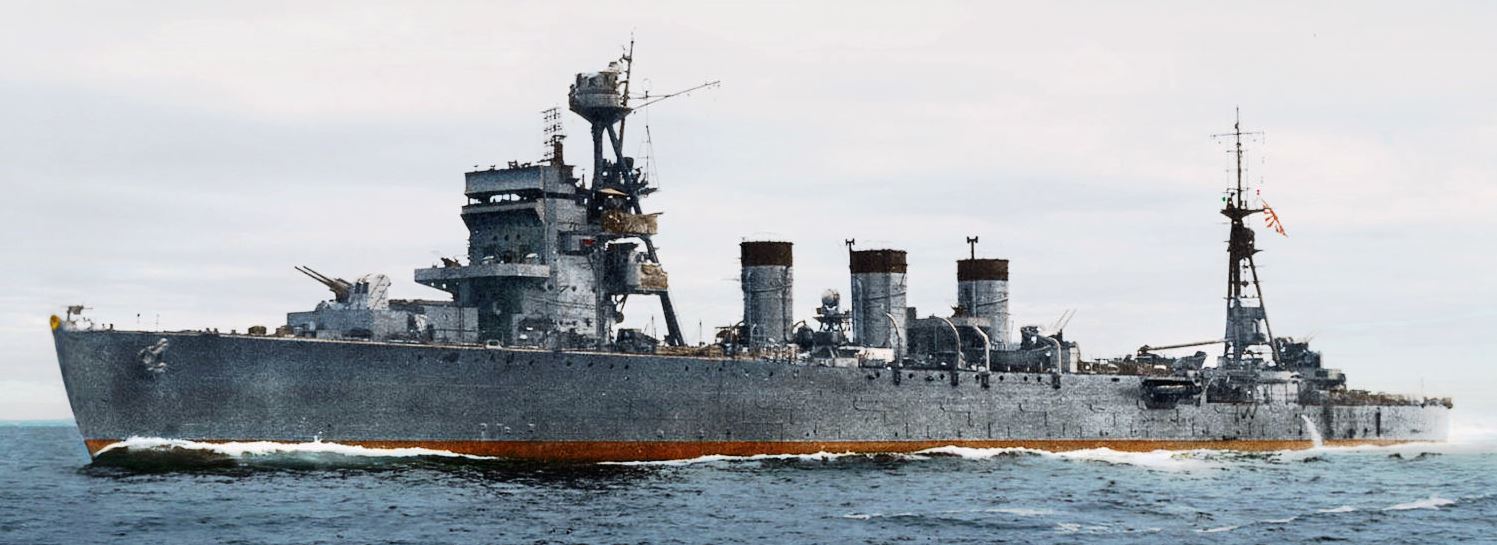
Tokyo. Laid down at the Uraga Dock Company shipyard as the
second unit of the NAGARA-class light cruisers (hull No. 171).
1 September 1921:
Captain Ishiwata Takenori (28)(former CO of YAKUMO)
is appointed the Chief Equipping Officer (CEO).
29 October 1921:
Launched and named ISUZU.
10 June 1923:
During the speed trials around 1300 ISUZU collides with
a small fishing vessel which is sunk; both crewmembers are rescued.
15 August 1923:
Completed and registered in the IJN. Attached to
Yokosuka Naval District. Captain Ishiwata Takenori is the Commanding Officer.
20 November 1923:
Cdr (later Vice Admiral) Hori Teikichi (32)(former
Combined Fleet/First Fleet staff officer) is appointed the acting CO.
1 December 1923:
Assigned to CruDiv 3, First Fleet with TAMA and
YUBARI. Cdr Hori is promoted Captain and appointed the CO.
6 March 1924:
Captain (later Vice Admiral) Ichimura Hisao (31)(former
CO of TATSUTA) is appointed the CO.
8 March 1924:
Departs Sasebo for a training cruise in Chinese waters
in company of TAMA and YUBARI. Returns to Sasebo after a stop at Mako (Makung),
Pescadores.
April 1924:
Drydocked at Yokosuka Navy Yard for a bridge rebuild
during which a target survey platform is fitted to the foremast searchlight
platform level.
1 December 1924:
Reassigned to DesRon 2 (Second Fleet) as its
flagship. Captain (later Vice Admiral) Matsuyama Shigeru (30)(former Naval
Academy instructor) is appointed the CO.
25 March 1925:
DesRon 2 departs Sasebo in company of CruDiv 5 for a
training cruise to the Yangtze River area, returning on 23 April.
20 November 1925:
Captain Tamura Shigehiko (32)(former ComDesDiv 4) is
appointed the CO.
29 March 1926:
DesRon 2 departs Tokuyama for a training cruise to
Tsingtao.
1 July 1926:
Captain Nakahara Ichisuke (31)(former CO of SENDAI) is
appointed the CO.
16 October 1926:
En route from Sasebo to Yokosuka via Osaka ISUZU runs
aground in Yasuoka Bight off Shimonoseki.
1 December 1926:
Placed in reserve at Yokosuka. Captain Tsuru Yuzo
(30)(former acting CO of TSUSHIMA) is appointed the CO.
3 March 1927:
Reassigned to the First Dispatched Squadron with SENDAI
to operate in the Yangtze River area.
15 April 1927:
Arrives at Yokosuka to serve as a training vessel
there.
1 December 1927:
Captain Shizume Shizuka (32)(former CO of YAKUMO) is
appointed the CO.
20 August 1928:
Captain (Fleet Admiral, posthumously) Yamamoto Isoroku
(32)(former Japanese Naval Attaché to Washington) is appointed the CO.
10 December 1928:
Captain (later Rear Admiral) Hani Rokuro (33)(former
section chief of the Personnel Bureau at the Navy Ministry) is appointed the CO.
March 1929:
Participates in the tests of the Kayaba type
spring-powered catapult, transferred to YURA in April.
26 September 1929:
Captain (later Rear Admiral) Ikenaka Kenichi
(31)(current CO of KONGO) is appointed the CO of ISUZU as additional duty.
27 November 1929:
Captain (later Admiral) Takasu Shiro (35)(former
Naval Academy instructor) is appointed the CO.
30 November 1929:
Reassigned to Makung Guard Unit as a guard ship.
1 December 1930:
Reassigned as guard ship at Yokosuka Naval Base.
Captain Goto Terumichi (35)(former naval aide to Imperial family) is appointed
the CO.
15 May 1931:
Placed in reserve at Yokosuka. The tripod foremast is
rebuilt, extending the existing fire command station and adding a lookout post
in front of it.
14 September 1931:
Captain (later Vice Admiral) Horie Rokuro
(36)(current CO of KITAKAMI) is appointed the CO of ISUZU as additional duty.
14 November 1931:
Cdr (promoted Captain 1 December; later Rear
Admiral) Aihara Aritaka (38)(former XO of YAKUMO) is appointed the CO.
16 February 1932:
Captain (later Rear Admiral) Masaki Katsuji
(34)(current CO of YAMASHIRO) is appointed the CO of ISUZU as additional duty.
20 June 1932:
Cdr (later Rear Admiral) Yamada Seizo (37)(former CO of
KOMAHASHI) is appointed the CO.
24 September-1 December 1932:
Refit at Yokosuka Navy Yard. The bridge
structure is extended and the AA suite increased by adding one quadruple and two
twin 13.2-mm Hotchkiss type machine gun mounts. The existing 6.5-mm machine guns
are replaced by two Lewis type 7.7-mm machine guns.
15 November 1932:
Captain (later Rear Admiral) Yamaguchi Minoru
(36)(former CO of TAMA) is appointed the CO.
1 December 1932:
Reassigned to Mako Guard Unit as a guard ship.
5 December 1932:
Arrives at Mako, then departs to participate in the
search of survivors from the destroyer SAWARABI. Rescues 14 officers and men in
all.
December 1932-August 1933:
Operates off South China coast while based
at Taiwan.
29 August 1933-17 February 1934:
Refit at Yokosuka Navy Yard. The pole
mainmast is replaced by a tripod with a single Sperry type 90-cm searchlight. A
Kure Type No. 2 Mod. 3 is installed to embark a Nakajima E4N2 Type 90
reconnaissance floatplane.
1 November 1933:
Reassigned to CruDiv 7, First Fleet, replacing YURA
as its flagship.
15 November 1933:
Captain (later Rear Admiral) Yamada Mitsuru
(37)(former section chief at Yokosuka Naval Arsenal) is appointed the CO.
30 October 1934-15 January 1935:
Refit at Kure Navy Yard. Topside
fittings are reduced and ballast is added to improve stability. The radio
equipment is modernized and two mixed-firing boilers converted to oil-firing.
15 November 1934:
Captain (later Vice Admiral) Makita Kakusaburo
(38)(former NGS section chief) is appointed the CO.
15 November 1935:
Placed in reserve at Yokosuka Guard Squadron.
Captain (later Rear Admiral) Chiba Keizo (38)(former CO of YAKUMO) is appointed
the CO.
7 January 1936:
Captain (later Vice Admiral) Hara Kenzaburo
(37)(current CO of TAKAO) is appointed the CO of ISUZU as additional duty.
25 April 1936:
Captain (later Vice Admiral) Matsunaga Sadaichi
(41)(former CO of SUNOSAKI) is appointed the CO.
1 December 1936:
Reassigned to SubRon 1, First Fleet, as its flagship.
Captain (Vice Admiral, posthumously) Yamaguchi Tamon (40)(former Naval Academy
instructor) is appointed the CO.
20-23 August 1937:
ISUZU (currently acting as the flagship of
ComSubRon 1, Rear Admiral Komatsu Teruhisa), BatDiv 1's NAGATO, MUTSU, and
BatDiv 3's HARUNA and KIRISHIMA ferry the troops of the IJA 11th Division from
Tadotsu, Shikoku, to the Shanghai area.
25 August 1937:
Returns to Sasebo.
17 September 1937:
Departs Sasebo to patrol in southern Chinese
waters.
7 October 1937:
Arrives at Mako.
1 December 1937:
Captain (later Rear Admiral) Nakamura Motoji
(39)(former CO of NAKA) is appointed the CO.
1 March 1938-January 1939:
Placed in reserve for a refit at Yokosuka
Navy Yard. Both twin 13.2-mm machine guns are replaced by two twin 25-mm Type 96
AA guns. The four 90-cm Sperry type searclights are replaced by three 110-cm
Type 92s.
1-15 June 1938:
Captain Nakamura is appointed the CO of KISO as
additional duty.
20 November 1938:
Captain Hashimoto Aiji (39)(former CO of
TSURUGISAKI) is appointed the CO.
20 July 1939:
Captain Hashimoto is appointed the CO of KAMOI as
additional duty.
15 November 1939:
Designated the flagship of SubRon 2, Second Fleet.
Captain (later Rear Admiral) Tsuruoka Nobumichi (43)(former ComSubDiv 11) is
appointed the CO.
26 March 1940:
Departs Nakagusuku Bay, Okinawa, to patrol in southern
Chinese waters.
2 April 1940:
Arrives at Takao (modern Kaohsiung/Gaoxiong), Taiwan.
25 August 1940:
Departs Yokosuka to patrol in southern Chinese waters.
21 September 1940:
Returns to Yokosuka.
15 November 1940:
SubRon 2 is reassigned to Sixth Fleet.
1 September 1941:
Captain Ura Koichi (46)(former CO of KITAKAMI) is
appointed the CO.
15 September 1941:
Reassigned to 15th Escort Squadron of Vice Admiral
Hara Kiyoshi's Second China Expeditionary Fleet with gunboats HASHIDATE and SAGA
and torpedo boats HIYODORI and KASASAGI.
16 September 1941:
Departs Yokosuka to participate in the naval
blockade of southern Chinese coast.
4 December 1941:
Departs Amoy to participate in the invasion of Hong
Kong.
6 December 1941: Operation "C" - The Invasion of the British Crown Colony
of Hong Kong.
9 December 1941:
After 0900 the Kawanishi E7K2 "Alf" reconnaissance
floatplane from ISUZU attacks the river gunboat CICALA, patrolling off Brothers
Point, dropping two 60-kg bombs; both miss.
25 December 1941:
Hong Kong surrenders.
27 December 1941:
Enters the harbor to debark a landing party and
remains as a guard ship.
15 January 1942:
Departs Hong Kong for Mako.
16 January 1942:
Arrives at Mako.
26 January 1942:
Departs Mako escorting an Army convoy, carrying
reinforcements for the 25th Army.
3 February 1942:
Arrives at Singora, Thailand. Departs that same day
for Hong Kong.
5 February 1942:
Arrives at Camranh Bay, occupied French Indochina.
6 February 1942:
Departs Camranh Bay.
8 February-March 1942:
Arrives at Hong Kong. Remains as a guard ship.
31 March-8 April 1942:
Drydocked at No. 2 Navy Repair Facility, Hong
Kong.
10 April 1942:
The 15th Escort Squadron is deactivated. ISUZU is
reassigned to Rear Admiral (later Vice Admiral) Hara Kenzaburo's CruDiv 16 in
Vice Admiral Takahashi Ibo's Second Southern Expeditionary Fleet with light
cruisers NATORI and KINU.
11 April 1942:
Departs Hong Kong.
15 April 1942:
Arrives at Makassar, Celebes.
23 April 1942:
Departs Makassar.
24 April 1942:
Arrives at Balikpapan, Borneo.
26 April 1942:
Departs Balikpapan.
27 April 1942:
Arrives at Makassar.
28 April 1942:
Departs Makassar.
29 April 1942:
Arrives at Surabaya, Java.
1 May-18 June 1942:
Designated flagship of CruDiv 16.
8 May 1942:
Departs Surabaya to support occupation operations in the
Lesser Sunda Archipelago.
25 May 1942:
Arrives at Surabaya.
9 June 1942:
Departs Surabaya for Batavia, Java.
10 June 1942:
Arrives at Batavia.
12 June 1942:
Departs Batavia for Surabaya.
14 June 1942:
Arrives at Surabaya.
20 June 1942:
Departs Surabaya for Yokosuka.
28 June 1942:
Arrives at Yokosuka for repairs and overhaul.
30 June-8 July 1942:
Drydocked at Yokosuka Navy Yard.
18 July 1942:
Departs Yokosuka.
26 July 1942: Operation "T" - The Banda Sea Operation:
Arrives at
Amboina. Departs that same day and supports landing operations on the Tanimbar
Islands.
31 July 1942:
Returns to Amboina.
1 August 1942: Operation "B" - The Indian Ocean Operations:
Departs
Amboina for Singapore.
5 August 1942:
Arrives at Singapore.
6 August 1942:
Departs Singapore for Mergui.
8 August 1942:
Arrives at Mergui, Burma.
9 August 1942:
Departs Mergui.
10 August 1942:
Arrives at Sabang Harbor, Sumatra.
11 August 1942:
Departs Sabang for Penang, Malaya.
12 August 1942:
Arrives at Penang.
24 August 1942:
Departs Penang for Makassar.
28 August 1942:
Arrives at Makassar. Guard ship.
8-9 September 1942:
Departs Makassar for Surabaya.
9 September 1942:
Departs Surabaya carrying 460 men of the 2nd Army
Division's 3rd Battalion (less one company), 16th Infantry Regiment.
12 September 1942:
Arrives at Batavia.
13 September 1942:
Departs Batavia with light cruiser KINU. Escorts
the first wave of transports from the Dutch East Indies to the Solomons,
carrying LtGen Maruyama Masao's 2nd Infantry Division's advance party,
consisting of the 16th Infantry Regiment HQ and the 3rd Battalion, half of the
AT [rapid fire artillery] Gun Company and half of the Regimental Gun Unit.
16 September 1942:
Arrives at Kendari, Celebes (Sulawesi).
20 September 1942:
Arrives at Rabaul, New Britain.
21 September 1942:
Departs Rabaul.
22 September 1942:
Arrives at Shortland Island, Bougainville.
Disembarks troops.
25 September 1942:
Departs Shortland for Truk. Replaces damaged JINTSU
as flagship of Rear Admiral (later Vice Admiral) Tanaka Raizo's DesRon 2's
DesDivs 15, 24 and 31 (9 destroyers). Embarks an Aichi E11A1 "Laura" night
reconnaissance floatplane.
11 October 1942:
Departs Truk with DesDiv 31's NAGANAMI, TAKANAMI and
MAKINAMI in the Combined Fleet's sortie against Guadalcanal with Vice Admiral
Kurita Takeo's BatDiv 3's HARUNA, KONGO, Rear Admiral (later Vice Admiral)
Kakuta Kakuji's CarDiv 2's HIYO and JUNYO, Rear Admiral (Admiral, posthumously)
Takagi Takeo's CruDiv 4's MAYA and CruDiv 5's MYOKO.
12 October 1942:
Vice Admiral Kurita detaches with KONGO and HARUNA,
Rear Admiral Tanaka's DesRon 2's ISUZU, DesDiv 31's MAKINAMI, DesDiv 32's
NAGANAMI and TAKANAMI. Joined DesDiv 15's HAYASHIO, KAGERO, KUROSHIO and the
OYASHIO, DesDiv 24's KAWAKAZE, SUZUKAZE and UMIKAZE, all out of Shortland.
13 October 1942: The Naval Bombardment of Henderson Field,
Guadalcanal:
After 0133, BatDiv 3's KONGO and HARUNA bombard Henderson Field.
ISUZU provides cover with DesDivs 15 and 31 and fires on Marine batteries on
Tulagi Island. At 0230, BatDiv 3 and DesRon 2 retire up the "Slot" at 29 knots.
17-18 October 1942:
DesRon 2 refuels N of the equator.
24-25 October 1942: The Battle of Santa
Cruz:
ISUZU operates with Vice Admiral Kondo Nobutake's Advance
Force.
30 October 1942:
Returns to Truk.
3-5 November 1942:
Departs Truk for Shortland with DesDivs 15, 24, 31
to escort transports carrying reinforcement elements of the 38th Infantry
Division.
13 November 1942: Naval Bombardment of Guadalcanal:
Departs Shortland
for Guadalcanal in Vice Admiral Mikawa Gunichi's (38)(former CO of KIRISHIMA)
Main Body: CruDiv 4's CHOKAI and CruDiv 6's KINUGASA, DesDiv 8's ARASHIO and
ASASHIO accompanied by Rear Admiral (later Vice Admiral) Nishimura Shoji's
Bombardment Unit: CruDiv 4's MAYA and CruDiv 7's SUZUYA, light cruiser TENRYU,
DesDiv 4's MICHISHIO, DesDiv 10's KAZAGUMO, MAKIGUMO and YUGUMO.
14 November 1942:
While retiring towards Shortland, Mikawa's squadron
is attacked by Douglas SBD-3 "Dauntless" dive bombers of VB-10 and VS-10 from
USS ENTERPRISE (CV-6). CHOKAI is damaged by a near miss.
After 1030 ISUZU is attacked by five SBDs of VS-10, led by Lt (later
Captain) Birney Strong in 08-55S, 157-20E. Lt(jg) Howard Burnett and John H.
Finrow score two near misses with 1000-lb bombs. Boiler rooms Nos. 2 and 3 are
flooded, reducing ISUZU's speed to 15 knots; the steering control is likewise
affected. Assisted by destroyer ASASHIO, she returns to Shortland to undergo
emergency repairs, probably by the repair ship YAMABIKO MARU.
16 November 1942:
Departs Shortlands, escorted by destroyer MOCHIZUKI.
20 November 1942:
Arrives at Truk. Additional repairs, probably
performed by repair ship AKASHI.
8 December 1942:
Departs Truk for Yokosuka. The floatplanes from
battleship KONGO provide ASW cover off Truk.
14 December 1942:
At Yokosuka.
11 January 1943:
Departs Yokosuka. Arrives at Mitsubishi's Yokohama
yard the same day.
19-31 January 1943:
Drydocked in Asano Dockyard at Yokohama for a
refit, battle-damage repairs and modifications. A Type 21 air-search radar is
installed. Two 14-cm guns are landed. One 12.7-cm Type 89 twin AA gun and two
triple 25-mm Type 96 mounts are added, bringing the AA suite to two 12.7-cm and
ten 25-mm guns, plus four 13.2-mm machine guns.
20 January 1943:
Reassigned to 16th Squadron, Second South
Expeditionary Fleet.
30 January 1943:
Captain (Rear Admiral, posthumously) Shinoda Kiyohiko
(43)(former CO of HIE MARU) is appointed the CO.
15 March-1 May 1943:
Drydocked in Asano Dockyard at Yokohama. Embarks
a Kawanishi E7K2 "Alf" reconnaissance floatplane.
1 April 1943:
Reassigned to Rear Admiral (later Vice Admiral) Ito
Kenzo's new CruDiv 14, Fourth Fleet, with NAKA.
7 May 1943:
Departs Yokohama. Arrives at Yokosuka that day and begins
trials.
21 May 1943:
Departs Yokosuka for Hashirajima.
22 May 1943:
Arrives at Hashirajima, then training in western Inland
Sea.
11 June 1943:
Departs Yokosuka to tow CarDiv 2's HIYO, torpedoed the night
before by LtCdr (later Rear Admiral) Roy S. Benson's (USNA '29) USS TRIGGER
(SS-237). HIYO was hit by two torpedoes in the starboard bow and boiler rooms,
but by the time ISUZU arrives the carrier has restored power. HIYO returns to
Tateyama that night in company of ISUZU and destroyers ARIAKE and YUGURE.
16
June 1943:
At 1400 departs Yokosuka for Truk with Kurita's Vanguard Force,
including carriers CHUYO, RYUHO, UNYO, battleships KONGO, HARUNA, heavy cruisers
KUMANO and SUZUYA and their escorts. ISUZU carries supplies and troop
reinforcements, consisting of 453 men of the 2nd Yokosuka Special Naval Landing
Force (SNLF)
21 June 1943:
At 0241 (K), lookouts on Cdr George A. Sharp's (USNA
'29) USS SPEARFISH (SS-190) spot an approaching convoy of "11 to 14" ships
including three carriers, probably a battleship, an AOBA-class cruiser and a
TENRYU-class cruiser. The remaining ships are probably criosers and destroyers.
Sharp starts an approach on the cruiser, then shifts to the carrier. At 0337
(K), he fires four torpedoes, but all miss. ISUZU dodges two torpedoes launched
by SPEARFISH.
22 June 1943:
Departs Truk for Nauru with NAKA and destroyers HAMAKAZE
and TANIKAZE.
25 June 1943:
Arrives at Nauru. Disembarks 453 SNLF troops.
28 June 1943:
Returns to Truk.
31 June 1943:
At Truk. Refuels from GENYO MARU.
2 July 1943:
The E7K2 floatplane from ISUZU is dispatched to Palau.
16 July 1943:
At 0700 departs Truk on a second transport run to Nauru,
escorted by destroyer TAMANAMI. Both ships carry 350 men and 200 tons of cargo,
earlier ferried to Truk aboard ZUIHO.
19 July 1943:
Arrives at Nauru. Unloads her cargo, then departs for
Truk.
22 July 1943:
Returns to Truk.
24-28 July 1943:
Departs Truk with destroyer ASANAGI to protect oiler
TONAN MARU No. 3, crippled earlier in the day by USS TINOSA (SS-283) W of Truk.
ISUZU takes the tanker in tow.
28 July 1943:
Returns to Truk.
15 August 1943:
Departs Truk for a supply run to Rabaul.
17 August 1943:
Arrives at Rabaul, unloads and departs.
19 August 1943:
Returns to Truk.
5 September 1943:
Loads troops and supplies for Mili. Departs Truk in
company of NAKA.
7 September 1943:
Arrives at Kwajalein. Unloads.
19 September 1943:
Departs Kwajalein with NAKA on a troop transport
mission.
20 September 1943:
Arrives at Mili.
21 September 1943:
Departs Mili.
22 September 1943:
Arrives at Wotje.
23 September 1943:
Departs Wotje.
24 September 1943:
Arrives at Kwajalein.
25 September 1943:
Departs Kwajalein.
26 September 1943:
Arrives at Jaluit.
29 September 1943:
Departs Jaluit.
3 October 1943:
Returns to Truk.
8 October 1943:
Departs Truk for Tokushima, Shikoku.
15 October 1943:
Arrives at Tokushima.
16 October 1943:
Departs Tokushima for Shanghai.
18 October 1943:
Arrives at Shanghai, where she is joined by NAKA.
Both embark troops.
21 October 1943:
ISUZU and NAKA depart Shanghai with destroyer
YAMAGUMO, escorting the second echelon of convoy "Tei No. 4", consisting of
troop transports (ex-AMC) KIYOSUMI and GOKOKU MARUs. ISUZU carries 471 soldiers
of the 17th Division, eight machine guns and 202 boxes of ammunition.
East China Sea. That same day, Captain (later Vice Admiral) Charles B.
"Swede" Momsen's (USNA '19) Task Group 17.14's USS CERO (SS-225), GRAYBACK
(SS-208) and SHAD (SS-235) receive an "Ultra" message from the codebreakers at
Pearl alerting them of the transit of the troop convoy through their patrol
area.
23 October 1943:
East China Sea. At 2320, LtCdr - (later Captain)
Edgar J. MacGregor's (USNA '30) USS SHAD picks up two targets on her SJ radar at
15,000 yards. It takes MacGregor two hours to gain an attack position. At 0145,
when the convoy is at 11,000 yards, he submerges to radar depth. At 0212, at
28-40N, 124-10E, MacGregor begins firing his torpedoes at ISUZU, NAKA and the
fast troop transports. He fires ten torpedoes from shallow water, then is forced
to head for deeper water to evade a depth-charge counter-attack. Although
MacGregor claims damaging both light cruisers, neither is hit.
28 October 1943:
Arrives at Truk.
1 November 1943:
In the afternoon the second echelon of convoy "Tei
No. 4" is reorganized and depart Truk. Entering dangerous waters, executed
embarkation training.
3 November 1943:
60 miles N of Kavieng, New Ireland. At 1129, the
convoy is attacked by 19 B-24 "Liberator" heavy bombers of the USAAF 13th Air
Force. NAKA and GOKOKU MARU suffer near misses. Transport (ex-AMC) KIYOSUMI MARU
is damaged. At 1500, ISUZU takes her in tow.
4 November 1943:
Light cruiser YUBARI departs with destroyers MINAZUKI
and ISOKAZE to assist KIYOSUMI MARU under tow by ISUZU escorted by light cruiser
NAKA and destroyer ISOKAZE.
NAKA removes 166 men and four rapid fire antitank guns from KIYOSUMI
MARU. YUBARI removes another 196 troops and three field guns. ISUZU removes 196
troops and four regimental guns from the transport. Destroyer MINAZUKI removes
267 troops and ISOKAZE removes 236 troops and two mountain guns. Ammunition and
supplies are also off loaded from KIYOSUMI MARU.
4 November 1943:
At 1700, ISUZU arrives at Kavieng and disembarks
troops. Soon after departure she hits a mine laid by USS SILVERSIDES (SS-236) 8
miles SW of Kavieng. ISUZU sustains hull damage forward and two main guns (Nos.
1 and 3) are jammed in train. Survey ship TSUKUSHI and converted auxiliary
RYUOZAN MARU are sunk in the same mine field while DesDiv 17's ISOKAZE is
damaged.
5 November 1943: The Carrier Raid on
Rabaul:
Aircraft from Rear Admiral (later Admiral) Frederick C.
Sherman's (USNA '10)(former CO of LEXINGTON (CV-2) Task Force 38 attack Rabaul.
Dive bombers from USS SARATOGA (CV-3) and PRINCETON (CVL-23) damage CruDiv 4's
ATAGO, TAKAO and MAYA and CruDiv 7's CHIKUMA and MOGAMI, light cruisers AGANO
and NOSHIRO and destroyers AMAGIRI and FUJINAMI. ISUZU is strafed and receives
minor damage.
6 November 1943:
Departs Rabaul for Truk.
8 November 1943:
Arrives at Truk for emergency repairs.
20 November 1943: American Operation "Galvanic" - The Invasion of the
Gilberts:
Forces under Vice Admiral (later Admiral) Raymond A. Spruance,
(USNA '06) Commander, Central Pacific, invade Tarawa and Makin Islands. The
invasion fleet of 200 ships includes 13 battleships and 11 carriers.
21 November 1943:
Departs Truk with NAKA after the American landings
in the Gilberts.
22 November 1943:
Arrives at Ponape. Both cruisers load about 1,500
army troops.
23 November 1943:
Departs Ponape.
25 November 1943:
Arrives at Kwajalein. Waits for an opportunity to
disembark troops at Tarawa, but the island falls to the Americans.
30 November 1943:
Departs Kwajalein.
1 December 1943:
Arrives at Mili (Mille). Disembarks troops at Mili
instead of the now captured Gilberts.
2 December 1943:
Departs Mili for Kwajalein.
4 December 1943:
Departs Kwajalein and arrives at Roi.
5 December 1943:
At 0455, Roi is attacked by SBD dive-bombers and TBF
torpedo-bombers from Rear Admiral (later Vice Admiral) Charles A. Pownall's
(former CO of RANGER, CV-4) TG 50.1's new carriers USS YORKTOWN (CV-10) and
LEXINGTON (CV-16).
During the raid, ISUZU receives three "250-kg" bomb hits to the starboard
of No. 6 main turret, starting a fire near the officers' wardroom and wrecking
the aft radio room. Near misses flood the steering compartment; the aft
ammunition magazine is flooded as a precaution. ISUZU's speed is reduced to 12
knots on a single shaft and she resorts to manual steering.
TG 50.1's planes also strafe the cruiser. During the attacks, 20 crewmen
are KIA and another 40 WIA.
7 December 1943:
Departs Roi for Kwajalein. Undergoes emergency
repairs.
9 December 1943:
Departs Kwajalein for Truk. Rendezvous with kaibokan
AMAKUSA en route.
12 December 1944:
Arrives at Truk in company of AMAKUSA. Begins
temporary repairs by repair ship AKASHI.
17 January 1944:
Departs Truk for Yokosuka.
23 January 1944:
Arrives at Yokosuka. Begins permanent repairs and
modification.
23-31 January 1944:
Drydocked at Yokosuka Navy Yard.
4 March 1944:
Reassigned to Central Pacific Area Fleet.
1 May-14 September 1944:
Mitsubishi Yokohama shipyard. ISUZU is
converted to an anti-aircraft cruiser. All 14-cm guns, 13.2-mm machine guns, the
catapult and two 110-cm searchlights are landed. Two twin 12.7-cm guns are
added. Her 25-mm AA suite is increased to 38 barrels (in eleven triple and five
single mounts). The torpedo armament is changed to two 61-cm quadruple mounts
for a total of sixteen Type 93 torpedoes. A modernized Type 21 air-search and a
Type 22 surface-search radar are fitted. A Type 0 hydrophone and two depth
charge rails are added. Two 10-m Shohatsu barges are embarked. [1]
20 June 1944:
Captain Matsuda Gengo (49)(former XO of SUZUYA) is
appointed the CO.
18 July 1944:
Reassigned to the Combined Fleet.
20 August 1944:
ISUZU becomes the flagship of Rear Admiral (Vice
Admiral, posthumously) Edo Heitaro's 31th (Antisubmarine) Squadron at the
Combined Fleet.
5 October 1944:
Departs Yokohama for Yokosuka.
6 October 1944:
Departs Yokosuka.
8 October 1944:
Arrives at Kure.
8-20 October 1944:
Conducts combat training in Inland Sea.
20 October 1944: Operation "SHO-1-GO"(Victory) -
The Battle of Leyte Gulf:
At 1700, departs Yashima anchorage towards
the Philippines in Vice Admiral Ozawa Jisaburo's Northern Mobile Force: CruDiv
31's ISUZU, DesDiv 41's KUWA and SUGI, DesDiv 43's MAKI and KIRI, DesDiv 61's
AKIZUKI, HATSUZUKI, WAKATSUKI and SHIMOTSUKI.
ISUZU and her destroyers screen CarDiv 1's ZUIKAKU, ZUIHO, CHITOSE and
CHIYODA, CarDiv 4's HYUGA and ISE and light cruisers OYODO and TAMA.
25-26 October 1944: The Battle off Cape
Engano:
Ozawa's force is attacked by TBM-1C aircraft of VT-21
from Rear Admiral (later Vice Admiral) Ralph E. Davison's TG 38.4's USS BELLEAU
WOOD (CVL-24) and VT-51 from SAN JACINTO (CVL-30). At 0835, CHITOSE is hit
portside forward. The carrier floods, begins to lose power and lists heavily to
port. At 0925, ISUZU attempts to take her in tow, but this proves impossible. At
0937, CHITOSE rolls over to port and sinks by the bow. ISUZU rescues 480 men and
SHIMOTSUKI rescues another 121 crewmen. At 0950, ISUZU escorts TAMA after she is
hit by an aircraft torpedo.
Later, ISUZU and DesDiv 43's MAKI are ordered to protect CHIYODA that is
damaged by a second strike by aircraft from LEXINGTON (CV-6) and FRANKLIN
(CV-13). Battleship/carrier HYUGA attempts to tow CHIYODA, but is prevented by a
third attack. ISUZU also attempts a tow but is unable. By 1530, navigation is
impossible for CHIYODA. ISUZU goes to rescue survivors lined up on CHIYODA's
deck with the ship's bugle blaring and her rising sun flag dipping into the sea,
but black smoke is seen off the far right horizon signalling the imminent
arrival of a large formation of American warships. ISUZU abandons her rescue
attempt and hastily departs. CHIYODA is sunk with all hands.
Later that evening, while rescuing personnel of other carriers, ISUZU and
several destroyers come under fire from Rear Admiral (later Admiral) Laurance T.
DuBose's (USNA '13) cruiser force. DesDiv 61's HATSUZUKI is sunk. ISUZU is
slightly damaged. Thirteen crewmen are killed.
26 October 1944:
Departs the Philippine Sea for Okinawa.
27 October 1944:
Arrives at Okinawa to refuel, then departs.
29 October-14 November 1944:
Arrives at Kure. Repaired and refitted at
Kure Navy Yard. Type 13 air-search radar and two Type 3 depth charge throwers
are installed.
14 November 1944:
Departs Kure on a troop transport run to Brunei with
destroyer MOMO.
18 November 1944:
Arrives at Manila.
19 November 1944:
Departs Manila with MOMO for Brunei.
55 miles W of Corregidor. ISUZU is attacked by LtCdr Frank Haylor's (USNA
'36) USS HAKE (SS-256) and hit by one of six torpedoes he fires. ISUZU's stern
is severely damaged and her rudder destroyed. Thirty-two sailors are KIA. After
at-sea emergency repairs, ISUZU, escorted by MOMO, changes course to Singapore.
23 November 1944:
Arrives at Seletar Naval Base, Singapore. Begins
temporary repairs by the No. 101 Repair Facility.
10 December 1944:
Departs Singapore. Arrives at Surabaya that night.
12 December 1944:
Surabaya. Begins permanent repairs at No. 112 Repair
Facility.
25 March 1945:
ISUZU is directly attached to the 10th Area Fleet.
4 April 1945:
Repairs are completed. Departs Surabaya to transport an
army detachment from Kupang to Sumbawa Island, escorted by torpedo boat KARI and
minesweepers W-12 and W-34. The ISUZU group is sighted off Paternoster Island by
a wolfpack led by Cdr (later Rear Admiral) Francis D. Boyle's (USNA '34) USS
CHARR (SS-328) with LtCdr Herman E. Miller's (USNA '38) USS BESUGO (SS-32l) and
LtCdr William B. Parham's (USNA '36) USS GABILAN (SS-252), but aircraft force
the pack to dive and they are unable to attack.
April 1945:
RAAF "Mosquito" fighter-bombers from No. 87 Squadron
shadow ISUZU and four smaller warships. One "Mosquito" is spotted by a Japanese
aircraft. The pilot of the Mosquito accelerates and leaves the Japanese aircraft
behind.
6 April 1945:
Boyle's wolf pack is alerted about the position of the
Japanese ships by an "Ultra" message from ComSubPac at Pearl and takes up
position near Bima Bay. They are joined there by ComSubSoWestPac's British
submarine HMS SPARK.
Kupang Harbor. At dawn, ISUZU embarks an Army detachment and departs for
Sumbawa. North of Sumbawa she is attacked by ten B-25 "Mitchell" bombers of the
Dutch 18th Squadron based at Batchelor airfield S of Darwin, Australia. ISUZU is
slightly damaged by near misses off her starboard bow by some of the sixty
300-kg bombs dropped. Later, she lands troops at Bima Bay, on the NE coast of
Sumbawa.
At 0910, USN codebreakers intercept a message from ISUZU: "I am being
engaged by 10 enemy aircraft. [Position] of attack [---] degrees, 35 miles from
Waingapoe."
Near Flores Island, Netherlands East Indies. ISUZU is attacked by
Consolidated B-24J "Liberator" bombers of the RAAF's Nos. 21 and 24 Squadrons
based in Northern Australia. ISUZU receives a direct hit (dud) to the bow; two
near misses around 0940 disable the steering engine and the crew reverts to
manual steering. Two B-24s are shot down by Japanese aircraft. [2]
Sape Strait, between Sumbawa and Komodo islands. About 1600, Miller's
BESUGO fires nine torpedoes at the ISUZU group. They miss ISUZU, but one sinks
W-12.
7 April 1945:
At 0220, departs Bima with KARI and W-34. CHARR makes
radar contact at 14,000 yards and Boyle alerts GABILAN.
60 miles NW of Bima. At 0605, ISUZU is struck by one of five torpedoes
fired by Parham's GABILAN. The torpedo hits portside below the bridge and causes
flooding forward. ISUZU's speed falls below 10 knots, she takes on a list and is
down by the bow.
At 0827, while her crew is performing emergency repairs, Boyle's CHARR
fires four torpedoes at her from 1,200 yds. ISUZU is hit portside near the aft
engine room by two torpedoes. Boyle fires two more torpedoes and gets another
hit. At 0843, ISUZU's bow breaks off. Three minutes later she capsizes to port
and sinks at 07-38S, 118-09E. HMS SPARK witnesses ISUZU's sinking. ISUZU's
escorts counterattack CHARR, but Boyle goes deep and evades them.
Captain Matsuda and 449 crewmen are rescued by KARI and W-34, but 190
crewmen and an unknown number of the embarked troops are lost.
The codebreakers intercept a message from torpedo boat KARI that reads:
"ISUZU sank at 0846." Then from KARI about 1453: "Discontinued rescue operations
at 1340 and am returning. [---] 437 survivors rescued. Captain of ISUZU is
aboard this vessel."
8 April 1945:
At 0720, USN codebreakers intercept a garbled message
from the CO of ISUZU, Captain Matsuda, about the 7 April event that reads: "At
0605 bearing 333, 65 miles from Bima this ship received one torpedo hit below
the bridge from an enemy submarine flooded forward. Carried out emergency
measures to utmost. Expecting to be able to proceed under own power. [---] and
headed back but at 0827 was attacked a second time by enemy submarine and
received two torpedo hits in the aft engine room. Since feared sinking, disposed
of secret documents. At 0843, hull split near point of forward [---]. At 0816
[sic on the times] finally sank. As the water in this area is about 1000 meters
deep, it would appear that there is no danger of the previously disposed of
documents falling into enemy hands."
20 June 1945:
Removed from the Navy List.
Authors' Notes:
[1] The original work orders issued to the Yokohama yard
specified the installation of a Type 93 Mod. 2 hydrophone and a Type 93 Mod. 3,
but apparently none were available. Also, the ordered Type 13 air-search radar
could not be installed at that time.
[2] Dutch sources claim the aircraft
and the squadrons involved in the strike were: No. 18 Dutch Squadron - 10 B-25s,
No. 2 RAAF Squadron - 10 B-25, and No. 82 RAAF Wing - 9 B-24s. Two of the B-24s
that attacked about 20 minutes later were shot down by Japanese Army fighters
(Nakajima Ki-43 "Oscars" and Nakajima Ki-44 "Tojos").
Special thanks for assistance in researching the IJN officers mentioned
in this TROM go to Mr. Jean-François Masson of Canada. Thanks also go to Aldert
Gritter/"Adm. Gritter" of the Netherlands.
Thanks also go to the late John Whitman for info on Japanese decrypts,
the December 1943 damage to ISUZU and for info in Revs 11-14.
-Bob Hackett and Sander Kingsepp.
Back to
Cruiser Page