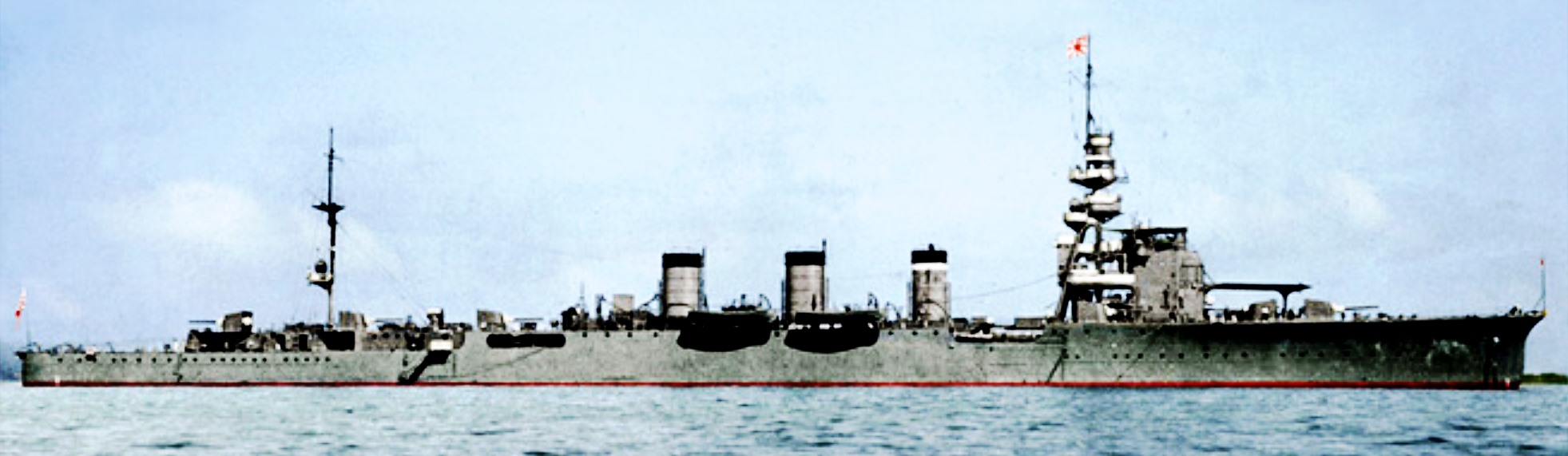
IJN ABUKUMA: Tabular Record of Movement
© 1997-2016 Bob Hackett and Sander Kingsepp
Revision 8
8 December 1921:
Tokyo. Laid down at the Uraga Dock Company and registered in the IJN.
16 March 1923:
Launched and named ABUKUMA.
20 October 1924:
Captain (later Rear Admiral) Tokuda Inosuke (30) (former CO of ASAHI) assumes post as Chief Equipping Officer.
26 May 1925:
Completed and registered in the IJN. Captain Tokuda is the CO.
1 December 1925:
Captain (later Rear Admiral) Otani Shiro (31) (former CO of KASUGA) is appointed CO.
1 November 1926:
Captain (later Rear Admiral) Nagai Minoru (32) (former CO of SATA) is appointed CO.
15 November 1927:
Captain (later Admiral) Toyoda Teijiro (33)(former XO of KONGO) is appointed CO.
10 December 1928:
Captain Irie Fuchitsune (33) (former CO of MAMIYA) is appointed CO.
30 November 1929:
Captain Nohara Shinji (34) is appointed CO.
20 October 1930: IJN Special Great Maneuvers:
S of Daio Zali. During the night, ABUKUMA collides with the portside of light cruiser KITAKAMI between her No 2. and No. 3 funnels. ABUKUMA loses her bow up to No. 1 140-mm turret. KITAKAMI sustains only limited damage above the waterline. Battleship MUTSU tows ABUKUMA to Tateyama and from there she is towed by tugs to Yokosuka.
6 November 1930:
Yokosuka. Enters dock. A temporary bow is fitted.
22 November 1930:
Undocked.
1 December 1930:
Captain Koga Shichisaburo (36) (former CO of HATAKAZE) is appointed CO.
1 April-20 December 1931:
Kure Navy Yard. Undergoes permanent repairs. Fitted with a new "yacht" bow similar to those fitted on JINTSU and NAKA after their collisions with destroyers during the 1927 IJN Special Great Maneuvers.
1 December 1931:
Captain (later Vice Admiral) Iwamura Seiichi (37)(former CO of YAHAGI) is appointed CO. Captain Koga assumes command of KAKO.
15 November 1932:
Captain (later Rear Admiral) Kojima Kentaro (36) (former Chief-of-Staff, Chinkai Guard District) is appointed CO. Captain Iwamura is later posted Adjutant of the Navy Department.
15 November 1933:
Captain Kohashi Yoshiaki (37) is appointed CO. Captain Kojima assumes command of YAMASHIRO.
15 November 1934:
Captain (later Vice Admiral) Kurita Takeo (38)(former CO of URAKAZE) is appointed CO. Captain Kohashi later assumes command of SAGARA MARU.
15 November 1935:
Captain (later Vice Admiral) Fujita Ruitaro (38)(former CO of SHIMAKAZE)
1 December 1936:
Captain (Rear Admiral, posthumously) Shimizu Iwao (39)is appointed CO.
1 December 1937:
Captain (later Vice Admiral) Akiyama Katsuzo (40)(former CO of RO-54) is appointed CO.
1 December 1938:
Captain (later Rear Admiral) Tanaka Kikumatsu (43) is appointed CO.
15 November 1939:
Captain (Rear Admiral, posthumously) Sakiyama Shakao (42)(former CO of AYANAMI) is appointed CO.
1 November 1940:
Captain (later Vice Admiral) Murayama Seiroku is appointed CO.
26 November 1941:
ABUKUMA is in Vice Admiral (Admiral, posthumously) Nagumo Chuichi's (36)(former CO of YAMASHIRO) First Air Fleet. She is the flagship of Rear Admiral (later Vice Admiral) Omori Sentaro's (41)(former CO of ISE) DesRon 1 that includes DesDiv 17's ISOKAZE, URAKAZE, TANIKAZE, HAMAKAZE, DesDiv 18's ARARE, KASUMI, KAGERO and SHIRANUHI.
DesRon 1 departs Tenzan Bay (Hitokappu Wan) at Etorofu Island in the Kuriles with Vice Admiral Mikawa Gunichi's (38)(former CO of KIRISHIMA) Support Force's BatDiv 3, Section 1's HIEI and KIRISHIMA, CruDiv 8's TONE and CHIKUMA and Supply Groups Nos. 1 and 2. Mikawa's Force accompanies Nagumo's Striking Force's ("Kido Butai") CarDiv 1's AKAGI and KAGA, CarDiv 2's HIRYU and SORYU and CarDiv 5's SHOKAKU and ZUIKAKU.
2 December 1941:
940 miles north of Midway Island. DesRon 1 receives the coded signal "Niitakayama nobore (Climb Mt. Niitaka) 1208" from the Combined Fleet. It signifies that X-Day hostilities will commence on 8 December (Japan time). [1]
7 December 1941: Operation "Z" - The Attack on Pearl Harbor:
The Carrier Striking Force launches attacks that sink battleships USS ARIZONA (BB-39), OKLAHOMA (BB-37) and CALIFORNIA (BB-44) and damage NEVADA (BB-36), PENNSLYVANIA (BB-38), TENNESSEE (BB-43), MARYLAND (BB-46), WEST VIRGINIA (BB-49) and other smaller ships. 2,335 American servicemen die in the attack, most on ARIZONA. After recovering all but 29 of its aircraft lost in the attack, the Striking Force departs Hawaiian waters towards Japan.
23 December 1941:
ABUKUMA arrives at Hashirajima.
24 December 1941:
Moves to Kure. Begins refit.
8 January 1942:
Departs Iwakuni for Truk with the Carrier Striking Force and BatDiv 3/1.
14 January 1942:
Arrives at Truk.
17 January 1942:Operation "R" - The Invasions of Rabaul and Kavieng:
DesRon 1's ABUKUMA with DesDiv 17's ISOKAZE, URAKAZE, TANIKAZE, HAMAKAZE, DesDiv 18's ARARE, KASUMI, KAGERO, SHIRANUHI and unattached AKIGUMO depart Truk with the Invasion Force's Carrier Striking Force and CruDiv 8,
20-22 January 1942:
The carriers launch air attacks on Rabaul.
27 January 1942:
Arrives at Truk. CarDiv 5's SHOKAKU is detached for Japan.
1 February 1942: American Air Raid on Kwajalein:
Vice Admiral (later Fleet Admiral) William F. Halsey Jr's (USNA ‘04)(former CO of SARATOGA, CV-3) Task Force 8 (USS ENTERPRISE (CV-6) raids Kwajalein and Wotje in the Marshall Islands. ENTERPRISE's Douglas "Dauntless" SBDs of VB-6 and VS-6 and TBD "Devastators" of VT-6 sink transport BORDEAUX MARU and damage light cruiser KATORI, submarine I-23, submarine tender YASUKUNI MARU and other ships.
That same day, DesRon 1 departs Truk with the Carrier Striking Force's CarDiv 1, CarDiv 5's ZUIKAKU, CruDiv 8's CHIKUMA and BatDiv 3/1 in pursuit of Halsey and Rear Admiral (MOH '14/later Admiral) Frank J. Fletcher's (USNA ’06)(former CO of VERMONT, BB-20) Task Force 17 (USS YORKTOWN, CV-5) reported to be attacking Wotje, Kwajalein, Jaluit, Makin and Mili in the Marshall and Gilbert Islands.
4 February 1942:
DesRon 1, BatDiv 3/1 and the Carrier Striking Force group are ordered to Palau. CarDiv 5's ZUIKAKU detaches via Truk for Japan to join SHOKAKU.
8 February 1942:
Arrives at Palau.
15 February 1942:
DesRon 1's ABUKUMA departs Palau with the Carrier Striking Force's CarDiv 1's AKAGI, Car Div 2's HIRYU and SORYU, CruDiv 8's CHIKUMA and TONE and DesDiv 17's URAKAZE, ISOKAZE, TANIKAZE and HAMAKAZE and DesDiv 18's KASUMI, SHIRANUHI and ARIAKE.
19 February 1942: The Raid on Port Darwin, Australia:
DesRon 1 supports the Striking Force's raid on Darwin. Nagumo's aircraft destroy 15 aircraft including nine American Curtiss P-40 "Kittyhawk" fighters, sink eight ships including the destroyer USS PEARY (DD-226) and large Army transport GENERAL M. C. MEIGS and damage nine ships including seaplane tender USS WILLIAM B. PRESTON (AVD-7).
21 February 1942:
DesRon 1, Carrier Striking Force and Bat Div 3/1 arrive at Staring (Teluk) Bay, near Kendari and refuel. Vice Admiral (later Admiral) Kondo Nobutake (35)(former CO of KONGO) also arrives from Palau with BatDiv 3/2's KONGO and HARUNA, CruDiv 4's ATAGO, MAYA and TAKAO and six destroyers.
25 February 1942:
DesRon 1 and BatDiv 3 departs Staring Bay in support of the Carrier Striking Force's attacks on Java.
9 March 1942:
After the surrender of the Dutch East Indies, returns to Staring Bay.
26 March 1942:
Sorties from Staring Bay via the Timor Sea into the Indian Ocean with DesRon 1, DesDiv 17's URAKAZE, ISOKAZE, TANIKAZE, HAMAKAZE, DesDiv 18's KASUMI, SHIRANUHI, ARARE, KAGERO, DesDiv 4's MAIKAZE, HAGIKAZE, CarDiv 5's AKIGUMO escorting
Nagumo's Carrier Striking Force's CarDiv 1's AKAGI, CarDiv 3's SORYU and HIRYU, CarDiv 5's SHOKAKU and ZUIKAKU, BatDiv 3's KONGO, HARUNA, HIEI and KIRISHIMA, CruDiv 8's TONE and CHIKUMA, Supply Group No. 1's oilers KENYO MARU, KOKUYU MARU, KYOKUTO MARU, NIPPON MARU, SHINKOKU MARU and TOEI MARU and Supply Group No. 2's oiler KYOEI MARU.
1 April 1942:
The Striking Force is S of Sumatra.
5 April 1942: Operation "C "– The Raids in the Indian Ocean:
The Striking Force attacks Colombo, Ceylon (now Sri Lanka). At 0800, 127 of the "Kido Butai's" aircraft led by Cdr (later Captain) Fuchida Mitsuo (52)(of Pearl Harbor) attack the British naval base. They wreck the base's facilities,
destroy 31 aircraft (6 Swordfish, 21 Hurricane, 4 Fulmar) aircraft and sink destroyer HMS TENEDOS and armed merchant cruiser HMS HECTOR. 55 RN personnel are killed at Colombo (TENEDOS 33, HECTOR 3, LUCIA 2, TRUSTY 1, BALTA 1, FAA
aircrew and ground crew 12, and an "Albacore" crew from INDOMITABLE 3).
A TONE floatplane finds Vice Admiral (later Admiral of the Fleet Sir) James Somerville's (former CO of HMS WARSPITE) British Eastern Fleet's cruisers HMS CORNWALL and HMS DORSETSHIRE at sea - without air cover. Between 1338-1400,
53 Aichi D3A "Val" dive-bombers from AKAGI, HIRYU and SORYU sink both ships. 424 RN personnel are killed (DORSETSHIRE 234, CORNWALL 190). After the attack, the Striking Force withdraws to the SE and searches unsuccessfully for the
rest of Somerville's fleet.
6 April 1942:
At 0500, Vice Admiral Nagumo orders the Striking Force to reverse course to the NW.
9 April 1942:
At 0600, the Striking Force launches 91 Aichi D3A1 Val dive-bombers and 41 Mitsubishi A6M2 Zeke fighters led by Commander Fuchida to attack the British naval base at Trincomalee, Ceylon. They find the harbor almost empty, but destroy
merchant ship SAGAING and the four aircraft she was carrying, and damage monitor EREBBUS. They also seriously damage the dockyard and the RAF station at China Bay, shoot down nine planes and destroy at least 14 aircraft on the ground.
HARUNA launches a E8N2 Dave floatplane that spots an enemy carrier 65 miles south of the base.
At 0900, the Striking Force launches 85 “Vals”, escorted by nine “Zekes”, which sink old light carrier HMS HERMES and Australian destroyer HMAS VAMPIRE. Nagumo's aircraft also find and sink corvette HMS HOLLYHOCK, oilers ATHELSTANE
and BRITISH SERGEANT and Norwegian merchant ship NORVIKEN.
The Striking Force departs the Indian Ocean through the Straits of Malacca for Singapore.
11 April 1942:
The fleet arrives at Singapore.
18 April 1942:
After the attack on Tokyo and other cities by 16 North American B-25 "Mitchell" bombers from USS HORNET (CV-8), Nagumo's Striking Force departs Mako in an unsuccessful pursuit of the "Doolittle Raiders".
22 April 1942:
Arrives at Sasebo for refit.
10 May 1942:
Drydocked.
18 May 1942:
Undocked.
20 May 1942:
Departs Sasebo. Assigned to Fifth Fleet with DesDivs 6 and 21.
22 May 1942:
Arrives at Ominato.
26 May 1942: Operation "AL" - The Seizure of Attu and Kiska, Aleutians:
ABUKUMA is in Vice Admiral Hosogaya Boshiro's (36)(former CO of MUTSU) Northern Force. Departs Ominato with Rear Admiral (later Vice Admiral) Omori Sentaro’s (41) Attu Invasion Force's DesDiv 21's HATSUHARU, HATSUSHIMO, WAKABA and the NENOHI, transport KINUGASA MARU, minelayer MAGANE MARU and the Main Body's cruiser NACHI (F), destroyers INAZUMA, IKAZUCHI, oilers FUJISAN MARU, NISSAN MARU, three cargo ships, the Carrier Striking Force's CarDiv 4's JUNYO and RYUJO, CruDiv 4's TAKAO and MAYA with destroyers AKEBONO, USHIO, SHIOKAZE and SAZANAMI, Captain (later Rear Admiral) Ono Takeji's (44) Kiska Invasion Force's light cruiser TAMA with destroyers AKATSUKI and HOKAZE and six transports.
7 June 1942:
The Invasion Force lands troops on Attu. ABUKUMA and WAKABA patrol the area and reconnoiter Shemya Island.
13 June 1942:
ABUKUMA and WAKABA reconoiter Amchitka Island.
15 June 1942:
ABUKUMA, WAKABA and NENOHI scout Amchitka for possible airfield sites.
18 June 1942:
Departs the Attu area.
24 June 1942:
Arrives at Mutsu Bay, Kawauchi.
28 June-7 July 1942:
Departs Kawauchi for Aleutians with CruDiv 21's KISO and TAMA and Rear Admiral (later Vice Admiral) Kakuta Kakuji's (39)(former CO of YAMASHIRO) Second Mobile Force CarDiv 4 reinforced by CruDiv 5's HAGURO and MYOKO and NACHI, DesDiv 4's ARASHI, MAIKAZE, HAGIKAZE, NOWAKI, DesDiv 7's USHIO, SAZANAMI, DesDiv 9's ASAGUMO, MINEGUMO and NATSUGUMO, DesDiv 10's AKIGUMO, KAZAGUMO, MAKIGUMO, YUGUMO and DesDiv 17's URAKAZE.
Covers the second reinforcement convoy to Kiska, Aleutians, then patrols SW of Kiska in anticipation of an American counter-attack.
7 July 1942:
Departs the area to assist destroyers KASUMI and SHIRANUHI that were torpedoed at Kiska on 4 July by LtCdr (later Cdr/MOH posthumously) Howard W. Gilmore's (USNA ’26) USS GROWLER (SS-215).
10 July 1942:
Arrives at Kiska. Departs that same day.
16 July 1942:
Arrives at Yokosuka. Refit.
4 August 1942:
Departs Yokosuka for Ominato.
6 August 1942:
Arrives at Ominato.
7 August 1942:
Rear Admiral (later Vice Admiral) William W. Smith's (former CoS to Admiral H. E. Kimmel) Task Group 8.6 bombardment group of USS LOUISVILLE (CA-28), INDIANAPOLIS (CA-35), NASHVILLE (CL-43), HONOLULU (CL-48) and ST LOUIS (CL-49) and the destroyers ELLIOT (DD-146), REID (DD-369), CASE (DD-370), GRIDLEY (DD-380) and McCALL (DD-400) shell Kiska, Aleutians.
8 August 1942:
After the American bombardment of Kiska, ABUKUMA departs Ominato. She joins the Fifth Fleet, but since the American force withdrew, the Fifth Fleet does not sortie.
11 August 1942:
Arrives at Paramushiro.
13 August 1942:
Departs Paramushiro. Conducts training.
16 August 1942:
Arrives at Ominato.
29 August 1942:
Departs with NACHI and cruises SW of Kiska to cover the transfer of Attu's garrison to Kiska.
18 September 1942:
ABUKUMA, NACHI and KISO arrive at Ominato.
20 September 1942:
Captain (Vice Admiral, posthumously) Shibuya Shiro (42)(former XO of JINTSU) is appointed CO. Captain Murayama becomes CO of AOBA in 1945.
ABUKUMA departs Ominato for Muroran.
24 September 1942:
Arrives back at Ominato.
30 September 1942:
Sorties from Ominato with NACHI after an erroneous report is received of the presence of American forces. The mission is aborted.
2 October 1942:
Arrives at Ominato.
15 October 1942:
Departs Ominato.
20 October 1942:
Arrives at Kashiwabara Bay, Paramushiro.
23 October 1942:
Arrives at Kataoka.
25 October 1942:
Arrives at Kakumabetsu Bay, Paramushiro.
27 October 1942:
Departs Paramushiro with KISO and TAMA, escorted by DesDiv 21's HATSUSHIMO and WAKABA carrying the Yonekawa Detachment to Attu.
29 October 1942:
Arrives at Attu. Disembarks troops. Covers the transport operation with NACHI.
30 October 1942:
Departs Attu.
1 November 1942:
Refuels in Kataoka Bay.
4 November 1942:
Arrives back at Ominato with TAMA.
9 November 1942:
Rear Admiral Mori Tomoichi (42)(former CO of HAGURO) assumes command of DesRon 1. Rear Admiral Omori is reassigned as Flag Officer, CruDiv 5's MYOKO and HAGURO. Departs Ominato.
10 November 1942:
Arrives at Otaru.
20 November 1942:
With KISO, embarks an army detachment. At 0830, departs Otaru.
23 November 1942:
At 0615, arrives at Kakumabetsu Bay, Paramushiro Island. At 1400, departs for Attu with KISO and destroyer WAKABA.
25 November 1942:
At 1810, arrives at Attu with KISO. Disembarks troops, then departs.
28 November 1942:
Arrives at Kakumabetsu. Both cruisers refuel and embark army reinforcements and supplies.
30 November 1942:
Departs Paramushiro for Kiska with KISO.
3 December 1942:
Arrives at Kiska. Disembarks troops, then departs.
7 December 1942:
Arrives at Paramushiro. ABUKUMA is refueled by oiler TEIYO MARU. Departs that same day.
10 December 1942:
Arrives at Ominato. Departs that same day.
12 December 1942:
Arrives at Sasebo. Refit.
14 December 1942:
Drydocked. During refit two triple-mount Type 96 25-mm AA guns are installed. The No. 5 140-mm gun is removed and the quad 13-mm mg mount in front of the bridge is replaced by a twin 13-mm mg mount.
12 January 1943:
Undocked.
16 January 1943:
Departs Sasebo.
18 January 1943:
Arrives at Ominato.
19 January 1943:
Departs Ominato.
24 January 1943:
Arrives at Kashiwabara, Paramushiro.
25 January 1943:
South Bay Kataoka. Oiler TEIYO MARU refuels ABUKUMA. Departs Paramushiro escorting Army cargo ship TAKO MARU.
26 January 1943:
Arrives at Kataoka Bay.
12 February 1943:
ABUKUMA is refueled by oiler TEIYO MARU.
18 February 1943:
Departs Kataoka Bay escorting converted cruiser AWATA MARU that is carrying Army reinforcements to Kiska.
20 February 1943:
120 miles N of Kiska. ABUKUMA detaches. The AWATA MARU continues alone.
25 February 1943:
Arrives at Kashiwabara, Paramushiro.
7 March 1943:
Departs Kashiwabara with the Fifth Fleet's cruisers NACHI and MAYA, light cruisers TAMA and KISO, destroyers IKAZUCHI, INAZUMA, USUGUMO, HATSUSHIMO and WAKABA to escort the converted cruiser ASAKA MARU and transport SAKITO MARU.
10 March 1943:
Arrives at Attu. KISO and the transports land supplies, while the other units patrol.
13 March 1943:
All units return safely to Kashiwabara.
23 March 1943:
Departs Paramushiro towards Attu with the NACHI, MAYA, light cruisers ABUKUMA, TAMA, destroyers IKAZUCHI, INAZUMA, USUGUMO, HATSUSHIMO, WAKABA escorting a three-ship reinforcement convoy including SANKO MARU.
26 March 1943: The Battle of the Komandorski Islands:
N Pacific. Off the Kamchatka Peninsula, Siberia. Rear Admiral (later Vice Admiral) Charles H. McMorris' (USNA ’12)(former CO of SAN FRANCISCO (CA-38) Task Group 16.6's USS RICHMOND (CL-9), SALT LAKE CITY (CA-25) and four destroyers engage Vice Admiral Hosogaya's Fifth Fleet cruisers NACHI (F), MAYA, ABUKUMA and TAMA and HATSUSHIMO and WAKABA escorting Convoy "D" that is carrying troops and supplies for the garrison on Attu.
In a four-hour running gun and torpedo battle, SALT LAKE CITY and BAILEY (DD-492) are damaged by gunfire. The other destroyers are not damaged. ABUKUMA is undamaged, but NACHI is hit several times. McMorris' attack causes the Japanese to abort their resupply mission.
28 March 1943:
Arrives at Paramushiro with the convoy. Disgraced by retreating from an inferior force, Hosogaya is relieved of command and forced to retire.
1 April 1943:
DesRon 1 is administratively attached to the Fifth Fleet. DesRon l includes DesDiv 9's ASAGUMO, USUGUMO, SHIRAKUMO and DesDiv 21's WAKABA, HATSUSHIMO and HATSUHARU. Vice Admiral Kawase Shiro (38)(former XO of KIRISHIMA) assumes command of the Fifth Fleet.
13 April 1943:
Departs Kataoka Bay escorted by DesDiv 6's INAZUMA. KISO temporarily becomes DesRon 1's flagship.
16 April 1943:
INAZUMA detaches for Yokosuka.
17 April 1943:
Arrives at the Maizuru Navy Yard. Refit.
3 May 1943:
Drydocked. A Type 21 air-search radar installed.
11 May 1943: American Operation "Landcrab" - The Invasion of Attu, Aleutians:
Rear Admiral (later Admiral) Thomas C. Kinkaid's (USNA ’08)(former CO of INDIANAPOLIS, CA-35) Task Force 16, covered by Rear Admiral (later Vice Admiral-Ret) Francis W. Rockwell’s (USNA ’11)(former CO of THATCHER, DD-162) Task Force 51, lands elements of the Army's 4th and 7th Infantry Divisions under the command of MajGen Eugene M. Landrum at Holtz Bay and Massacre Bay that later capture the island.
17 May 1943:
Undocked. Departs Maizuru.
21 May 1943: Operation "KE" - The Evacuation of Kiska:
The Imperial General Headquarters decides to evacuate the garrison at Kiska Island, Aleutians.
That same day, ABUKUMA arrives at Kataoka Bay and rehoists DesRon 1's flag.
25 May 1943:
Departs Kataoka Bay with KISO and four destroyers on a transport and evacuation run to Attu.
29 May 1943:
The operation is canceled as Attu's fall is imminent. Recalled.
31 May 1943:
Arrives at Kataoka Bay.
7 June 1943:
Departs Kataoka Bay for Ominato.
10 June 1943:
Rear Admiral (later Vice Admiral) Kimura Masatomi (41)(former CO of SUZUYA) assumes command of DesRon 1.
12 June 1943:
Departs Ominato.
14 June 1943:
Arrives at Paramushiro. Patrols and trains in the area for the impending Second Phase of the Kiska Evacuation Operation (evacuation by surface craft).
7 July 1943: Operation "KE" - The Evacuation of Kiska.
Departs Paramushiro with the Evacuation Task Force consisting of Rear Admiral Kimura's DesRon 1's light cruisers TAMA and KISO with DesDiv 10's YUGUMO, KAZAGUMO, AKIGUMO, DesRon 9's ASAGUMO, USUGUMO, DesDiv 6's HIBIKI, Guard Unit No. 1's DesDiv 21's WAKABA, HATSUSHIMO, DesDiv 32's NAGANAMI, Guard Unit No. 2 DesDiv 11's SHIMAKAZE, DesDiv 27's SAMIDARE, the Supply Force's converted cruiser AWATA MARU, oiler NIPPON MARU and kaibokan KUNASHIRI.
The mission is aborted due to weather.
18 July 1943:
Arrives back at Paramushiro.
22 July 1943:
Departs Paramushiro for Kiska.
26 July 1943:
At 1745, while steaming in column, KUNASHIRI collides with ABUKUMA, hitting her starboard quarter. WAKABA veers starboard and is hit by HATSUSHIMO on her starboard quarter. HATSUSHIMO ricochets against the NAGANAMI. WAKABA and KUNASHIRI are sent back to Paramushiro.
29 July 1943:
ABUKUMA and the remaining units anchor in Trout Lagoon, Kiska.
29 July 1943:
Departs Kiska with the No. 1 Transport Unit with 1,2l2 men aboard with KISO (No. 2 Transport Unit) and DesDiv 10.
1 August 1943:
Arrives at Paramushiro.
3 August 1943:
Departs Paramushiro.
6 August 1943:
Makes a recreation call at Otaru.
10 August 1943:
Departs Otaru.
11 August 1943:
Arrives at Ominato.
18 August 1943:
Captain (Rear Admiral posthumously) Konishi Kaname (44)(former ComDesDiv 7) is appointed CO. Captain Shibuya is later reassigned as CO of NACHI.
21 August 1943:
Departs Ominato.
24 August 1943:
Arrives at Paramushiro.
12 September 1943:
Off Paramushiro. ABUKUMA suffers slight damage by near misses by bombs from B-24 and B-25 aircraft of the 28th Composite Air Force.
24 September 1943:
Departs Paramushiro.
26 September 1943:
Arrives at Nemuro.
30 September 1943:
Departs Nemuro.
4 October 1943:
Arrives at Paramushiro. Departs that same day.
8 October 1943:
Arrives at Yokosuka. Refit.
20 October 1943:
Drydocked. During refit the No. 7 gun mount is removed, a twin mount of 40-cal Type 89 127-mm HA guns (unshielded) is fitted, as are a triple-mount Type 96 25-mm AA gun and four single-mount 25-mm AA guns that bring the total number of 25-mm AA guns to 20 barrels.
5 November 1943:
Undocked.
23 November 1943:
Departs Kisarazu, Tokyo Bay.
25 November 1943:
Arrives at Ominato.
3 December 1943:
Departs Ominato.
6 December 1943:
At 0815, codebreakers at the USN Fleet Radio Unit, Melbourne (FRUMEL), Australia intercept and later decrypt a message from the Kuriles Base Force that reads "ABUKUMA is expected to arrive Horomushiro at 0910 on 7th.
Until she has passed, which will be about 0300 on 7th, KAIHO MARU and No. 2 TENYO MARU are to remain on patrol."
7 December 1943:
Arrives at Paramushiro.
10 December 1943:
Departs Paramushiro.
13 December 1943:
Arrives at Ominato.
29 December 1943:
Departs Ominato.
1 January 1944:
Arrives at Paramushiro area for antisubmarine patrol.
15 January 1944:
Departs Paramushiro.
18-28 January 1944:
Arrives at Muroran.
28 January 1944:
Departs Muroran.
28 January 1944:
Arrives at Ominato for local training.
15 February 1944:
Shima Kiyohide (39)(former CO of OI) assumes command of the Fifth Fleet. Vice Admiral Kawase is reassigned to the NGS and later becomes CINC, 2nd Southern Expeditionary Fleet.
March 1944:
ABUKUMA's catapult is removed.
19 March 1944:
Departs Ominato.
20 March 1944:
Arrives at Akkeshi Bay.
26 March 1944:
Captain Hanada Takuo (48) is appointed CO. Captain (Rear Admiral, posthumously) Kaname later assumes command of UNRYU on which he is KIA on 19 Dec '44.
2 April 1944:
Departs Akkeshi.
3 April 1944:
Arrives at Ominato for local training.
1 May 1944:
Oiler TEIYO MARU undergoes towing replenishment training with ABUKUMA, then refuels ABUKUMA.
6 June 1944:
Departs Ominato. Arrives at Otaru.
18 June 1944:
Departs Otaru. Arrives at Ominato.
19 June 1944:
Departs Ominato.
21 June 1944:
Arrives at Yokosuka. Refit, modification. A Type 22 surface-search radar is fitted. Ten single-mount Type 96 25-mm AA guns are also fitted that bring ABUKUMA's total 25-mm AA gun suite to thirty barrels. Five single-mount Type 93 13-mm machine guns are added that bring ABUKUMA's total to ten 13-mm machine guns.
13 July 1944:
Departs Yokosuka.
15 July 1944:
Arrives at Ominato.
16 July 1944:
Arrives at Ominato.
17 July 1944:
Arrives at Otaru.
28 July 1944:
Departs Otaru.
29 July 1944:
Arrives at Ominato.
31 July 1944:
Departs Ominato.
2 August 1944:
Arrives at Kure. Refit.
14 August 1944:
Drydocked.
20 August 1944:
Undocked.
21 August 1944:
Staging from Kure, trains in the western Inland Sea for the next seven weeks.
14 October 1944:
Departs Hiroshima Bay for Iwakuni. Vice Admiral Shima, CINC, Fifth Fleet, confers briefly with the Mobile Fleet Commander Vice Admiral Ozawa Jisaburo (37)(former CO of HARUNA).
15 October 1944:
At 0700, ABUKUMA, DesDiv 7's AKEBONO, KASUMI, USHIO, DesDiv 18's SHIRANUHI, DesDiv 21's WAKABA, HATSUSHIMO and HATSUHARU sortie from the Bungo Straits with Shima's Second Raiding Force's NACHI and ASHIGARA to "destroy the crippled U.S. Fleet" off Formosa.
Bungo Straits. Cdr Thomas L. Wogan's (USNA ’30) USS BESUGO (SS-321) spots Shima's fast moving force at 7,500 yards, but is unable to close. Wogan reports the sighting to COMSUBPAC.
16 October 1944:
Shima's force arrives at Amami-O-Shima.
18 October 1944:
Departs Amami-O-Shima with CruDiv 21 and DesRon 1.
W of Okinawa. At about 1030, Shima's force is sighted by LtCdr Orme C. Robbins' (USNA ’34) USS STERLET (SS-392) at 15 miles. Robbins closes to four miles, but is unable to get closer in the daylight. He reports the sighting to COMSUBPAC.
S of Okinawa. That evening, Shima's force is sighted by LtCdr (later Vice Admiral) Frederick J. Harlfinger’s (USNA ’37) USS TRIGGER (SS-392) at nine miles. Harlfinger closes to five miles, but is driven off by an aircraft and a Japanese submarine that fires a torpedo at TRIGGER.
20 October 1944:
Formosa Strait. At 0400, LtCdr (later MOH/Rear Admiral-Ret) Richard H. O’Kane’s (USNA ’34)(former XO of WAHOO, SS-238) USS TANG (SS-306) picks up Shima's zigzagging force now
making 19 knots. O'Kane tracks the force until dawn, but cannot close.
Shima's force arrives at Mako, Pescadores.
21 October 1944: The Battle of Leyte Gulf:
At 1600, Shima's Force departs Mako for Manila with CruDiv 21, but diverts to Coron to support Vice Admiral Nishimura Shoji's (39)(former CO of HARUNA) First Raiding Force's BatDiv 2's YAMASHIRO and FUSO and CruDv 7's MOGAMI and four destroyers.
22 October 1944:
Luzon Strait. At about 0100, LCdr (later Cdr) James H. Ashley’s (USNA ’34) USS SEADRAGON (SS-194) sights Shima's force at 30,000 yards. Ashley misidentifies the force as "a carrier, two light cruisers and six destroyers." Ashley signals the sighting to Cdr (later KIA) Edward N. Blakely (USNA ’34) in SHARK (SS-314), commander of the wolf pack, and LtCdr Robert F. Sellars' (USNA ’34) BLACKFISH (SS-221). Ashley closes to 3,000 yards on the surface and fires his four stern tubes by radar bearings at the "carrier" and an overlapping cruiser at 21-57N, 118-14E. Ashley then takes SEADRAGON
deep and evades. Later, he claims hiots on both ships, but postwar these are substantiated.
At 0855, LtCdr Richard W. Peterson's (USNA ’31) submerged USS ICEFISH (SS-367) spots a destroyer, then sights a task force of two NACHI-class heavy cruisers, escorted by three destroyers, bearing 064 T, course 160 T, speed 16 to 18 knots. ICEFISH cannot gain a position closer than 8,000 yards and is unable to attack. In heavy seas, Peterson surfaces to get off a contact report, but is forced under by Japanese planes before he can get off a report. Later that night, he tries again and is successful.
23 October 1944:
Arrives at Coron.
24 October 1944:
At 0200, the Second Raiding Force departs Coron for the Mindanao Sea and the Surigao Strait.
25 October 1944: The Battle of the Surigao Strait:
In the early hours, when entering the Surigao Strait, the force is attacked by American PT-boats. ASHIGARA, NACHI, ABUKUMA and DesDivs 7 and 18 maneuver for a single-column attack formation.
Binit Point, Panaon Island. In the darkness, Lt (j. g.) I. Mike Kovar's PT-137 approaches to within 900 yards of a destroyer. Kovar launches a torpedo, but it runs deep and passes underneath the destroyer. The destroyer snaps on her searchlight and opens fire on the PT-137.
As Kovar struggles to escape, his errant torpedo continues on and hits unseen ABUKUMA near the No. l boiler room. At 0325, the night sky is illuminated by an explosion. 30 of ABUKUMA's crewmen are killed.
After emergency repairs, ABUKUMA, down by the bow, resumes course at slow speed. At 0445, Captain Hanada increases speed to 20 kts. At 0535, he reverses course and joins the other units of Shima's force retiring from Surigao.
At 0830, Rear Admiral Kimura's flag is transferred to the destroyer KASUMI. Destroyer USHIO is ordered to escort ABUKUMA to Cagayan. Because of the American air threat, the force proceeds to Dapitan arriving at 2230. Repairs are made throughout night.
26 October 1944:
Departs for Coron with USHIO.
Sulu Sea. Between 1006 and 1044, ABUKUMA suffers three attacks by Consolidated B-24 "Liberator" bombers of the 5th Group, 13th Air Force. At 1006, she takes a direct hit near the No. 3 140-mm gun mount. At 1020, B-24 bombers of the 33rd Squadron, 22nd Group, 5th Air Force score two direct hits aft that start heavy fires. Power is lost, the steering gear breaks down and her speed falls off. The fire spreads to the aft engine and torpedo rooms. At 1037, four Type 93 "Long Lance" oxygen-propelled torpedoes explode.
Off Negros Island. Between 1200-1230, ABUKUMA's crew abandons ship. At 1242 hours, she sinks by stern at 09-20N, 122-32E with the loss of 250 crewmen. Captain Hanada and 283 crewmen are rescued by USHIO.
27 October 1944:
At 1432, USN codebreakers intercept and decrypt a message (probably from USHIO) that reads: “Abukuma Action Summary: Departed Dapitan (08-40 N, 123-25E) at 0600 on the 26th. (We were torpedoed on the way back from the Leyte Area on the 25th) and while enroute Ceron (at 18 knots) we were bombed by one B-24 -- Dapitan. No damage sustained or inflicted. Between -- and -- we were attacked by -- B-24s ---. At 1037 there was an explosion in our torpedo room which blew a large hole in the port side amidships (?). -- sank at 1242.”
20 December 1944:
Removed from the Navy List.
Authors' Notes:
[1] Mt. Niitaka, located in Formosa (now Taiwan), was then the highest point in the Japanese Empire.
Special thanks for assistance in researching the IJN officers mentioned in this TROM go to Jean-François Masson of Canada. Thanks also goes to "Adm. Gurita" of the Netherlands.
Thanks also go to the late John Whitman for info on CNO intercepts of Japanese messages.
Thanks go to Rob Stuart of Canada for information about Operation "C" in Rev 6 and to Matt Jones and Don Kehn, Jr about the 1930 collision in Rev 7 and again to Matt Jones for more COs.
- Bob Hackett and Sander Kingsepp.
Back to
Cruiser Page