YUSOSEN!

Stories and Battle Histories of the IJN's Fleet Oilers

28 August 2010

By Bob Hackett and Peter Cundall

Discussion & Questions


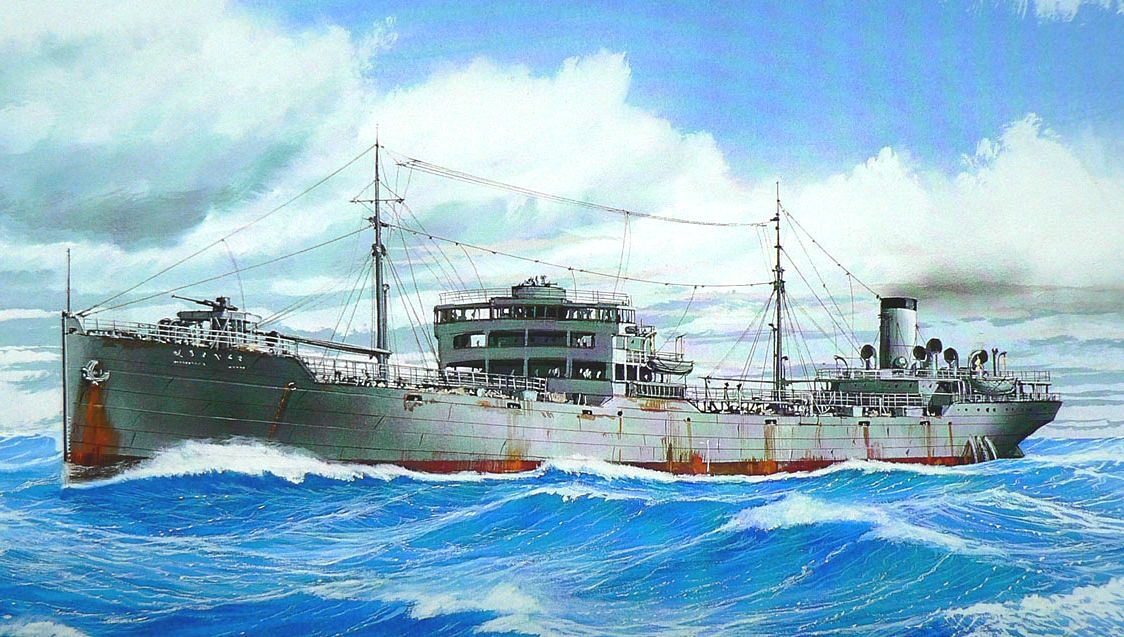
(Oiler by Takeshi Yuki scanned from "Color Paintings of Japanese Warships")


Oil was a key factor in the Empire of Japan's decision to go to war with America. After Japan occupied southern French Indochina in the summer of 1941, the United States, Great Britain and the Netherlands East Indies placed an embargo on all petroleum products into Japan.

Just before their attack on Pearl Harbor, Japan had only 49 merchant tankers of about 587,000 tons and the IJN had but nine slow fleet oilers. Despite its prewar stockpiling of two years of petroleum products, Japan had to rely on imports from its conquered South Asia territories for survival.

Like all navies, oil was the lifeblood of the IJN. As a result, the IJN requisitioned 77 merchant ships from their owners for conversion to auxiliary oilers.

During the war the Japanese employment of merchants ships was divided into three main administrative categories:
A = requisitioned and operated by the Japanese Army
B = requisitioned and operated by the Japanese Navy with civilian crew (captain often being Navy Reserve)
C = controlled and operated by Senpaku UnŽeikai (Civilian Shipping Administration)
X = requisitioned by the IJN and converted into armed Naval Auxiliaries with IJN crews (gunboats, minesweepers, etc.)

Beside the above categories, there were many shared employments Army/Civilian (A/C) and Navy/Civilian (B/C). These ships were called Haitosen. Normally, this meant that the vessel on its outbound journey was under Army or Navy control carrying troops, military supplies, etc. and on its return voyage was carrying cargo for the benefit of the civilian owner of ship.

While used by the Army, the Haitosen also received Army transport numbers like Army requisitioned vessels (A). Employments by Army or Navy could also be expanded, meaning that the ship was used by Army/Navy for one full turn (outward and homeward voyage) or even a series of voyages.

This page will cover the activities of 132 fleet and coastal tankers - 70 merchant tanker auxiliaries, 18 Navy fleet oilers and 37 civilian merchant tankers in Japanese national service and six captured and one German vessel in Japanese service.

Two of the Navy fleet oilers also served in the seaplane tender role and four were designed as aviation gasoline tankers to resupply carriers underway at sea. The latter Yusosen were officially termed Kihatsuyu Umpankan. Two tankers were converted to escort carriers for the IJA while still on the ways. One of these also would have served as a tanker. Neither became operational.

Some ex-foreign vessels served as tankers, but documenation of their Japanese service for most is either sparse or non-existant.


Tabular Records of Movement (TROMs):

Auxiliary Fleet Oilers

(Classes link to specifications summaries)


GENYO MARU Class

Genyo Maru (revised 4/17/2010)

Itsukushima Maru (revised 10/3/09))
Kenyo Maru (revised 5/12/2010)
Kokuyo Maru (revised 5/12/2010)
Nichiei Maru (revised 4/24/2010)
Toei Maru (posted 3/29/2007)

KYOKUTO MARU Class

Kyokuto Maru (posted 7/27/2007)

Toa Maru (revised 4/24/2010)
Toho Maru (posted 7/27/2007)

FUJISAN MARU Class

Fujisan Maru(revised 4/24/2010)

NIPPON MARU Class

Nippon Maru (revised 5/12/2010)

Tatekawa Maru (revised 4/17/2010)

SHINKOKU MARU Class

Shinkoku Maru (revised 5/12/2010)

GOYO MARU Class

Goyo Maru (posted 3/28/2008)

HOYO MARU Class

Hoyo Maru (revised 4/17/2010)

Kaijo Maru No. 2 Go (posted 3/7/2009)

AKATSUKI MARU Class

Akatsuki Maru (posted 7/24/2010)

Akebono Maru (revised 6/12/2010)

TEIYO MARU Class

Teiyo Maru (revised 12/12/2009)

SAN RAMON MARU Class

San Ramon Maru (posted 11/8/2008)

San Clemente Maru (posted 8/23/2008)

SAN PEDRO MARU Class

San Pedro Maru (posted 12/27/2008)

San Luis Maru (revised 5/23/2009)
San Diego Maru (posted 11/15/2008)

OTOWASAN MARU Class

Omurosan Maru (posted 1/10/2009)

OGURA MARU No. 2 Class

Ogura Maru No. 2 (revised 4/30/10)

OGURA MARU No. 3 Class

Ogura Maru No. 3 (posted 1/17/2009)

KIRISHIMA MARU Class

Kirishima Maru (revised 4/30/10)

NISSHO MARU Class

Nissho Maru (revised 4/30/10)

KYOKUYO MARU Class

Kyokuyo Maru (revised 4/30/10)

TOEN MARU Class

Toen Maru (revised 4/17/2010)

TONAN MARU No. 2 Class

Tonan Maru No. 2 (revised 4/17/2010)

Tonan Maru No. 3 (revised 4/17/2010)
HISHI MARU No. 2 Class

Hishi Maru No. 2 (revised 4/30/10)

MOJI MARU Class

Moji Maru (posted 7/5/2009)

KYOEI MARU Class

Kyoei Maru (posted 5/22/2010)

KYOEI MARUs
No. 2 Class

Kyoei Maru No. 2 (posted 7/3/2010)

Kyoei Maru No. 3 (posted 8/22/2009)

AZUMA MARU Class

Azuma Maru (posted 1/2/2010)

Arima Maru (posted 12/5/2009)

SHOYO MARU Class

Shoyo Maru (posted 2/13/2010)

KINREI MARU Class

Kinrei Maru (posted 4/10/2010)

JUKO MARU Class

Juko Maru (posted 6/26/2010)

KIYO MARU Class

Kiyo Maru (posted 6/26/2010)

KUMAGAWA MARU Class

Kumagawa Maru (posted 7/3/2010)

TERUKAWA MARU Class

Terukawa Maru (posted 7/10/2010)

HISHI MARU Class

Hishi Maru (posted 7/17/2010)

KORYU MARU Class

Koryu Maru (posted 7/31/2010)

STANDARD TANKER 1TL Class

Azusa Maru (posted 6/28/08)

Seiyo Maru (posted 8/1/09)
Miri Maru (posted 8/8/09)
Kyuei Maru (posted 10/10/09)
Ryoei Maru (posted 10/17/09)
Nampo Maru (posted 10/31/09)
Nippo Maru (posted 8/7/10)
Ominesan Maru (posted 8/14/10)
Okikawa Maru(posted 8/28/10)
Amatsu Maru
Shimane Maru

STANDARD TANKER 1TM Class

Yuho Maru (revised 4/17/2010)

Tarakan Maru(posted 8/29/09)
Manei Maru (posted 10/24/09)
Ryuei Maru (posted 11/7/09)
Shimpo Maru (posted 11/14/09)
Asanagi Maru (posted 11/21/09)
Asashio Maru (posted 8/7/10)
Bokuei Maru (posted 8/21/10)
Eiho Maru
Eiyo Maru No. 2
STANDARD TANKER 2TE Class

Murotsu Maru (posted 9/5/09)

Naval Fleet Oilers

(Classes link to specifications summaries)

SHIRETOKO Class

Shiretoko (posted 9/14/2007)

Notoro (revised 5/29/2007)
Iro (revised 4/24/2010)
Erimo(posted 12/14/2007)
Tsurumi (revised 4/17/2010)
Shiriya (revised 5/23/2009)
Sata (revised 4/24/2010)
Ondo (revised 5/23/2009)
Hayatomo (revised 4/24/2010)
Naruto (revised 4/24/2010)

KAMOI Class

Kamoi (posted 4/18/2006)

HAYASUI Class

Hayasui (posted 1/9/2010)

KAZAHAYA Class

Kazahaya (posted 2/6/2010)

SUNOSAKI Class

Sunosaki (posted 6/12/10)

Takasaki (posted 7/17/2010)

ASHIZURI Class

Ashizuri (posted 6/20/2009)

Shioya (posted 7/25/09)


HARIO Class

Hario (revised 6/26/2010))

Civilian Merchant Tankers in Japanese National Service

(Classes link to specifications summaries)


OTOWASAN MARU Class

Otowasan Maru(posted 9/12/2009)


EIYO MARU Class

Eiyo Maru (revised 1/12/2010)


CHIYODA MARU Class

Chiyoda Maru (posted 1/30/2010)

Chihaya Maru (posted 2/6/2010)

TONAN MARU Class

Tonan Maru

HOKKI MARU Class

Hokki Maru

STANDARD TANKER 1TL Class

Hakko Maru

Hakko Maru No. 2
Hashidate Maru
Niyo Maru
Isshin Maru
Takane Maru


STANDARD TANKER 1TM Class

Jambi Maru

Sarawak Maru
Palembang Maru
Otorisan Maru
Marifu Maru
Yamamizu Maru No. 2
Nichinan Maru No. 2
Ariake Maru
Tenshin Maru
Zuiho Maru
STANDARD TANKER 2TL Class

Jinei Maru

Seria Maru
Mitsushima Maru
Tenei Maru
Arita Maru
Tojo Maru
Fujisan Maru
Kaiho Maru
Munakata Maru
Akashi Maru
Amato Maru
Akane Maru
Matsushima Maru
Tatekawa Maru No. 2
Yamashio Maru


Captured and Foreign Vessels in Japanese Service as Tankers

(Ex-Countries link to specifications summaries)

Ex-American Vessel

Sanraku Maru


Ex-British Vessels

Choran Maru
Enoshima Maru


German Vessel

Teikon Maru

Ex-Dutch Vessels

Ose
Kyoko Maru
Aiten Maru

Bibliography of Sources

About the Authors

Mr. Robert Hackett is a military historian and researcher. Retired from the United States Air Force and later from the aerospace industry, he resides in the United States.

Mr. Peter Cundall is a maritime historian and researcher who specializes in merchant ships. He resides in Australia.

Questions to the authors concerning these TROMs should be posted on the Discussion and Questions board.