YUSOSEN!
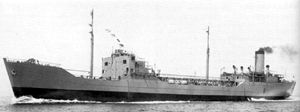 (A Type 1TM Standard Tanker underway)
IJN YUHO MARU:Tabular Record of Movement
© 2008-2020 Bob Hackett and Peter Cundall.
Revision 7
1 January 1943:
Nagasaki. Laid down at Mitsubishi Zosen as a 5,266-ton Type 1TM Wartime Standard Merchant Tanker for Iino Kaiun K.K.
20 August 1943:
Launched and named YUHO MARU.
11 October 1943:
Completed and requisitioned by the IJN.
12 October 1943:
Departs Nagasaki and arrives later that day at Sasebo.
15 October 1943:
Registered in the Sasebo Naval District as an auxiliary transport (oil).
16 October 1943:
Departs Sasebo and arrives the same day at Nagasaki.
26 October 1943:
YUHO MARU departs Nagasaki.
27 October 1943:
Arrives at Tokuyama. Takes on fuel.
28 October 1943:
YUHO MARU departs Tokuyama and later that day arrives at Moji.
3 November 1943:
YUHO MARU departs Moji in convoy No. 111 consisting of OMINE and FUJIKAWA MARUs and eight other unidentified ships escorted by kaibokan SADO.
8 November 1943:
Arrives at Takao.
10 November 1943:
YUHO MARU departs Takao and later that day arrives Mako, Pescadores.
21 November 1943:
At 1540 YUHO MARU departs Mako in convoy No. 339 consisting of USSURI, ARABIA, ANYO MARUs and two unidentified merchant ships escorted by auxiliary gunboat CHOJUSAN MARU.
26 November 1943:
At 1000 arrives at St Jacques, Indochina.
28 November 1943:
YUHO MARU departs St Jacques in convoy No. 528 consisting of USSURI, ARABIA, and ANYO MARUs unescorted.
1 December 1943:
Arrives at Singapore.
10 January 1944:
At 1600, YUHO MARU departs Moji for Singapore in convoy HI-33 consisting of AOBASAN MARU and tankers TARAKAN, ASASHIO and ASANAGI MARUs and an unidentified ship escorted by kaibokan ETOROFU.
14 January 1944:
At 1933 arrives at Takao.
16 January 1944:
At 1400, departs Takao.
23 January 1944:
At 1030, the convoy arrives at Singapore.
8 March 1944:
YUHO MARU departs unknown location.
10 March 1944:
YUHO MARU arrives at Singapore.
16 March 1944:
YUHO MARU departs Singapore for Palau in a convoy consisting of AMATSU and ASASHIO MARU and fleet oiler OSE (ex-Dutch GENOTA) with an unidentified escort.
24 March 1944:
Arrives at Palau.
29 March 1944:
At 0800 YUHO MARU departs Palau for Saipan in a convoy consisting of ammunition ship ARATAMA MARU and MATSUE and KIZUGAWA MARUs and tanker KYOEI MARU escorted by destroyers MINAZUKI, YUZUKI, subchaser CH-30
auxiliary subchasers KYO MARU No. 7 and TAKUNAN MARU No. 2.
1 April 1944:
Iino Kaiun Kogyo is renamed Iino Kaiun K.K.
5 April 1944:
At 1530 arrives at Saipan.
18 April 1944:
Departs Balikpapan in a convoy also consisting of tankers KOKUYO and YUHO MARUs, and gasoline tanker SUNOSAKI escorted by destroyers OKINAMI, TANIKAZE and URAKAZE and kaibokan KANJU.
26 April 1944:
Arrives at Saipan, Marianas. Discharges fuel oil.
29 April 1944:
Departs Saipan in convoy also consisting of tankers KOKUYO and YUHO MARUs, and gasoline tanker SUNOSAKI escorted by destroyers OKINAMI, TANIKAZE and URAKAZE and kaibokan KANJU.
7 May 1944:
Arrives at Balikpapan.
20 May 1944:
YUHO MARU departs Tawi Tawi in a convoy consisting of fleet oiler TSURUMI and tankers MANEI and EIHO MARUs escorted by destroyers AKIZUKI and URANAMI and kaibokan MANJU.
21 May 1944:
AKIZUKI is detached and returns to Tawi Tawi. Later that day arrives at Tarakan, Borneo.
10 June 1944:
Departs Tarakan in convoy with MANEI MARU escorted by kaibokan KANJU and MIYAKE. Later that day, arrives at Karang Besar.
11 June 1944:
Departs Karang Besar
.
12 June 1944:
Arrives at Balikpapan.
17 June 1944:
Departs Balikpapan in convoy also consting of transport KAGU MARU and tankers YUHO and EIHO MARUs escorted by kaibokan KANJU and MIYAKE.
18 June 1944:
Arrives at the Berouw (Berau) River mouth, NE Borneo.
19 June 1944:
Departs the Berouw River mouth.
20 June 1944:
Arrives and departs Tarakan. KAGU MARU is detached there. Anchors that evening in Ligitan Channel, Celebes Sea.
21 June 1944:
Departs Ligitan Channel and enters the Sulu Sea via the Alice Channel.
23 June 1944:
At 0800 minesweeper W-15 and submarine chaser CH-38 departs Cebu and joins up with YUHO MARU convoy At 2150 arrives at Guimaras where W-15 is detached.
26 June 1944:
Departs Guimaras Bay in convoy with tanker MANEI MARU escorted by destroyer TSUGA, kaibokan KANJU and MIYAKE and submarine chasers CH-38, CH-49 and CH-58.
27 June 1944:
Arrives at Zamboanga.
CH-38 is apparently detached.
29 June 1944:
Departs Zamboanga.
30 June 1944:
Arrives at Tawi Tawi, Philippines.
1 July 1944:
Departs Tawi Tawi with tankers EIHO MARU and TSURUMI joining at this point. Later that day, anchors in Ligitan Channel.
2 July 1944:
Departs Ligitan Channel. Later that day, anchors off Tarakan.
TSUGA is detached. TETSUYO MARU joins.
3 July 1944:
Arrives at Berouw River mouth.
TETSUYO MARU runs aground and is detached. The ship later refloat herself and returns to Tarakan.
4 July 1944:
Departs the Berouw River mouth.
5 July 1944:
Arrives at Balikpapan. Loads fuel oil.
10 July 1944:
Departs Balikpapan in convoy with tankers MANEI MARU, TSURUMI and EIHO MARU escorted by kaibokan KANJU and MIYAKE and submarine chasers CH-38, CH-49 and CH-58.
11 July 1944:
Arrives at the Berouw River mouth.
ANKO and TATSUMATSU MARUs and tanker HISHI MARU No. 2 join the convoy.
12 July 1944:
Departs the Berouw River mouth. Later that day, anchors off Tarakan.
13 July 1944:
Departs Tarakan. Arrives at the Ligitan Channel. [2]
14 July 1944:
Departs the Ligitan Channel. Later that day, arrives at Tawi Tawi.
15 July 1944:
Departs Tawi Tawi. Later that day, arrives at Jolo, Philippines.
TSURUMI, TATSUMATSU and ANKO MARUs and HISHI MARU No. 2 are detached.
16 July 1944:
Departs Jolo. Later that day, arrives at Zamboanga, Philippines.
18 July 1944:
Departs Zamboanga.
19 July 1944:
Arrives at Calabasa at the northern entrance to Guimaras Strait.[2]
20 July 1944:
Departs Calabasa. Later that day, arrives at Sapian Bay, N coast of Panay Island. [2]
21 July 1944:
Departs Sapian Bay. Later that day, arrives at Pilar, N-coast of Panay.[2]
22 July 1944:
Departs Pilar. Later that day, arrives at Manila.
EIHO MARU is detached.
26 July 1944:
Departs Manila in convoy also consisting of MANEI MARU escorted by kaibokan KANJU and MIYAKE.
31 July 1944:
Arrives at Zamami, Kerama Retto to shelter from a typhoon.
2 August 1944:
Departs Zamami.
5 August 1944:
Arrives at Mutsure. Departs later that day. Arrives at Kure.
Probably undergoes overhaul, maintenance and upkeep.
6 September 1944:
Departs Kure.
7 September 1944:
Departs Moji and anchors at nearby Mutsure Jima.
8 September 1944:
At 1100, YUHO MARU departs Moji for Singapore in convoy HI-75 consisting of oilers NICHIEI, RYOEI, TOHO (1944 built), SERIA, AMATO and MANEI MARUs and passenger liner ASAMA MARU, auxiliary gunboat SAIGON MARU and flying boat tender AKITSUSHIMA escorted by escort carrier SHINYO, kaibokan KANJU, MANJU and MIYAKE and DesDiv 30’s YUZUKI and UZUKI.
12 September 1944:
In the morning, SAIGON MARU, YUZUKI and KANJU are detached for the China coast. They later rejoin at Takao.
13 September 1944:
At 1400, arrives at Takao.
14 September 1944:
The convoy is increased by the addition of oilers FUJISAN MARU (1944), KUROSHIO and TAIHO MARUs, torpedo boat HIYODORI and kaibokan CD-28. At 1630, the convoy departs Takao. Soon thereafter, AMATO MARU, and at 1900, YUHO MARU develop engine problems and are detached.
Apparently the ship later rejoins.
16 September 1944:
Kaibokan KURAHASHI departs Yulin, Hainan Island, China to reinforce the escort of the convoy.
22 September 1944:
Kaibokan CD-28 falls behind due to rudder problems. Arrives at Singapore. At 1840 CD-28 solves the rudder problems.
23 September 1944 :
Departs Singapore.
25 September 1944:
Arrives at Palembang, Sumatra. Loads fuel oil.
26 September 1944 :
Off Palembang. YUHO MARU transships some of her cargo to tanker NICHIEI MARU. Departs Palembang and later that day arrives Muntok (Mentok), Bangka Island, S of Lingga.
Transfers some of her cargo to tanker RYOEI MARU.
27 September 1944:
Departs Muntok.
28 September 1944:
Arrives at Palembang. Loads fuel oil.
29 September 1944:
Departs Palembang.
1 October 1944:
Arrives at Seletar Naval Base, Singapore.
During the month, YUHO MARU refuels battleships NAGATO and FUSO.
6 October 1944:
Arrives at Palembang. Loads fuel oil.
7 October 1944:
Departs Palembang.
8 October 1944:
Arrives at Singapore.
10 October 1944:
Departs Singapore.
11 October 1944:
Arrives at Palembang. Loads fuel oil.
12 October 1944:
Departs Palembang.
13 October 1944:
Arrives at Seletar, Singapore.
14 October 1944:
Departs Seletar. Arrives at Lingga (S of Singapore) fleet anchorage that same day.
16 October 1944: Operation SHO-I-GO ("Victory") - Battle of Leyte Gulf:
Headquarters, Combined Fleet, assigns YUHO MARU to Vice Admiral Kurita Takeo's (38)(former CO of KONGO) First Striking Force's 1st Supply Force with oilers ITSUKUSHIMA MARU, NICHEI, RYOEI, OMUROSAN and MANEI (BANEI) MARUs and kaibokan CHIBURI, CD-19 and CD-27, minelayer YURISHIMA and minesweeper W-34.
17 October 1944:
At 1057 the convoy reverses its course. At 1125, Kurita orders YUHO and HAKKO MARUs to proceed from Lingga to Brunei Bay, Borneo to refuel his Striking Force. Kurita detaches destroyers MICHISHIO and NOWAKI to escort the oilers.
RYOEI MARU is detached from convoy and is escorted to Takao by kaibokan MANJU and MIYAKE.
18 October 1944:
At 1000, YUHO MARU departs Singapore with HAKKO MARU escorted by MICHISHIO and NOWAKI. YUHO MARU carries 6,300 tons of fuel and HAKKO MARU 13,000-tons. Their ETA at Brunei is 1100, 21 October.
20 October 1944:
Vice Admiral Kurita's Striking Force arrives at Brunei. At 1150, Kurita orders destroyers ASAGUMO and YAMAGUMO to sortie and find YUHO and HAKKO MARUs. At 1300, Kurita orders KUMANO and YAHAGI to launch radar-equipped E13A1 Jake floatplanes to help the destroyers locate the fueling group and provide anti-submarine cover. At 1630, ASAGUMO and YAMAGUMO return to Brunei after searching in vain for YUHO and HAKKO MARU.
21 October 1944:
At 1120 (JST), YUHO and HAKKO MARUs arrive at Brunei escorted by MICHISHIO and NOWAKI. At 1220, YUHO MARU refuels Vice Admiral Kurita Takeo's Striking Force, Force A (Center Force) including cruiser MAYA, BatDiv 1’s superbattleship YAMATO. HAKKO MARU refuels BatDiv 1’s superbattleship MUSASHI.
22 October 1944:
At 0500, the refueling is completed. At 0800, Kurita's Striking Force departs Brunei and steams for Leyte Gulf via the Sibuyan Sea and San Bernardino Strait.
23 October 1944:
YUHO MARU departs Brunei.
24 October 1944:
Arrives at Miri. Takes on fuel oil.
25 October 1944: Operation "SHO-I-GO" (Victory) - The Battle of Leyte Gulf:
In the course of battle, Kurita loses battleship MUSASHI, cruisers ATAGO, MAYA, CHOKAI, CHIKUMA and SUZUYA with KUMANO, MYOKO and TAKAO damaged severely. Several destroyers are also lost and damaged.
27 October 1944:
Arrives at Coron Bay. YUHO and NICHIEI MARUs refuel cruiser ASHIGARA and destroyers AKISHIMO, HAMANAMI, KISHINAMI, SHIMAKAZE and URAKAZE. YUHO MARU then departs Coron Bay for Brunei.
28 October 1944:
Arrives at Brunei.
29 October 1944:
YUHO MARU refuels YAMATO. YUHO, HAKKO and OMUROSAN MARUs refuel battleships HARUNA, KONGO and NAGATO, cruiser HAGURO, light cruiser YAHAGI and DesDiv 17’s HAMAKAZE, URAKAZE, ISOKAZE and YUKIKAZE.
31 October 1944:
At 0630 HAKKO, MANEI and YUHO MARUs and storeship HAYASAKI depart Brunei escorted by kaibokan CHIBURI and CD-19, submarine chaser CH-34 and destroyer SHIGURE. At 1930 the ships arrive at Miri. YUHO MARU takes on fuel oil.
6 November 1944:
Tanker MANEI (BANEI) MARU departs Miri for Manila in an unidentified convoy escorted by kaibokan CHIBURI and CD-19 and later part way by destroyer SHIGURE. YUHO MARU likely is part of the convoy.
8 November 1944:
At 0300, to avoid air raids, Vice Admiral Kurita Takeo's Striking Force departs Brunei towards Pratas Islands (near Formosa Strait) with BatDiv 1's YAMATO, NAGATO, DesRon 10's light cruiser YAHAGI and DesDiv 17's four destroyers. The task group makes a feint through the Balabac Strait, then turns towards Brunei.
100 miles SW of Olongapo (Subic Bay), Luzon, Philippines. That same day, the MANEI MARU convoy is attacked. At about 0400, LtCdr (later Cdr) Francis A. Greenup's (USNA ‘36) USS HARDHEAD (SS-365) torpedoes and sinks MANEI MARU loaded with 7,000-tons of crude oil, at 13-30N, 119-25E. 36 crewmen are KIA.
11 November 1944:
The Striking Force arrives back at Brunei. At 1000, battleships YAMATO, NAGATO, HARUNA and KONGO, DesRon 10's light cruiser YAHAGI and DesDiv 17's HAMAKAZE, URAKAZE, ISOKAZE and YUKIKAZE arrive at the anchorage. HAKKO MARU refuels each warship.
15 November 1944 (E):
The convoy arrives at Manila. Later that day, YUHO MARU, loaded with avgas, departs for Miri as sole ship convoy escorted by kaibokan CHIBURI and CD-19.
E 23 November 1944:
Palawan Passage. YUHO MARU's escort is joined by kaibokan CD-17 from Saigon.
26 November 1944:
About 22 miles (35 kms) NNE of Cape Baram, Sarawak, Borneo. At 1611, LtCdr David B. Bell's (USNA ‘37) USS PARGO (SS-264) torpedoes YUHO MARU at 04-54N, 114-07E. She breaks in two and the stern section sinks. The bows remain afloat. All 26 personnel on board are KIA.
All three kaibokan counterattack PARGO. She undergoes the worst depth charging of her career, but it causes only moderate damage and she escapes. Later, CHIBURI tows the compartmentalized forward part of YUHO MARU to Miri, Sarawak.
2 December 1944:
Miri. At 0400, the forward part of YUHO MARU is grounded near the port. Later that month, since YUHO MARU’s bow tanks contain precious fuel, the Japanese decide to tow it to Singapore.
12 December 1944:
About 125 miles (200 km) east of Singapore. While under tow, the bow's watertight bulkheads fail and it sinks.
10 January 1945:
Removed from the Navy List.
Authors' Note:
[1] YUHO MARU either had left Palau or escaped the 30-31 March 1944 "Operation Desecrate" USN air strikes without recorded damage. There is a gap in her later movements, possibly suggesting damage and repairs in Japan.
Thanks go to Sander Kingsepp of Estonia for info on HAKKO MARU from author Kimata Jiro's works and from Senshi Shoso. Thanks also go to Australian diver/photojournalist Kevin Denlay for info on the wreck of YUHO MARU, to Gengoro Toda of Japan and to Gilbert Casse of France.
- Bob Hackett and Peter Cundall
Back to the Oilers Page

