SOKAITEI!
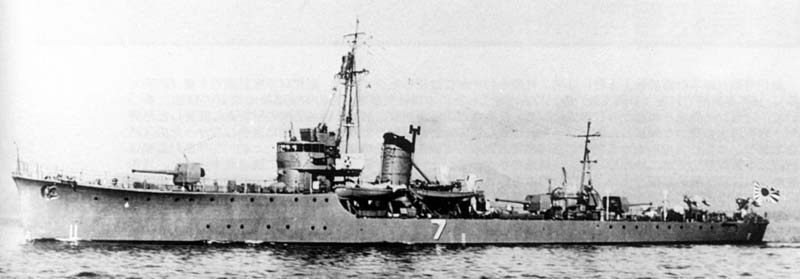 (W-7 class minesweeper scanned from SOTW, V. 507)
IJN Minesweeper W-12:
Tabular Record of Movement
© 2005-2018 Bob Hackett and Peter Cundall
Revision 9
28 May 1938:
Tokyo. Laid down at the Ishikawajima shipyard.
17 February 1939:
Her assigned signal code is JXLD.
18 February 1939:
Launched and numbered W-12.
15 August 1939:
Completed and registered in the IJN at the Sasebo Naval District.
1 June 1941:
W-12 is assigned to Vice Admiral Takahashi Ibo's (36) (former CO of KIRISHIMA) Third Fleet's 1st Base Force in MineSweepDiv 21 with W-7, W-8, W-9, W-10 and W-11.
21 September 1941:
Cdr (Rear Admiral, posthumously) Kitamura Masayuki (45) assumes command of MineSweepDiv 21.
27 November 1941:
Departs Sasebo.
30 November 1941:
Arrives at Mako, Pescadores.
1 December 1941:
Her signal code changes to JXLP.
December 1941:
Lt Hanyu Hidekazu assumes command.
6 December 1941:
Departs Takao, Formosa (now Kaoshiung, Taiwan) and arrives at Boryo, Formosa (now Fangliao, Taiwan) later this day.
7 December 1941: Operation "M" - The Attack on the Southern Philippines:
W-12 departs Mako in Rear Admiral (later Vice Admiral) Nishimura Shoji’s (39) Vigan Invasion Force.
10 December 1941:
Departs Vigan, Philippines.
12 December 1941:
Arrives at Mako.
13 December 1941:
Departs Mako.
15 December 1941:
Arrives at Amami O-shima, Ryukyus.
17 December 1941:
Departs Amami O-Shima. Escorts convoys to Lamon Bay and Davao.
25 December 1941:
Arrives at Lamon Bay.
26 December 1941:
Departs Lamon Bay.
31 December 1941:
Arrives at Davao.
7 January 1942:
Departs Davao and arrives at Magnaga Bay, NE Davao Gulf later this day.
9 January 1942: Operation "H" - The Invasion of Celebes, Netherlands East
Indies:
MineSweepDiv 21's W-12, W-7, W-8, W-9 and W-11, light cruiser
NAGARA, patrol boats PB-1, PB-2, PB-34 and SubChasDiv 1's CH-1, CH-2 and CH-3
departs Magnaga Bay or Davao escorting eight transports carrying Captain (later Vice Admiral)
Mori Kunizo's (40)(former CO of AO SATA) Sasebo No. 1 Combined Special Naval Landing
Force (SNLF) and Rear Admiral Kubo Kyuji's (38) 1st Base Force.
11 January 1942: The Invasion of Menado, Celebes Dutch East
Indies:
Rear Admiral Kubo Kyuji’s (38) 1st Base Force with MineSweepDiv 21, NAGARA,
patrol boats and SubChasDiv 1’s CH-1, CH-2 and CH-3 provides escort for the
Menado invasion force of eight transports carrying Captain Mori's Sasebo No. 1
Combined SNLF.
At 0300, the SNLF lands on Kema, Celebes. At 0400, they land on Menado.
Later, 334 men of Cdr (later Captain) Horiuchi Toyoaki's (50) (later XO of TAKAO)
Yokosuka No. 1 SNLF (Air) are dropped successfully from Mitsubishi G3M1-L Nell
converted transport aircraft in the Menado-Kema area. The paratroops seize Langoan airfield.
W-12 arrives at Menado. Later that day departs and arrives at Banka later this day.
15 January 1942:
Departs Banka.
17 January 1942:
Arrives ar Banka.
20 January 1942:
Departs Banka.
21 January 1942:
Arrives at Banka. Departs Banka escorting the Kendari invasion convoy and conducts
minesweeping.
23-24 January 1942: The Invasion of Kendari, Celebes:
MineSweepDiv
21’s W-12, W-7, W-8, W-9 and W-11, DesRon 10’s light cruiser NAGARA, DesDiv 15’s
HAYASHIO, KUROSHIO, OYASHIO and NATSUSHIO, DesDiv 16’s TOKITSUKAZE, HATSUKAZE,
AMATSUKAZE and YUKIKAZE, and Subchaser Div 1’s CH-1 and CH-2 escort Rear Admiral
Kubo’s Kendari Invasion Force under consisting of six troop transports carrying
Captain (later Vice Admiral) Mori Kunizo’s Sasebo Combined Special Naval Landing
Force (SNLF). The 11th Seaplane Tender Division’s CHITOSE and MIZUHO provide
distant support.
24 January 1942:
Arrives at Kendari.
26 January 1942:
Departs Kendari to search for missing aircraft.
27 January 1942:
Arrives at Kendari.
29 January 1942:
Departs Kendari. Escorts the Ambon, invasion convoy.
31 January 1942: The Invasion of Ambon Island, Moluccas, Netherlands East
Indies:
The convoy includes ten transports carrying 820 men of Rear Admiral
(later Vice Admiral) Hatakeyama Koichiro's (39) (former CO of KINUGASA) Kure No. 1
SNLF, elements of the Sasebo SNLF and the 228th Infantry Regiment escorted by
Rear Admiral (later Vice Admiral) Tanaka Raizo's (41) DesRon 2’s light cruiser JINTSU, DesDiv 8’s ASASHIO,
MICHISHIO, ARASHIO and OSHIO, DesDiv 15’s HAYASHIO, KUROSHIO, OYASHIO and
NATSUSHIO, DesDiv 16’s TOKITSUKAZE, HATSUKAZE, AMATSUKAZE and YUKIKAZE,
Minesweeper Div 21’s W-7, W-8, W-9, W-11 and W-12 and Subchaser Div 1’s CH-1,
CH-2 and CH-3. CHITOSE and MIZUHO arrive at Ceram and provide air cover for the
invasion convoy.
2 February 1942:
Ambon. Lt Hanyu's W-12 explodes a mine while sweeping and is damaged.
8 March 1942:
At 0700 W-7, W-8, W-11 and W-12 depart Kupang.
9 March 1942:
At 1900 arrive at Macassar. The ships are refuelled by tanker OGURA MARU No. 2.
10 March 1942:
Surabaya, Java. W-12 is assigned to the 2nd Southern Expeditionary Fleet's Special Base Force 21 with W-8 and W-11. That same day, she completes repairs. At 0500 W-7, W-8, W-11 and W-12 depart Macassar.
21 March 1942:
Departs Ambon for a trial. Returns to Ambon later this day.
17 April 1942:
Departs Ambon for a trial. Returns to Ambon later this day.
20 April 1942:
At 0700 departs Ambon with W-11. Escorts convoys.
21 April 1942:
At 1240 W-11 and W-12 arrive at Kendari and depart at 1440.
24 April 1942:
At 1600 W-11 and W-12 arrive at Surabaya, Java. Escorts convoys
.
30 April 1942:
At 1515 departs Surabaya.
8 May 1942: Operation "S" – The Seizure of the Lesser Sunda Islands:
At 0900, W-12, CruDiv's 16 light cruiser IZUSU, torpedo boat TOMOZURU and subchasers CH-6, CH-19 and CH-20 depart Surabaya for Lombok Island escorting Rear Admiral (later Vice Admiral) Hara Kenzaburo’s (37) Lesser Sunda Islands Invasion Force consisting of seaplane tender SANYO MARU and minelayer WAKATAKA carrying the Yokosuka No. 1 SNLF and two Army transports.
9 May 1942:
At 1700, the invasion convoy arrives at Mataram, Lombok Island. The SNLF lands and occupies the island.
10 May 1942:
Departs Mataram.
13 May 1942:
At 0830, arrives at Bima, Soembawa Island. The SNLF lands and occupies Bima. At 1000, departs Bima.
14 May 1942:
Arrives at Reo, Flores Island. The SNLF lands and occupies Reo.
16 May 1942:
Arrives at Labuhanbadjo, Flores Island and at Waingapoe, Soemba Island. The SNLF lands and occupies both locations.
17 May 1942:
Arrives at Larantoeka and Endeh, Flores Island. The SNLF lands and occupies both locations.
10 August 1942:
Takes over the escort from subchaser CH-8 of IJA transports NAKO, KINUGAWA and CHIHAYA (Ex Dutch TJISAROEA) MARUs.
12 August 1942:
Arrives at Surabaya. Drydocked for hull repairs.
26 August 1942:
Departs Surabaya. Escorts a convoy.
1 September 1942:
Arrives at Davao.
2 September 1942:
Departs Davao.
6 September 1942:
Arrives at Manila.
8 September 1942:
Departs Manila.
10 September 1942:
Arrives at Mako.
12 September 1942:
Departs Mako.
16 September 1942:
Arrives at Sasebo.
22 September 1942:
Drydocked at the fifth graving dock at Sasebo.
5 October 1942:
Undocked and transfers to quay No. 1.
24 October 1942:
Undocked.
29 October 1942:
Departs Sasebo.
2 November 1942:
Arrives at Takao and departs later that day.
4 November 1942:
Arrives at Manila.
5 November 1942:
Departs Manila.
9 November 1942:
Arrives at Balikpapan.
12 November 1942:
Departs Balikpapan on an escort mission.
14 November 1942:
Arrives at Surabaya.
16 November 1942:
Surabaya. Sweeps the Kohoku waterway for mines.
19 November 1942:
Arrives back at Surabaya.
21 November 1942:
Departs Surabaya and escorts a convoy.
23 November 1942:
Arrives back at Surabaya. Later that day departs Surabaya and sweeps the approaches for mines.
24 November 1942:
Returns to Surabaya.
25 November 1942:
Departs Surabaya on a waterway survey mission.
26 November 1942:
Arrives at Surabaya. Again departs Surabaya and sweeps the approaches for mines.
27 November 1942:
Departs Surabaya on an escort mission.
29 November 1942:
Arrives at Kendari.
8 December 1942:
Departs Surabaya. Escorts a convoy to Ambon.
1 January 1943:
Arrives at Batavia.
3 January 1943:
Departs Batavia with KOREI MARU for rescue of victims of KANAYAMA MARU (2733 gt).
8 January 1943:
Early am arrives at Surabaya.
9 January 1943:
Departs Surabaya on an escort mission.
11 January 1943:
In the late evening arrives at Zandhuis Banken (Pulau Sabadur).
13 January 1943:
Departs Zandhuis Banken escorting YOSHIDA MARU No. 1 and YAMAZATO MARU.
16 January 1943:
Arrives at Ambon.
18 January 1943:
Early am departs Ambon on an escort mission.
23 January 1943:
Arrives at Surabaya.
3 February 1943:
Departs Surabaya on an escort mission.
6 February 1943:
Arrives back at Surabaya.
12 February 1943:
Departs Surabaya on an escort mission.
16 February 1943:
Arrives at Kupang and departs later the same day. Arrives at Dili, Portugese Timor later this day.
17 February 1943:
Departs Dili.
18 February 1943:
Arrives at Tandjoeng Kebon (now Tanjung Kebang), Pulau Solor.
19 February 1943:
Departs Tandjung Kebon and arrives at Dili later that day.
20 February 1943:
Departs Dili for Lautem.
21 February 1943:
Arrives off Lautem and undertakes patrols.
24 February 1943:
Arrives at Lautem.
25 February 1943:
Arrives at Kebola Bay (Teluk Kalabahi).
26 February 1943:
Departs Kebola Bay on an escort mission.
2 March 1943:
Arrives at Surabaya.
6 March 1943:
Departs Surabaya escorting No.4 Ji Yuso Convoy consisting of YOSHIDA MARU No. 1, PENANG, FUKOKU, KYOKKO and TAIMEI MARUs.
9 March 1943:
Breaks off escort mission to anchor at undisclosed location.
10 March 1943:
Resumes the escort mission.
11 March 1943:
Arrives at Ambon.
13 March 1943:
Departs Ambon still escorting No.4 Ji Yuso Convoy.
15 March 1943:
Arrives at Babo.
16 March 1943:
Departs Babo on an escort mision still presumably escorting No.4 Ji Yuso convoy.
17 March 1943:
Arrives at Kaimana.
19 March 1943:
Departs Kaimana on an escort mission still presumably escorting No.4 Ji Yuso convoy.
20 March 1943:
Arrives at Patipi Bay (Solat Len).
21 March 1943:
Departs Patipi Bay (Solat Len) on escort mission still presumably escorting No.4 Ji Yuso convoy.
23 March 1943:
Arrives at Ambon.
24 March 1943:
Departs Ambon on an escort mission still presumably escorting No.4 Ji Yuso convoy.
25 March 1943:
Temporarily anchors at an undetermined location.
26 March 1943:
Resumes voyage, still presumably escorting No.4 Ji Yuso convoy.
29 March 1943:
Arrives at Surabaya.
1 April 1943:
Departs Surabaya to search for a missing aircraft.
4 April 1943:
Arrives Jakarta and departs later on patrol.
7 April 1943:
Arrives at Christmas Island.
9 April 1943:
Departs Christmas Island and resumes patrol.
12 April 1943:
Arrives at Jakarta.
13 April 1943:
Departs Jakarta on patrol.
16 April 1943:
Arrives at Surabaya.
18 April 1943:
Lt Kawano Atsumu assumes command.
25 April 1943:
Departs Surabaya on an escort mission.
30 April 1943:
Arrives at Ambon.
2 June 1943:
Escorts convoys to western New Guinea.
1 July 1943:
At Ambon.
5 July 1943:
At 0000 departs Ambon.
7 July 1943:
Late that evening arrives at Kaimana.
9 July 1943:
Late that evening departs Kaimana on an escort mission.
12 July 1943:
Arrives at Ambon.
14 July 1943:
Departs Ambon.
19 July 1943:
Arrives at Surabaya.
21 July 1943:
Departs Surabaya.
23 July 1943:
Arrives at Macassar.
24 July 1943:
Departs Macassar for Lombok area.
27 July 1943:
Arrives back at Surabaya.
1 August 1943:
Arrives at Surabaya. Drydocked.
13 August 1943:
Undocked.
15 August 1943:
Departs Surabaya. Escorts a convoy to Ambon.
21 August 1943:
At 1530 arrives at Ambon.
25 August 1943:
At 1600 departs Ambon on an escort mission.
27 August 1943:
At 0645 arrives at Kaimana. Later departs and returns to Ambon.
30 August 1943:
At 0730 arrives at Ambon.
3 September 1943:
At 1300 arrives at Maumere.
4 September 1943:
At 1800 departs Maumere on an escort mission.
7 September 1943:
At 1200 arrives at Surabaya.
11 September 1943:
At 1100 departs Surabaya on an escort mission.
14 September 1943:
At 0900 arrives at Jakarta.
15 September 1943:
At 0000 departs Jakarta on an escort mission.
22 September 1943:
At 1500 arrives at Ambon.
25 September 1943:
At 1000 departs Ambon on an escort mission.
26 September 1943:
At 1330 arrives at Bula.
9 October 1943:
At 0828 departs Bula (or some other location in area) on an escort mission.
11 October 1943:
At 1800 arrives at Surabaya.
15 October 1943:
At 1200 departs Surabaya on an escort mission.
17 October 1943:
At 1700 arrives at Jakarta.
20 October 1943:
At 1830 departs Jakarta on an escort mission.
22 October 1943:
At 1430 arrives at Surabaya.
29 October 1943:
At 0955 departs Surabaya on an escort mission.
1 November 1943:
Arrives back at Surabaya.
3 November 1943:
At 1030 departs Surabaya on an escort mission.
5 November 1943:
At 1630 arrives at Batavia.
6 November 1943:
At 0900 departs Batavia on an escort mission.
9 November 1943:
At 0830 arrives at Balikpapan.
10 November 1943:
At 0800 departs Balikpapan escorting SENKO MARU.
E 12 November 1943:
W-12 hands over escort to W-8 at 04-00S, 112-00E and heads for Surabaya. SENKO MARU and W-8 proceed to Padang.
13 November 1943:
At 1930 arrives at Surabaya.
16 November 1943:
At 1600, departs Surabaya escorting NANKAI MARU.
17 November 1943:
W-12 develops engine trouble. The convoy anchors for five hours at Kabanramari Island, Postiljon Archipelago, while W-12 carries out engine repairs.
20 November 1943:
At 0730, arrives at Ambon. W-12 is detached from the convoy that proceeds to Halmahera Island.
26 November 1943:
After 1200, W-12 and W-11 depart Ambon escorting a convoy consisting of SUEZ MARU carrying sick and wounded Japanese troops and 1,102 mostly sick British and Dutch POW's and NICHINAN MARU (2732 gt). A E-13A1 "Jake"float plane is located on the fore deck of the ship. The aircraft has a fractured fuselage and is scheduled for repairs at Repair Depot No. 102 in Surabaya.
27 November 1943:
W-11 detaches from the convoy and heads for Kendari. North of Flores discovers an enemy submarine.
28 November 1943:
NICHINAN MARU is detached. In the evening, W-12 detaches to hunt an enemy submarine, but rejoins SUEZ MARU the following morning.
29 November 1943:
At 0800, LtCdr (later Cdr) Thomas W. Hogan's (USNA ’31) USS BONEFISH (SS-223) fires four torpedoes at the overlapping targets of SUEZ MARU and W-12 at 06-22N, 116-35E. SUEZ MARU's lookouts sight the torpedoes and she avoids two. The third explodes prematurely, but Hogan's fourth torpedo strikes hold No. 4, which along with hold No. 3 contains the POW's. Most of the POW's in the hold are killed in the blast. The ship settles rapidly with a steep list and sinks at 0940.
About 200-250 POW's survive. W-12 rescues about 200-250 Japanese and Koreans, but is unable to accommodate any POW's. After much arguing, and on the insistence of Lt Kawano Atsumu, CO of W-12, IJA Lt Koshio Masaji, in charge of the POW's, agrees to massacre the survivors in the water. Between 1415 and 1630, a rifle party of a dozen men is based on the warship's foredeck and together with a machine gun mounted on the bow opens fire on the POW's. Either in the ensuing massacre, or in the water over the next few days, all but possibly one of the POW's are killed. A solitary survivor, British Soldier Kenneth Thomas, was allegedly rescued 24 hours later by the Australian minesweeper HMAS BALLARAT, although this is unconfirmed.
E 1 December 1943:
W-12 is diverted to Batavia because of mines in Surabaya.
7 December 1943:
Arrives at Surabaya.
3 January 1944:
At 1200 arrives back at Surabaya from an escort mission.
4 January 1944:
At 1200 departs Surabaya on an escort mission.
17 January 1944:
At 1200 arrives back at Surabaya.
22 January 1944:
At 1400 departs Surabaya on an escort mission.
31 January 1944:
At 1700 arrives back at Surabaya.
6 February 1944:
At 0120 departs Surabaya on an escort mission.
9 February 1944:
At 1430 arrives back at Surabaya.
15 February 1944:
At 1400 departs Surabaya on an escort mission.
28 February 1944:
Arrives back at Surabaya.
1 March 1944:
At 1200, W-12 and auxiliary subchaser CHa-103 depart Surabaya escorting a convoy consisting of KITA MARU and tankers KYOEI MARU and TSURUMI.
2 March 1944:
A radio message is received advising Balikpapan Port has been mined. The convoys sails to Pagatan arriving there later that day.
3 March 1944:
At 0400, departs Pagatan. At 0930, KITA MARU is detached from the convoy. Later that day, the convoy arrives in the Kotabaru Sea and anchors there.
4 March 1944:
At 1530, departs Kotabaru Sea and at 2000 arrives at Pamukan Bay.
5 March 1944:
At 0500, departs Pamukan Bay and later that day arrives at Balikpapan.
6 March 1944:
At 1430 W-12 (that must have detached at some point) arrives back at Surabaya.
8 March 1944:
At 1500 departs Surabaya for Waingapu, Sumba on an escort mission and anti submarine sweep.
14 March 1944:
At 08-17S- 125-49E, carries out an anti submarine sweep and drops depth charges.
16 March 1944:
At 1100 arrives back at Surabaya. At 1710 departs Surabaya on an escort mission and anti submarine sweep.
21 March 1944:
At 2325, at 07-59S 115-1E discovers surfaced enemy submarines and attacks them.
22 March 1944:
At 1630 arrives back at Surabaya.
26 March 1944:
At 0800, W-12 and subchaser CH-2 depart Surabaya escorting a convoy consisting of NICHINAN (2732 gt), HEIAN and KUNIYAMA MARUs. That evening, anchors at Kangean Island. NICHINAN MARU carries the main body of the IJA 147th Infantry Regiment [less 3rd Battalion].
27 March 1944:
At 0600, departs Kangean Island. At 1000, LtCdr Willard R. Laughon's (USNA ’33) USS RASHER (SS-269) torpedoes and sinks NICHINAN MARU at 07-27S 115-52E. 311 passengers, including the 147th Infantry Regimental Commander and 264 men below the rank of colonel, 28 crewmen and 10 shipboard gunners die.
W-12 and subchaser CH-2 counter-attack dropping 35 depth-charges without effect. The convoy returns to Surabaya. At 1825, the convoy again departs port.
28 March 1944:
The escort is handed over to patrol boat No. 104 at 07-15S, 115.50E. W-12 and subchaser CH-2 return to Surabaya.
29 March 1944:
At 0100, runs aground at the west end of Saseel Island. At 0330, PB-104 arrives and assists with refloating. Arrives at Surabaya later this day.
1 April 1944:
At 1400 arrives at Surabaya. Unloads ammunition and depth charges. At 1400, enters the first dock of the 102nd. Naval Construction and Repair Department for hull bottom inspection and refurbishment.
4 April 1944:
At 1500, docks and thereafter transfers to quay No. 3.
5 April 1944:
At 1600, transfers to buoy C1.
6 April 1944:
Departs Surabaya on a trial run, returns later this day.
7 April 1944:
Loads 45t heavy oil and 80t coal. At 1500 arrives at Surabaya.
8 April 1944:
In the morning loads ammunition and 12 ninety-nine type depth charges.
12 April 1944:
At 1300, W-12 and subchaser CH-2 depart Surabaya escorting a convoy consisting of MIKASA MARU and SHINSEI MARU No. 17.
13 April 1944:
The convoy arrives at Hertenbeest Island (now Pulau Menjangan). W-12 and CH-2 guard and patrol the anchorage.
14 April 1944:
At 0000, departs Hertenbeest Island and at 2000, arrives at Lawang anchorage, (Poelau Lawang) in Strait Soengian (now Selat Sugian).
15 April 1944:
At 0400, departs Lawang anchorage and at 2400, arrives at Bima, Sumbawa Island.
16 April 1944:
At 0500 departs Bima Bay.
17 April 1944:
At 1100, arrives at Maumere, Flores Island and the ships begin unloading their cargo. At 1700, anchors.
18 April 1944:
At 1300, unloading cargo is completed and departs Maumere.
19 April 1944:
At 1930, arrives at Bima Bay.
20 April 1944:
From 0900 till 1220 alongside SHINSEI MARU No. 17 and loads 50t coal and 10t fresh water. At 1230, anchors.
21 April 1944:
At 0100 departs Bima Bay. At 2130 arrives at Lauan.
22 April 1944:
At 0130, departs Lauan.
23 April 1944:
At 1200, arrives at Surabaya.
24 April 1944:
At 1800 departs Surabaya on patrol. At 1930, beacause of an air alert temporarily remains in the Surabaya north waterway exit.
25 April 1944:
At 0700, departs the Surabaya north waterway exit. At 0800 arrives back at Surabaya. Loads 42t heavy oil from the 102nd Naval Construction and Repair Department and 60t coal and 20t boiler water from the First Port Authority.
26 April 1944:
In the morning loads seven days of fresh food from the 102nd. Naval Construction and Repair Department. At 1200, departs Surabaya with surveying ship escort KATSURIKI escorting CHOYO (ex RNN surveying vessel TYDEMAN) towing 473 ton oil barge (presumed) JOKAI MARU and accompanied by TOYO MARU No. 5 towing 486 ton oil barge (presumed) JOTOU MARU. At 1620, sweeps channel A for mines on the outside of the buoy area and finds mines. The mines are destroyed with gunfire. The 25 mm guns fire 24 rounds, the 12 mm guns fire 160 rounds, the 7.7 mm guns fire 24 rounds and the Arisaka rifles fire 60 rounds.
27 April 1944:
At 1800, arrives at Jakarta. Loads 20t heavy oil and 5t coal from the 102nd. Naval Construction and Repair Department.
28 April 1944:
Loads for 5 days of fresh foods from the 102nd. Naval Construction and Repair Department. At 1500, departs Jakarta.
30 April 1944:
Loads 20t coal and 5t boiler water from the 11th. Naval Construction Department. At 0450 arrives at unidentified location Ke-Ra-Ke-Ya-Tsu-Pu (Krakapu?)
- [possibe mistranslation for Tjilatjap???]
2 May 1944:
At 0930, departs the unidentified location with TYDEMAN towing TOYO MARU No. 5.
5 May 1944:
At 0940, arrives at Jakarta. Jakarta. Loads for 3 days of fresh food from KATSURIKI. At 1400 departs port.
6 May 1944:
At 1530, arrives at Surabaya.
7 May 1944:
In the morning unloads ammunition and depthcharges. At 1200, enters 1st drydock. Drydocked.
15 May 1944:
Loads 2 months of stored goods.
25 May 1944:
Undocked.
Transfers to the first quay.
27 May 1944:
Loads 50t heavy oil from the 102nd. Naval Construction and Repair Department.
29 May 1944:
Loads 30t fresh water from the first Port Authority.
30 May 1944:
Departs Surabaya to test the underwater hearing instruments, radio stations and speed outside the harbor. At 1640, temporarily remains in the Surabaya waterway because of an air alert.
31 May 1944:
At 0700, departs the Surabaya waterway and returns to Surabaya. Loads ammunition, depthcharges and 9t heavy oil from the 102nd. Naval Construction and Repair Department.
1 June 1944:
Loads 60t coal, 15t boiler water and 11 days of resh foods from the 102nd. Naval Construction and Repair Department.
3 June 1944:
At 0900, W-12 departs Surabaya escorting a convoy to Balikpapan, Borneo consisting of KITA, ENOSHIMA and JAMBI MARUs.
4 June 1944:
At 0000, west of Bawean Island detaches and heads towards Balikpapan. At 1445, ordered to return to Surabaya as soon as possible.
5 June 1944:
At 1055, arrives at Surabaya. In the afternoon loads 15t coal, 26t heavy oil and 5 days of fresh food from the 102nd. Naval Construction and Repair Department.
6 June 1944:
At 1000 departs Surabaya escorting TENSHIN MARU.
At 1500, because of low quality coal the TENSHIN MARU can’t make enough speed and returns to Surabaya. At 1920, temporarily stays outside Surabaya harbor.
7 June 1944:
At 1100, departs Surabaya to escort TENSHIN MARU. At 1320, arrives at Surabaya.
8 June 1944:
In the morning loads 6t coal, 5t heavy oil and 15t fresh water from the 102nd. Naval Construction and Repair Department.
9 June 1944:
Loads 4 days of fresh food.
10 June 1944:
At 1000, W-12 departs Surabaya escorting a convoy consisting of IKUTAGAWA and SEIA MARUs.
11 June 1944:
At 2030, arrives at Laut Island, SE Borneo.
12 June 1944:
At midnight, departs Laut Island. At 1920, arrives at Doangdoangan Island. At 2100, auxiliary subchaser SHONAN MARU No. 1 joins the convoy.
13 June 1944:
At midnight, departs Doangdoangan Island. At 1845, arrives at Tioro Strait.
14 June 1944:
At 0010, alongside SEIA MARU and loads 37t heavy oil. At 0910, departs Tioro Straits and SHONAN MARU No. 1 is detached. At 1800, enters Wowoni Channel.
15 June 1944:
At 0500, departs Wowoni Channel. At 1650, W-22 joins the escort . At 1730, arrives at Litrusaru (Little Saloe).
16 June 1944:
At 0900, departs Litrusaru (Little Saloe). At 1730 arrives at the N side of Sanana Island.
17 June 1944:
At 0230 departs Sanana Is. At 1630, arrives at Namlea, Buru Island.
18 June 1944:
At 0600, departs Namlea and at 1340, arrives at Ambon.
Departs Ambon to carry out an anti submarine sweep at the mouth of the bay.
19 June 1944:
Returns to Ambon. In the afternoon loads 40t heavy oil, 10t coal and 15t fresh water from the Ambon branch of the 102nd. Naval Construction and Repair Department.
21 June 1944:
Loads 3 days of fresh food.
23 June 1944:
Loads 4 days of fresh food and a part of the stored food products.
24 June 1944:
At 0700, W-12, torpedo boat KIJI, auxiliary minesweeper Wa-9 and auxiliary NITTO MARU No. 18 depart Ambon escorting a convoy consisting of SHINNO and KOHOKU MARUs and TENKAI No. 4. At 1720, arrives at Namlea Bay, Buru Island.
25 June 1944:
At 0530, departs Namlea Bay. W-12 and TENKAI No. 4 are detached and head for Surabaya.
26 June 1944:
At 0820, at the northern tip of Taliabu Island detaches. At 1215, stops escorting TENKAI No. 4 and returns to Ambon alone.
27 June 1944:
At 0920, auxiliary subchaser TAKANAN MARU No. 5 and SHONAN MARU No. 2 stop escorting TENKAI No. 4 and return to Ambon. Together with TAKANAN MARU No. 5 and SHONAN MARU No. 2 joins escort of auxiliary transport NICHIEI MARU convoy. NICHIEI MARU had been damaged the day before in an air strike. At 1300, arrives at Ambon.
28 June 1944:
In the afternoon loads 40t heavy oil, 20t coal, 25t boiler water and 6 days of fresh food from the Ambon branch of the 102nd. Naval Construction and Repair Department.
29 June 1944:
Loads 2 days of fresh food.
30 June 1944:
At 1100, W-12, torpedo boat KARI and auxiliary minelayer SHONAN MARU No. 2 depart Ambon escorting a convoy to Surabaya consisting of IKUTAGAWA and SEIA MARUs and LSTs 101 and 102.
At 1850, arrives at Namlea.
1 July 1944:
At 0500 departs Namlea. At 0840, 4 enemy aircraft arrive of which one makes an attack. No damage occurs. At 1900 arrives at Vesuvia.
2 July 1944:
At 0700 departs Vesuvia. At 1800 arrives at Great Saloe anchorage.
3 July 1944:
At 0220 departs Great Saloe Anchorage. At 1100 arrives at Laoe Bay.
At 2000, alongside SEIA MARU and loads 30t heavy oil.
4 July 1944:
At 0600 departs Laoe Bay. At 0925, inverts after receiving a report about the presence of enemy submarines in the Salajar Channel. At 1100, arrives off Tandjung Patjube.
5 July 1944:
At 1900, departs Tandjung Patjube.
SHONAN MARU No. 2 joins the convoy escort. Subsequently together with SHONAN MARU No. 2 detaches fom the convoy to carry out an anti submarine sweep in Boni Bay.
6 July 1944:
At 0545, with SHONAN MARU No. 2 rejoins the convoy. At 2100, arrives at Doangdoangan.
SHONAN MARU No. 2 detaches.
7 July 1944:
At 0650, departs Doangdoangan. At 1655, detaches to attack an enemy submarine discovered by a patrol aircraft. At 1742, at 04-30S 116-35E drops 27 depth charges. At 2100, ends the anti submarine sweep and returns to the convoy.
8 July 1944:
At 0430, rejoins the convoy. At 1130, arrives at Surabaya.
9 July 1944:
Arrives at Surabaya. Loads 50t heavy oil from the 102nd Military Division.
11 July 1944:
Loads ammunition (100 shells for the 12 cm guns and 2400 bullets for the 25 mm guns) and 27 type 95 depthcharges from the 102nd. Naval Construction and Repair Department.
12 July 1944:
Alongside quay No. 2.
13 July 1944:
At 1145, loads 30t coal, 20t fresh water and 8 days of fresh food from the 102nd. Naval Construction and Repair Department.
14 July 1944:
Starts adding additional equipment.
15 July 1944:
At 1630, departs quay No. 2. At 1700, anchors.
16 July 1944:
Completes adding additional equipment.
17 July 1944:
At 0850, transfers to buoy C3.
18 July 1944:
Loads 6 days of fresh food from SEIA MARU.
19 July 1944:
At 1600 departs Surabaya on patrol. At 2050, begins an anti aircraft patrol.
20 July 1944:
At 0720, 25 mm guns trial. At 1805 arrives back at Surabaya. Loads 15t fresh water from the First Port Authority.
21 July 1944:
In the afternoon loads 7t heavy oil from the 102nd. Naval Construction and Repair Department.
23 July 1944:
At 1650, loads 10t fresh water and 3 days of fresh food from the First Port Authority.
24 July 1944:
At 1015, departs Surabaya escorting SEIA MARU to Ambon.
25 July 1944:
At 2130, arrives at Laut Island and departs there at 2359.
26 July 1944:
At 2000, arrives at Doangdoangan.
27 July 1944:
At 0000, departs Doangdoangan. At 1830, arrives at the west mouth of Tioro Straits and anchors there.
28 July 1944:
At 0530, departs the west mouth of Tioro Straits. At 1230, at Strait Boeton alongside SEIA MARU and loads 44t heavy oil and 5t boiler water. At 1710, CH-53 joins the convoy escort. At 1800, arrives at Wowoni.
29 July 1944:
At 0400, departs Wowoni. At 1800, arrives at Great Saloe.
30 July 1944:
At 0830, departs Great Saloe and at 1340 arrives off Little Saloe.
Alongside SEIA MARU and loads 13t heavy oil.
31 July 1944:
At 0800 departs Little Saloe. At 1830, arrives at Taboro Bay on Tabulu Island.
1 August 1944:
At 0102, SEIA MARU is attacked by one enemy bomber aircraft. At 0110, SEIA MARU is hit and a fire starts. At 1315 SEIA MARU sinks. At 1800, takes 178 survivors from SEIA MARU onboard and departs Taboro Bay. CH-53 stays at the sinking scene.
2 August 1944:
At 0217, at 02-52S 127-20E attacked by one enemy bomber aircraft. No damage occurs. At 0730 arrives at Ambon.
3 August 1944:
At 0114, one enemy bomber aircraft attacks. No damage occurs. At 0730, loads 35t coal, 33t heavy oil and 20t boiler water from the Ambon branch of the 102nd. Naval Construction and Repair Department.
4 August 1944:
At 1100, loads 5 days of fresh food. At 1330, W-12 and subchasers CH-26, CH-34 and CH-35 depart Ambon escorting a convoy to Staring Bay, Celebes consisting of SHINTAI, KANTO and KURAMASAN MARUs.
5 August 1944:
At 0945, CH-26 reverses course back to Ambon.
6 August 1944:
At 1045, KANTO MARU detaches and heads towards Raja. At 1400, the convoy arrives at Staring Bay.
Thereafter departs for Surabaya.
8 August 1944:
At 1915 arrives at Surabaya.
9 August 1944:
Loads 1 day of fresh food.
11 August 1944:
In the morning unloads ammunition and depthcharges. At 1100, loads 10t fresh water.
13 August 1944:
At 1000, W 12 enters Surabaya Dockyard's No.2 Dock for engine repairs and hull anti fouling paint replacement.
17 August 1944:
At 0930, undocked.
18 August 1944:
At 0900, loads 15t boiler water. At 1100, loads stored products.
19 August 1944:
At 0930, departs Surabaya on trials. Returns at 1520.
20 August 1944:
In the morning loads 40t coal, 60t heavy oil and 15t fresh water from the 102nd. Naval Construction and Repair Department.
21 August 1944:
Loads ammunition.
22 August 1944:
At 1530, loads 20t boiler water and 8 days of fresh food.
23 August 1944:
At 1150, departs Surabaya with KOTSUSEN (Shuttleboat) No. 113 for Christmas Island.
24 August 1944:
At 2020, executes an anti submarine sweep in the Sunda Strait.
25 August 1944:
At 1135, stops the anti submarine sweep and heads towards Christmas Island meanwhile searching for KOTSUSEN No. 113. She is missing since the bombardment of Christmas Island on 22 August 1944.
26 August 1944:
At 0900, arrives Christmas Island. Unloads stored products and a portion of liquor. Later departs port to search for enemy submarines and KOTSUSEN No. 113.
28 August 1944:
At 0930, returns towards Christmas Island meanwhile keeps searching for enemy submarines and the KOTSUSEN 113. At 2205, reports that KOTSUSEN No. 113 cann’t be found.
29 August 1944:
At 1130, arrives at Jakarta. Loads 65t coal, 58t heavy oil, 15t fresh water and 8 days of fresh food from the Jakarta branch of the 102nd. Naval Construction and Repair Department.
30 August 1944:
At 1730, departs Jakarta for Padang escorting SHIRETOKO MARU.
At 2400, searching for KOTSUSEN No. 113 which inverted its course coming from Krakatau Island.
31 August 1944:
At 0400, south of Babi Island meets up with KOTSUSEN No. 113 and auxiliary submarine chaser CHa-117. At 0550, detaches and departs Babi Island.
1 September 1944:
At 1940, joins the SHIRETOKO MARU convoy off Padang. With CH-1 escorts SHIRETOKO MARU and reverse.
5 September 1944:
At 0415, at 05-44S 104-58E SHIRETOKO MARU is torpedoed and sinks. The escorts immediately begin an anti submarine attack. At 1000 rescues 8 survivors. At 1515 CHa-117 joins the anti submarine attack.
6 September 1944:
At 0800, because of insufficient fuel and boiler water stops the anti submarine attack and heads towards Jakarta. Arrives at Jakarta at 1600. Loads 50t coal, 60t heavy oil and 15t fresh water.
7 September 1944:
Loads 8 days of fresh food. At 1900, departs Jakarta escorting KOTSUSEN No. 113.
8 September 1944:
At 1240 keeps track of KOTSUSEN No. 113. At 1400, beside KOTSUSEN No. 113 and departs.
11 September 1944:
At 1620, arrives at Christmas Island.
13 September 1944:
At 0820, departs Christmas Island escorting KOTSUSEN No. 113.
15 September 1944:
At 0900, detaches and heads towards Jakarta. Ät 1900, arrives at Jakarta.
16 September 1944:
Loads 15t fresh water.
18 September 1944:
In the morning loads 30t heavy oil and 5 days of fresh food from the Jakarta branch of the 102nd. Naval Construction and Repair Department. At 1800, departs Jakarta escorting MANYO MARU.
19 September 1944:
At 1706, a transport aircraft found surfaced enemy submarines at 340 degrees and 120 nautical miles (enemey cours 300 degrees) from Surabaya. At 1730, an army aircraft found an enemy submarine at 6 degrees 2 minutes south latitude and 110 degrees 10 minutes east longitude. W-12 is ordered to attack the enemy submarine. At 2030, detaches from MANYO MARU and heads towards the reported location to execute an anti submarine sweep. MANYO MARU returns to Semarang and waits there.
20 September 1944:
At 0000, arrives at the reported location and begins an anti submarine sweep.
22 September 1944:
The Bawean Island guard discovers a surfaced enemy submarine near the south eastern tip of the Island.
23 September 1944:
At 1200, heads towards the southern end of Bawean Island to execute an anti submarine sweep.
24 September 1944:
At 1300, stops the anti submarine sweep and heads towards Surabaya to be resupplied. At 1930, arrives off Gresik (Grissee), Java.
25 September 1944:
At 0710, departs off Gresik and arrives at Surabaya later this day.
26 September 1944:
In the morning unloads amunition, depthcharges and 10t fresh water. At 1130, enters No. 1 drydock. Repairs begin.
30 September 1944:
Completes repairs.
1 October 1944:
At 1500, undocks and transfers to quay No. 2.
2 October 1944:
Loads 1 month of stored products from the 102nd. Naval Construction and Repair Department.
3 October 1944:
Loads 25t fresh water.
4 October 1944:
Loads 20t fresh water.
6 October 1944:
At 1810 transfers to buoy C1.
7 October 1944:
In the afternoon loads 61t heavy oil and 20t fresh water from the 102nd. Naval Construction and Repair Department.
8 October 1944:
In the morning loads 60t coal from the 102nd. Naval Construction and Repair Department.
9 October 1944:
Departs Surabaya for a trial outside the harbor and returns later that day.
10 October 1944:
Loads ammunition, 35t coal and 6t heavy oil from the 102nd. Naval Construction and Repair Department.
11 October 1944:
Loads 20t fresh water and 8 days of fresh food. At 1330, departs Surabaya.
At 1800, heads towards Southern Bawean Island to execute an anti submarien sweep. At 2130, arrives at Southern Bawean Island and begins an anti submarine sweep.
12 October 1944:
At 1200, stops the anti submarine sweep.
13 October 1944:
At 1015, at S05.19-E112.32 begins installing a large red floating buoy. At 1330, installing the floating buoy is finished and departs.
14 October 1944:
At 0945, NW of Tandjung Selatan meets up with TENCHO MARU. Searches for KANTO MARU (JBFO) towards the South Exit of Laut Strait. W-12 and TENCHO MARU anchor in Laut Strait at 2245.
15 October 1944:
At 0620, departs Laut Strait and at 0700, meets with DAI and KANTO MARUs and head towards outside Bandjarmasin harbor.
16 October 1944:
At 0250, arrives Bandjermasin. At 0650, departs port and temporarily anchors nearby. At 0800, arrives with TENCHO MARU off the coast of Pegatan. At 1220, alongside TENCHO MARU and begins loading 15t coal and 4t fresh water. At 1500, loading is completed.
17 October 1944:
At 0650, departs off the coast of Pegatan, escorting a convoy consisting of KANTO, TENCHO and DAI MARUs. At 1320, a report of an enemy submarine ahead is received and the convoy turns back to Batakani, near Cape Selatan arriving there at 1930.
18 October 1944:
At 2100, departs Batakani.
20 October 1944:
At 1530, arrives at Surabaya.
21 October 1944:
Departs Surabaya on a submarine excercise with a German submarine as target. Returns at Surabaya later this day. Loads 25t fresh water.
22 October 1944:
Unloads ammunition.
24 October 1944:
At 1100, docked in Dock No. 2 for repairs.
26 October 1944:
At 1000, undocked and transfers to quay No. 2.
28 ~ 29 October 1944:
Gun replacement.
6 November 1944:
At 1630 departs Surabaya on an anti submarine patrol.
9 November 1944:
At 1110 arrives back at Surabaya.
10 November 1944:
At 1210 departs Surabaya escorting a convoy consisting of NAGARA and NITTEI MARUs and NANSHIN MARU No. 12 and NANSHIN MARU No. 16.
16 November 1944:
At 0830, W-12, auxiliary subchasers CHa-2 and CHa-3 depart Sebuku Island, SE Borneo escorting a convoy consisting of AKITSU MARU towing HOKKAI MARU assisted by auxiliary salvage ship KAIKO MARU and auxiliary netlayer SHUNSEN MARU (that is known in some sources as HARUKAWA MARU, an alternate reading of the same name characters).
18 November 1944:
At 2345, arrives in the swept eastern channel to Surabaya Port.
19 November 1944:
At 1230, arrives at Surabaya. HOKKAI MARU enters drydock.
23 November 1944:
At 1530 departs Surabaya on an escort mission.
28 November 1944:
At 1845 arrives at Surabaya.
December 1944:
Transfers to Tarakan area.
1 December 1944:
On that day, FRUMEL provides the following information:
"Vessels for transporting troops between Jolo and Tarakan (Minesweepers 12 and 8 and Subchaser 4), will leave Balikpapan at 1830 on 3rd and arrive Jolo at 1700 on 5th.
880 men of NADA Force comprise the troops to be transported."
5 December 1944:
At 1830 departs Balikpapan on the transport mission with CH-4 and W-8.
7 December 1944:
At 1730 arrives at Jolo.
9 December 1944:
At 0700 arrives at Tarakan.
10 December 1944:
At 1800 arrives back at Balikpapan.
30 December 1944:
Arrives at Surabaya.
28 January 1945:
At 1300, meets up with SUITEN (ex Dutch SCHOUTEN) and TAITO MARUs escorted by PB-2. Starts escorting. They arrive at Pekalongan later this day and stay there during the night.
29 January 1945:
Departs Pekalongan and arrives at Rembang later that day. The convoy stays there temporarily and it departs later that night.
30 January 1945:
At 1145, arrives with the convoy at Surabaya.
3 February 1945:
Departs Balikpapan. At 1930 anchors near the first buoy.
4 February 1945:
At 0300, departs the first buoy.
5 February 1945:
At 0830, joins with the second group (PB-108 and CH-5). At 1804 PB-36 runs aground. At 2255, PB-36 detaches. Continues as the first group with CH-5. Arrives at Tawi-Tawi later this day and departs later that day.
6 February 1945:
Arrives at Tawao (Tawau) and departs later this day.
7 February 1945:
Arrives at Balikpapan.
11 February 1945:
Departs Balikpapan.
12 February 1945:
Arrives at Bandjarmasin.
14 February 1945:
At 0600, W-12 and patrol boat No. 10 depart depart the mouth of Barito escorting convoy BASU-12 consisting of DAI, OTOME, KOMPIRA, NITTEI, HEIYO, TOKUYAMA and NANSHO MARUs, communications boats No's 312, 401, 402, 408 and 409. At 1300, No. 408 breaks down and No. 409 takes the boat in tow back to Bandjarmasin.
15 February 1945:
At 2020, the convoy anchors in Surabaya's eastern channel.
16 February 1945:
At 0800, departs and at 1100, arrives at Surabaya Port.
25 February 1945:
At 1500 departs Surabaya.
26 February 1945:
Departs Surabaya on an escort mission and returns later that day.
28 February 1945:
Escorts W-8 towing auxiliary submarine chaser SHONAN Maru No. 1. At 0015, retreats towards 340 degrees and 25 nautical miles of Cape Selatan lighthouse, Borneo. Arrives at Surabaya later that day.
8 March 1945:
At 0940 departs Surabaya on No.1 transport mission for No. 2 Sakusen and joins W-11, W-34 and torpedo boat KARI.
11 March 1945:
Arrives at Kupang and departs later that day.
13 March 1945:
At 1730 W-11, W-12, W-34 and KARI arrive back at Surabaya.
15 March 1945:
At 1600 W-12 departs Surabaya on an escort mission.
19 March 1945:
At 1310 arrives back at Surabaya.
24 March 1945:
At 1200 W-12 departs Surabaya and joins W-11 and W-34 on an anti submarine sweep and then an escort mission.
31 March 1945:
At 1500 arrives at Surabaya.
2 April 1945:
In the early morning loads fuel, ammunition and food. At 1000, W-12 and W-34 depart Surabaya for Timor Island, then Sumbawa Island via Bima.
4 April 1945:
W-12 and W-34 and torpedo boat KARI depart Surabaya escorting light cruiser ISUZU transporting an army detachment from Kupang to Sumbawa Island. The ISUZU group is sighted off Paternoster Island by a wolf pack led by Cdr (later Rear Admiral) Francis D. Boyle's (USNA ’34) USS CHARR (SS-328) with LtCdr Herman E. Miller's (USNA ’38) USS BESUGO (SS-32l) and LtCdr William B. Parham's (USNA ’36) USS GABILAN (SS-252), but Japanese aircraft force the pack to dive and they are unable to attack.
5 April 1945:
At 1930, arrives at Kupang, Timor. Unloading of armament suppplies and disembarking of 2033 soldiers begins. At 2200, unloading and disembarking is completed. At 2200, departs Kupang.
6 April 1945:
Depart Kupang. Boyle's wolf pack is alerted about the position of the Japanese ships by an "Ultra" signals-intelligence message from ComSubPac at Pearl and takes up position near Bima Bay. They are joined there by ComSubSoWestPac's British submarine HMS SPARK.
Kupang Harbor. At dawn, ISUZU embarks an army detachment and departs for Sumbawa. N of Sumbawa, ISUZU is attacked by ten B-25 "Mitchell" bombers of the Dutch 18th Squadron based at Batchelor airfield S of Darwin, Australia. ISUZU is slightly damaged by near-misses. Later, she lands troops at Bima Bay, on the NE coast of Sumbawa.
Near Flores Island, Netherlands East Indies. ISUZU is hit in the bow by bombs from Consolidated B-24J "Liberator" bombers of the RAAF's No. 21 and No. 24 Squadrons based in Northern Australia. Two B-24's are shot down by Japanese aircraft.
Sape Strait, between Sumbawa and Komodo islands. About 1600, Miller's BESUGO fires nine torpedoes at the ISUZU group. They miss ISUZU, but two hit W-12 that has a deckload of troops. W-12 is beached, but torpedoed again and sinks at 08-13S, 119-14E.
At 1508, USN codebreakers intercept and decrypt a message from the CO of the Forward Transportation Unit that reads: “At 1508 W-12 received a torpedo hit forward of the bridge. While backing down it ran aground in the vicinity of the southern tip of the west coast of Komodo Island. We made requisition to the resident Army and Navy Officials at Bima for using the remaining small boats in salvage operations and in landing the soldiers.” (Komodo Island is at 08-40S, 119-25 E.)
14 April 1945:
At 1714, codebreakers intercept a message that reads: “Report of the state of salvage of W-12. At 1508 on 6th April she received a hit from a torpedo in a position approximately 4000 meters to the northwest of Klapa Island. It severed the forward part from the bridge and started a fire from the vicinity of ---- which set light to the fuel. There was no way of ----- the ship and after the work of rescuing the crew out of the after deck and completing the releasing of the material which would float. Complement left the hull. At 16----- she was again torpedoed amidships on the port side and the hull sank. -----.”
25 May 1945:
Removed from the Navy List.
Authors Note:
Thanks go to Mr. Aki of Japan and Matthew Jones of Ohio for help in identifying COs. Thanks to Mr. Gilbert Casse of France and Berend van der Wal of Netherlands for general assistance. Thanks also go to the late John Whitman of Virginia, USA for info on CNO intercepts of Japanese messages.
Photo credit goes to Ships of the World (SOTW) via J. Ed Low.
-Bob Hackett and Peter Cundall.
Back to
Minesweeper Page

