TOKUSETSU SENSUI-BOKAN!
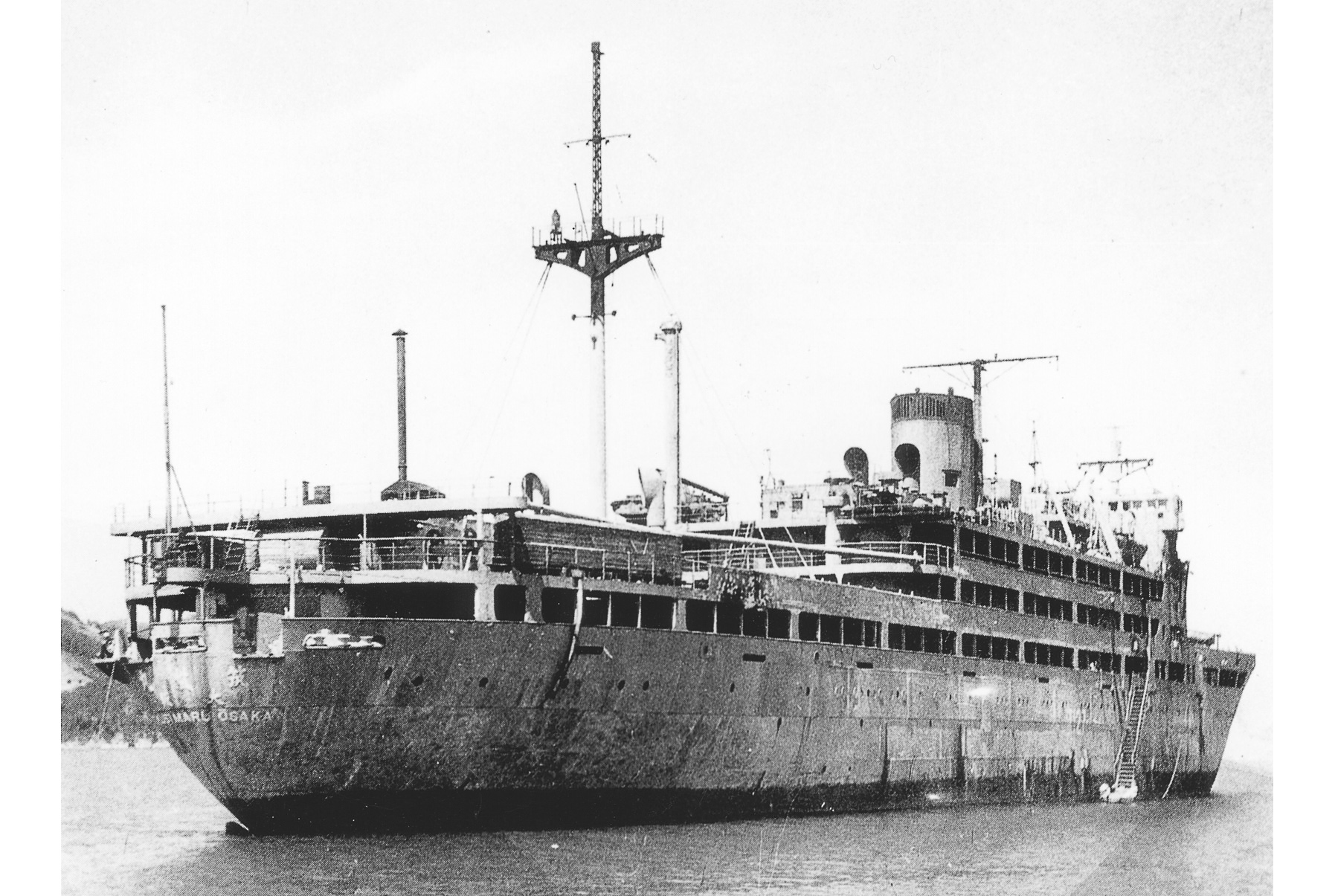 (TSUKUSHI MARU at war's end)
IJN Submarine Tender
TSUKUSHI MARU: Tabular Record of Movement
© 1998-2018 Bob Hackett, Sander Kingsepp and Peter Cundall.
Revision 5
20 June 1940:
Kobe. Laid down at Kawasaki Jukogyo for passenger-cargo service for the Osaka Shosen KK Line between Kobe and Dairen, Manchukuo. A sister ship, NANIWA MARU is projected but never built.
24 September 1941:
Launched and named TSUKUSHI MARU. Fitting out is delayed owing to other more critical demands on the shipbuilder. TSUKUSHI MARU is not finally delivered until completion of the conversion in March 1943.
15 January 1943:
Kobe. Requisitioned by the IJN. Begins conversion at Kawasaki Heavy Industies to an auxiliary submarine tender. She is fitted with one 152-mm (6-inch) gun and two 13.2-mm single-mount Type 93 machine guns. Captain-Ret (Rear Admiral, posthumously) Seki Tei (36)(former CO of SANTOS MARU) is posted as the Chief Equipping Officer.
25 March 1943:
Completes conversion and is registered as a submarine tender in the Sasebo Naval District. Captain Seki is the Commanding Officer. Assigned to Rear Admiral (later Vice Admiral), the Marquis, Daigo Tadashige's (40) soon to be activated SubRon 11, First Fleet.
1 April 1943:
Arrives at Kure. Begins training duty in the Seto Inland Sea. For the next ten months, TSUKUSHI MARU remains at Kure, but makes frequent local voyages, most probably for training purposes. During this period, she runs aground, but is refloated successfully.
1 May 1943:
Captain Mizohata Sadakazu (46)(former CO of SHIRETOKO) is appointed CO. Captain Seki is reassigned to SubRon 3 and later becomes CO of YASUKUNI MARU on which he is KIA.
17 December 1943:
Departs Kure.
21 December 1943:
TSUKUSHI MARU departs Moji in fleet convoy HI-27 consisting of cargo-passenger liner MIIKE MARUs, transport KUNIKAWA MARU, cargo liner NOTO MARU, IJA landing craft depot ship MAYASAN MARU and oilers KYUEI and OTORISAN MARUs escorted by destroyer ASAKAZE. NOTO MARU carries the 72nd Field AA Battalion, 14th Shipping Eng Regiment and she and the convoy also carry the 1st echelon of the 53rd Division consisting of Div Hq, 53rd Div, 128th Infantry Regiment and div troops (including comms, transportation, veterinary, supply, maintenance etc.), 234th Naval Construction Unit, 43rd Independent Field AAA Company, 46th Field Ops Machine Cannon Company, 47th Field Ops Machine Cannon Company and 12th Independent Searchlight Company.
24 December 1943:
Arrives at Takao, Formosa.
26 December 1943:
Departs Takao for Singapore with a replacement escort, kaibokan MATSUWA. The convoy now only consists of TSUKUSHI, KUNIKAWA, KYUEI and OTORISAN MARUs; the others remain at Takao.
27 December 1943:
At about 1100, in the second of two submerged attacks, LtCdr (later Captain) Robert D. Risser's (USNA’34) USS FLYING FISH (SS-229) successfully torpedoes and sinks tanker KYUEI MARU at 21-25N, 118-05E. 54 crewmen are KIA. MATSUWA rescues survivors and TSUKUSHI MARU and the other ships continue their voyage.
1 January 1944:
TSUKUSHI MARU is assigned as a tender of Rear Admiral Ishizaki Noboru's (42) (former CO of SubRon 8) SubRon 11, Sixth Fleet (Submarines), consisting of the 1-42, I-43, I-45, I-52, I-183, I-184, RO-40, RO-41, RO-43, RO-113, RO-114, RO-115 and flagship CHOGEI.
2 January 1944:
Arrives at Singapore.
27 January 1944: Operation "Tatsumaki" (Tornado) - Amphibious Tank Attack at Majuro, Marshalls:
Arrives at Sasebo. Later that same day, arrives at Nasake Jima, Inland Sea. TSUKUSHI MARU and the I-36, I-38, I--41, I-44 and I-53 commence training for Tatsumaki. The operation, part of the planned "YU-GO" surprise attack on the American fleet anchorage at Majuro, calls for the submarines to each carry two Type 4-shiki Motor Boat amphibious tanks on their afterdecks from Kure to Majuro. The tanks, armed with Type 2 (450-mm) torpedoes, are to be launched at night, climb over the coral, make their way overland, enter the water again and torpedo the anchored American carriers. [1]
30 January 1944:
Arrives at Kure.
9 February 1944:
Departs Kure.
11 February 1944:
Arrives at Sasebo.
17 February 1944:
Departs Sasebo.
4 March 1944:
Departs Guam for Truk.
17 March 1944:
Departs Truk in a convoy consisting of TSUKUSHI, KAZUURA, IMIZU MARUs and minelayer YURISHIMA escorted by kaibokan OKI.
24 March 1944:
Arrives at Saipan. Departs later that day.
27 March 1944:
Arrives at Yokosuka.
30 March 1944:
Arrives at Kure. For the next four months, TSUKUSHI MARU remains at Kure, but makes frequent local voyages for training purposes.
4 May 1944:
Departs Kure for Iyo Nada.
May 1944:
Nasake Jima, Inland Sea. The CINC, Sixth Fleet, Vice Admiral (Admiral, posthumously) Takagi Takeo (39) (former CO of MUTSU) aboard TSUKUSHI MARU personally leads preparations for Operation Tatsumaki, the planned amphibious tank attack on Majuro. Takagi concentrates five submarines and 14 tanks on small Nasake Jima. Also, several support vessels and a 30-ton floating crane arrive from Kure to facilitate loading the tanks aboard the submarines. Each of the five submarines carries one tank and practices crash-dives, full-speed underwater maneuvers, launch exercises and torpedo attacks. [1]
12 May 1944:
After tests reveal major deficiencies in the amphibious tanks, Vice Admiral Takagi submits a negative report to the Naval General Staff. Operation YU-GO is "postponed".
16 May 1944:
TSUKUSHI MARU arrives back at Kure.
22 June 1944:
RO-41 is ordered to proceed to the Western part of the Inland Sea where she is to be provisioned and repaired by TSUKUSHI MARU.
20 July 1944:
Nominally transferred to Sixth Fleet at Kure.
27 July 1944:
Capt Takahashi Chojuro (49) (former CO of SubDiv 15) is appointed CO.
15 August 1944:
Kure. TSUKUSHI MARU is reassigned as the flagship of Vice Admiral Miwa Shigeyoshi's (39) (former CO of KINU) CINC, Sixth Fleet.
1 October 1944:
Departs Kure. Arrives at Tokuyama.
9 October 1944:
Departs Tokuyama.
10 October 1944:
Arrives at Kure.
2 December 1944:
Kure. Vice Admiral Miwa convenes a special conference of more than 200 staff officers and specialists aboard flagship TSUKUSHI MARU to evaluate the results of the first kaiten suicide-submarine mission to Ulithi by the "Kikushi" (floating chrysanthemum) Group. Based on action reports and photo reconnaissance, the Sixth Fleet staff concludes erroneously that three aircraft carriers and two battleships were sunk in the attack.
Late 1944:
Converted to a collier to transport coal between Osaka and Kobe. A portion of her second deck is removed.
6 January 1945:
Capt Sekimoto Orinosuke (38)(former CO of SANTOS MARU) is appointed CO. Captain Takahashi is appointed CO of light aircraft carrier RYUHO.
20 January 1945:
Rerated an auxiliary transport in the Sasebo Naval District. Assigned to transport troops and materials to the Kure Naval District. During the next six months, TSUKUSHI MARU makes frequent voyages to Inland Sea ports, probably picking up and delivering coal.
5 March 1945:
At 0817 departs Saitozaki.
7 March 1945:
At 1037 arrives at Amagasaki.
12 March 1945:
At 1242 departs Amagasaki.
14 March 1945:
At 1315 arrives at Hesaki and departs at 1708. At 1905 arrives at Mutsure Jima.
15 March 1945:
At 0545 departs Mutsure Jima.
16 March 1945:
At 0640 arrives at Miike.
22 March 1945:
At 1458 departs Miike.
25 March 1945:
At 1337 arrives at Kure. Remains there for the rest of the month and early April.
13 April 1945:
At 0717 departs Kure.
15 April 1945:
At 0836 arrives at Moji.
21 April 1945:
At 0836 departs Moji.
22 April 1945:
At 1042 arrives at Niihama.
30 April 1945:
At 1117 departs Niihama for Nishi Sakito.
2 June 1945:
At 0115 departs Karatsu. At 1255 arrives at Yobuko.
4 June 1945:
At 0518 departs Yobuko.
5 June 1945:
At 1520 arrives at Kure.
21 June 1945:
At 0940 to 1009 transfers from Kure to Koyaura, north of Kure. Remains there for the rest of the month.
4 July 1945:
SE of Shimonoseki. TSUKUSHI MARU hits a mine at 33-50N, 131-19E and sustains damage.
15 August 1945: The Cessation of Hostilities:
TSUKUSHI MARU is surrendered to the Allies.
1 October 1945:
Capt Otomo Bunkichi (50)( former XO of TAIHO) is appointed CO.
5 October 1945:
Removed from the Navy List.
25 December 1945:
Capt Ueda Yasuhiko (47)(former CO of Fujisawa NAG) from the Second Bureau of the Demobilization Ministry is appointed CO.
1945-1947:
TSUKUSHI MARU is taken over by the Allied Repatriation Service and employed thereafter as a transport.
26 October 1945:
Departs Kure on her first repatriation voyage.
3 November 1945:
Arrives at Manila.
8 November 1945:
Departs Manila.
6 November 1945:
Arrives at Saiki.
27 November 1945-4 February 1946:
Undergoes extensive repairs at Sasebo Dockyard.
4 February 1946:
Departs Sasebo.
7 February 1946:
Arrives at Amoy, China.
8 February 1946:
Departs Amoy.
11 February 1946:
Arrives at Kagoshima, Kyushu.
14 February 1946:
Departs Kagoshima.
15 February 1946:
Arrives at Sasebo.
16 February 1946:
Departs Sasebo.
17 February 1946:
Arrives at Kagoshima.
18 February 1946:
Departs Kagoshima.
21 February 1946:
Arrives at Amoy.
22 February 1946:
Departs Amoy.
23 February 1946:
Arrives at Swatow, China.
24 February 1946:
Departs Swatow.
27 February 1946:
Arrives at Sasebo.
2 March 1946:
Arrives at Kagoshima.
3 March 1946:
Arrives at Sasebo.
7 March 1946:
Departs Sasebo.
12 March 1946:
Arrives at Manila.
18 March 1946:
Departs Manila. The ship embarks a number of ex-Japanese diplomates in Manila. They come from the European embassies and included Vice Admiral Abe Katsuo (40), the highest-ranking IJN officer in Europe, as well as MajGen Onodera Makoto, the former Japanese military attaché in Sweden.
23 March 1946:
Arrives at Okinawa. Departs the same day.
26 March 1946:
Arrives at Sasebo. After unloading, re-enters dock for repairs.
13 May 1946:
Repairs are completed.
15 May 1946:
Departs Sasebo.
22 May 1946:
Arrives at Manila. On this voyage, repatriates various Japanese ex-diplomats.
3 June 1946:
Arrives at Sasebo.
6 June 1946:
Departs Sasebo.
11 June 1946:
Arrives at Guam.
15 June 1946:
Departs Guam.
19 June 1946:
Arrives at Tinian, Marianas. Departs the same day.
26 June 1946:
Arrives at Okinawa. Departs the same day.
3 July 1946:
Arrives at Amami-Oshima. Departs the same day.
9 July 1946:
Arrives at Naze. Departs the same day.
10 July 1946:
Arrives at Kagoshima. Enters Kitami Dockyard for repairs.
18 August 1946:
Repairs completed and departs Kagoshima.
23 August 1946:
Arrives at Korojima, China.
24 August 1946:
Departs Korojima.
26 August 1946:
Arrives at Hakata.
1947:
Returned to owners.
1952:
Sold to the Pan-Islamic Steamship Co., Karachi, Pakistan and renamed SAFINA-E-MILLAT.
16 March 1953:
Karachi. While refitting as a pilgrim carrier for the Hadj, catches fire and is burnt out. A constructive total loss, the wreck is later sold to the Pak-Hedjaz Shipping Company, Karachi and scrapped.
Authors' Notes:
[1] For more on Operation "Tatsumaki" see
YU-GO: THE JAPANESE PLAN FOR A SECOND PEARL HARBOR SURPRISE ATTACK!
Photo credit and general thanks for reviewing this TROM go to Mr. Gilbert Casse of France.
- Bob Hackett, Sander Kingsepp and Peter Cundall.
Back
to Submarine Tender Page

