FUSETSUKAN!
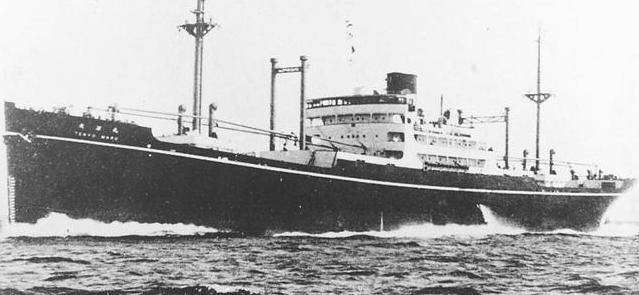 (TENYO MARU in peacetime)
IJN Auxiliary Minelayer TENYO MARU:
Tabular Record of Movement
© 2008-2017 Bob Hackett, Sander Kingsepp and Peter Cundall
Revision 3
3 July 1934:
Nagasaki. Laid down at Mitsubishi Shipbuilding as a 6,843-ton cargo ship for Toyo Kisen K.K., Tokyo.
22 January 1935:
Launched and named TENYO MARU.
28 March 1935:
Completed.
1935-1940:
Chartered to Mitsui Ltd. In service on Mitsui’s New York route.
9 September 1941:
Requisitioned by the IJN.
15 September 1941:
Arrives at Harima shipyard.
20 September 1941:
Begins conversion to a large specially installed minelayer. Registered in the Kure Naval District. Captain (later Rear Admiral) Ishido Yuzo (36)(former CO of FUBUKI) is appointed Commanding Officer.
31 October 1941:
The conversion is completed. Assigned to Vice Admiral (later Admiral) Inouye Shigeyoshi's (37) Fourth Fleet in Rear Admiral (later Vice Admiral) Shima Kiyohide's (39) Mine Division 19 with minelayer OKINOSHIMA and auxiliary minelayer TOKIWA.
15 November 1941:
Departs Kure.
2 December 1941:
TENYO MARU receives the signal "Niitakayama nobore (Climb Mt. Niitaka) 1208" from the Combined Fleet. This signifies that X-Day hostilities will commence on 8 December (Japan time).
3 December 1941:
At 1130 minelayer OKINOSHIMA and TENYO MARU arrive at Jaluit.
6 December 1941:
Jaluit. Embarks troops and departs with OKINOSHIMA and NAGATA MARU.
8 December 1941: Operation "Gi”:
Assigned to the Gilbert Islands Invasion Force that includes minelayers TSUGARU and TOKIWA carrying the 51st Guards Unit escorted by DesDiv 29/Section 1's ASANAGI and YUNAGI. The CHITOSE Naval Air Group provides air cover. At 1300 departs Jaluit.
10 December 1941:
At 0045, TENYO MARU and OKINOSHIMA arrive at Makin and disembark SNLF troops. By 0515, the island is secured. At 0841, auxiliary gunboat NAGATA MARU enters the Makin lagoon and unloads seaplane construction materials. Within two days a flying boat facility is completed.
14 December 1941:
Makin. Auxiliary gunboat NAGATA MARU comes alongside TENYO MARU at Makin and loads aviation fuel. Departs Makin later that day.
16 December 1941:
Arrives at Roi, Kwajalein.
20 December 1941:
Transfers 77 volatile oil drums to minelayer TSUGARU destined for the Gilberts air corps.
21 December 1941: The Second Invasion of Wake Island:
The greatly reinforced Attack Force consisting of two fleet carriers, a seaplane tender, six heavy cruisers, two light cruisers and 11 destroyers sorties from Roi in support of the second invasion's troop transports.
23 December 1941:
After a magnificent, but hopeless stand, Wake's grossly outnumbered American garrison is overwhelmed and forced to surrender.
24 December 1941:
TENYO MARU departs Roi for Wake Island.
26 December 1941:
Arrives at Wake island and departs later that day.
29 December 1941:
Arrives back at Roi.
4 January 1942:
At 0600 departs Roi.
7 January 1942: Operation "R" - The Invasions of Rabaul, New Britain and Kavieng, New Ireland:
TENYO MARU is assigned to the main body for the capture of Rabaul. That same day at 0725 arrives at Truk.
9 January 1942:
Departs Truk.
11 January 1942:
At 0635 arrives at Guam. Departs at 1500.
12 January 1942:
At 0912 returns to Guam.
14 January 1942:
At 1330 departs Guam.
20 January 1942:
TENYO MARU participate in the invasion of Rabaul with Mine Division 19's auxiliary minelayers MOGAMIGAWA MARU and TOKIWA and minelayers TSUGARU, OKINOSHIMA escorted by DesRon 6's light cruiser YUBARI, DesDiv 30's MUTSUKI, MOCHIZUKI, YAYOI, DesDiv 29's OITE, ASANAGI and YUNAGI and auxiliary seaplane tender KIYOKAWA MARU.
TENYO MARU transports air base construction materials.
23 January 1942:
The invasion forces swiftly overcome light Australian opposition and occupy both Rabaul and Kavieng. At 1425 TENYO MARU anchors off Rabaul.
27 January 1942:
At 1710 arrives at Rabaul.
29 January 1942:
At 0700, alongside auxiliary oiler KAIJO MARU No. 2 GO and is supplied with heavy oil. At 0806 departs Rabaul.
1 February 1942:
Arrives at Truk (ETA 1600).
4 February 1942:
At 1000 departs Truk.
8 February 1942:
At 0845 arives at Palau.
9 February 1942:
At 1300 departs Palau.
13 February 1942:
At 1000 arrives at Jolo and departs later that day at 1600.
20 February 1942:
At 0730 arrives at Kavieng and departs later that day at 1500.
21 February 1942:
At 0600 arrives at Rabaul.
25 February 1942: Operation “SR” – The Invasion of Lae and Salamaua, New Guinea:
Loads troops for landings at Salamaua, New Guinea. The convoy consists of TENYO MARU and transports KONGO and KOKAI MARUs to Lae and YOKOHAMA and CHINA MARUs for Salamaua. Armed merchant cruiser KINRYU MARU is part of the escort providing support.
5 March 1942:
At 1300 departs Rabaul.
8 March 1942:
Arrives at Lae-Salamaua. The invasion force unloads troops and cargo.
10 March 1942:
The Invasion force is attacked by Vice Admiral Wilson Brown's (USNA ’02) Task Force 11, including ships of Rear Admiral (later Admiral) Frank J.Fletcher's (USNA ’06) TF 17. Ninety aircraft (SBDs, TBDs and F4Fs) of USS LEXINGTON (CV-2) and USS YORKTOWN (CV-5) from the Coral Sea fly over New Guinea's Owen Stanley mountain range to make the attack.
Off Lae. At 0844 TENYO MARU suffers two direct bomb hits (nine crewmen KIA) and breaks in two. The forward section sinks, but the rear section remains afloat. KONGO MARU (unknown casualties) and transport YOKOHAMA MARU (one crewman KIA) are also sunk. Light cruiser YUBARI, seaplane carrier KIYOKAWA MARU, destroyers YUNAGI, ASANAGI, minelayers OKINOSHIMA and TSUGARU, minesweeper W-2 and auxiliary minesweeper TAMA MARU and transport KOKAI MARU are damaged.
10 March 1942:
The rear section sinks from the funnel back. TENYO MARU is abandoned at 06-49S, 147-02E.
1 April 1942:
Removed from the Navy List.
- Bob Hackett, Sander Kingsepp and Peter Cundall
Thanks to Mr. Gilbert Casse of France.
Back to
Minelayer Page

