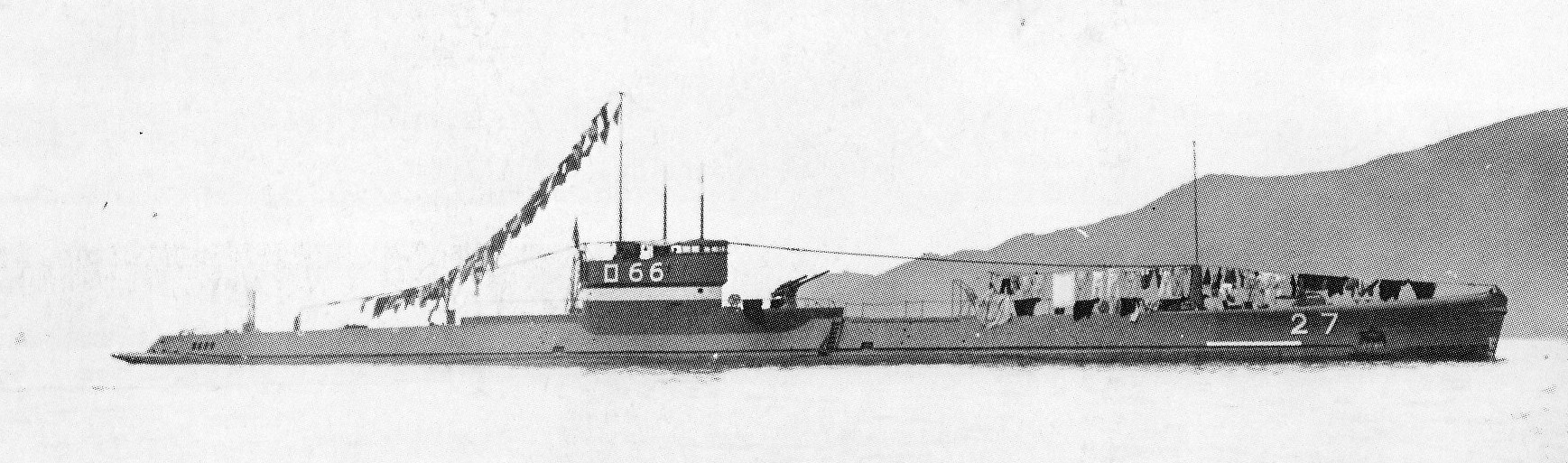
IJN Submarine RO-65:
Tabular Record of
Movement
© 2001-2017 Bob Hackett & Sander Kingsepp:
Revision 3
15 November 1924:
Kobe. Laid down at Mitsubishi Shipbuilding
as a 990-ton L4
submarine.
19 September 1925:
Launched and designated RO-65.
1 March 1926:
Lt (later Rear Admiral) Saito Eisho (42)(former CO of
RO-17) is appointed the Chief Equipping Officer (CEO).
30 June 1926:
Completed and attached to Sasebo Naval District. Lt
Saito (promoted LtCdr 1 December 1927) is the CO. Assigned to SubDiv 27, First
Fleet.
15 January 1927:
SubDiv 27 is reassigned to SubRon 1.
16 May 1928:
LtCdr (later Rear Admiral) Uozumi Jisaku (42)(former CO
of RO-16) is appointed the CO.
20 September 1929:
Lt (Rear Admiral, posthumously) Otake Toshio (45)
(former torpedo officer of I-122) is appointed the CO.
30 November 1929:
Lt (later Captain) Nagai Takeo (47)(former member of
the equipping crew of I-61) is appointed the CO.
1 April 1931:
Placed in reserve at Sasebo. Lt (later Cdr) Tsutsumi
Michizo (48)(former torpedo officer of I-52) is appointed the CO of RO-65 and
RO-66 as an additional duty.
1 December 1931:
LtCdr (later Captain) Sugiura Kuro (47)(former
torpedo officer of I-53) is appointed the CO.
20 August 1932:
LtCdr (later Captain) Hamano Motoichi (47)(former CO
of TSUTA) is appointed the CO.
15 November 1933:
Placed in reserve at Sasebo.
1 November 1934:
Lt (promoted LtCdr 15 November; Rear Admiral,
posthumously) Emi Tetsuhiro (50)(former CO of RO-29) is appointed the CO.
28 February 1935:
Lt (promoted LtCdr 15 November; Vice Admiral,
posthumously) Matsumura Kanji (50)(former torpedo officer of I-5) is appointed
the CO.
1 December 1936:
Placed in reserve at Sasebo.
20 March 1937:
LtCdr (Rear Admiral, posthumously) Togami Ichiro
(51)(former damage control officer of MAMIYA) is appointed the CO.
1 December 1937:
LtCdr (Cdr, posthumously) Ichikawa Akira (52)(the
current CO of RO-67) is appointed the CO of RO-65 as an additional duty. [1]
19 April 1938:
Lt (Cdr, posthumously) Ueno Toshitake (56)(former
torpedo officer of I-121) is appointed the CO of RO-65 and RO-67 as an
additional duty.
10 June 1938:
Lt (later Cdr) Kono Masamichi (52)(former CO of I-65) is
appointed the CO of RO-65 and RO-67 as an additional duty.
4-30 July 1938:
Lt Kono is appointed the CO of I-66 and I-67 as an
additional duty.
30 July 1938:
LtCdr (Cdr, posthumously) Yajima Yasuo (51)(former
torpedo officer of I-72) is appointed the CO of RO-65 and RO-67 as an additional
duty.
15 December 1938:
LtCdr (Captain, posthumously) Ogawa Tsunayoshi
(50)(former CO of KURI) is appointed the CO of RO-65 and RO-67 as an additional
duty.
20 March 1939:
LtCdr (Captain, posthumously) Uno Kameo (53)(former
torpedo officer of I-3) is appointed the CO of RO-65 and RO-67 (until 1
September 1939) as an additional duty.
20 March 1940:
LtCdr (Cdr, posthumously) Ueno Toshitake (56)(former CO
of I-61) is appointed the CO (his second tour as the CO of that boat).
10 August 1940:
Cdr (Rear Admiral, posthumously) Otake Toshio (45)(the
current ComSubDiv 27) is appointed the CO of RO-65 as an additional duty (his
second tour as the CO of that boat).
28 September 1940:
LtCdr (Captain, posthumously) Harada Hakue
(52)(former CO of RO-68) is appointed the CO.
31 July 1941:
LtCdr (Captain, posthumously) Kudo Kaneo (56)(former
torpedo officer of I-15) is appointed the CO.
2 December 1941: Operation "Z":
The coded signal "Niitakayama nobore
(Climb Mt. Niitaka) 1208" is received from the Combined Fleet. It signifies that
hostilities will commence on 8 December (Japan time). Mt. Niitaka, located in
Formosa (now Taiwan), is then the highest point in the Japanese Empire.
5 December 1941:
Kwajalein, Marshall Islands. RO-65 is in Captain
(Rear Admiral posthumously) Fukaya Sokichi's (46) SubDiv 27 of Rear Admiral
Onishi Shinzo's (42) SubRon 7 in Vice Admiral (later Admiral) Inoue Shigeyoshi's
(37)(former CO of HIEI) Fourth Fleet with RO-66 and RO-67.
RO-65 proceeds to Roi.
6 December 1941:
Departs Roi for the Wake Island area.
8 December 1941: The First Attack on Wake Island:
Kwajalein. SubDiv 26
is on 'standby alert' at the outbreak of hostilities.
Wake Island is assaulted by Rear Admiral (Vice Admiral, posthumously)
Kajioka Sadamichi's (39)(former CO of KISO) Occupation Group: DesRon 6's light
cruiser YUBARI, eight destroyers, two transports and RO-65, RO-66 and RO-67. The
United States Marines beat back the first assault with their 5-inch shore
batteries. Kajioka loses LtCdr Takatsuka Minoru's (56) destroyer HAYATE to the
shore batteries and LtCdr Ogawa Yoichiro’s (57) destroyer KISARAGI to Marine
Grumman F4F "Wildcats".
12 December 1941:
CarDiv 2's HIRYU and SORYU are detached from Vice
Admiral (Admiral, posthumously) Nagumo Chuichi's (36)(former CO of YAMASHIRO)
Striking Force returning from Pearl Harbor to reinforce Kajioka, as is Rear
Admiral (later Vice Admiral) Abe Hiroaki's (39)(former CO of FUSO) CruDiv 8's
TONE, CHIKUMA and two destroyers. Rear Admiral (Vice Admiral, posthumously) Goto
Aritomo's (38)(former CO of MUTSU) CruDiv 6's AOBA, KINUGASA, KAKO, FURUTAKA,
seaplane tender CHIYODA and two other destroyers also reinforce Kajioka. Rear
Admiral Abe, now senior officer present, has overall command.
SubDiv 26's RO-61, RO-60 and RO-62 are assigned to the reinforced Wake
Occupation Group.
13 December 1941:
Departs the patrol area.
17 December 1941:
Returns to Kwajalein with RO-67.
23 December 1941: The Second Attack on Wake Island:
After a
magnificent stand, Wake's garrison is overwhelmed and surrenders.
25 December 1941:
Departs Kwajalein on her second war patrol off
Howland, Phoenix Islands.
2 January 1942:
Returns to Kwajalein.
7 January 1942:
Departs Kwajalein for Truk in company of RO-67.
11 January 1942:
Arrives at Truk.
16 January 1942:
Departs Truk to patrol S of the Cape St. George with
RO-67 to support the invasion of Rabaul.
21 January 1942:
SubDiv 27 and SubDiv 23 are assigned to patrol and
attack enemy craft in the St George Straits. The squadron is in the area for
several days, but no Allied warships are sighted.
29 January 1942:
Returns to Truk.
10 February 1942:
SubDiv 27 is disbanded. RO-65 and RO-67 are
reassigned to SubDiv 26.
15 February 1942:
LtCdr (later Cdr) Torisu Kennosuke (58)(former
torpedo officer of I-8 is appointed the CO. [2]
18 February 1942:
Departs Truk with RO-67 to reconnoiter the Makin
area.
28 February 1942:
Arrives at Ponape.
3 March 1942:
Departs Ponape for the Makin area.
17 March 1942:
Arrives at Jaluit, departs on the next day.
24 March 1942:
Arrives at Saipan.
27 March 1942:
Departs Saipan for Sasebo.
2 April 1942:
Arrives at Sasebo.
10-30 May 1942:
LtCdr Torisu is appointed the CO of RO-67 as an
additional duty.
30 June 1942:
Lt (Cdr, posthumously) Egi Shoichi (60)(former torpedo
officer of I-18) is appointed the CO.
14 July 1942:
SubDiv 26 is reassigned to the Fifth Fleet.
10 September 1942:
Departs Sasebo with RO-67 for Ominato.
13 September 1942:
Arrives at Ominato.
15 September 1942:
Departs Ominato for Paramushiro.
19 September 1942:
Arrives at Paramushiro.
21 September 1942:
Departs Paramushiro for Kiska.
26 September 1942:
Arrives at Kiska just in time for an American air
attack. RO-67 is repeatedly strafed and receives several near misses. Her
periscopes and both electric engines are rendered inoperable. Departs for
Ominato.
28 September 1942:
Another air attack on Kiska. RO-65 is strafed by
fighter planes and receives minor damage to her conning tower.
1 October 1942:
Departs Kiska to reconnoiter Cold Bay with RO-62.
10 October 1942:
Penetrates Cold Bay.
15 October 1942:
Returns to Kiska.
17 October 1942:
Following the loss of destroyer OBORO in an air
attack N of Kiska, RO-65 is dispatched to rescue her crew and to stand by to
rescue the crew of damaged destroyer HATSUHARU.
19 October 1942:
Departs her patrol area.
21 October 1942:
RO-65 is redirected to reconnoiter Attu.
23 October 1942:
Reconnoiters Holz Bay, Attu.
31 October 1942:
Returns to Kiska.
3 November 1942:
Kiska. USAAF 11th AF B-24 "Liberator" heavy bombers
raid the shipping in the harbor. After the alarm has been given, all submarines
in the harbor crash-dive immediately. RO-65 dives, but with her conning tower
hatch and main induction valve still open. The quartermaster attempts to secure
the lower hatch, but the inrushing water shoves him aside.
The boat is heavily flooded and her stern receives a 30-degree down
angle, until it touches the seabed. Seventeen sailors in the aft compartments
and two machinists' mates from the diesel engine compartment drown. A total of
45 sailors including Lt Egi escape through the forward torpedo tubes. After the
bow has lost all buoyancy, RO-65 sinks at 51-58N, 177-33E. [3]
1 August 1943:
Removed from the Navy List.
September 1989:
Kiska. RO-65 is surveyed by divers from the USS
SAFEGUARD (ARS-50).
Authors' Notes:
[1] Ichikawa Akira later changed his name to Isobe Akira. He
was KIA as the CO of I-73 in January 1942.
[2] Torisu Kennosuke's family name appears in several sources in a
cropped form as 'Tosu'.
[3] Several older sources suggest that RO-65 was sunk in an air attack on
26 or 28 September, probably confusing her with RO-67, damaged on the 26th.
Thanks go to Dr. Higuchi Tatsuhiro of Japan.
– Bob Hackett
Back to Submarine
Page