SENSUIKAN!
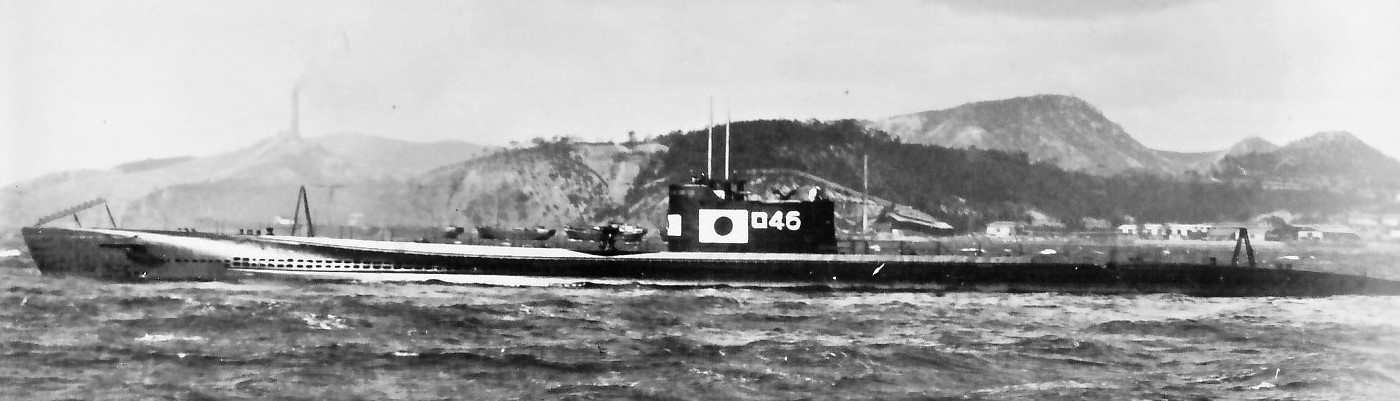 (RO-46)
IJN Submarine RO-49:
Tabular Record of
Movement
© 2001-2017 Bob Hackett & Sander Kingsepp
Revision 2
16 November 1942:
Tamano. Laid down at Mitsui Zosensho
shipyard as a 965-ton type K6
submarine No. 390.
31 July 1943:
Numbered RO-49 and provisionally attached to Maizuru
Naval District.
3 August 1943:
Launched.
1 April 1944:
Lt (promoted LtCdr 1 May; Cdr, posthumously) Fumon
Shozo (63)(former CO of RO-67) is appointed the Chief Equipping Officer (CEO).
19 May 1944:
RO-49 is completed and attached to Maizuru Naval
District. Assigned to SubDiv 33 for working-up. LtCdr Fumon is the Commanding
Officer.
27 May 1944:
Captain Otani Kiyonori (49)(current ComSubDiv 33) is
appointed the CO of RO-49 as an additional duty.
10 July 1944:
LtCdr (later Captain, JMSDF) Oba Saichi (62)(former
CO of RO-67) is appointed the CO.
Mid-July 1944:
RO-49 and I-157 participate in the tests of the
submarine version of Type 13 air-search radar.
5 August 1944:
Lt (promoted LtCdr 1 November) Sugayoshi Tessho
(65)(former CO of RO-109) is appointed the CO.
15 August 1944:
RO-49 is reassigned to SubRon 11.
13 October 1944: Operation "SHO-I-GO" - The Defense of the
Philippines:
Tokyo. Admiral Toyoda Soemu, (33) CINC, Combined Fleet, orders
the SHO-I-GO plan activated.
20 October 1944: American Operation "KING TWO" - The Invasion of Leyte,
Philippines:
Admiral (later Fleet Admiral) William F. Halsey's (USNA '04)
Third Fleet of 738 ships including 18 aircraft carriers, six battleships, 17
cruisers, 64 destroyers and over 600 support ships land the Army's X Corps (24th
Infantry and 1st Cavalry Divisions) and the XXIV Corps (7th, 77th and 96th
Infantry Divisions) that begin the campaign to retake Leyte.
10 November 1944:
RO-49 is reassigned to SubDiv 34 in Vice Admiral
Miwa Shigeyoshi's (39)(former CO of CL KINU) Sixth Fleet (Submarines).
16 November 1944:
Departs Kure on her first war patrol. Her assigned
area is E of Luzon.
28 November 1944:
After RO-49 damages her Type 93 hydrophone in rough
seas, LtCdr Sugayoshi orders to terminate the patrol.
7 December 1944:
Returns to Kure.
1 January 1945:
Departs Kure on her second war patrol to operate in
the Philippine Sea E of the Philippines.
4 January 1945:
RO-49 is redirected to the west coast of Luzon (north
of 15N), Philippines.
9 January 1945: American Operation "MIKE ONE" - The Invasion of Luzon:
Vice Admiral (later Admiral) Thomas C. Kinkaid's (USNA '08) Task Force 77
lands almost 175,000 men of LtGen (later Gen) Walter Krueger's Sixth Army at
Lingayen Gulf under the cover of Vice Admiral (later Admiral) Jesse B.
Oldendorf's (USNA '09) TG 77.2 bombardment force and aircraft of Rear Admiral
(later Vice Admiral) Calvin T. Durgin's (USNA '16) TG 77.4. In a five-month
campaign, the Sixth Army defeats General Yamashita Tomoyuki's 14th Army Group's
defenders.
12 January 1945:
South China Sea, 55 miles WNW of Iba, Luzon,
Philippines. LtCdr Sugayoshi sights two escort carriers and three battleships
under heavy escort. He makes a determined attack and reports sinking an
"IDAHO-class" battleship (not substantiated postwar).
21 January 1945:
LtCdr Sugayoshi receives an order to return to base.
31 January 1945:
On that day, codebreakers at the USN Fleet Radio Unit,
Melbourne (FRUMEL), Australia, provide the following information:
"Japanese submarines RO-46 and RO-49 are on passage to Japan from their
patrol areas west of Luzon. /.../ RO-49 ETA Bungo Channel is 2nd February."
1 February 1945:
Returns to Kure.
5 February 1945:
Lt (LtCdr, posthumously) Go Yasuo (66)(former CO of
I-158) is appointed the CO.
16 March 1945:
Transfers to Saeki.
18 March 1945:
Departs Saeki on her third war patrol to operate SE of
the Nansei Shoto (Ryukyus) in company of I-8, RO-41 and RO-56.
25 March 1945:
Lt Go sends a situation report. It is the last signal
received from RO-49.
26 March 1945: American Operation "ICEBERG" - The Invasion of
Okinawa:
The 77th Infantry Division lands on the Kerama Retto, Ryukyus and
captures its anchorage.
That same day, a submarine attacks the Task Group 54.3. At 0932, lookouts
aboard USS WICHITA (CA-45) spot a periscope to starboard. WICHITA makes an
emergency turn to starboard and evades a torpedo. USS ST. LOUIS (CA-49) also
reports sighting torpedo tracks. Neither cruiser is damaged. The submarine evades
and escapes counter-attack. [1]
1 April 1945:
Vice Admiral (later Admiral) Raymond A. Spruance's (USNA
'06) Fifth Fleet, including more than 40 aircraft carriers, 18 battleships, 200
destroyers and over 1,000 support ships surround Okinawa. LtGen Simon B. Buckner
Jr's Tenth Army (7th, 77th, 96th Infantry and 1st, 6th Marine divisions) makes
amphibious landings and takes the island from LtGen Ushijima Mitsuru's 32nd
Army.
5 April 1945:
Off Kumejima, near Okinawa. LtCdr R. R. Pratt's USS
HUDSON (DD-475) is on radar picket duty. She receives a signal of a submarine
sighting from LCS-115. At 0345, she detects it with her SG radar. As Pratt
approaches to investigate, HUDSON fires a starshell that forces the submarine to
dive. The contact is lost.
HUDSON reacquires the contact on sonar and begins the first series of
attacks that range over the next six hours. In all, she drops six barrages of
depth charges that sink a submarine - possibly RO-49 - at 26-22N, 126-30E. [2]
15 April 1945:
Presumed lost with all 79 hands SE of Okinawa.
25 May 1945:
Removed from the Navy List.
Authors' Notes:
[1] Author Jürgen Rohwer speculates that the attack was made
by RO-49, but Japanese sources credit the Okinawa-based Type C midget No. 60 of
the 2nd Squadron, led by Lt Kawashima Gen and further indicate that it took place
on 27 March.
[2] Some accounts claim RO-49 was sunk in the Bungo Suido on 24 February
1945 by USS LAGARTO (SS-371), but these accounts are clearly wrong since RO-49
was active and filing reports a month later. Japanese sources suggest that RO-49
was already MIA on 5 April 1945 and that the submarine HUDSON sank was I-56.
Thanks go to Dr. Higuchi Tatsuhiro of Japan and to Hans Mcilveen of the
Netherlands for info on FRUMEL intercepts.
– Bob Hackett and Sander Kingsepp.
Back to Submarine
Page

![]()