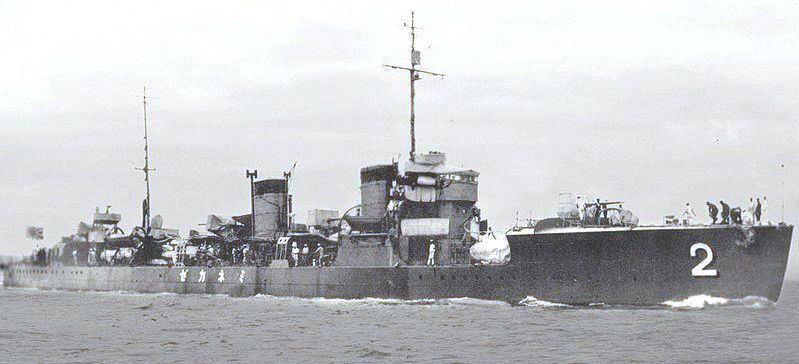
© 2007-2018 Bob Hackett, Sander Kingsepp and Peter Cundall
Revision 6
5 September 1919:
Maizuru Naval Yard. Laid down as a MINEKAZE-class destroyer.
31 March 1920:
Launched and named SHIMAKAZE.
15 November 1920:
Completed and registered in the Maizuru Naval District.
LtCdr Iwaki Moshin (33) is appointed the CO. Attached to Yokosuka Naval District. Assigned to DesDiv 3.
1 December 1920:
LtCdr (later Vice Admiral) Arichi Jugoro (33) is appointed acting CO.
1 December 1921:
Cdr Arichi assumes command.
20 November 1922:
LtCdr Eguchi Kihachi (current CO of ) is appointed the acting CO.
1 December 1922:
LtCdr (later Capt) Morita Shigefusa (33) is appointed the CO.
5 August 1923:
LtCdr (later Vice Admiral) Ozawa Jisaburo (37) is appointed acting CO.
20 January 1925:
Cdr (later Vice Admiral) Kobayashi Sonosuke (35) assumes command.
1 December 1925:
LtCdr (later Capt) Homoto Shigeji (36) is appointed the CO.
10 August 1927:
LtCdr (later Capt) Nagao Sosuke (36)(former CO of SUSUKI) is appointed the CO.
11 October 1928:
Uraga Strait. While participating in naval maneuvers, at 0920 SHIMAKAZE collides with YUKAZE and receives a hole to the bow area. Proceeds to Yokosuka for repairs.
10 December 1928:
Cdr (later Vice Admiral) Fujita Ruitaro (40) assumes command.
5 September 1929:
Placed in reserve at Yokosuka.
1 December 1931:
LtCdr (later Rear Admiral) Nakase Noboru (45) assumes command.
1 December 1932:
Placed in reserve at Yokosuka.
15 December 1933:
Cdr (later Capt) Nishida Masao (44) is appointed the CO.
15 August 1934:
LtCdr (later Capt) Shimazui Takemi (47) is appointed the CO.
15 June 1936:
LtCdr (later Cdr) Shiraishi Nagayoshi (49) is appointed the CO.
1 December 1936:
LtCdr (later Rear Admiral) Furukawa Bunji (49) assumes command.
28 September 1937:
LtCdr (later Capt) Arimoto Terumichi (50) is appointed the CO.
1 December 1937:
LtCdr Miyauchi Shinichi (51)(former CO of HAYABUSA) is appointed the CO.
1940:
Yokosuka Navy Yard. The two forward boilers are removed reducing speed to 20 knots. Additionally, the first and third banks of torpedo tubes, and No. 2 4.7-inch/45 cal main gun are removed
.
1 April 1940:
Reclassified as a special duty patrol boat and renumbered PB-1. Attached to the Yokosuka Naval District and assigned to the Yokosuka Guard Unit.
1941:
Undergoes reconstruction. Nos. 3 and 4 4.7-inch/45 cal main guns, the second bank of torpedo tubes and depth charge equipment are removed. The stem is cut down to the waterline to form a ramp and fitted to carry and launch two 46-ft Daihatsu landing craft. The interior spaces are modified to accommodate up to 250 troops.
20 November 1941:
Assigned to Captain Nishikawa Hayami's (34) Patrol Boat Squadron 1 with PB-2, PB-32, PB-33, PB-34, PB-35, PB-36, PB-37, PB-38 and PB-39.
22 November 1941:
At 1100 arrives at Sasebo.
26 November 1941:
At 1255 departs Sasebo and at 1626 arrives off Terajima and departs from there at 1645.
29 November 1941:
At 2210 arrives at Takao.
6 December 1941:
At 1730 departs Takao and at 2020 arrives at Fangliao.
7 December 1941:
At 1805 departs Fangliao and escorts auxiliary seaplane tender SANUKI MARU.
8 December 1941: Operation "M" - The Invasion of the Philippines:
Participates in the Luzon Strait landing at Batan Island.
At 0730 arrives off Batan Island and departs from there at 1810.
10 December 1941:
Arrives off Camiguin Island with SANUKI MARU and departs at 1220.
14 December 1941:
At 0952 arrives at Satsukawa Wan, Amami Oshima.
15 December 1941:
At 0800 refuelled by collier/tanker ASAKAZE MARU.
16 December 1941:
At 1400 stored by storeship HAKUREI MARU.
17 December 1941:
At 1500 PB-1 and PB-2 depart Amami-Oshima.
23 December 1941:
At 2050 arrive off Lamon Bay.
24 December 1941:
At 0230 both arrive at Lamon Bay. At 1330 takes on water from GORYU MARU and from 1730, bunkers from HAYATOMO.
25 December 1941:
Stored by transport MYOKO MARU.
26 December 1941:
At 0800 departs Lamon Bay.
29 December 1941:
At 1117 arrives at Palau. At 1549 refuelled by GENYO MARU.
30 December 1941:
At 1150 stored by storeship MAMIYA.
2 January 1942:
At 1430 departs Palau.
4 January 1942:
At 1700 arrives at Davao.
5 January 1942:
At 1430 transfers to nearby Malalag.
6 January 1942:
At 1546 transfers to nearby Magunaga. Stored by OOI MARU.
9 January 1942: Operation "H" - The Invasion of Celebes, Netherlands East Indies:
At 1015 PB-1 departs Davao, Philippines with PB-2 and PB-34 in Rear Admiral (later Vice Admiral) Kubo Kyuji's (38) (former CO of AOBA) 1st Base Force with light cruiser NAGARA, MineSweepDiv 21's W-11, W-7, W-8, W-9 and W-12 and SubChasDiv 1's CH-1, CH-2, CH-3 escorting eight transports carrying Captain (later Vice Admiral) Mori Kunizo's (40) (former CO of SATA) Sasebo No. 1 Combined Special Naval Landing Force (SNLF).
11 January 1942:
At 0200 the ships arrive and at 0300, the SNLF lands on Kema, Celebes. At 0400, they land on Menado. Later, 334 men of Cdr (later Captain) Horiuchi Toyoaki's (50) (later XO of TAKAO) Yokosuka No. 1 SNLF (Air) are dropped successfully from Mitsubishi G3M1-L Nell converted transport aircraft in the Menado-Kema area. The paratroops seize Langoan airfield.
14 January 1942:
At 2300 departs Kema escorting KATSURAGI MARU.
15 January 1942:
At 0840 PB-1 arrives at Menado, and later that day PB-1 and PB-2 and other units arrive at Banka.
17 January 1942:
At 1120 PB-1 arrives back at Menado escorting KATSURAGI, NANKAI, HOKUROKU, and KINAI MARUs. At 1517 PB-1 arrives back at Banka and refuels from auxiliary fleet oiler SAN CLEMENTE MARU.
18 January 1942:
At 1310 stored by CHOKO MARU (842 grt). At 1950 arrives back at Menado.
20 January 1942:
At 0921 departs Menado and at 1201 arrives at Banka.
21 January 1942:
At 1200 along with various units departs Banka.
24 January 1942:
At 0200 both PB-1 and PB-2 arrive off Kendari. At 1100 arrive at Kendari.
26 January 1942:
Stored by HAKUSAN MARU.
27 January 1942:
At 1330 departs Kendari escorting AMAGISAN, NANKAI, HOKUROKU, and KINAI MARUs.
29 January 1942:
At 0445 the convoy arrives back at Banka.
2 February 1942:
At 0800 departs Banka with survey ship TSUKUSHI, minelayer AOTAKA, submarine chasers CH-3 and CH-14, PB-2, IKUSHIMA, MATSUE, MONTEVIDEO, SAN CLEMENTE and YAMASHIMO MARUs. IKUSHIMA MARU carries 5th and 6th construction units.
4 February 1942:
At 0610 arrives at Kendari. PB-1 refuels from auxiliary fleet oiler SAN CLEMENTE MARU.
5-10 February 1942: The Invasion of Makassar, Celebes:
PB-1 is with Rear Admiral Kubo’s 1st Base Force with PB-2 and PB-34, light cruiser NAGARA, MineSweepDiv 21 and SubChasDiv 1’s CH-1, CH-2 and CH-3 that escort the Makassar invasion force of six transports carrying Captain Mori's Sasebo Combined SNLF. Prior to leaving Kendari PB-1 is stored by IKUSHIMA MARU.
6 February 1942:
At 2115 the invasion convoy escorted in part by PB-1 departs Kendari.
8 February 1942:
At 2210 arrives at Macassar.
11 February 1942:
At 0800 departs Macassar.
12 February 1942:
At 1715 both PB-1 and PB-2 arrive back at Staring Bay, Kendari. PB-1 is stored by auxiliary storeship HAKUREI MARU.
13 February 1942:
At 1405 PB-1 refuels from auxiliary fleet oiler GENYO MARU. At 1700 departs Kendari.
14 February 1942:
At 1754 arrives at Ambon.
15 February 1942:
PB-1 is stored by KIKU MARU.
17 February 1944:
At 0500 departs Ambon.
18 February 1942:
Off Ambon PB-1 meets up with invasion convoy for Dili, Portugese Timor consisting of PB-2 and PB-34 and five transports escorted by MineSweepDiv 21's W-7 and W-8, DesDiv 24's KAWAKAZE and YAMAKAZE and a subchaser. CruDiv 5's HAGURO and MYOKO, DesDiv 6's INAZUMA and IKAZUCHI and DesDiv 7's AKEBONO provide distant cover. Air cover is provided by seaplane carrier MIZUHO.
20 February 1942:
Portugese Timor is invaded. At 2325 PB-1 arrives at Kupang.
23 February 1942:
At 1600 departs Kupang.
24 February 1942:
At 0715 arrives at Dili. At 1500 departs Dili escorting YAMAURA and KASUGA MARUs.
25 February 1942:
At 0700 PB-1 and PB-2 arrive at Kupang escorting YAMAURA and KASUGA MARUs. LYONS MARU transfers supplies to PB-1.
1 March 1942:
PB-1 departs Kupang escorting LYONS, TENRYU and NANIWA MARUs. At some point the ships are joined by PB-2 and LYONS MARU is detached and KATSURAGI MARU joins.
3 March 1942:
At 1100 arrives at Kendari and transfers to Staring Bay, arriving at 1500. Takes on fuel from auxiliary fleet oiler TEIYO MARU, water from auxiliary water carrier GORYU MARU and stores from auxiliary storeship MINATO MARU.
8 March 1942:
Stored by storeship IRAKO.
14 March 1942:
At 0900 departs Kendari.
16 March 1942:
At 1531 arrives at Bali. At 1800 departs Bali escorting NAGISAN and RAKUTO MARUs.
19 March 1942:
At 1025 arrives at Kupang and departs alone at 1252.
21 March 1942:
At 0800 arrives at Ambon.
25 March 1942:
Refuelled and stored by Fleet oiler HAYATOMO.
28 March 1942:
Stored by auxiliary storeship HAKUREI MARU.
29 March 1942: The Invasion of Dutch New Guinea:
Rear Admiral (later
Vice Admiral) Fujita Ruitaro's (38) (former CO of FUSO) "N" Expeditionary Force assembles at Ambon Island. Fujita's Force includes CarDiv 11's seaplane carrier CHITOSE, light cruiser KINU, DesDiv 16's YUKIKAZE and TOKITSUKAZE, torpedo boats TOMOZURU, HATSUKARI, patrol boats PB-1, PB-2, PB-38 and PB-39, SubChasDiv 54's SHONAN MARU Nos. 5 and 17 and FUKUEI MARU No. 15, oiler SEIAN MARU and transport HOKUROKU MARU plus a Special Naval Landing Force. The N Expeditionary Force departs Ambon.
30 March 1942:
At 0450 departs Ambon escorting transport HOKUROKU MARU with torpedo boats TOMOZURU and HATSUKARI.
31 March 1942:
At 0630 arrives at Boela, Ceram Island. Moluccas.
1-21 April 1942:
The N Expeditionary Force invades Fak-Fak, Babo, Sorong, Manokwari, Moemi, Nabire, Seroei, Sarmi and Hollandia, New Guinea.
1 April 1942:
At 1425 departs Boela with other escorts and transport HOKUROKU MARU.
2 April 1942:
At 0600 arrives at Babo with transport TAIKO MARU having joined.
3 April 1942:
At 1700 departs Babo with transports HOKUROKU and TAIKO MARUs.
5 April 1942:
At 0920 arrives at Gani Bay, south Halmahera Island. Refuelled by oiler HAYATOMO.
6 April 1942:
At 0900 departs Gani Bay with transports HOKUROKU and TAIKO MARUs.
7 April 1942:
At 0730 arrives at Ternate.
8 April 1942:
At 0500 departs Ternate and transfers to nearby Jailolo. At 1300 departs Jailolo and at 1641 arrives at Ternate.
9 April 1942:
At 1400 departs Ternate with transports HOKUROKU and TAIKO MARUs.
12 April 1942:
At 1000 arrives at Manokwari where troop landings are undertakwn.
13 April 1942:
PB-1 is refuelled by oiler HAYATOMO.
14 April 1942:
At 2250 departs Manokwari.
15 April 1942:
At 0500 arrives at Momi (Moemi).
16 April 1942:
At 1330 departs Momi.
17 April 1942:
At 0530 arrives at Nabire.
18 April 1942:
At 2350 departs Nabire.
19 April 1942:
At 0700 arrives at Hollandia (Jayapura).
20 April 1942:
At 0900 departs Hollandia.
21 April 1942:
At 1650 arrives at Manokwari.
22 April 1942:
Refuels from Fleet oiler HAYATOMO.
23 April 1942:
The N Expeditionary Force is dissolved. All units return to Ambon Island. At 0800 PB-1 departs Manokwari.
27 April 1942:
At 0937 arrives at Saipan. Refuels from shore facility.
28 April 1942:
At 0547 departs Saipan for Yokosuka.
1 May 1942:
Reattached to the Yokosuka Naval District with PB-2, PB-34 and PB-35.
15 May 1942:
At 1230 PB-1 and PB-2 depart Yokosuka escorting Seaplane carrier AKITSUSHIMA and transport ex liner BRAZIL MARU. The convoy sails at 16 knots.
19 May 1942:
Arrives at Saipan.
28 May 1942:Operation "MI" - The Battle
of Midway:
PB-1, PB-2 and PB-34, depart Saipan in Vice Admiral (later
Admiral) Kondo Nobutake's (35)(former CO of KONGO) Midway Invasion Force's Transport
Group with oiler AKEBONO MARU, transports ZENYO, ARGENTINA, BRAZIL, AZUMA,
KIYOSUMI, KEIYO, GOSHU, KANO, HOKUROKU, KIRISHIMA and NANKAI MARUs and TOA MARU
No. 2. The transports carry an airfield construction unit, LtCol Ichiki Kiyonao's
IJA detachment and two battalions of Special Naval Landing Forces (SNLF).
Rear Admiral (later Vice Admiral) Tanaka Raizo's (41) (former CO of KONGO) DesRon 2's light cruiser JINTSU and DesDiv 15's KUROSHIO and OYASHIO, DesDiv
16's AMATSUKAZE, HATSUKAZE, TOKITSUKAZE and YUKIKAZE and DesDiv 18's KAGERO
provide the escort with destroyer-transports SHIRANUHI, KASUMI and ARARE. Air
cover is provided by Rear Admiral (later Vice Admiral) Fujita Ruitaro's (38) (former
CO of FUSO) seaplane tenders CHITOSE and KAMIKAWA MARU.
PB-1 collides with oiler AKEBONO MARU, but the damage is minor.
3 June 1942:
The convoy is bombed by nine Boeing B-17 "Flying
Fortresses". Later, the convoy is also attacked by three torpedo-carrying
Consolidated PBY "Catalina" amphibious patrol planes. AKEBONO MARU is hit
in the bow and KIYOSUMI MARU is strafed.
5 June 1942:
At 0255, the Combined Fleet's Commander-in-Chief Admiral
(Fleet Admiral, posthumously) Yamamoto Isoroku (32)(former CO of AKAGI), aboard his
flagship YAMATO, orders Operation MI cancelled.
16 June 1942:
The Transport Group arrives at Guam and disembarks LtCol Ichiki's detachment.
1 July 1942:
Reassigned to the Yokosuka Guard Unit with PB-2.
5 July 1942:
At 0710 arrives at Nagaura.
7 July 1942:
At 1215 departs Nagaura.
11 July 1942:
Departs Yokosuka escorting a convoy consisting of SAIPAN and GOSEI MARUs. The convoy heads south at 9 knots.
15 July 1942:
At 1500 arrives at Nagaura.
28 July 1942:
Arrives at Saipan.
7 August 1942: American Operation "Watchtower" - The Invasion of
Guadalcanal, British Solomons:
Rear Admiral (later Admiral) Richmond K.
Turner's (USNA ’08) (former CO of USS ASTORIA, CA-34), Amphibious Task Force 62, covered by
Vice Admiral (MOH/later Admiral) Frank J. Fletcher's (USNA ’06) (former CO of USS VERMONT,
BB-20) Task Force 61 and Rear Admiral (Admiral posthumously) John S. McCain's (USNA ’06) (former
CO of USS RANGER, CV-4) Task Force 63's land-based aircraft, lands MajGen (later
General/MOH/Commandant) Alexander A. Vandegrift's 1st Marine Division on
Florida, Tulagi, Gavutu, Tanambogo and Guadalcanal opening the campaign to retake the islands.
9 August 1942:
At 1000 PB-1 and PB-2 depart Yokosuka.
13 August 1942:
Due to arrive at Saipan.
16 August 1942:
Truk. At 0500, DesDiv 4's ARASHI and HAGIKAZE, DesDiv
15's KAGERO and DesDiv 17's HAMAKAZE, TANIKAZE and URAKAZE depart Truk for
Guadalcanal as the first echelon of a reinforcement convoy carrying 917 men of LtCol Ichiki Kiyonao's 28th Infantry Regiment.
The second echelon of the reinforcement convoy departs Truk consisting of BOSTON and DAIFUKU MARUs carrying 1,100 men of Ichiki's Regiment escorted by light cruiser JINTSU and PB-35 and PB-34. Rear Admiral Tanaka in JINTSU is in command of the convoy.
PB-1 and PB-2 depart Truk escorting the third echelon consisting of armed merchant cruiser KINRYU MARU carrying about 1,000 troops of the Yokosuka No. 5 SNLF.
18 August 1942:
About noon, DesDiv 24's KAWAKAZE, SUZUKAZE and UMIKAZE join the second and third echelons still enroute to Guadalcanal.
19 August 1942:
Cape Taivu, E of Lunga Point, Guadalcanal. At 0100, the first echelon lands LtCol Ichiki's troops.
20 August 1942:
At midnight, Ichiki's troops storm Guadalcanal's "Henderson Field" to retake the airfield, but almost all of Ichiki's men are cut down by U.S. Marines. Ichiki commits ritual suicide.
21 August 1942:
That evening, Tanaka receives a signal from Headquarters, Eighth Fleet that Vice Admiral Kondo's Second Fleet and Vice Admiral Nagumo's Third Fleet will support Tanaka's reinforcement convoy
consisting of the second and third echelons.
24 August 1942: The Battle of the Eastern Solomons.
At 1230, Tanaka's force sights light carrier RYUJO, covered by CruDiv 8's TONE and DesDiv 16's AMATSUKAZE and TOKITSUKAZE. Later, RYUJO launches two strikes against Henderson Field. At 1357, RYUJO is attacked by aircraft from Vice Admiral Fletcher's Task Force 61's USS SARATOGA (CV-3). RYUJO is hit by four bombs and a torpedo hit that floods her starboard engine room. At 1800, RYUJO capsizes and sinks.
CarDiv 1's SHOKAKU and ZUIKAKU launch aircraft that find and damage ENTERPRISE (CV-6). That evening, aircraft from USS SARATOGA damage seaplane carrier
CHITOSE. The same night, DesDiv 15's KAGERO, DesDiv 17's ISOKAZE, DesDiv 24's KAWAKAZE and DesDiv 30's MUTSUKI and YAYOI shell Henderson Field, then race northward to join Tanaka's convoy.
25 August 1942:
150 miles N of Guadalcanal. At 0600, six USMC Douglas SBD "Dauntless" dive-bombers attack the convoy. KINRYU MARU is hit and begins to sink. Her embarked troops are evacuated by DesDiv 30's MUTSUKI and YAYOI and PB-1 and PB-2.
BOSTON MARU is damaged by an SBD's near-miss. A bomb hits JINTSU's forecastle and starts fires that cause her forward magazines to be flooded. Rear Admiral Tanaka is injured and shifts his flag to destroyer KAGERO. B-17 bombers arrive and sink MUTSUKI still evacuating troops from sinking KINRYU MARU.
25 August 1942:
The convoy returns to Shortland, Bougainville that night.
27 November 1942:
At 0550 departs Rabaul for Palau with submarine chaser CH-16 escorting a convoy consisting of KAMO, NISSHUN, TEIRYU (ex German AUGSBURG) and MEIU MARUs. At some point CH-16 is detached and returns to Rabaul.
12 January 1943:
10 miles SW of Tingwon island, near New Hanover, Bismarcks. At about midnight, while PB-1 is escorting oiler AKEBONO MARU, they are attacked by LtCdr (Rear Admiral-Ret) Thomas B. Klakring's (USNA ’27) USS GUARDFISH (SS-217). Using his new SJ radar, Klakring torpedoes and sinks PB-1 at 02-51S, 149-43E.
10 February 1943:
Removed from the Navy List.
-Bob Hackett, Sander Kingsepp and Peter Cundall
Thanks to Mr. Gilbert Casse of France and Berend van der Wal of Netherlands.
Back to
Patrol Boat Page