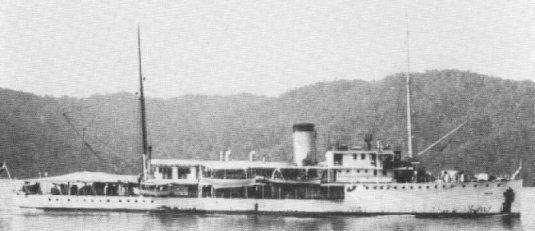
© 2007-2015 Bob Hackett, Sander Kingsepp and Peter Cundall
Revision 8
1929:
Schiedam (near Rotterdam), the Netherlands. Laid down at Wilton-Fijenoord shipyard for the Royal Netherlands Navy (RNN).
19 October 1929:
Launched and named VALK (Falcon).
1930:
Completed. VALK's main assignment is to serve as an anti-smuggling “opium-jager” (opium-hunter) in the Netherlands East Indies (NEI),
1930s:
Dutch East Indies. GM ss (Gouvernements stoomschip) patrol boat VALK is assigned to the Dutch civil navy as an opium trade interdiction vessel. [1]
24 August 1939:
Following increasing tensions in Europe, the Dutch Army in the Netherlands starts its pre-mobilization, but there is no mobilization in the NEI. However, surveillance is tightened.
1 September 1939: World War II Begins:
Following the mobilization in the Netherlands, Governor-General Alidius W. L. Tjarda van Starkenborgh-Stachouwer decides to militarize the GM and it becomes a part of the Royal Netherlands Navy. The patrol boats are put under the RNN's East Indies Squadron.
2 September 1939:
The GM ships' new status is activated. This does not mean every GM ship is now under military orders, but VALK is one that is; she becomes Hr.Ms. VALK.
8 September 1939:
Patrol boat VALK and six of the larger patrol boats are converted are converted to seaplane tenders and assigned to the Marine Luchtvaart Dienst (MLD). VALK is also equipped with a utility Fokker floatplane. [2]
25 September 1939:
The CO GM is notified that VALK, FAZANT, AREND, MEREL, BELLATRIX, GEMMA, CASTOR, SIRIUS, REIGER, ZUIDERKRUIS, RIGEL and TYDEMAN are the only GM ships to receive orders from military authorities.
October 1939:
VALK and five other converted seaplane tenders are stationed at Ambon, Moluccas.
10 May 1940: The German invasion of the Netherlands:
Of 19 German merchant ships in the NEI, 18 are captured after a PTT telegraph operator withholds a coded telegram, dated 9 May '40, directed at these ships’ captains; only SS SOPHIE RICKMERS is sunk by her crew.
April 1941:
Hungarian freighter NYUGAT departs Adelaide, Australia for Shanghai. The Dutch suspect it may try to make contact with a German commerce raider. Several Dutch warships are ordered to capture the freighter. VALK is ordered to patrol W of Timor while destroyer Hr.Ms. KORTENAER patrols E of the island.
13 April 1941:
NYUGAT is spotted by KORTENAER and captured at 11-20S, 123-40E. VALK is then ordered to return to the Moluccas.
28 September 1941:
An MLD plane reports a suspect ship in the Ceram Sea. Two destroyers are sent to investigate, but do not find the intruder, “probably an IJN auxiliary”. The destroyers are sent because VALK, acting as the scouting vessel in the Eastern Archipelago, could not reach the position in time.
7 January 1942:
Halong Naval Air Staion, Ambon Roads. GGM ss VALK is supporting GVT-17 comprised of four Consolidated PBY "Catalina" flying boats.
January 1942:
Ambon undergoes air attacks from the 7th onward.
12 January 1942:
Ambon. An unidentified American warship, probably a gunboat, arrives and anchors in the inner bay.
13 January 1942:
Ambon Bay. Japanese bombers and fighters appear at great altitude. VALK's crew had arranged a dummy AA gun on the compass bridge, connected to the engine room by a steam line. The crew fires ‘salvos’ of steam puffs. VALK opens fire with her 12.7-mm machine-gun, but without effect. The gunboat also opens fire. The Japanese aircraft stay at fairly high altitude. Two Brewster “Buffalo” fighter planes take off from a nearby airfield to attack them, but face no less than 10 Japanese fighters. Both are shot down, but both pilots manage to bail out.
14 January 1942:
Departs Ambon Roads for Surabaya, Java to escort convoys.
February 1942:
Tandjong Priok (near Batavia), Java. VALK is damaged heavily in an air raid.
12 February 1942:
VALK departs Tandjong Priok escorting passenger/cargo vessel M.S. TEGELBERG through the Sunda Strait to a position about 200 nautical miles SE of Sunda Strait. TEGELBERG is enroute to South Africa.
27 February 1942:
VALK departs Tjilatjap escorting TOBA, MERKUS and VAN GOENS. All three ships are enroute for Colombo. VALK returns to Tjilatjap. On 4 March, NE of Cocos Island, MERKUS is sunk by gunfire from IJN submarine I-7 at 08-40S, 94-30E. The crew of MERKUS later reaches Sumatra.
1 March 1942:
Vice Admiral (later Admiral) Conrad E. L. Helfrich, CINC, RNN, issues two orders. First, he demilitarizes the GGM that becomes the GM once more. After that order, he issues the general evacuation order. This order does not apply to GM ships.
3 March 1942:
VALK is damaged in an air raid at an unknown location.
4 March 1942:
Tjilatjap is bombed for the first time. Damage to several ships and shore installations is considerable and almost all native Javanese (including crewmen of VALK) flee the harbor. [3]
5 March 1942:
Carriers AKAGI, KAGA, HIRYU and SORYU launch air strikes against Tjilatjap. VALK is damaged in the attack. That same day, the CO of the Marines’ Battalion is ordered to arrange a crew for VALK to take part in the evacuation of Java, but the order is rescinded the following night, probably because of the damage received.
7 March 1942:
Tjilatjap. VALK is scuttled by her crew. An attempt is made to block the narrowest part of the harbor entrance by sinking her there, but it fails. Only a few ‘motorsloepen’ (motor-lifeboats) and one patrol boat are able to assist and cannot control VALK. She merely runs aground.
8 March 1942:
Bandung. Governor-General Tjarda van Starkenborgh-Stachouwer surrenders Java to the Japanese.
21 April 1943:
Refloated and towed to Surabaya where she undergoes repairs by the IJN's No. 102 Repair Facility.
31 January 1944:
Repairs are completed. Registered in the IJN. Reclassified as a patrol boat and numbered PB-104. Attached to Sasebo Naval District. Assigned to the Southwest Area Fleet's 21st Special Base Force.
Early February 1944:
Batavia (Jakarta). Undergoes work at the Tandjong Priok branch of the No. 102 Repair Facility.
8 February 1944:
Transferred to Surabaya. At 1956 departs Batavia.
9 February 1944:
At 1725 arrives at Sourabaya.
15 February 1944:
At 1400 departs Surabaya on first mission, escorting tanker NISSHO MARU (for Balikpapan) to southern tip of Laut Island.
17 February 1944:
At 1715 arrives back at Surabaya.
20 February 1944:
At 1335 departs Surabaya escorting transporet NANKAI MARU (for Macassar).
22 February 1944:
At 1247 arrives back at Surabaya.
23 February 1944:
At 0800 departs Surabaya escorting ASAKAZE MARU.
25 February 1944:
Arrives back at Surabaya.
26 February-10 March 1944:
Surabaya. Drydocked at No. 1 Dry Dock. One 5-inch AA gun and a Type 93 Mod. 1 sonar are installed.
Lt Komatsu Takashi is appointed CO during this time.
10 March 1944:
Reserve Lt Kosaka Minezo assumes command.
14 March 1944:
At 1500 PB-104 departs Surabaya escorting a convoy consisting of TAIKO and HEIRYU MARUs. TAIKO MARU is towing an auxiliary patrol boat HIJUN MARU.
16 March 1944:
At 2030 arrives at Tandjung Pamukan.
17 March 1944:
At 0500 departs Tandjung Pamukan and at 1120 arrives at Surabaya.
23 March 1944:
At 1500, PB-104 departs Surabaya for Kotabaru, Laut Island, Borneo escorting an unnumbered convoy consisting of IKUTAGAWA and SENKO MARUs.
24 March 1944:
At 1900 arrives at Laut Island, The convoy loads iron and coal.
25 March 1944:
At 1200, PB-104 departs Laut Island escorting an unnumbered convoy consisting of TAIKO and NAGATA MARUs.
27 March 1944:
At 1530, arrives at Surabaya. At 1825 departs Surabaya on a sub sweep.
28 March 1944:
PB-104 departs patrol area to catch up with an outgoing unnunmbered convoy consisting of HEIAN and KUNIYAMA MARUs that left at 1825 the previous day. Off Sepandang Island, PB-104 joins the convoy and takes over from subchaser CH-2 and minesweeper W-12. During the day, the escorts attack an unidentified submarine.
29 March 1944:
At 0100, W-12 runs aground at the west end of Saseel Island. At 0330, PB-104 arrives and assists with refloating. At 0750, arrives at Bima, Sumbawa Island. At 1850, the convoy departs.
30 March 1944:
At 2010, arrives at Surabaya.
31 March 1944:
At 0200 departs Surabaya escorting SHUNSEN MARU en route to Kupang.
1 May 1944:
Departs Manila at 0400 escorting Take Convoy consisting of ADEN, TAJIMA, AMATSUSAN, YOZAN, TEIKAI, KAZUURA, BRAZIL and MITSUKI MARUs with escorts now consisting of PB-102 and PB-104, auxiliary netlyer KOREI MARU, submarine chaser CH-38, minelayer SHIRATAKA and destroyers FIJINAMI and SHIRATSUYU. Tanker JAMBI MARU apparently also joins for part of the way.
6 May 1944:
N Celebes Sea. About 0800, lookouts aboard LtCdr Charles H. Andrews’ (USNA ’30) USS GURNARD (SS-254) spot SHIRATAKA's coal-burning smoke at 19 miles. By 1400 (JST), Andrews completes an "end-around" and gains an attack position on convoy Take No. 1. At 1402, FUJINAMI discovers a submarine. Andrews sets up carefully and fires two three-torpedo salvos at the transports. TAJIMA and ADEN MARUs are hit and sink quickly. AMATSUSAN (TENSHINZAN) MARU is set on fire but remains afloat. TAJIMA MARU takes down 58 of 2701 troops, three crewmen and nine gunners. ADEN MARU takes down 499 troops, 12 crewmen and four gunners.
The escorts launch a heavy counterattack against USS GURNARD. Andrews evades 98 depth charges, after which the escorts break off their attack. USS GURNARD surfaces and finds one of the transports burning, but still afloat. About midnight, USS GURNARD shells the transport with her four-inch deck gun, but she still does not sink. Andrews then fires another torpedo that finally sinks AMATSUSAN (TENSHINZAN) MARU. 95 out of 212 soldiers on board are killed.
7 May 1944:
At 1059 arrives at Bangka.
8 May 1944:
At 0500 departs Bangka. At 1555, PB-102 sights an enemy periscope. She starts an anti submarine attack and drops 3 depth charges.
9 May 1944:
At 1824 arrives at Wasile Bay.
13 May 1944:
At 0355, PB-104 departs Wasile Bay, Halmahera, with minelayer SHIRATAKA, auxiliary netlayer KOREI MARU, and subchaser CH-38 escorting the remnants of convoy Take No. 1 consisting of TEIKAI (ex German FULDA), MITSUKI, KAZUURA, BRAZIL MARUs, newly joined ATLAS MARU to and one other unidentified ship (possibly YOZAN MARU).
14 May 1944:
Arrives at Lembeh anchorage, Celebes.
20 May 1944:
At 2105, the convoy arrives at Manila.
21 May 1944:
At 1130 PB-104 departs Manila and at 1655 arrives at Cavite and docked.
26 May 1944:
At 0745 departs Cavite and at 0925 arrives back at Manila.
28 May 1944:
At 1300, PB-104 departs Manila with PB-102 (ex-USS STEWART, DD-224), destroyer TSUGA, subchaser CH-38 and auxiliary netlayer KOREI MARU escorting convoy H-27 consisting of SHINNO, KOHOKU, KOSEI, MURORAN, SHIROGANESAN, TAIYU, TEIYU (ex Italian CARIGNANO) and JUZAN MARUs.
3 June 1944:
At 2044, arrives at Banka anchorage, NE Celebes.
4 June 1944:
At 0555, departs Banka anchorage.
8 June 1944:
At 1617, arrives at Wasile, Halmahera, Moluccas.
11 June 1944:
At 0525 PB-104 and PB-102 depart Kau Bay, Halmahera with old destroyer TSUGA, subchasers CH-21 and CH-38, auxiliary netlayer KOREI MARU and auxiliary gunboat KAZAN MARU escorting convoy M-22 consisting of AKAGISAN, KOAN, SORACHI, SHIROGANESAN, YOZAN and TAIYU MARUs and YOSHIDA MARU No. 3.
12 June 1944:
TSUGA and CH-38 are detached for Davao.
14 June 1944:
At 1003, LtCdr Willard R. Laughon's (USNA ’33) USS RASHER (SS-269) torpedoes and sinks KOAN MARU at 04-33N, 122-23E. One ship's gunner and 13 crewmen are killed. The ship’s Captain remained on the bridge as the ship sank and the fore-post mast pulled him below the surface.
15 June 1944:
At 0350 arrives at Jolo.
17 June 1944:
At 0800 departs Jolo.
20 June 1944:
At 0925, arrives at Manila.
23 June 1944:
At 0800 departs Manila with auxiliary minesweeper BANSHU MARU No. 56 to meet KANKYO and BELGIUM MARUs (both from M-24 convoy) after the latter ship reports a torpedo attack in 13-10N 120-21E.
24 June 1944:
At 1430 arrives back at Manila.
2 July 1944:
Departs Manila with submarine chasers CH-46 and CH-41 escorting convoy H-31 consisting of TOSHO, ASAHISAN, SHINKOKU and MINO MARUs. TOSHO MARU is towing the hyoteki (midget sub) HA-58.
11 July 1944:
Arrives at Bitung, Celebes.
13 July 1944:
At 0600 departs Bitung.
14 July 1944:
Arrives off Kau Bay. Because of reports of enemy minelaying the ships wait at the northern entrance to the bay. As TOSHO MARU slows to anchor HA-58 comes to the surface and is sighted by a patrolling aircraft that mistakes the midget submarine for an enemy submarine and attacks it with bombs, inflicting minor damage. At 1330 the ships arrive at Kau.
15 July 1944:
At 0500 departs Kau with submarine chasers CH-46 and CH-41 escorting convoy M-27 consisting of HAVRE, SHIRAHAMA, RYOCHI MARUs and possibly others.
16 July 1944:
At 0100 arrives at Bitung.
21 July 1944:
Departs Bitung for Manila.
31 July 1944:
PB-104 is damaged by unknown causes.
21 August 1944:
At 0700 PB-104 departs Manila with subchaser CH-21 escorting convoy MAYU-07 consisting of ATLAS MARU and two unidentified merchant ships.
25 August 1944:
At 1700 arrives at Yulin.
28 August 1944:
At 0400, PB-104 departs Yulin, Hainan Island for Takao with subchaser CH-21 escorting convoy YUTA-11 consisting of iron-carriers MITSUKI, SAIHO, ATLAS, KOKKA and HOKOKU MARUs. The convoy is diverted enroute to Keelung.
2 September 1944:
At 0830, arrives at Keelung, Formosa.
5 September 1944:
At 1000 PB-104 departs Keelung for Moji with patrol boat PB-102 and subchaser CH-21 escorting convoy TAMO-25 consisting of SAIHO, MITSUKI, ATLAS, KOKKA, HENGSHAN, MEIRYU, TATSUSHO and TATSUTAMA MARUs. KOKKA MARU runs aground shortly after leaving Keelung. Later, she is refloated and returns to Keelung.
10 September 1944:
At 2100 arrives at Moji. Departs soon after for Sasebo.
11 September 1944:
Arrives at Sasebo. Begins a refit. Several 41st Year Type 8-cm guns, Type 93 13.2-mm AA guns and a Type 13 air-search radar are installed.
23 September 1944:
The refit is completed. At 1600, PB-104 departs Moji with kaibokan DAITO, auxiliary gunboat KAZAN (HUASHAN) MARU, subchaser CH-21, auxiliary subchasers CHa-87, CHa-92 escorting convoy MI-21 consisting of TEIKA (ex French CAP VARELLA), TSUYAMA, EJIRI, FUSHIMI, KEISHIN, KEIZAN, CHOSAN, TATSUBATO, KENEI, TOYOKAWA and YOSHU MARUs and tankers SAN LUIS, SHUNTEN and EIKYO MARUs. The tanker RYUEI MARU and cargo ship EIKO MARU (1843 grt) joins the convoy from Sasebo later that day.
28 September 1944:
TEIKA MARU (ex French CAP VARELLA) is detached and arrives at Kirun.
29 September 1944:
At 1700, arrives at Takao and the convoy is dissolved.
1 October 1944:
At 1700, PB-104 departs Takao with kaibokan DAITO, YASHIRO, auxiliary gunboat KAZAN (HUASHAN) MARU, subchaser CH-21 and auxiliary subchasers CHa-87 and CHa-92 escorting convoy TAMA-28 consisting of TSUYAMA, NANKING, EIKO, CHOSAN, MURORAN, MACASSAR, FUYUKAWA, MITSU, SHINSEI, KIZAN, FUSHIMI and TAISEI MARUs.
2 October 1944:
Luzon Strait. During a storm, Cdr Frank C. Acker's (USNA ’32) USS POMFRET (SS-391) torpedoes and sinks TSUYAMA MARU at 20-50N, 121-31E. The ship is carrying 1,600 men of the 2nd Mobile Infantry Regiment. 1200 passengers, 11 gunners and 73 crew are KIA.
3 October 1944:
At 2000 arrives at Musa.
4 October 1944:
At 0600 departs Musa and at 1930 arrives at Lapoc Bay.
5 October 1944:
At 0700 departs Lapoc Bay and at 1230 arrives at San Fernando.
6 October 1944:
At 0630 departs San Fernando. At 1915 arrives and shelters in Lapoc Bay. Meanwhile YASHIRO suffers generator problems and is detached to Aparri.
7 October 1944:
At 0030 departs Lapoc Bay. Later LtCdr Henry C. Stevenson's (USNA ’30) USS ASPRO (SS-309) torpedoes and sinks MACASSAR MARU at 17-30N, 119-52E. The ship was carrying approx 400 Naval Shock Troops of 100th Regiment and four of these, a gunner and three crewmen are killed.
8 October 1944:
At 1745, TAMA-28 arrives at North San Fernando, Philippines. FUSHIMI, FUYUKAWA and SHINSEI MARUs are detached.
11 October 1944:
At 0600, the convoy departs North San Fernando. Off San Vicente, Luzon. YASHIRO is damaged by planes of Vice Admiral (Admiral posthumously) John S. McCain’s (USNA ’06) Task Force 38. Following the attack YASHIRO is redirected to Mako, Pescadores. At 1748, the convoy arrives at Masinloc anchorage.
12 October 1944:
At 1320 departs Masinloc anchorage.
13 October 1944:
At 0242 arrives at Manila.
17 October 1944:
Manila. Japanese naval authorities, fearing another air attack by Vice Admiral (Admiral posthumously) John S. McCain's (USNA ’06) Task Force 38, order a number of ships out of Manila to relieve congestion in the harbor.
At 1820, CH-21 departs Manila with destroyer SHIOKAZE, patrol boat PB-104, auxiliary gunboat KAZAN (HUASHAN) MARUs and torpedo boat HIYODORI escorting the "Taihi" (Refugee) convoy consisting of MANILA, EIMAN, HAKUROKU (HAKUSHIKA), TEIFU (ex French BOUGAINVILLE), DAIIKU, KENEI, DAIMEI, SHIRANESAN, ARABIA, SHINSEI and TAIKAI MARUs and NICHIYU MARU No. 2 and tankers KYOEI MARU No. 6 and MITSU MARU.
18 October 1944:
PB-104 and subchaser CH-21 assist transport ARABIA MARU torpedoed at 0716 that morning by LtCdr (later Captain) Eric L. Barr's (USNA ’34) USS BLUEGILL (SS-242). At 1228, ARABIA MARU sinks. The ship had been carrying 1870 troops of the Army 49th Division and 765 troops of the 20th Army Division and 1658 of these troops, 50 ship’s gunners, and 39 crew are killed. HAKKO MARU, loaded with survivors, is escorted back to Manila. Later, the escorts depart Manila to catch up with convoy that left the previous day.
>At 2015 in position 14.03N 119.39E about 105 metres W of Nasugbu HAKUROKU MARU is hit by two torpedoes also from USS BLUEGILL on the port side in hold No.3 and the fuel bunker. Pumping operations begin but are then suspended and the ship sank later that day. The ship was loaded with war supplies, empty drums and about 2000 troops for Java and Burma. 1156 of these troops and 30 of the crew were killed.
According to a FRUMEL decrypt from that same day, ARABIA MARU (9480 GRT) and CHINSEI MARU were torpedoed in 14-10N, 119-40E at 1130. PB-104 counterattacked the submarine, dropping 19 depth charges with unknown result.
20 October 1944:
At 1220 the convoy arrives at Bacuit Bay, Philippines. By this time the convoy, depleted by submarine attack, consists of MANILA, EIMAN, TEIFU (ex French BOUGAINVILLE), DAIIKU, KENEI, TAIMEI, SHINSEI MARUs and NICHIYU MARU No. 2 and tanker KYOEI MARU No. 6 escorted by PB-104, destroyer SHIOKAZE, auxiliary gunboat KAZAN (HUASHAN) MARU and torpedo boat HIYODORI. [5]
21 October 1944:
At 0855, departs Bacuit Bay.
22 October 1944:
Attacked by B-24 "Liberator" heavy bombers.
23 October 1944:
Attacked by B-24 bombers.
24 October 1944:
At 1958 arrives at Gaya Bay, north Borneo. Some ships separate at this point.
26 October 1944:
At 0635, departs Gaya Bay and at 1835 arrives at Labuan.
27 October 1944:
At 1045, departs Labuan. At 1930 anchors off Brunei.
28 October 1944:
At 0600 departs Brunei and at 1650, arrives at Miri. Only MANILA, TEIFU (ex French BOUGAINVILLE), SHINSEI and KENEI MARUs and KYOEI MARU No. 6 are in the convoy at this point.
30 October 1944:
At 0600, PB-104 departs Miri with auxiliary gunboat KAZAN (HUASHAN) MARU escorting convoy MISHI-12 consisting of Army transports MANILA, TASMANIA and JUNPO MARUs, Army shared transports TEIFU (ex-French BOUGAINVILLE), EIMAN and DAIIKU MARUs and NICHIYU MARU No. 2, auxiliary oiler SAN LUIS MARU, Army shared tanker (A/C-AO) KYOEI MARU No. 6 and one unidentified merchant ship (possibly Army shared transport TATSUBATO MARU).
3 November 1944:
At 1030, arrives at Singapore. Docked at No.4 Dock. During the subsequent repairs a radar detector is installed.
18 November 1944:
Convoy SHIMA-05 departs Singapore with kaibokan CD-31, CD-32, subchaser CH-56, auxiliary minesweeper Wa-10 and auxiliary patrol boat NITTO MARU No. 17 consisting of MANILA, TASMANIA, KENEI and AYANAMI MARUs and SHINSEI MARU No. 5 and one unidentified merchant ship. At 1448 LST T-149, which departed Singapore earlier that day, joins the convoy.
20 November 1944:
The convoy arrives at Cape Datu, Borneo (now Malaysia).
21 November 1944:
The convoy departs Cape Datu.
22 November 1944:
At 0730 PB-104 departs Singapore and joins the convoy en route.
24 November 1944:
At 1105 the convoy arrives at Miri. KENEI MARU, T-149 and the one unidentified merchant ship and Wa-10 and NITTO MARU No. 17 are detached. Kaibokan KURAHASHI join the escort.
25 November 1944:
At 0535, LtCdr Joseph J. Staley’s (USNA ’34) USS MINGO (SS-261) torpedoes and sinks MANILA MARU at 05-42N 113-15E. The ship was loaded with 20000 barrels of aviation gasoline, 5904 barrels of gasoline, other ammunition and 10 Daihatsu barges and 96 crewmen, 51 gunners and four other passengers are KIA.
27 November 1944:
At 0600, PB-104 departs Miri, Borneo for Manila with auxiliary NITTO MARU No. 17, subchaser CH-21, auxiliary minesweeper Wa-10 and auxiliary subchaser CHa-11 escorting SHIMA-05A convoy consisting of KENEI MARU carrying ammunition and KYOEI MARU No. 6 carrying aviation gasoline.
28 November 1944:
At 1932 arrives at Labuan.
29 November 1944:
At 0055 departs Labuan and at 1755 arrives at Darun Bay.
30 November 1944:
At 0550 departs Darun Bay.
1 December 1944:
At 1516, arrives at Bacuit Bay, Palawan Islands, Philippines.
2 December 1944:
At 0705, departs Bacuit Bay and at 1736, arrives at Coron Bay, Calamian Islands, Philippines.
3 December 1944:
At 0700, departs Coron Bay.
4 December 1944:
At 0600, arrives at Manila. At 1100, departs for Singapore with subchaser CH-56, auxiliary subchaser KYOEI MARU No. 13 and auxiliary netlayer TOKACHI MARU escorting convoy MASHI-04 consisting of AYANAMI and SHOEI MARUs and BANSHU MARU No. 63.
5 December 1944:
AYANAMI MARU has engine trouble and is detached back to Manila.
13 December 1944:
At 1625, arrives at Singapore.
14 December 1944:
Drydocked at No. 2 Dry Dock of No. 1 Shipyard in Singapore. Probably a Type 22 surface-search radar is installed.
19 December 1944:
Undocked.
21 December 1944:
At 1550 departs Singapore to meet up with SASHI-37 convoy.
22 December 1944:
At 1552 detaches from SASHI-37 convoy.
23 December 1944:
At 0817 meets up with and begins escorting damaged cruiser MYOKO also escorted by minelayer YURIJIMA and minesweeper W-34.
25 December 1944:
At 0145 arrives at Seletar.
30 December 1944:
At 0830 departs Seletar and off Singapore begins escorting convoy SHISA-32 consisting of TOYU, OTSUSAN and SAN LUIS MARUs and two unidentified merchant ships as well as minesweeper W-20 and three unidentified escorts (probably same escorts as for SASHI-39).
4 January 1945:
At 0720 arrives at St Jacques.
6 January 1945:
At 0300 PB-104 departs St Jacques with minesweeper W-20, auxiliary minesweeper Wa-9, auxiliary subchaser KYO MARU No. 13 and TOKACHI MARU escorting convoy SASHI-39 consisting of SHINYU MARU and nine unidentified merchant ships.
9 January 1945:
At 1900 arrives at Singapore.
13 January 1945:
At 0730 departs Singapore to the Banka Straits escorting a convoy consisting of KANTO, GYOSHIN, SUMIRE, ENKEI, HISHI and GYOSHO MARUs.
14 January 1945:
At 1910 arrives at the Banka Straits. The ship detaches from the convoy.
15 January 1945:
At 0700 departs Banka Straits and at 2000 arrives at Palembang channel. Departs soon after.
16 January 1945:
At 1920 arrives at Seletar. Undergoes repairs.
22 January 1945:
At 0700, PB-104 departs Singapore with subchasers CH-20 and CH-35 escorting convoy HI-88-B (SHISA-35) consisting of DAIETSU, ENKI and TATSUTAMA MARUs.
27 January 1945:
At 2230 arrives at St Jacques, Indochina. TATSUTAMA MARU and CH-35 are detached. Kaibokan NOMI and CD-60 join the escort.
28 January 1945:
At 2110, departs St Jacques.
29 January 1945:
At 2230, arrives at Van Phong, Indochina.
30 January 1945:
At 0700, departs Van Phong.
31 January 1945:
After two submarine sightings, at 0551, DAIETSU MARU and one minute later, ENKI MARU are torpedoed by Cdr Royce L. Gross' (USNA ’30) USS BOARFISH (SS-327) at 14-56N, 109-00E. ENKI MARU, loaded with 7000 tons of fuel oil, and 1600 tons crude rubber, tin, mail and other goods together with 21 passengers goes down with one escort trooper KIA. PB-104 stands by and probably rescues survivors. DAIETSU MARU, carrying about 8000 tons fuel oil, 570 tons tin and 1200 tons rubber is run aground on the coast to prevent sinking. Two escort troops and seven crewmen are killed. Later, the wreck is bombed.
2 February 1945:
At 1700 PB-104 arrives at Saigon.
3 February 1945:
At 1150 departs Saigon on an anti submarine sweep and return voyage to Singapore.
6 February 1945:
Arrives back at Seletar.
9 February 1945:
At 0800, patrol boat PB-104 departs Singapore with subchaser CH-63 and kaibokan CD-132 escorting convoy HI-88E consisting of tanker ENKEI MARU and cargo ship SHINYU MARU.
E 14 February 1945:
Arrives at Cap St Jacques. CH-63 is detached.
15 February 1945:
At 1640, arrives at Camranh Bay, Indochina.
16 February 1945:
At 0700 departs Camranh Bay. At 2240 arrives at Qui Nhon.
17 February 1945:
At 0600, departs Qui Nhon, Indochina. At 2312 arrives at Cape Batangan.
18 February 1945:
At 0736 departs Cape Batangan. At 1928 arrives at Tourane.
19 February 1945:
At 0800 departs Tourane.
21 February 1945:
Hainan Island Strait. Lays over several hours because of dense fog.
28 February 1945:
At 0530 arrives at Meisan Liehtao, China.
2 March 1945:
At 0650 departs Meisan Liehtao.
6 March 1945:
At 0800 arrives at Choshohori, Koje Island, Chosen.
7 March 1945:
At 0600 departs Choshohori and at 1605 arrives at Miura Wan, Tsushima.
8 March 1945:
At 0526 departs Miura Wan. At 1715 arrives at Moji.
9 March 1945:
At 0745 departs Moji.
10-31 March 1945:
At 1030 arrives at Sasebo. Drydocked at No. 6 Dry Dock. One twin Type 96 25-mm AA mount and two single AA guns of the same caliber are installed.
Early April to 20 April 1945:
Undergoes hull and engine repairs.
30 April 1945:
Reassigned to the Osaka Naval Guard District.
8 May 1945:
At 1100 departs Sasebo.
9 May 1945:
At 1340 arrives at Hakata. Remains there for most of the month.
25 May 1945:
At 1300 departs Hakata. Later 3.5 miles off Futaoi Light, Kammon Straits (near Moji). At 1805, PB-104 hits a mine laid by USAAF 20th Air Force B-29s and is damaged heavily. The ship is beached at Yoshimo Wan.
29 May 1945:
At 1400 departs Yoshimo Wan and at 1750 arrives at Moji. Enters drydock at Hikoshima for repairs.
June 1945:
Lt Maruyama Haruyoshi is appointed CO.
2 to 10 June 1945:
Shimonoseki. Drydocked at Hayashi-Hikoshima shipyard.
After 14 June 1945:
Moji. Anchors at No. 6 pier.
22 June 1945:
At 1040 departs Moji for Kure.
23 June 1945:
At 0550 arrives at Kure. Scheduled to commence repairs and refit in early July.
26 July 1945:
Kure. Ordered to proceed to Sasebo that same day.
15 August 1945:
Maizuru. Surrendered to Allied Forces.
24 August 1945:
Shimonoseki Strait, off Nishiyama. PB-104 strikes a mine and sinks.
15 September 1945:
Removed from the Navy List.
Authors Notes:
[1] GM ss (Gouvernements stoomschip). The Dutch civil navy, tasked with transport of government goods, charting sealanes and countering piracy, was militarized in 1939. It became a part of the RNN as the GGM (Gemilitairiseerde Gouvernementsmarine - Militarised Government Navy Force).
[2] Marine Luchtvaart Dienst (MLD) = Naval Air Service.
[3] Until this late date, native Javanese in Dutch service performed loyally – including during the Battle of the Java Sea when no crewman - ‘European’ or ‘native’ - deserted, but the fall of the NEI is obvious by now.
[4] Helfrich demilitarized the GGM at the request of Hoofdinspecteur J. Kuiper, head of the Dienst van Scheepvaart. The hope was to save GM personnel, now civilian, from military captivity (POW). Of 58 GM ships only 4 escaped. The relatively fast VALK and AREND had a better chance at escaping than most ships - but only a 'chance'. The 9-knot merchant JANSSENS made it while receiving reports about interception of faster ships by the IJN on her wireless. Escape was by luck of the draw.
[5] It is unclear whether CH-21 caught up with the convoy the previous day.
Special thanks go to Mr. Aldert Gritter ("Admiral Gurita") of the Netherlands for his assistance. We are also indebted to Ms. Anita M. C. van Dissel of the Dutch Institute for Military History (Nederlands Instituut voor Militaire Historie) for her assistance and to Mr Matthew Jones of Mississippi, USA for Co information. Also many thanks to Mr. Gilbert Casse of France. Special thanks go to Hans Mcilveen of the Netherlands for info on FRUMEL intercepts.
Photo credit goes to Jan Visser of the Netherlands.
-Bob Hackett, Sander Kingsepp and Peter Cundall
Back to
Patrol Boat Page