© 2010-2016 Bob Hackett, Sander Kingsepp and Peter Cundall
Revision 6
22 August 1917:
New York. Laid down at Standard Shipbuilding Co's shipyard as a Lapwing Class minesweeper.
30 March 1918:
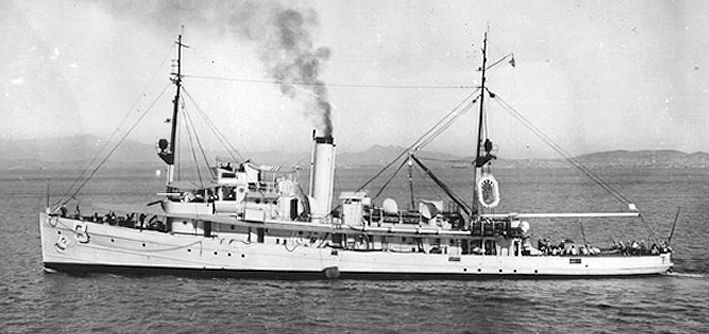
Launched, named and numbered USS FINCH Minesweeper No. 9.
10 September 1918:
Commissioned in the USN.
9 August 1919:
Departs New York for Kirkwall, Orkney Islands, Scotland.
August-October 1919:
FINCH sweeps mines laid in the North Sea during World War I.
23 December 1918 -19 July 1919:
After World War I, USN minesweepers sweep one-mile wide channels into the principal ports serving troops returning from Europe. USS FINCH, in the approach to New York harbor, is one of seven Lapwing Class minesweepers temporarily stationed as Navy lightships at the five approaches to the ports of disembarkation. Each ship is equipped with illumination, fog signal, and submarine bell signal apparatus.
17 July 1920:
Redesignated AM-9.
29 November 1920:
Arrives at Charleston, SC.
3 January 1920:
Departs Charleston for San Pedro, CA.
1 March 1920-29 August 1920:
Arrives at San Pedro. Undergoes modernization.
29 August 1921:
Departs San Francisco for duty with the U. S. Asiatic Fleet. She serves in the Philippines in the winter months and at Chefoo, China in the summer months. Her duties include towing and salvage work, fleet exercises and patrols on the Yangtze River.
September 1921:
Manila Bay. USS FINCH arrives at Cavite Naval Base, Philippines.
December 1921:
Cavite. Assigned as tender to the newly arrived Submarine Division 18 comprised of S-boats USS S-2, USS S-14, USS S-15, USS S-16 and USS S-17.
23 April 1923:
FINCH and submarine tender USS RAINBOW (AS-7) steam with the Asiatic Fleet's submarine divisions to serve at Shanghai, Chefoo, Chinwangtao, Woosung and Amoy along the China Coast.
10 September 1923:
USS FINCH departs China with USS RAINBOW for Olongapo, Philippines, serving there and at Cavite.
24 June 1924:
USS FINCH departs Cavite with USS RAINBOW and the S-boats of Divisions 12 and 18 to serve at Tsingtao, Chefoo and Amoy.
20 September 1924:
FINCH departs China for Olongapo.
23 September 1924:
Arrives at Olongapo.
June 1937:
China. LtCdr (later Admiral) Hyman G. Rickover (USNA ’22) assumes command of USS FINCH, but is reassigned within three months.
7 July 1937: The Marco Polo Bridge (The"First China Incident") Incident:
Hun River, Lukuokiao, China. Japanese troops at the bridge fire blank cartridges during night maneuvers. Chinese troops fire back. Later, the Japanese discover a soldier missing. They demand entry to the Beijing suburb of Wanping to look for him, but the Chinese refuse. The Japanese shell the city and an undeclared war on China begins.
10 January 1939:
USS FINCH is at Tsingtao.
1 October 1939:
Tsingtao. USS FINCH tows submarine salvage ship USS PIGEON (ASR-6) free after she ran aground during a typhoon in September.
November 1941:
Cavite Naval Station, Manila. USS FINCH is flagship of Lt Thurlow W. Davison's Mine Div 8 with USS BITTERN (AM-36).
18 November 1941:
In response to deteriorating political conditions in China, Admiral (later Senator) Thomas C. Hart (USNA ’97), CINC, U. S. Asiatic Fleet orders Rear Admiral (later Vice Admiral) William A. Glassford, CO of the Yangtze River Patrol, to return to Manila with five of his larger gunboats.
29 November 1941:
River gunboats USS LUZON (PR-7), carrying Admiral Glassford, and USS OAHU (PR-6) depart Shanghai for Manila.
30 November -1 December 1941:
About midnight, USS FINCH and submarine rescue vessel USS PIGEON (ASR-6) rendezvous with USS LUZON and USS OAHU.
1 December 1941:
Formosa Straits. USS FINCH, USS PIGEON, USS LUZON and USS OAHU encounter a large Japanese convoy headed southward. A floatplane circles the Americans, followed by seven Japanese warships of various types.
2 December 1941:
As Glassford's flat-bottomed river boats attempt to cross the Formosa Straits they encounter a Typhoon. Admiral Hart, concerned for the gunboats' safety, directs USS FINCH and USS PIGEON to tow them, or if necessary, take off their crews.
3 December 1941:
USS PIGEON's rudder is damaged by mountainous seas and she loses an anchor. USS FINCH loses both of her anchors, but manages to take the unnavigable USS PIGEON under tow. USS LUZON and USS OAHU are detached.
4-10 December 1941:
USS LUZON and USS OAHU reach Manila followed by USS FINCH and USS PIGEON. All the other gunboats arrive over the next few days.
8 December 1941:
At about 1220, nine hours after their attack on Pearl Harbor, the Japanese, delayed by bad weather, bomb LtGen Douglas MacArthur's air bases in the Philippines and destroy many bombers and fighters on the ground.
29 December 1941:
IJNAF land attack planes bomb Corregidor for the first time. Off shore, bombs set fire to Philippine freighter DON JOSE and the hulk of American freighter CAPILLO. USS FINCH puts out the fires on both ships.
9 April 1942:
3 miles off N shore of Corregidor. USS FINCH is anchored next to minesweeper USS QUAIL (AM-15 ) with many of the Asiatic Fleet's minesweepers, gunboats and tugs. At about 1600, Japanese shore batteries open fire on the gathering. All the ships up anchor and zigzag to the center of Manila Bay, but the shore batteries continue firing and sink two tugs. Finally, the other ships get out of range of the guns, only to be attacked by nine dive-bombers. USS FINCH and minesweeper USS TANAGER (AM-5) claim shooting down one dive-bomber.
During the action, USS FINCH is damaged by the near-miss of a bomb and fragments pierce her hull. Her seams open causing flooding and USS FINCH has to be abandoned, but her entire crew is safely landed. The Japanese continue bombing and strafing unit about 1700, but their aim is off and they score no hits, just near-misses. As darkness closes in, the planes withdraw.
10 April 1942:
Off Corregidor. USS FINCH is grounded in shallow water at 14-22N, 120-35E.
6 May 1942:
Corregidor falls.
8 May 1942:
The Japanese begin to salvage USS FINCH.
1 April 1943:
Registered in the IJN as patrol boat PB-103. Attached to the Maizuru Naval Base. Assigned to the South West Area Fleet's Third Southern Expeditionary Fleet at Manila while being repaired at the IJN's No. 103 Repair Facility at Cavite.
9 April 1943:
Lt (Reserve) Imazato Shichiro is appointed the CO.
1 to 17 May 1943:
Transferred to No. 103 Repair Facility at Cavite for hull repairs and reinforcement.
17 May 1943:
At 0845 departs Cavite for engine trials, returns at 1145 that same day. Later, a 1-meter Barr & Stroud rangefinder is installed on the rebuilt bridge.
19 May 1943:
Transferred to the IJN. The armament consists of one 3-in/40 Armstrong gun in the bow, two 0.5-in American machine guns abreast the mainmast, two Type 92 7.7-mm machine guns abreast the foremast and one Type 91 Mk. 1 depth-charge thrower. More trials are conducted with departure at 1000 and the ship returns to Cavite at 1355.
20 May 1943:
At 0900 departs Cavite and returns later that day at 1100.
21 May 1943:
At 0830 departs Cavite and returns at 1610.
27 May 1943:
Hull repairs are completed.
28 May 1943:
At 0831 the ship departs Cavite and arrives at Manila at 0930. At 1600 returns from Manila to Cavite.
31 May 1943:
At 1412 departs Cavite and returns later that day at 1805.
2 June 1943:
At 0835 departs Manila.
4 June 1943:
At 2015 arrives back at Manila.
5 June 1943:
At 1007 departs Manila and arrives at 1100 arrives at Cavite.
6 June 1943:
At 0829 departs Cavite and arrives back at Manila at 0932. At 1505 departs Manila with minelayer YAEYAMA.
9 June 1943:
At 1526 arrives at Lahui (Lahuy) Island.
10 June 1943:
At 0826 departs Lahui Island with minelayer YAEYAMA and at 1427 arrives at Tabaco.
11 June 1943:
At 0544 departs Tabaco.
13 June 1943:
At 1925 arrives at Manila.
17 June 1943:
At 1405 departs Manila.
19 June 1943:
Outside Subic Bay meets auxiliary netlayer KOREI MARU. At 1715 arrives back at Manila. Undertakes weapons trials. A Japanese-style galley is fitted.
21 June 1943:
At 1300 departs Manila.
23 June 1943:
At 1023 arrives at Cebu.
24 June 1943:
At 1900 departs Cebu.
E 26 June 1943:
Probably escorts a convoy consisting of tanker MATSUMOTO MARU bound for Miri and transport HACHIMAN MARU bound for Balikpapan escorted by auxiliary netlayer KOREI MARU (to Balabac Island).
27 June 1943:
At 0740 arrives back at Cebu.
28 June 1943:
At 0634 departs Cebu.
29 June 1943:
At 2055 arrives back at Cebu.
30 June 1943:
At 1800 departs Cebu.
2 July 1943:
At 1042 arrives at Manila.
3 July 1943:
At 1110 departs Manila.
4 July 1943:
At 1700 arrives back at Manila.
5 July 1943:
At 1059 departs Manila escorting convoy No. 856 consisting of tankers SHUNTEN and NITTETSU MARUs and SATA and four of six unidentified merchant ships (a further two having left two days earlier).
7 July 1943:
At 1110 arrives back at Manila and at 1240 transfers to Cavite, arriving at 1410.
10 July 1943:
At 0823 departs Cavite.
12 July 1943:
At 1327 arrives at Manila.
16 July 1943:
At 1435 departs Manila escorting TEIRYU MARU.
18 July 1943:
At 0615 arrives back at Manila.
20 July 1943:
At 1510 departs Manila escorting LYONS and KASAGISAN MARUs.
22 July 1943:
At 0835 arrives at Cebu.
24 July 1943:
At 1650 departs Cebu escorting TAIEI and HOKUHI MARUs.
27 July 1943:
At 1158 arrives at Manila.
31 July 1943:
At 0813 departs Manila.
1 August 1943:
Arrives back at Manila.
10 August 1943:
At 1329 departs Manila.
11 August 1943:
At 1652 arrives back at Manila.
12 August 1943:
At 0125 departs Manila.
15 August 1943:
At 1431 arrives at Manila.
25 August 1943:
At 0828 departs Manila escorting DOSEI MARU (ex DON JOSE).
1 September 1943:
At 0030 arrives at Hong Kong.
3 September 1943:
At 1754 departs Hong Kong escorting salvage tug KEISHU MARU (ex salvage tug HENRY KESWICK) bound for Manila.
4 September 1943:
At 0918 returns to Hong Kong.
7 September 1943:
At 1839 departs Hong Kong.
10 September 1943:
At 1539 arrives at Manila.
20 September 1943:
At 0830 departs Manila.
22 September 1943:
At 1538 returns to Manila.
26 September 1943:
At 0830 departs Manila.
27 September 1943:
At 1420 returns to Manila.
28 September 1943:
At 0830 departs Manila.
30 September 1943:
At 2000 arrives at Takao.
1 October 1943:
At 1205 departs Takao with PB-105.
4 October 1943:
At 0510 arrives at Manila.
7 October 1943:
At 0745 departs Manila with PB-105 and at 1437 arrives at Olongapo.
8 October 1943:
At 0620 departs Olongapo and at 1320 arrives at Manila.
12 October 1943:
At 1250, PB-103 departs Manila with auxilary netlayer KOREI MARU escorting convoy H-2 to Kau, Halmahera consisting of HAMBURG, SUEZ, WAKATSU (ex Greek ANDREAS) and YUBAE MARUs.
14 October 1943:
At 1620, convoy H-2 arrives at Cebu and partially unloads. PB-103 is detached and replaced as escort by minelayer WAKATAKA.
15 October 1943:
At 1600 PB-103 departs Cebu and returns to Manila.
17 October 1943:
At 0600 arrives back at Manila.
25 October 1943:
At 1055 departs Manila for San Fernando escorting HOKUHI MARU (ex CETUS).
E 26 October 1943:
Meets up with convoy No.774 consisting of TATSUHO. TEIKAI (ex German FULDA), SHIRANESAN, KOHOKU, TOHO, TOYAMA, IKOMASAN, JUNYO, MATSUEI (SHOEI), NICHINAN MARUs, SHINSEI MARU No. 1, SHINSEI MARU No. 17 and one unidentified merchant ship escorted by destroyer KURETAKE and torpedo boat TOMOZURU.
27 October 1943:
At 2200 arrives in Manila Bay.
28 October 1943:
At 1150 arrives back at Manila.
31 October 1943:
At 1200, PB-103 departs Manila escorting convoy No. 1 consisting of TEIKAI (ex German FULDA), TOHO, NICHINAN, SHINSHU and SHIRANESAN MARUs.
2 November 1943:
While nearing Cebu Port, TEIKAI MARU (ex German FULDA) runs aground and NICHINAN MARU is detached to assist. At 2305, TEIKAI MARU is refloated and they arrived at Cebu the following day.
3 November 1943:
At 0830 arrives at Cebu.
6 November 1943:
At 0900, PB-103 departs Cebu escorting convoy H-3 consisting of TEIKAI (ex German FULDA), NICHINAN, TATSUHA, TOHO and TOYAMA MARUs.
10 November 1943:
At 0830, arrives at Kau.
11 November 1943:
At 0530, PB-103 departs Kau escorting a convoy consisting of MINRYO and HINODE MARUs and YOSHIDA MARU No. 3.
14 November 1943:
Arrives Zamboanga. CHOJO MARU joins the convoy.
15 November 1943:
At 1000, arrives at Cebu.
16 November 1943:
At 0800, departs Cebu.
18 November 1943:
At 0830, arrives at Manila.
22 November 1943:
At 1745, PB-103 departs Manila escorting convoy H-6 consisting of TATSUHARU, CHINKAI, RYUSEI, FUJIKAWA and NANREI MARUs.
E 24 November 1943:
Off Legaspi, NANREI MARU detaches from the convoy.
26 November 1943:
HAMBURG MARU joins the convoy.
29 November 1943:
At 0815, arrives at Kau.
1 December 1943:
At 0500, PB-103 departs Kau escorting convoy M-3 consisting of AKAGISAN MARU and FUKUEI MARU No. 8.
4 December 1943:
FUKUEI MARU No. 8 is detached from the convoy because of her slow speed.
5 December 1943:
Near Cebu. AKAGISAN MARU suffers rudder problems and stops for temporary repairs. PB-103 proceeds independently and both arrive at Cebu at 2010 that day.
9 December 1943:
At 0805, PB-103 departs Cebu escorting convoy M-092 consisting of DAISOKU MARU No. 13 and SHINSEI MARU No. 17.
11 December 1943:
At 1300, arrives at Manila.
13 December 1943:
At 0840 departs Manila and transfers to Cavite, arriving at 0940.
27 December 1943:
At 1720 enters drydock.
January 1944:
An order is received to fit PB-103 with a larger depth-charge magazine.
6 January 1944:
At 1625 undocked.
7 January 1944:
At 0840 trials and then at 0915 returned to Cavite.
13 January 1944:
At 0835 trials and then at 1408 returned to Cavite.
15 January 1944:
At 0805 transfers from Cavite to Manila, arriving at 0900.
16 January 1944:
At 1130 departs Manila on an anti submarine sweep.
17 January 1944:
At 1909 returns to Manila.
20 January 1944:
At 0900, PB-103 and subchaser CH-46 depart Manila escorting convoy H-14 to Kau, Halmahera consisting of TONEGAWA, KUROGANE, MOJI, MITSUKI, ADEN, KENWA, UGO and RYOCHI MARUs.
22 January 1944:
At 1150, arrives at Cebu, Philippines.
23 January 1944:
At 0900, departs Cebu.
27 January 1944:
At 1456, arrives at Kau.
30 January 1944:
At 0800, PB-103 departs Kau for Manila with subchaser CH-46 and auxiliary subchaser KYO MARU No. 13 escorting the "M" convoy (number unknown) consisting of KAZUURA, YAMAMIYA, TSUKIKAWA and ODATSUKI MARUs.
2 February 1944:
At 0650 arrives at Davao.
5 February 1944:
At 0800 departs Davao but later that day at 1034 returns to Davao.
7 February 1944:
At 1300 departs Davao.
9 February 1944:
At 0800 arrives at Zamboanga but departs the port later that day at 1845. Joins convoy MO-72 consisting of MINRYO and SEKINO MARUs that sailed unescorted from Palau on 7 February.
11 February 1944:
At 0900 arrives at Cebu
12 February 1944:
At 0750 departs Cebu.
14 February 1944:
W of Batangas. At 0505, LtCdr (later Rear Admiral) Reuben T. Whitaker's (USNA ’34) USS FLASHER (SS-249) torpedoes and sinks MINRYO MARU at 13-44N, 120-37E. Four passengers and four of the crew are killed. The convoy arrives at Manila later that day at 2000.
18 February 1944:
At 0830 departs Manila on an anti submarine sweep.
20 February 1944:
At 1455 arrives back at Manila.
25 February 1944:
At 1500, PB-103 departs Manila for Kau, Halmahera Island escorting convoy H-19 consisting of NITTAI, YAMAGATA, SHOGEN, SHINYU, RYUWA and TENCHO MARUs.
28 February 1944:
At 1000, arrives at Cebu, Philippines. The convoy is joined by KANTO MARU and auxiliary subchaser CHa-24 and auxiliary minesweeper Wa-8.
29 February 1944:
At 1600 departs Cebu. At 2330 RYUWA MARU suffers engine problems and returns to Cebu.
1 March 1944:
The escorts detect a submarine. CHa-24 drops depth charges, but without effect.
3 March 1944:
Celebes Sea, 290 miles NW of Wasili, Halmahera. At 2347, LtCdr Willard R. Laughon’s (USNA ’33) USS RASHER (SS-269) attacks convoy H-19. Laughon torpedoes and sinks army transport NITTAI MARU carrying 8655 tons of white rice at 03-8N, 123-56E. One crewman is killed. The escorts drop seven depth charges that slightly damage USS RASHER.
4 March 1944:
At 1825, the convoy's escort is joined by auxiliary NITTO MARU No. 17. At 2300, the escorts detect a surfaced submarine and attack, but without success.
5 March 1944:
At 0405, Laughon's USS RASHER fires torpedoes at the convoy at 02-49N, 126-40E. SHINYU MARU barely manages to evade a hit.
6 March 1944:
At 0237, arrives at Wasile, Halmahera, then departs for Kau at 1300, arriving there at 1450.
8 March 1944:
At 0700 departs Kau and later arrives at Wasile Bay at 0926.
9 March 1944:
At 0600, PB-103 departs Wasile, Halmahera with auxiliary subchaser CHa-12 and auxiliary NITTO MARU No. 17 escorting convoy M-14 consisting of NORWAY, TATSUJU and CELEBES MARUs. PB-103 experiences some malfunctions and the convoy anchors off Kau.
11 March 1944:
At 0715, after repairs to PB-103, the convoy departs Kau for Wasile, Halmahera. The convoy's escort is joined by auxiliary netlayer TOKO MARU No. 1. Later that day the convoy arrives and departs Wasile.
14 March 1944:
Cebu Sea. TEIYU MARU joins the convoy.
15 March 1944:
At 1230, arrives at Zamboanga, Mindanao. Departs at 1850.
19 March 1944:
At 0400, off Cape Santiago, Luzon, the convoy is attacked by an unidentified submarine, but no damage is incurred. Later that day at 1858, arrives at Manila.
25 March 1944:
At 0852 departs Manila and returns later the same day, at 1420.
31 March 1944:
At 0358, PB-103 departs Manila for Kau, Halmahera Island with PB-105, auxiliary netlayer KOREI MARU and auxiliary submarine chaser CHa-24 escorting convoy H-23 consisting of BUNZAN, TATSUJU, MIYAURA and TAIYU MARUs.
2 April 1944:
At 0808 arrives at Cebu. KOREI MARU and CHa-24 are apparently detached.
3 April 1944:
At 0625 PB-103 departs Cebu and returns at 1820.
4 April 1944:
At 0620 PB-103 departs Cebu and returns at 1710.
6 April 1944:
At 0733, the convoy departs Cebu. Enroute, the convoy is joined by KURAMASAN and MITO MARUs from Davao.
10 April 1944:
At 1735, arrives at Kau.
11 April 1944:
At 1442 departs Kau and transfers to Wasile, arriving at 1754.
12 April 1944:
At 1550, PB-103 departs Kau for Manila with with PB-105, auxiliary subchasers YATSUSHIRO MARU and KYO MARU No. 2 escorting convoy M-17 consisting of YAMAGATA, SHOGEN and SHINYU MARUs and NIKKO MARU No. 1 and Army LST BANRYU (later SS-2).
15 April 1944:
At 2340, LtCdr (later Cdr) Marshall H. Austin's (USNA ’35) USS REDFIN (SS-272) torpedoes and damages SHINYU MARU, but she is able to continue.
16 April 1944:
At 0240, USS REDFIN torpedoes and damages YAMAGATA MARU transporting about 100 wounded soldiers and 25 other passengers, and later she sinks. 28 passengers and five crewmen are killed.
17 April 1944:
At 1215 arrives at Zamboanga and departs at 2040 the same day.
21 April 1944:
JANBI and BUGEN MARUs join the convoy.
22 April 1944:
At 0720 arrives at Cebu. TAIKO and HOKUHI MARUs join the convoy. Departs the same day at 1445.
24 April 1944:
At 1505 convoy M-27 arrives at Manila.
25 April 1944:
At 0825 departs Manila and at 0920 arrives at Cavite.
4 May 1944:
At 1025 departs Cavite and at 1210 arrives at Manila.
7 May 1944:
At 1650 departs Manila and at 1742 arrives at Cavite.
8 May 1944:
At 0955 departs Cavite and at 1052 arrives back at Manila.
9 May 1944:
At 0330 departs Manila escorting convoy H-25 consisting of MANSHU, PEKING, YAMAHAGI, SHIROTAE, KUROGANE, TSUSHIMA, KENNICHI and FUKUYO MARUs.
15 May 1944:
At 0940 arrives at Kau. At 1200 departs Kau and at 1255 arrives at Malifut.
17 May 1944:
At 0800 departs Malifut and at 1043 arrives at Wasile.
20 May 1944:
At 1905 departs Wasile but returns at 1945.
21 May 1944:
At 0500 departs Wasile.
23 May 1944:
At 1900 arrives at Wasile.
24 May 1944:
At 0830 departs Wasile and at 1110 arrives at Malifut.
25 May 1944:
At 0700 departs Malifut and at 1100 arrives at Wasile. At 1230 departs Wasile, but returns at 1830.
26 May 1944:
At 1350, PB-103 departs Wasile, Halmahera Island for Manila escorting convoys M-20 and M-21 consisting of TSUSHIMA, MANSHU, YAMAHAGI, TATSUMA, SHIROTAE, FUKUYO, PEKING, FUYO, KENNICHI, TENSHO and KUROGANE MARUs.
30 May 1944:
At 0845, arrives at Zamboanga, Mindanao and departs later that day, at 1725.
1 June 1944:
At 0740, arrives at Cebu and departs later that day at 1545.
3 June 1944:
At 2120, arrives at Manila.
12 June 1944:
At 0800, PB-105 departs Manila for Wasile, Halmahera Island with PB-103, submarine chaser CH-45 and kaibokan CD-10 escorting convoy H-29 consisting of MACASSAR, JUNPO, FUYO, YAMAGIKU, FRANCE, KURAMASAN, HIBI and TAIYU MARUs.
17 June 1944:
HIBI MARU is detached for Zamboanga.
22 June 1944:
At 1845 arrives at Malifut.
23 June 1944:
At 0800 departs Malifut. At 1710, convoy H-29 arrives at Halmahera.
25 June 1944:
At 0550, PB-105 and PB-103 depart Wasile for Manila with kaibokan CD-10 escorting convoy M-25 consisting of MACASSAR, JUNPO, YAMAGIKU, FRANCE and TAIYU MARUs.
28 June 1944:
Moro Gulf, 35 miles E of Zamboanga. At 0712, LtCdr Ian C. Eddy’s (USNA ’30) USS PARGO (SS-264) attacks the convoy. Eddy torpedoes and sinks YAMAGIKU MARU with the loss of three crewmen, and damages CD-10 at 06-50N, 121-30E.
29 June 1944:
At 1550, the convoy departs Zamboanga with KASAGISAN MARU as an additional member.
1 July 1944:
Cebu Sea. FRANCE and TAIYU MARUs are detached. That same day, Lt Kosaka Minezo is posted CO.
3 July 1944:
The remainder of convoy M-25 arrives at Manila.
12 July 1944:
PB-103 departs Manila for Zamboanga with subchaser CH-31 and auxiliary subchasers CHa-84 and MOGAMI MARU escorting convoy C-124 consisting of MAYA, TATEISHI, SHIROUMA (HAKUBA) and NATSUKAWA MARUs.
14 July 1944:
At 1050. arrives at Cebu.
15 July 1944:
Att 2345 departs Cebu.
16 July 1944:
At 1800, LtCdr William C. Thompson's (USNA ’35) USS CABRILLA (SS-288) attacks the convoy, and claims to have attacked 2 ships simultaneously, a "loaded AP with cut down masts, similar to KASHIMA MARU" and a "large AK", both at 1731 (H)(08-15N, 122-50E), claiming the AP as probably sunk. The escorts counter-attack and drop 24 depth charges that slightly damage USS CABRILLA.
17 July 1944:
At 0230, USS CABRILLA torpedoes and sinks MAYA MARU. The ship is carrying 36 passengers and war supplies. Six passengers, two gunners and 13 crewmen are killed. Thompson also torpedoes and damages NATSUKAWA MARU. Minsweeper W-30 and auxiliary subchaser MOGAMI MARU are sent to assist.
18 July 1944:
At 0623 arrives at Zamboanga.
19 July 1944:
At 1023 departs Zamboanga escorting NATSUKAWA MARU.
20 July 1944:
At 0720 arrives off Talisay, Tawi Tawi. At 0950 departs. At 1610 returns to Zamboanga.
22 July 1944:
At 2030 departs Zamboanga.
23 July 1944:
At 1145 arrives at Talisay and departs there at 1255.
24 July 1944:
At 1230 arrives back at Zamboanga.
25 July 1944:
At 0705 departs Zamboanga still escorting NATSUKAWA MARU. At 1040 arrives at Talisay, Tawi Tawi. At 1600 departs.
26 July 1944:
At 1320 arrives back at Zamboanga.
27 July 1944:
At 1017 departs Zamboanga. At 1145 arrives at Talisay. At 1330 departs Talisay and at 1550 arrives back at Zamboanga.
28 July 1944:
At 1005 departs Zamboanga and arrives at Talisay at 1125. Departs Talisay at 1250.
29 July 1944:
At 1130 anchors off Talisay. At 1305 departs Talisay. At 1625 arrives at Zamboanga.
31 July 1944:
At 1050 departs Zamboanga and at 1230 arrives at Talisay. Departs Talisay at 1507 still escorting NATSUKAWA MARU.
1 August 1944:
At 1230 arrives at Zamboanga.
3 August 1944:
At 1048 departs Zamboanga still escorting NATSUKAWA MARU.
4 August 1944:
At 1315 arrives back at Zamboanga.
6 August 1944:
At 1000 departs Zamboanga.
7 August 1944:
At 1330 arrives at Zamboanga and departs at 1904 with auxiliary patrol boats TERUKAZE and MOGAMI MARUs.
9 August 1944:
At 1250 arrives at Zamboanga.
11 August 1944:
Receives Philippines Unit Telegram No. 479:
Patrol boat PB-103 and auxiliary subchaser TERUKAZE MARU are assigned to escort the SHIRETOKO between Cebu and Bongao. During the escort PB-103 and TERUKAZE MARU are under command of the captain of the SHIRETOKO. At 0828 departs Zamboanga.
12 August 1944:
At 1150 arrives at Cebu.
15 August 1944:
At 0054 PB-103 departs Cebu and at 0225 arrives off Navy oiler SHIRETOKO that has run aground near Cebu and assists in refloating of the vessel. About the same SHIRETOKO begins offloading cargo.
16 August 1944:
At 0846 SHIRETOKO completes offloading cargo. At 0950 SHIRETOKO and PB-103 arrive at Cebu.
17 August 1944:
At 0050 PB-103, submarine chaser CH-31, auxiliary patrol boat TERUKAZE MARU and SHIRETOKO depart Cebu.
18 August 1944:
At 1730 arrives at Jolo. CH-31 ends escort and heads towards Zamboanga.
19 August 1944:
At 0510 departs Jolo still escorting SHIRETOKO. At 1748 arrives at Bongao.
21 August 1944:
At 0627 departs Bongao escorting oiler SUNOSAKI. At 1856 arrives at Jolo.
22 August 1944:
At 0633 departs Jolo and at 1625 arrives at Zamboanga.
24 August 1944:
At 1052 departs Zamboanga but at 1324 returns to Zamboanga.
25 August 1944:
At 1025 departs Zamboanga escorting SUNOSAKI.
26 August 1944:
At 1910 arrives at Cebu.
28 August 1944:
At 0615 departs Cebu apparently with SUNOSAKI. At 1825 arrives at Cabugao.
29 August 1944:
At 0614 departs Cabugao. At 1801 arrives at Bulan.
30 August 1944:
At 0750 departs Bulan. At 1535 arrives at Santa Cruz.
31 August 1944:
At 0650 departs Santa Cruz. At 1556 arrives at Puerto Galera.
1 September 1944:
At 0830 departs Puerto Galera escorting oiler SUNOSAKI. At 1630 arrives at Manila.
5 September 1944:
At 0830 departs Manila and at 0905 arrives at Cavite.
6 September 1944:
At 0600, PB-103 departs Cavite and then Manila for Cebu with torpedo boat HAYABUSA, auxiliary subchaser MOGAMI MARU and auxiliary TERUKAZE MARU escorting convoy C-067 consisting of MIKASA, KEIAN, GENKAI, TOYO, RAKUTO, AYASONO and BANRYU (later SS-2) MARUs and FUKUEI MARU No. 17.
8 September 1944:
At 1335, arrives at Cebu. MIKASA MARU, FUKUEI MARU No. 17 and BANRYU are detached.
10 September 1944:
At 1050, arrives at Loc Bay, Masbate Is.
12 September 1944:
At 1049, departs Loc Bay.
13 September 1944:
At 0430, arrives at Santa Cruz, Mindoro Island.
16 September 1944:
At 0947, departs Santa Cruz and at 1915 anchors at Batangas.
17 September 1944:
At 0555, departs Batangas and at 1600 arrives at Manila.
19 September 1944:
At 0855 departs Manila and at 1005 arrives at Cavite
20 September 1944:
At 0810 departs Cavite for Kanakao, arriving at 0840. Later, docks at No. 103 Repair Facility for repairs. Type 93 sonar and a radar detector are also installed. Probably at that time, her Type 91 depth-charge thrower is replaced by a Type 94.
10 October 1944:
Completes repairs at No. 103 Repair Facility. At 0350 departs Kanakao and at 0950 arrives back at Kanakao.
12 October 1944:
At 0910 departs Kanakao and at 0950 arrives at Cavite. Undergoes hull inspection at Cavite No. 2 pier.
17 to 24 October 1944:
At 0808 departs Cavite and at 1840 arrives and docks at Kanakao for additional hull reinforcement.
24 October 1944:
At 0330 departs Kanakao and at 0618 arrives at Cavite. At 0648 docked at Cavite.
25 October 1944:
At 1110 departs Cavite and at 1130 arrives at Kanakao. At 1815 departs Kanakao.
27 October 1944:
At 0530 arrives at Ambugan. At 0840 anchors in Lagara Cove. At 1625 departs Lagara Cove.
28 October 1944:
At 0842 arrives at Sicogon. Departs at 0805.
30 October 1944:
At 0740 arrives at Coron.
31 October 1944:
At 1905 departs Coron.
1 November 1944:
At 0910 arrives at Puerto Concepcion. At 1531 departs the port.
2 November 1944:
At 0725 arrives at Manila.
3 November 1944:
At 0615 briefly departs Manila, returning at 0715.
4 November 1944:
At 0630 departs Manila and at 0732 arrives at Cavite.
5 November 1944:
At 0700 departs Cavite and at 0830 arrives at Manila.
November 1944:
A Type 96 twin 25-mm AA mount (abaft the mainmast) and four single mounts are fitted.
7 November 1944:
At 1715 departs Manila.
8 November 1944:
At 0726 arrives at Santa Cruz.
9 November 1944:
At 0640 departs Santa Cruz escorting NANKING MARU. At 2140 anchors in Manila Bay.
10 November 1944:
At 0900 arrives at Manila.
11 November 1944:
At 2100 departs Manila with submarine chasers CH-30 and CH-31 escorting Taihi Refugee convoy consisting of tankers KYOEI MARU No. 3, and AYAGUMO and ASOKAWA MARUs.
14 November 1944:
At 1635 arrives at Buliluyan.
15 November 1944:
At 0658 departs Buliluyan. At 1854 arrives at White Rocks Bay.
16 November 1944:
At 1200 departs White Rocks Bay. At 1837 arrives at Jesselton.
17 November 1944:
At 0658 departs Jesselton. At 1542 arrives at Brunei.
18 November 1944:
At 1210 departs Brunei. At 1922 arrives at Patches, an area of
submerged reefs, S of the Ampa and Browne Patches, 4-50N, 114-20E
19 November 1944:
At 0720 departs Patches. At 1839 arrives at Miri.
21 November 1944:
At 1000 departs Miri escorting tanker KYOEI MARU No. 3.
24 November 1944:
Arrives at Pulau Pangkil. At 1735 PB-103 anchors in Riau Strait.
25 November 1944:
At 0825 departs Pulau Pangkil.
25 November 1944:
Ar 1720 arrives at Singapore, Malaya.
4 December 1944:
At 0800, PB-103 departs Singapore for Manila with kaibokan CD-43, subchasers CH-30 and CH-31 escorting convoy SHIMA consisting of SHOEI, KOSHIN and EIHO MARUs and KYOEI MARU No. 3.
8 December 1944:
NNE of Kuching, Borneo. At 0104, either LtCdr John C. Martin's (USNA ’34) USS HAMMERHEAD (SS-364) or LtCdr Joseph P. FitzPatrick's (USNA ’38) USS PADDLE (SS-263) torpedoes and sinks SHOEI MARU with a cargo of 5,000-tons of gasoline at 04-02N, 111-12E. 42 crewmen are KIA.
9 December 1944:
At 0830 arrives off Cape Paloh.
11 December 1944:
At 0700 departs Cape Paloh. At 0900 arrives at Pending and departs there at 1200.
12 December 1944:
At 1300, arrives at Kuching.
13 December 1944:
At 1200, departs Kuching.
16 December 1944:
KOSHIN MARU suffers engine trouble and has to be towed to Miri. At 1930 the ships arrive at Miri.
17 December 1944:
At 0600 departs Miri.
18 December 1944:
At 1930 arrives at Cape Paloh.
19 December 1944:
At 0700 departs Cape Paloh and at 0900 arrives at Pending.
23 December 1944:
At 1400 departs Pending. Soon after LtCdr (later Captain) Irvin S. Hartman's (USNA ’33) USS BARBERO (SS-317) torpedoes and sinks subchaser CH-30 at 02-42N, 111-05E.
24 December 1944:
At 1700 the convoy anchors off Cape Paloh. The convoy's destination is changed to Cape St Jacques, Indochina.
25 December 1944:
At 1200, departs Cape Paloh.
1 January 1945:
At 1100, the convoy arrives at Cape St Jacques.
2 January 1945:
At 1020 departs Cape St Jacques and at 1830 arrives at Saigon.
6 January 1945:
At 1200 departs Saigon and at 1500 arrives at Cape St Jacques.
11 January 1945:
At 1100, PB-103 departs Cape St Jacques with kaibokan CD-35, CD-43, minesweeper W-101 and subchaser CH-31 escorting convoy SATA-05 consisting of KENSEI and TOYU MARUs, landing ship transport T. 149 and tankers AYAYUKI, KOSHIN and EIHO MARUs. In the evening, T. 149 finds the heavy seas too dangerous. She is detached from the convoy and returns to St Jacques.
12 January 1945: American Operation "Gratitude"- Task Force 38's Strikes on Indochina:
Off Cape Padaran, SE French Indochina. Carrier aircraft of Vice Admiral (Admiral posthumously) John S. McCain’s (USNA ’06) Task Force 38 attack convoy SATA-05. PB-103 is repeatedly strafed and most of her AA armament is disabled. The depth-charges on the afterdeck catch fire. At 1515, after several successive explosions the ship sinks in 28 feet of water. Her bridge remains partially visible. Twenty three officers and men are killed, 53 wounded.
TF 38’s planes also sink merchant tanker AYAYUKI MARU (with 4800 tons of oil products lost and 16 crewmen killed), kaibokan CD-35, CD-43, subchaser CH-31 and minesweeper W-101 at 11-10N, 108-55E.
10 March 1945:
Removed from the Navy List.
Thanks to Mr. Gilbert Casse of France.
-Bob Hackett, Sander Kingsepp and Peter Cundall.
Back to
Patrol Boat Page