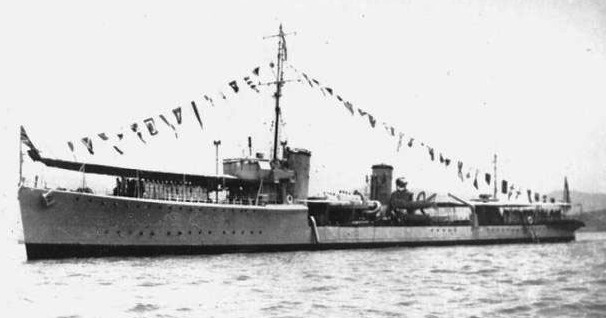
© 2007-2015 Bob Hackett, Sander Kingsepp and Peter Cundall
Revision 8
10 January 1918:
Laid down at Hawthorn Leslie & Co. (Hebburn-on-Tyne, U. K.) as an Admiralty S class destroyer.
5 March 1920:
Launched, named and numbered HMS THRACIAN (D86).
21 April 1920:
Commissioned in the Royal Navy. Transferred to Sheerness Dockyard for fitting out and completion.
21 April 1922:
Completed.
26 October 1936:
China. LtCdr Edward B. Tancock, RN, assumes command of HMS THRACIAN.
8 August 1937:
Off Chilang Point, 90 miles N of Hong Kong. A China National Aviation Corporation Sikorsky S-43 "Chekiang“ passenger flying boat bound for Shanghai crashes in the sea. HMS THRACIAN and a Chinese customs cruiser are dispatched to the site of accident. Eight survivors are transferred to HMS THRACIAN that delivers them to Hong Kong the next day at 0630.
2 September 1937:
One of the worst typhoons of the 20th Century hits Hong Kong. Twenty-seven ships are driven aground and the storm does enormous damage to the city and its environs; however, damage, if any, to HMS THRACIAN is unknown.
18 August 1938:
LtCdr Henry Dudley G. De Chair, RN, assumes command of HMS THRACIAN that is assigned to the Hong Kong Local Defence Flotilla with HMS TENEDOS; later that year they are joined by destroyers HMS THANET and HMS SCOUT. [1]
12 October 1938:
At dawn, LtGen Furusho Motoo’s 21st Army, supported by the China Area Fleet’s Fifth Fleet and Formosa-based and carrier-based Navy air units, make a surprise landing at Ta-Ya (Bias Bay), 35 miles NE of Hong Kong. Thereafter, Japanese forces continued their advance with little or no resistance and by 21 October capture Canton. The operation isolates Hong Kong and Macao.
Mid-September 1939:
Following the outbreak of World War II, HMS THRACIAN is fitted with an additional 4-in gun, torpedo tubes and mine rails. She participates in laying several minefields in the Hong Kong area.
February 1941:
LtCdr A. L. Pears assumes command of HMS THRACIAN.
8 December 1941:
The Japanese open their offensive on Hong Kong by moving troops across the New Territories frontier. Twelve Tachikawa Ki-36 "Ida" Army bombers of the 45th Sentai based at Canton escorted by nine Ki-27 "Nate" fighters also attack Kai Tak airport on Kowloon. The Ida's bomb from low level, while the Nates strafe. All five of the token RAF aircraft (2 "Walrus" amphibians and 3 Vickers "Vildebeeste" torpedo bombers) stationed at Kai Tak are quickly either damaged or destroyed as are numerous light trainers and civilian cargo planes. In the harbor, PanAm’s visiting Sikorsky S-42B flying boat "Hong Kong Clipper" is bombed, set afire and sinks.
At 2100, destroyers HMS THANET and HMS SCOUT depart Hong Kong for Singapore.
13 December 1941:
Major General Christopher M. Maltby, British Indian Army, orders the evacuation of Kowloon Peninsula. At 0400, LtCdr Pears' HMS THRACIAN, now Hong Kong's only destroyer, is ordered around from Aberdeen to assist in ferrying troops across the bay. She arrives at about 0600. Laden with troops, HMS THRACIAN plus several boats of the 2nd MTB Flotilla, assorted launches and Chinese sampans withdraw to Hong Kong Island. By 0930, all British and Commonwealth troops are evacuated from the Mainland to Hong Kong Island. In the meantime, Royal Engineers destroy anything useful on the north side.
December 1941:
HMS THRACIAN and two old gunboats HMS ROBIN and HMS CICALA lay off the southern coast of Hong Kong Island and bombard Japanese positions.
15 December 1941:
Hong Kong Island is subjected to heavy air and artillery bombardment. LtGen Sakai Takashi, C-in-C, 23rd Army, begins preparations for the invasion of the island.
That night, HMS THRACIAN makes her way past Green Island and engages two anchored river steamers that may have been full of Japanese troops. She sinks them both in Kowloon Bay, 1,000 yards E of the electric power station, but THRACIAN is grounded unintentionally off Lamma Island.
16 December 1941:
HMS THRACIAN is badly damaged by Japanese aircraft. She is scuttled by being run aground on Round Island in Repulse Bay. [2]
18 December 1941:
The Japanese land on the NE corner of Hong Kong Island. They soon seize Taikoo Dockyard before it can be destroyed and capture minesweepers HMS TAITAM and HMS WAGLAN under construction in the yard. [3]
19 December 1941:
A mixed naval force of about 200, including men from THRACIAN, are sent to take over defense of the Little Hong Kong ordnance base area.
25 December 1941: Christmas Day and the Fall of Hong Kong:
General Maltby advises Governor Sir Mark A. Young to surrender the outnumbered British garrison because of lack of food and water. At 1800, in Japanese headquarters in the Peninsula Hotel at Kowloon, Young surrenders the Crown Colony to General Sakai. That night, nearly 6,500 British and Commonwealth troops go into Japanese captivity.
10 July 1942:
HMS THRACIAN is salvaged and refloated by the IJN. Repaired at No. 2 Repair Facility in Hong Kong.
27 September 1942:
LISBON MARU departs Hong Kong for Shanghai with 778 troops and 1816 prisoners of war aboard.
1 October 1942:
Six miles from Tung Fusham Island, China coast. LtCdr (later Rear Admiral-Ret) Rob R. McGregor's (USNA ’30) USS GROUPER (SS-214) torpedoes and sinks LISBON MARU at 30-17N, 123-13E with loss of thee IJA soldiers and 845 POWs, including seven former crewmen of HMS THRACIAN.
That same day, PB-101 is attached to the Yokosuka Naval District. She plays no part in the LISBON MARU saga.
25 November 1942:
Completes repairs and is tentatively registered as patrol vessel PB-101, for alternative use as a training vessel. Transferred to Yokosuka later that year for a weapons refit. [4]
16 January 1943:
PB-101 escorts tanker KENYO MARU south from Tokyo Bay.
E 17 January 1943:
At 33 degrees north PB-101 detaches and returns to Yokosuka.
19 January 1943:
PB-101 departs Tokyo Bay escorting KIMIKAWA MARU north-east.
31 January 1943:
PB-101 departs Tokyo Bay escorting convoy No. 1131 consisting of KOKURYU and TSUNESHIMA MARUs bound for Hokkaido.
8 February 1943:
At 1230 PB-101 departs Yokohama escorting convoy No. 1208A consisting of HAKOZAKI, ERIE and SHINTO (KAMISHIMA) MARUs bound for Hokkaido.
11 February 1943:
PB-101 returns to Tokyo Bay with destroyer NOKAZE escorting convoy No. 2211 from Hokkaido consisting of FUKUYAMA, KIFUNE, ATLANTIC MARUs, BANEI MARU No. 3 and UNKAI MARU No. 7.
15 February 1943:
At Yokosuka. Redesignated as patrol boat. Reserve LtCdr Sugimoto Yasumasa (former CO of CH-32) is appointed CO.
18 February 1943:
Departs Nagaura for trials but returns later that day.
19 February 1943:
At 0850 departs Nagaura and begins escorting KIKUKAWA MARU, bound for Truk.
20 February 1943:
At 0035 PB-101 is detached and at 1200 arrives back at Nagaura.
21 February 1943:
At 0720 departs Nagaura and at 0840 anchors off Uraga.
22 February 1943:
At 0800 departs Uraga and at 0940 arrives back at Nagaura.
24 February 1943:
At 1635 departs Nagaura and at 1700 arrives at Yokosuka.
25 February 1943:
At 0400 PB-101 departs Yokosuka escorting HAKOZAKI MARU bound for Miike.
26 February 1943:
At 1145 arrives at Kobe.
28 February 1943:
At 1200 PB-101 departs Kobe, Inland Sea escorting convoy No. 8228 consisting of KOKURYU, IKOMA, SAN PEDRO, MICHI, MISHIMA and KARYO (CHIAKING) MARUs and HAKUTETSU MARU No. 15 bound for Tokyo Bay.
2 March 1943:
Arrives at Yokosuka. PB-101 detaches and arrives at nearby Nagaura at 1000.
9 March 1943:
At 0900 departs Nagaura. At 0900 arrives at Yokohama and at 1200 departs Yokohama escorting convoy No. 1309.
11 March 1943:
At 0100 ceases escort and at 0640 arrives at Onagawa. At 1640 departs Onagawa for Yokosuka.
12 March 1943:
At 1440 arrives at Nagaura. Spends the rest of the month outfitting.
30 March 1943:
Departs Nagaura and at 0945 arrives at nearby Yokosuka. Docked at No.5 Dock.
14 April 1943:
At 0950 undocked.
18 April 1943:
At 1025 departs Nagaura and at 1600 departs Yokohama escorting convoy No.7418 consisting of four unidentified merchant ships.
20 April 1943:
At 0847 arrives at Kobe.
22 April 1943:
At 1228 PB-101 departs Kobe, Inland Sea escorting convoy No. 8422 consisting of ISSEI, NIKKIN, KINSHU, YAMAZURU and IMIZU MARUs and HAKUTETSU MARU No. 15 bound for Tokyo Bay.
24 April 1943:
At 0915 arrives at Nagaura.
28 April 1943:
At 1030 departs Nagaura and at 1600 PB-101 departs Yokohama escorting convoy No. 7428 consisting of SAISHU, SHOHO (1365 grt), SHOEI (3099 grt) and YOZAN MARUs bound for the Inland Sea. SHOHO MARU was bound for Nagasaki.
29 April 1943:
At 0540 off Omae Zaki YOZAN MARU is detached.
30 April 1943:
At 0920 arrives at Kobe.
2 May 1943:
At 1200 departs Kobe escorting convoy No. 8502A consisting of EIAN, TORYU, MISAKI and KYORYOKU MARUs and one unidentified merchant ship (presumably FRANCE MARU).
4 May 1943:
At 0445 KYORYOKU MARU collides with FRANCE MARU and then EIAN MARU. PB-101 summons Cable layer escort HATSUSHIMA to assist. At 1115 arrives at Nagaura.
6 May 1943:
At 0725 departs Nagaura with auxiliary TOEI MARU escorting convoy No. 7505 consisting of SOSHU and KOSHU MARUs and two unidentified merchant ships (which likely joined en route). Arrives at Tateyama and at 1125 departs port. At 1600 SOSHU MARU and escort TOEI MARU are detached off Ito.
8 May 1943:
At 0107 anchors off Wada Misaki and at 0846 raises anchors and arrives at Kobe at 0913.
10 May 1943:
At 1201 departs Kobe escorting convoy No. 8510 consisting of three unidentified merchant ships.
12 May 1943:
At 0240 arrives off eastern Yokosuka ligthbuoy and anchors. At 0620 raises anchor and at 0720 arrives at Nagaura.
19 May 1943:
At 1130 departs Yokosuka escorting convoy No. 7519A consisting of HIE and SAGARA MARUs.
20 May 1943:
At 1250 arrives off Wada Misaki. At 1252 proceeds in and at 1330 arrives at Kobe
23 May 1943:
At 1028 departs Kobe escorting convoy 8523 consisting of six unidentified merchant ships.
25 May 1943:
At 0816 arrives off Yokosuka. At 0845 departs and at 1005 arrives at Nagaura.
27 May 1943:
At 1558 departs Nagaura and at 1659 arrives off Yokohama.
28 May 1943:
At 0130 PB-101 departs Yokohama escorting convoy No. 7528A consisting of AMAGISAN and SANSEI MARUs (2386 gt) bound for Kobe, Inland Sea.
29 May 1943:
At 0845 arrives at Yura. At 1054 departs Yura and at 1445 arrives at Kobe.
1 June 1943:
At 1030 departs Wada Misaki escorting convoy No. 8601.
3 June 1943:
At 0835 arrives at Yokosuka.
7 June 1943:
At 1428 departs Yokosuka escorting fleet oilers ASHIZURI and SUNOSAKI.
9 June 1943:
At 0950 arrives at Yura and departs there at 1400. At 1745 arrives at Kobe.
12 June 1943:
At 1000 departs Kobe escorting convoy No. 8612 consisting of YUZAN MARU and four unidentified merchant ships.
13 June 1943:
At 0400 YUZAN MARU suffers an engine breakdown and anchors to undertake repairs.
14 June 1943:
At 0645 arrives at Yokosuka.
16 June 1943:
At 0658 departs Yokosuka on an anti submarine sweep off Omae Zaki.
17 June 1943:
At 0700 arrives back at Yokosuka.
19 June 1943:
At 1555 departs Yokosuka and at 1700 arrives at Yokohama.
20 June 1943:
At 0400 departs Yokohama escorting convoy No. 7620 consisting of three unidentified merchant ships.
21 June 1943:
At 1855 arrives at Kobe.
24 June 1943:
At 1000 departs Kobe escorting convoy No. 8624 consisting of three unidentified merchant ships.
26 June 1943:
At 0730 arrives at Yokosuka.
28 June 1943:
At 1725 departs Yokosuka with destroyer IKAZUCHI escorting convoy No. 3628 consisting of HAKUSAN MARU and Naval stores ship IRAKO. At some point PB-101 is detached.
30 June 1943:
At 0500 arrives back at Yokosuka. At 1147 departs Yokosuka escorting seaplane tender AKITSUSHIMA.
2 July 1943:
At 1345 arrives at Muroran.
5 July 1943:
At 0805 departs Muroran escorting convoy No. 2705.
6 July 1943:
At 2130 off Kinkasan ceases escort of convoy.
7 July 1943:
At 1942 arrives at Yokosuka.
8 July 1943:
At 0530 departs Yokosuka but at 0650 returns to Yokosuka.
10 July 1943:
At 0952 departs Yokosuka and at 1302 arrives at Yokohama.
11 July 1943:
At 0355 departs Yokohama escorting convoy No. 7711 consisting of two unidentified merchant ships.
12 July 1943:
At 2350 arrives off Wada Misaki.
13 July 1943:
At 0655 departs Wada Misaki and at 0737 arrives at Kobe.
16 July 1943:
At 0930 departs Kobe escorting convoy No. 8716.
18 July 1943:
At 0300 ceased escort and at 0610 arrives at Nagaura.
26 July 1943:
At 0600 PB-101 departs Nagaura escorting convoy No. 3726 consisting of TSUNESHIMA, KENRYU, SANTO MARUs and EIKO MARU No. 2 GO also escorted by auxilary sub-chaser CHa-14 and auxiliary gunboat EDO MARU.
29 July 1943:
At 1430 the convoy arrives at Chichi-Jima. PB-101 is detached.
3 August 1943:
At 1207 departs Chichi Jima escorting SHIBAZONO MARU.
5 August 1943:
At 0916 arrives at Hachijo Jima and at 1900 departs the island.
6 August 1943:
At 0835 PB-101 ceased escorting and at 1112 arrives at Nagaura.
12 August 1943:
At 0945 departs Nagaura and at 1102 arrives at Yokohama. At 1530 departs Yokohama escorting convoy No. 1812
15 August 1943:
PB-101 is redesignated as a training patrol boat at Yokosuka Naval Torpedo School. At 0530 arrives at Muroran.
18 August 1943:
At 1030 departs Muroran escorting convoy No. 2818 consisting of HOKURYU, TAMA, TAISEI and MIYAZAKI MARUs originally from the Kuriles to Japan
21 August 1943:
At 0750 arrives at Uraga. At 1108 transfers from Uraga to Yokosuka, arriving at 1255.
25 August 1943:
At 1446 departs Nagaura and at 1627 arrives at Yokohama.
26 August 1943:
At 0430 departs Yokohama escorting convoy No. 7826.
27 August 1943:
At 1403 the escort ceased and at 1802 PB-101 arrives at Kobe.
30 August 1943:
At 1744 departs Kobe escorting convoy No. 8830 consisting of YAMAKUNI, DAITO and BUSHU MARUs.
31 August 1943:
At 1530, auxiliary minelayer TAKACHIHO MARU joins the escort. At 1702, a patrol aircraft is launched and drops a bomb at 140 degrees and 4,2 nautical miles of Kaketsuka. Together with PB-101 carries out an anti submarine sweep. Drops 18 depth charges. PB-101 claims sinking the enemy submarine. At 1745, the convoy begins to proceed again.
1 September 1943:
At 0701 arrives at Uraga. At 1000 departs Uraga and at 1125 arrives at Nagaura.
7 September 1943:
At 0441 departs Nagaura escorting convoy No. 7907.
8 September 1943:
At 2105 arrives at Yura.
9 September 1943:
At 0939 departs Yura. At 1445 arrives at Kobe.
12 September 1943:
At 1330 departs Kobe escorting convoy No. 8912A consisting of RYUA, OGASAWARA, KACHIYAMA and KURETAKE MARUs.
14 September 1943:
At 1100 arrives at Nagaura.
16 September 1944:
At 1455 departs Nagaura and at 1600 arrives at Yokohama.
17 September 1943:
At 0425 departs Yokohama escorting convoy No. 7917.
18 September 1943:
At 1800 arrives at Yura.
19 September 1943:
At 0815 departs Yura and at 1215 arrives at Kobe.
21 September 1943:
At 1046 departs Kobe escorting convoy No. 8921.
23 September 1943:
At 0415 arrives and anchors off Futtsu and departs from there at 0744. At 0810 arrives at Uraga and at 1130 departs from there. At 1315 arrives at Nagaura.
25 September 1943:
At 0457 departs Nagaura escorting convoy No. 7925A consisting of REIYO, NICHIAN MARUs, tanker HOZAN MARU No. 2 GO and one unidentified ship. At 2030 arrives at Shimizu.
26 September 1943:
At 0350 departs Shimizu.
27 September 1943:
At 0530 arrives at Yura. At 0900 departs Yura and at 1245 arrives at Kobe.
1 October 1943:
At 0900 departs Kobe and at 1330 arrives at Yura.
2 October 1943:
At 0800 departs Yura and at 1205 arrives at Kobe. At 1445 departs Kobe escorting escort carrier CHITOSE, still under conversion. At 1537 arrives off Wada Misaki.
3 October 1943:
At 1230 departs from off Wada Misaki. At 1500 anchors off Sumoto.
4 October 1943:
At 0000 departs from off Sumoto and at 2118 arrives at Yokosuka.
5 October 1943:
At 0758 departs Yokosuka and at 0855 arrives at Nagaura.
11 October 1943:
At 0638 departs Nagaura escorting convoy 7010 consisting of five unidentified merchant ships bound from Tokyo to Inland Sea.
12 October 1943:
PB-101 is detached from the convoy. At 1540 arrives at Nagaura. At 1940 departs Nagaura.
Meanwhile off Chichi-Jima. At about 0500, Cdr David C. White's (USNA ’27) USS CERO (SS-225) attacks convoy No. 3009A. White torpedoes and damages MAMIYA at 28-39N, 137-28E. Hit in the stern, her rudder probably damaged, MAMIYA becomes unnavigable. About noon, Cdr White makes a second attack on anchored MAMIYA. He fires six torpedoes and gets four hits, one of which is a dud.
At 0705, USN codebreakers intercept and decrypt a message from MAMIYA that reads: “At 0530 received torpedo attack in position 28-39 N, 137-28 E. Torpedo hit bulkhead between starboard engine room and No. 5 hold. Both engines, No. 5 hold and shaft alley were completely flooded. The boiler room and the No. 7 hold were slightly flooded. Unable to navigate ---- under our own power. ”
14 October 1943:
At 2038 arrives at Chichi Jima. During salvage operations, torpedo boat CHIDORI collides with MAMIYA.
15 October 1943:
At 0950 departs Chichi Jima escorting storeship MAMIYA. The following day Submarine tender JINGEI departs Kure to assist MAMIYA. JINGEI finds MAMIYA drifting SW of the Ogasawara Islands and takes her in tow until the arrival of collier ASAKAZE MARU and destroyers OITE and ASANAGI that take over towing and assist PB-101 in escort duties.
17 October 1943:
At 1434 after detaching arrives at Yura. MAMIYA proceeds via Bungo Suido to Kure for lengthy repairs.
18 October 1944:
At 0840 departs Yura and at 1300 arrives at Kobe.
19 October 1943:
At 1200 departs Kobe with auxiliary patrol boat KAZUMI MARU and auxiliary netlayer KASHI MARU escorting convoy No. 8019 consisting of KOSEI MARU and possibly others.
20 October 1943:
Auxiliary subchaser NUZAN MARU joins the convoy escort.
21 October 1944:
At 0955 arrives at Nagaura.
28 October 1943:
At 1247 departs Nagaura escorting convoy No. 7028 consisting of five unidentified ships.
30 October 1943:
At 0430 arrives at Yura. At 0840 departs Yura and at 1215 arrives at Kobe.
1 November 1943:
At 1530 departs Kobe escorting convoy No. 8101 consisting of three unidentified merchant ships.
3 November 1943:
At 0832 ceases escort duties and at 0925 arrives at Uraga. At 1245 departs Uraga and at 1445 arrives at Yokosuka.
4 November 1943:
Yokosuka Navy Yard. Starts rebuild. HMS THRACIAN's British AA guns and torpedo tubes are landed and replaced by Japanese weapons. A breakwater is fitted forward of No. 1 gun turret. The foremast and charthouse layout are rearranged. The aft magazine is rebuilt for embarking additional depth charges. One 13.2-mm Type 93 AA twin machine gun and one Type 94 depth-charge thrower are installed.
31 December 1943:
Reserve LtCdr Fukuchi Akiji is appointed CO.
18 January 1944:
The rebuild is substantially complete. Departs Yokosuka for trials, returns later that night.
7 February 1944:
At 0855, departs Nagaura, Yokosuka on trials and returns at 1455.
9 February 1944:
At 0856, departs on further trials and returns at 1423.
11 February 1944:
PB-101 departs Nagaura escorting convoy No.7211 consisting of SEIYO MARU.
12 February 1944:
At 2205, arrives at Yura.
13 February 1944:
At 0806 arrives at Kobe. Departs there at 1300.
18 February 1944:
At 0615, joins an unidentified convoy. At 1608, arrives at Irako.
19 February 1944:
At 0458, departs Irako.
20 February 1944:
At 0935, arrives at Nagaura, Yokosuka.
26 February 1944:
Transfers to Yokohama. At 1621, departs Yokohama escorting a convoy.
1 March 1944:
At 1119, arrives at Kobe.
2 March 1944:
At 2224, departs Kobe escorting convoy Ko-Otsu (details unknown).
3 March 1944:
At 1516, arrives at Irako.
5 March 1944:
At 0956 departs Irako but returns at 1041 because of a storm.
6 March 1944:
At 0556, departs Irako.
7 March 1944:
At 1150, arrives at Nagaura (Yokosuka).
8 March 1944:
At 0830, departs Yokosuka on patrol. At 1505 returns to Nagaura.
10 March 1944:
At 0832. departs on patrol. At 1634, returns to Nagaura.
11 March 1944:
At 1030, arrives at Yokohama. PB-101 departs at 1728 escorting convoy 7311 consisting of SHOEI (2764 gt), TAIRYU, INARI MARUs.
12 March 1944:
At 0500, arrives at Shimoda. Departs at 1210.
13 March 1944:
At 2250, arrives off Wada Misaki (Kobe).
14 March 1944:
At 0710, departs Wada Misaki and, at 0930, arrives at Kobe.
15 March 1944:
Reconstruction is completed. Redesignated as special training ship No. 1 (Toku 1-go Renshutei). Attached to the Torpedo School at Yokosuka.
31 May 1944:
LtCdr Fukuji is appointed Chief Equipping Officer of ISOSHIMA.
15 August 1945:
PB-101 is at Yokosuka when the Japanese surrender. An unsuccessful attempt to scuttle had been made and she is lying alongside a jetty.
Early September 1945:
Yokosuka. A party from Australian destroyers HMAS NAPIER and HMAS NIZAM board PB-101.
December 1945:
PB-101 is recovered by a party from HMS destroyer UNDINE. A Japanese centimetric radar is found fitted aft on a special mast structure, but the ship is in poor condition. [5]
October 1945:
Hong Kong. Returned to the Royal Navy.
February 1946:
Sold for breaking up. Scrapped at Hong Kong.
Authors' Note:
[1] LtCdr De Chair departed Hong Kong before it fell, escaping captivity by the Japanese. On 15 May 1945, Cdr De Chair was CO of the 26th Destroyer Flotilla's HMS VENUS when that unit sank heavy cruiser HAGURO in the Malacca Strait.
[2] Sources conflict as to the date of HMS THRACIAN's scuttling. Most British sources say she was intentionally grounded on 16 Dec '41, but others put this date at 24 Dec '41.
[3] HMS TAITAM and HMS WAGLAN are later completed by the Japanese and registered in the IJN as minesweepers W-101 and W-102.
[4] PB-101 is, of course, an Allied designation. The original IJN designation was "101-go Shokaitei" or No. 101 Patrol Boat.
[5] The ship's bell survived and is now held by the "Blue Boar" Public House at Poole, Dorset, England.
An account exists that PB-101 was used as a radar trials ship for the successful "Long Lance" Type 95 torpedoes, in which the Japanese installed their latest experimental gear including water-cooled S-band magnetrons, but the story is questionable.
Thanks to Mr. Gilbert Casse of France for assistance with Revision 6 and to Matthew Jones of Mississippi, USA for CO information.
-Bob Hackett, Sander Kingsepp and Peter Cundall.
Back to
Patrol Boat Page