TOKUSETSU JUNYOKAN!
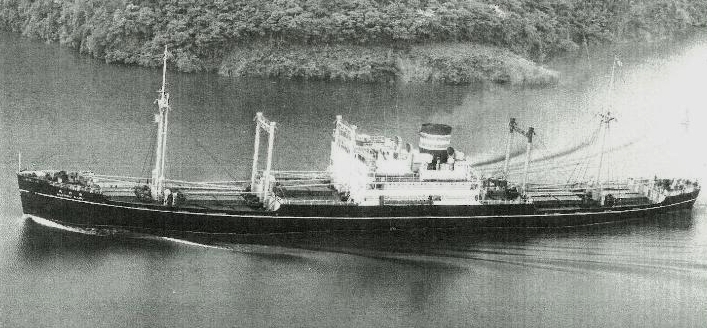 (NOSHIRO MARU passing through the Panama Canal in 1937)
IJN NOSHIRO MARU: Tabular Record of Movement
© 2010-2018 Bob Hackett and Sander Kingsepp
Revision 6
8 December 1932:
Nagasaki. Laid down at Mitsubishi Shipbuilding for the
Nippon Yusen Kaisen (NYK) Line.
28 June 1934:
Launched and named NOSHIRO MARU.
30 November 1934:
Completed as a 7,183 as a passenger-cargo ship.
1935:
Departs Yokohama on her maiden voyage to New York.
7 July 1937: The "First China Incident" and the Beginning of the Second Sino-Japanese War:
Hun River, Lukuokiao, China. Imperial Japanese Army (IJA) troops on night maneuvers at the Marco Polo Bridge fire blank cartridges. Chinese troops across the river think they are under attack. They fire live round back, but do not cause injuries. At morning roll call, the Japanese discover a soldier missing and assume the Chinese have captured him. The Japanese demand entry to the Peiping (Beijing) suburb of Wanping to look for the soldier, but the Chinese refuse. The Japanese then shell the city. An undeclared war on China begins.
8 August 1937:
Requisitioned by the Imperial Japanese Army (IJA) as a troop transport and assigned Army number 226.
28 August 1937:
NOSHIRO MARU departs Ujina and arrives at Moji.
29 August 1937:
NOSHIRO MARU departs Moji in a convoy also consisting of BAIKAL, MIZUHO, PINTUNG, SHINKO, YOSHINO and ZENYO MARUs. NOSHIRO MARU carries the 3rd Division’s 18th Infantry Regiment including the 1st Battalion HQ, 1st and 2nd Company, Regiment Rapid Fire Gun Artillery Company, Infantry Gun Platoon, 3rd Batallion, 9th Field Searchlight Unit, 3rd Division, Ammunition Train, 8th Independent Light Armored Car Company, 2nd and 3rd Companies, 5th Independent Heavy Siege Artillery Battalion and most of 2nd Company, 5th Tank Battalion.
2 September 1937:
Arrives at Wusung, China.
26 September 1937:
NOSHIRO MARU departs Osaka in a convoy also consisting of
five other unidentified ships. The convoy is carrying the 36th Infantry Regiment of the IJA's 9th Division.
26 September 1937:
Arrives at Wusung (Woosung), China located 14 miles downriver from Shanghai.
7 January 1939:
Returned to owners and resumes commercial service
1 May 1941:
Requisitioned by the IJN.
25 June 1941:
Begins conversion to a specially installed aircraft
tender.
1 July 1941:
Registered (commissioned) in the IJN in the Yokosuka
Naval District. Captain Yoshikawa Mamoru is the Commanding Officer.
10 July 1941:
Conversion to an auxiliary aircraft tender is completed. Allegedly renamed NOSHIROGAWA MARU, although this name does not appear again in records.
9 August 1941:
Initial reconstruction is completed.
19 September 1941:
Begins reconversion to an auxiliary cruiser. Four
152-mm/50 cal. (6-inch) licence-built Vickers guns single mount (6x1) guns, one
80-mm (3.15-inch) single mount AA gun and two 7.7-mm single mount machine guns
are installed. NOSHIRO MARU is allocated two observation float planes.
20 September 1941:
Registered as a specially installed cruiser in the
Yokosuka Naval District.
14 October 1941:
Completes reconstruction. Assigned to the Yokosuka
patrol squadron.
3 January 1942:
Departs Yokosuka.
27 February 1942:
Arrives at Yokosuka.
5 March 1942:
Departs Yokosuka.
22 March 1942:
Arrives at Yokosuka.
April 1942:
Departs Yokosuka.
10 April 1942:
Arrives at Truk and departs later that same day as the
sole escort of an unnumbered convoy consisting of KIMPOSAN and KINE MARUs.
12 April 1942:
At 0800 the convoy arrives at Ponape.
25 April 1942:
Departs Truk at 1500 as the sole escort for large
tanker (ex-whale oil factory ship) TONAN MARU No.2.
30 April 1942:
At 0400, the two ships arrive at Kwajalein.
30 May 1942:
Departs Rabaul.
10 June 1942:
At 0900, departs Rabaul as the sole escort for an
unnumbered convoy consisting of CLYDE and MITO MARUs.
23 June 1942:
Arrives off the Bungo Straits and detaches from the
convoy. Arrives at Yokosuka the same day.
1 July 1942:
Departs Yokosuka as sole escort of an unnumbered convoy
consisting of YAMASHIRO, INARI, TATEYAMA and SHINYUBARI MARUs.
6 July 1942:
The convoy is partially dissolved at 19-33N, 146-55E.
YAMASHIRO and INARI MARUs head unescorted to Saipan and TATEYAMA MARU steams
unescorted to Truk. NOSHIRO MARU continues to escort SHINYUBARI MARU and
proceeds to Ponape.
11 July 1942:
At 0500, arrives at Ponape. Departs later that day.
5 August 1942:
Demilitarized and registered as a specially installed
transport ship in the Yokosuka Naval District.
8 August 1942:
Departs Truk for Rabaul.
(E) 13 August 1942:
Arrives at Rabaul.
24 August 1942:
Arrives at Kure. Captain Tokunaga Sada is posted as the new Commanding Officer. That same day, NOSHIRO MARU departs Kure with seaplane carrier KUNIKAWA MARU to operate from the Shortlands area off Bougainville.
25 August 1942:
Transits the Bungo Straits heading south.
27 August 1942:
Assigned to the Second Marine Escort Division for the Southwest Pacific
8 October 1942:
Departs Yokosuka. Arrives at Muroran.
9 October 1942:
Departs Muroran.
14 October 1942:
Departs Kawasaki.
17 October 1942:
Arrives at Yokosuka.
19 October 1942:
Yokosuka Navy yard. Begins installation of equipment.
24 October 1942:
Completes equipment installation.
27 October 1942:
Departs Yokosuka and later arrives at Tokyo.
2 November 1942:
Departs Tokyo for Saipan, Marianas.
14 November 1942:
Arrives at Tinian, Marianas.
16 November 1942:
Departs Tinian for Truk.
29 November 1942:
Departs Truk.
5 December 1942:
Arrives at Kure.
11 December 1942:
Departs Kure.
22 December 1942:
Arrives at Rabaul.
16 January 1943:
Rabaul. During an air raid, NOSHIRO MARU is hit by a bomb dropped by a Fifth Air Force Boeing B-17 "Flying Fortress" and suffers medium damage. Plans are made for repairs to be carried out later at Truk by repair ship AKASHI. Notwithstanding her damage, she loads eight field guns, food and ammunition, fuel and 174 troops.
21 January 1943:
Departs Rabaul.
25 January 1943:
Arrives at Shortland, Bougainville.
3 February 1943:
Departs Shortland for Rabaul.
18 February 1943:
Departs Shortland. Arrives at Vila, Kolombangara
Island, New Georgia.
19 February 1943:
Departs Kolambangara Island for Shortland and then Rabaul.
12 March 1943:
Departs Rabaul.
13 March 1943:
100 miles NW of the Bismarck Archipelago. At about
1800, NOSHIRO MARU is torpedoed by LtCdr (later Rear Admiral) Edward C.
Stephan's USS GRAYBACK (SS-208) at 00-10S,151-06E. Stephan claims two hits of
four torpedoes he fires in a submerged attack. The damage is light indicating
GRAYBACK's Mark-14 steam torpedoes may have been duds.
16 March 1943:
Arrives at Truk for temporary repairs.
26 April 1943:
Departs Truk.
29 April 1943:
Arrives at Saipan.
10 May 1943:
Departs Saipan for Yokosuka. Possibly escorted part way
by torpedo boat HIYODORI that departs Saipan the following day also for
Yokosuka.
19 May 1943:
Arrives at Yokosuka for repairs.
21 July 1943:
Yokohama. Repairs are completed.
16 November 1943:
Departs Yokohama.
22 November 1943:
Arrives at Kure.
28 November 1943:
Departs Kure.
30 December 1943:
Arrives at Balikpapan.
10 January 1944:
Departs Singapore.
29 January 1944:
Arrives at Niihama.
3 February 1944:
Departs Niihama.
4 February 1944:
Arrives at Kobe.
8 February 1944:
Departs Kobe.
9 February 1944:
Arrives at Kure.
18 February 1944:
Departs Kure.
21 February 1944:
At 0700, departs Moji in convoy HI-47 consisting of
transport NOSHIRO MARU and oilers AMATSU, OMINESAN, OTOWASAN and KYOKUHO MARUs escorted by kaibokans ETOROFU and SADO.
26 February 1944:
At 0850 the convoy arrives at Takao.
27 February 1944:
At midnight the convoy departs Takao, its number
swelled by five unidentified merchants and the kaibokan IKI.
4 March 1944:
LtCdr Charles M. Henderson's USS BLUEFISH (SS-222)
torpedoes and sinks oiler OMINESAN MARU at 05-29N, 108-46E.
5 March 1944:
At 1100, the remainder of the convoy arrives at
Singapore.
23 May 1944:
At 0700, NOSHIRO MARU departs Singapore in fast convoy HI-62 consisting of transports KINUGASA, NISSHO, TAMATSU and TEIRITSU (ex-Vichy French LeCONTE
de LISLE) MARUs and tankers OTORISAN, SARAWAK and NICHINAN MARUs escorted by escort carrier TAIYO that provides antisubmarine air cover and kaibokans SADO, KURAHASHI, CD-5, CD-7 and CD-13.
29 May 1944:
HI-62 arrives at Manila.
1 June 1944:
At 0400, HI-62 departs Manila. TAIYO continues to provide antisubmarine air cover.
8 June 1944:
Arrives at Mutsure anchorage, then proceeds to Moji arriving at 0230. Departs Moji that same day.
9 June 1944:
Arrives at Kobe and berths at M Wharf.
10 June 1944:
Departs Kobe and later that day arrives at Gobo anchorage.
11 June 1944:
Departs Gobo anchorage and later that day arrives at Tashikawa Bay.
12 June 1944:
Departs Tashikawa Bay and later that day arrives at Shimizu.
15 June 1944:
Departs Shimizu and later that day arrives at Yokosuka and Yokohama.
16 June 1944:
Transfers from No. 3 Buoy to anchorage off Kisarazu.
18 June 1944:
Transfers from Yokosuka to Yokohama and anchors at No. 5 Buoy.
19 June 1944:
Repairs at Mitsubishi Zosen Yokohama’s yard commenced.
23 June 1944:
Transfers to No. 3 Mitsubishi Zosen berth.
5 July 1944:
Enters No. 3 Dock.
15 July 1944:
Undocked and conducts trials then berthed at No. 4 wharf in the new Port.
17 July 1944:
Embarks 237 men from the 99th Navy Air Defense Unit. Departs Yokohama and later that day arrives off Tateyama.
18 July 1944:
Departs from off Tateyama and later that day arrives at Owase Bay.
19 July 1944:
Departs Owase Bay and later that day arrives at Kobe.
22 July 1944:
Captain Yamamoto is posted CO.
25 July 1944:
Departs Kobe and later that day arrives at Kure.
29 July 1944:
Kure. Three men of the 99th Navy Air Defense Unit are disembarked,
31 July 1944:
Kure. Embarks 99 men of the 108th Patrol Squadron.
4 August 1944:
Departs Kure.
5 August 1944:
Arrives off Hesaki and moves to Moji's No. 4 Buoy.
6 August 1944:
Moji. Embarks 130 men from the Takada Corps.
8 August 1944:
Departs Moji for Mutsure, and then Imari Bay arriving later that day.
10 August 1944:
At 0500, NOSHIRO MARU departs Imari Bay for Singapore with convoy HI-71 comprised of fleet oiler HAYASUI, oilers TEIYO and EIYO MARUs,
transports TEIA (ex-Vichy French Liner ARAMIS), AWA, NOTO, HOKKAI, TAMATSU and MAYASAN MARUs and food-supply ship IRAKO. NOSHIRO MARU probably carries 463 passengers.
Rear Admiral (Vice Admiral, posthumously) Kajioka Sadamichi's (former CO of KISO) 6th Escort Convoy Command's destroyers FUJINAMI and YUNAGI, kaibokans HIRATO, KURAHASHI, MIKURA, SHONAN, CD-11 and escort carrier TAIYO provide the screen. TAIYO's 631st Naval Air Group provides air cover with 12 Nakajima B5N “Kates.
15 August 1944:
HI-71 arrives at Mako, Pescadores.
17 August 1944:
In near-Typhoon weather conditions, convoy HI-71 sorties from Mako for Manila transporting troops and supplies for the defense of the Philippines. Kajioka's escort forces are augmented by old destroyer ASAKAZE and kaibokan SADO, ETOROFU, MATSUWA and HIBURI that are sent from Takao, Formosa on orders of the 1st Surface Escort Division.
18 August 1944:
At 0524, LtCdr Louis D. McGregor's USS REDFISH (SS-395) torpedoes and damages 8,673-ton EIYO MARU. Destroyers ASAKAZE and
sister YUNAGI detach to escort her back to Takao.
Off Cape Bolinao, Luzon. At about 2200, LtCdr (later Captain) Henry G. Munson's USS RASHER (SS-269) hits TEIYO MARU with three of six torpedoes fired. She explodes in a column of flame and part of the ship is blown off. She sinks
about 20 minutes later.
At 2222, escort carrier TAIYO, bringing up the rear of the convoy, is hit in her starboard quarter by three of four torpedoes fired by LtCdr Munson in a surface radar attack. Set afire, she sinks quickly taking down most of her crew
of 850 men with her.
At 0510, Munson's RASHER torpedoes oiler TEIYO MARU in another surface radar attack. Hit by three of six torpedoes, she is set afire and sinks. At 2310, RASHER, still on the surface, hits transport TEIA MARU with three of four torpedoes using radar. The ex-Vichy French liner is set afire and sinks. [1]
19 August 1944:
The convoy splits into two groups. Just past midnight, LtCdr Munson's RASHER, still running on the surface, closes on an eastbound group of three large ships with one escort. At 0033, Munson puts two radar directed torpedoes into the port sides of NOSHIRO and AWA MARUs. Both ships beach themselves near Port Curiman. The AWA MARU is later taken under tow and arrives in Manila on 21 August after the main body of the convoy.
LtCdr Charles M. Henderson's USS BLUEFISH (SS-222) and LtCdr Gordon W.
Underwood's SPADEFISH (SS-411), on her first patrol, join in the attack on HI-71. At 0320, the BLUEFISH hits HAYASUI. She bursts into flames and goes down stern first. Underwood's SPADEFISH hits TAMATSU MARU with two torpedoes and the big landing craft depot ship rolls over and sinks with 4,755 men on board killed. [2]
Admiral Kajioka orders HI-71 to make for San Fernando. SADO, MATSUWA and HIBURI are ordered to cover the convoy's flight with antisubmarine sweeps.
20 August 1944:
Arrives Santiago Bay and soon after departs and arrives San Fernando.
21 August 1944:
Departs San Fernando and later that day arrives at Bolinao.
22 August 1944:
Departs Bolinao and later that day arrives at Santa Cruz.
An intercepted message from an unknown Japanese station says: "NOSHIRO MARU took refuge on 21st at Bolinao. In view of enemy (submarine menace ?) it will be several days before she can sail for Manila." [3]
23 August 1944:
Departs Santa Cruz and later that day arrives at Silanguin.
24 August 1944:
Departs Silanguin and later that day arrives at mouth of Corregidor Channel, from there to outside Manila Port and finally, later that day, berthed at Manila.
28 August 1944:
Berthed at No. 3 Pier.
12 September 1944:
In response to major air attack the ship seeks refuge in Manila bay.
13 September 1944:
Departs Manila bay and later that day arrives at Subic Bay.
17 September 1944:
At 0740, NOSHIRO MARU departs Subic Bay anchorage.
At 1450, that same day she arrives outside the Port of Manila where she awaits
an opportunity to enter.
21 September 1944:
Vice Admiral (later Admiral) Marc A. Mitscher's (former CO of HORNET, CV-8) Task Force 38 begins strikes on shipping in Manila and Subic Bays, Cavite Navy Yard and Nichols Air Field near Manila. Task Group 38.1, TG 38.2 and TG 38.3's planes sink over 20 ships at Manila and damage many more. Manila. At 0924, a large air raid occurs. NOSHIRO MARU is attacked unsuccessfully. At 1300, she gets up steam and departs the port ready to evade. During the fourth attack that begins at 1630, NOSHIRO MARU suffers three direct bomb hits at three different times.
The first bomb strikes the ship on her starboard side near the bridge and causes major damage. Many holes are blown in the her side. The second bomb hits the starboard side of the bridge and passes through and explodes in the radio room, wrecking it and starting a fire. The third bomb hits the starboard side boat deck and passes through to the engine room causing a fierce fire. That night, this fire spreads to NOSHIRO MARU's fuel bunkers and reaches ammunition storage, which along with the fuel bunkers causes a large explosion. Three soldiers and six crewmen are killed.
24 September 1944:
1.1 miles and 188 degrees off the S Lighthouse,
Southern Breakwater, Manila Port. By 1200, NOSHIRO MARU is aground near 14-33N,
120-57E.
10 November 19445:
Removed from the Navy List.
Authors' Notes:
[1] Ex-Vichy French liner TEIA MARU was the second-largest merchant
ship sunk by U.S. submarines during the war. Sunk in rough seas at night with no rescue ships, TEIA MARU took down 2,665 men with her.
[2] Japanese records show the sinking of TAMATSU MARU as the worst merchant disaster of the war.
Photo credit goes to Gilbert Casse of France.
Thanks to Peter Cundall of Australia and Toda Gengoro-san of Japan for information in Revision 1.
Thanks also to the late John Whitman and Fontessa-san of Japan for info in the Revs.
- Bob Hackett and Sander Kingsepp.
Back to
Auxiliary Cruisers Page

