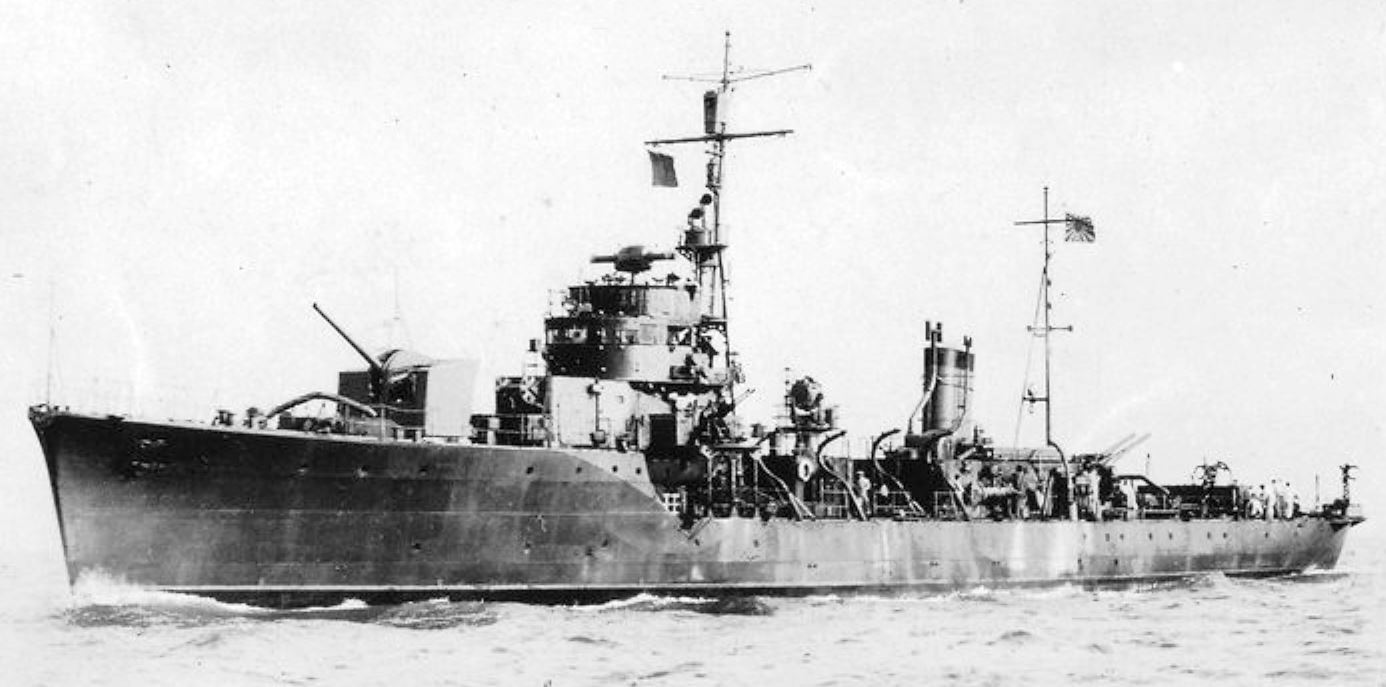
© 2006-2017 Bob Hackett, Sander Kingsepp and Peter Cundall
Revision 8
10 August 1943:
Tsurumi. Laid down at Nihon Kokan K. K.’s shipyard as kaibokan No. 326.
3 December 1943:
Launched and named NOMI.
28 February 1944:
Completed and registered in the Yokosuka Naval District. LtCdr Hera Genzaburo is the Commanding Officer. Assigned to the Yokusuka Guard Unit.
15 March 1944:
Assigned to the General Escort Command's Second Surface Escort Division.
22 March 1944:
Tokyo Bay. NOMI departs Tokyo Bay for Palau with light cruiser YUBARI, DesDiv 5's HATAKAZE, DesDiv 6's IKAZUCHI and DesDiv 32's TAMANAMI, torpedo boat OTORI, kaibokan HIRADO and subchasers CH-48, CH-51 and CH-54 escorting troop reinforcement convoy Higashi-Matsu "East Pine" No. 3 consisting of supply ship HAYASAKI and KOJUN, MEIRYU, TATSUURA, KENAN, TOMITSU, CHOHAKUSAN and NANYO MARUs and JUICHISEI (HOSHI MARU No. 11) MARU and NISSEI MARU No. 1.
25 March 1944:
The convoy is attacked by LtCdr (later Rear Admiral-Ret) Bafford E. Lewellen's (USNA ’31) old USS POLLACK (SS-180). Lewellen torpedoes and sinks subchaser CH-54 and claims damage to several transports.
28 March 1944:
The convoy is diverted to Saipan after an American Task Force is reported E of Palau.
30 March 1944:
Arrives at Saipan.
7 April 1944:
At 0540 departs Saipan in convoy No. 4407 consisting of ASAKA MARU and MANJU (ex SANTOS) MARU, also escorted by submarine chaser CH-17.
12 April 1944:
At 1600 arrives at Yokosuka.
28 April 1944:
At 0600, NOMI departs Tokyo with kaibokan CD-12, CD-18, CD-22, minesweeper W-27 and submarine chasers CH-16 and CH-18 escorting "Higashi Matsu" Convoy No.7 (outbound) consisting of TATSUHARU, MITAKESAN, ASAHISAN, OKINAWA, YAMATAMA, BINGO, MEIRYU, MOJI and MIHO MARUs bound for Saipan; ASAKA MARU and landing ships T.128 and T.150 for Palau; KOSHIN and BOKUYO MARUs for Yap and TAITO MARU for Chichi-Jima. The convoy arrives safely at these destinations.
29 April 1944:
At 1230 W-27 is detached and returns to Nagaura.
May 1944:
The convoy's participants arrive safely at their destinations.
20 May 1944:
At 1800, NOMI departs Saipan with kaibokan OKI and subchaser CH-30 escorting convoy Higashi-Matsu No. 8 consisting of MANJU, TOSAN and NOTO MARUs.
26 May 1944:
Arrives at Tokyo.
6 June 1944:
NOMI departs Yokosuka for Saipan with kaibokan AMAKUSA and OKI, destroyer MATSUKAZE, torpedo boat CHIDORI (part way only), auxiliary minesweepers SHOWA MARU No. 7 and SHOWA MARU No. 8 and subchasers CH-16 and CH-18 escorting convoy No. 3606 consisting of SUGIYAMA, SHINROKU, KANSEISHI, KAIKO, AWAJI, YAMATAMA, DAITEN, RYUKO, TOYOKAWA, TOKO, SHOZUI, MIHO and HAKUYO MARUs. Soon after leaving, SUGIYAMA MARU is attacked and damaged by LtCdr (later Captain) James B. Grady's (USNA ’33) USS WHALE (SS-239) at 31-06N, 142-24E, but the ship is taken in tow.
9 June 1944:
NE of Chichi-Jima. LtCdr Edmund K. Montross' (USNA ’35) USS SWORDFISH (SS-193) torpedoes and sinks MATSUKAZE (number of survivors unknown but her CO, LtCdr Kadono Tetsuo [62] is KIA) at 26-59N, 143-13E. The convoy steams to Chichi-Jima arriving later that day. It is decided to unload the convoy and return to Yokosuka.
14 June 1944:
At 0100, NOMI departs Chichi-Jima with destroyer SATSUKI, kaibokan AMAKUSA and OKI and auxiliary minesweepers SHOWA MARU Nos.7 and No. 8 escorting the "Miho Maru" convoy consisting of MIHO, KANSEISHI, TOYOKAWA and AWAJI MARUs.
15 June 1944:
About 150 km SE of Tori Shima. At 0103, LtCdr Montross' (USNA ’35) USS SWORDFISH torpedoes and sinks KANSEISHI MARU at 29-30N, 141-14E. Only two men are KIA. The convoy puts into Yaene Wan, Hachijo Jima for safety departing later that day at 1800.
17 June 1944:
At 1400, arrives Yokosuka.
27 June 1944:
Arrives at Ominato.
29 June 1944:
Departs Ominato on patrol.
30 June 1944:
Arrives at Wakkanai.
2 July 1944:
At 1950 departs Wakkanai escorting convoy KI-203 consisting of KOKAI, MIHO and JUICHISEI (HOSHI MARU No. 11) MARUs escorted by NOMI, minesweeper W-24, and auxiliary minesweeper FUKUEI MARU No. 7. The convoy is bound for Iwami Hama (possibly error for Izumi Hama, Urup).
5 July 1944:
At 0310 W-24 and the convoy arrives at Izumi Hama, Uruppu, with MIHO MARU having detached en route.
6 July 1944:
At 0923 NOMI departs Uruppu with convoy now consisting of KOKAI and JUICHISEI (HOSHI MARU No. 11) MARUs escorted by minesweeper W-24 and auxiliary minesweeper FUKUEI MARU No. 7.
7 July 1944:
NOMI arrives back at Wakkanai.
8 July 1944:
At 1907 departs Wakkanai on patrol.
9 July 1944:
At 1827 arrives at Ominato.
16 July 1944:
At 1556 NOMI departs Ominato towing a daihatsu landing barge.
17 July 1944:
At 2206 arrives at Wakkanai.
18 July 1944:
Reassigned to the Ominato Naval Guard District.
20 July 1944:
At 2345 departs Wakkanai with minesweeper W-23 escorting a convoy KI-102 consisting of KOUN MARU No. 2 (bound for Tennei) and JUICHISEI MARU (HOSHI MARU No. 11) bound for Toro.
23 July 1944:
At 0200 arrives at Oha.
24 July 1944:
At 2230 departs Oha.
25 July 1944:
At 1855 arrives back at Wakkanai.
26 July 1944:
At 0800 departs Wakkanai on patrol and at 1400 arrives at Odomari.
27 July 1944:
At 1651 departs Odomari on an anti submarine sweep and to assist RIZAN MARU that has suffered an engine breakdown. At 2106 returns to Odomari.
29 July 1944:
At 0720 departs Odomari escorting a convoy to Oha.
30 July 1944:
At 0300, NOMI departs Oha, NE Karafuto (Sakhalin) Island escorting a convoy consisting of HAKUEI and MITSU MARUs.
1 August 1944:
35 nms N of Kita-Shiretoko-Misaki Light. At about 0400, HAKUEI MARU runs aground and opens her No. 1 and No. 2 tanks to the sea causing the loss of about 3,000 tons of crude oil. About 2,000 tons of crude remain in her other tanks. NOMI’s CO, LtCdr Hera, is appointed commander of the salvage operation by the CO of the Soya Defense Force who sends out KANATSU MARU, tug MAGANE MARU, towing oil barge YUSEN GO No. 2 and salvage vessel NASU MARU to assist in the salvage of HAKUEI MARU. MITSU MARU continues on her way.
2 August 1944:
NOMI arrives back at Wakkanai.
5 August 1944:
The first vessel arrives on the scene. Thereafter, KANATSU MARU and YUSEN GO No. 2 recover about 980 tons and 400 tons of crude oil respectively from HAKUEI MARU.
7 August 1944:
NOMI departs Wakkanai.
10 August 1944:
Transfer of the crude is completed and salvage work begins, but proves very difficult. Nevertheless, HAKUEI MARU is refloated successfully. She is towed to Wakkanai, N Hokkaido for further emergency repairs.
11 August 1944:
NOMI arrives back at Wakkanai.
20 August 1944:
NOMI departs Wakkanai.
23 August 1944:
Departs Wakkanai via Otaru for Hakodate, Hokkaido. At noon, arrives at Hakodate Dockyard. HAKUEI MARU enters into full-scale repairs.
26 August 1944:
NOMI arrives back at Wakkanai.
6 September 1944:
Departs Otaru escorting convoy KI-505 consisting of KOAN and SHONAN MARUs and possibly others, also escorted by old destroyer NAMIKAZE.
8 September 1944:
The USS SEAL attacks the convoy at 47.18N 148.28E and blows the stern off NAMIKAZE.
9 September 1944:
USS SEAL continues her attacks on the convoy and torpedoes and sinks SHONAN MARU in 47.03N 148.18E. The destroyers NOKAZE and KAMIKAZE are sent from Otaru to assist NAMIKAZE.
11 September 1944:
Arrives at Shikuka.
15 September 1944:
Departs Shikuka escorting the same convoy.
20 September 1944:
Arrives at Kataoka.
24 September 1944:
Departs Kataoka Wan escorting a convoy.
27 September 1944:
Kuriles. At about 0300, LtCdr (later Captain) Melvin H. Dry's (USNA ’34) USS SEARAVEN (SS-197) undertakes a gun attack on what Dry takes to be a small patrol boat at 45-44N, 148-41E. USS SEARAVEN scores a number of hits before recognising the ship as a much larger vessel. Dry crash dives and fires three torpedoes at NOMI that all miss. NOMI suffers medium damage.
29 September 1944:
At 2000 kaibokan KUNASHIRI and NOMI are scheduled to depart Wakkanai. Alternatively NOMI may have arrived at Otaru.
1 October 1944:
Departs Otaru.
2 October 1944:
Arrives at Ominato. Undergoes repairs.
22 October 1944:
Reassigned to the First Surface Escort Division of the Ominato Naval District. At 2200 departs Ominato.
24 October 1944:
At 1200 arrives at Moji.
26 October 1944:
At 1800 NOMI departs Moji with light cruiser KASHII, kaibokan UKURU and minelayer NIIZAKI escorting convoy HI-79 consisting of TENEI, MATSUSHIMA, KAGU, MELBOURNE and ARIMASAN MARUs and fleet supply ship MAMIYA.
27 October 1944:
Kaibokan CD-17 joins the escort.
28 October 1944:
Minesweeper W-21 joins the escort.
29 October 1944:
MELBOURNE MARU is detached for Keelung escorted by kaibokan UKURU
and CD-17.
30 October 1944:
At 1900 HI-79 arrives at Takao. MAMIYA, KAGU MARU and minesweeper W-21 are detached.
31 October 1944:
At 1600, NOMI departs Takao with light cruiser KASHII, kaibokan UKURU, MANJU, NOMI, CD-17 and minelayer NIIZAKI escorting convoy HI-79 consisting of tankers TENEI and MATSUSHIMA MARUs. In the afternoon, KUROSHIO and RYOEI MARUs join Singapore-bound convoy HI-79 off Takao.
1 November 1944:
NOMI is reassigned to the General Escort Command's First Surface Escort Division.
2 November 1944:
At 1432, the convoy is attacked by a Consolidated B-24 Liberator without damage.
9 November 1944:
At 1000, arrives at Singapore.
17 November 1944:
At 1800 NOMI departs Singapore with light cruiser KASHII (F), kaibokan MANJU, UKURU, KASADO, MIYAKE, CD-17 and CD-51 and minelayer NIIZAKI escorting convoy HI-80 consisting of TENEI, MATSUSHIMA, RYOEI, MUNAKATA, ARIMASASN, KUROSHIO, NICHINAN and KAIHO MARUs.
20 November 1944:
At 0600 CD-23 joins the convoy from St Jacques. At 1240, CD-17 is detached for Saigon.
27 November 1944:
At 0930, RYOEI and ARIMASAN MARUs escorted by NIIZAKI are detached for Takao.
3 December 1944:
At 1800 HI-80 arrives at Moji. At 1900 NOMI is detached and kleaves immediately for Sasebo.
4 December 1944:
At 1200 arrives at Sasebo.
10 December 1944:
Reassigned to the First Escort Fleet.
12 December 1944:
At 0700 departs Sasebo and later meets up with MOTA-28 consisting of MURORAN, TEIKAI MARUs and tankers DAINAN, SHINGI, OEI, DAIGYO, OESAN and YAMAZAWA MARUs that has departed Miike with kaibokan MIYAKE, CD-20, CD-39, CD-138 also escorting.
22 December 1944:
At 1000 arrives at Takao.
25 December 1944:
NOMI departs Takao with kaibokan MIYAKE and CD-138 escorting convoy TAMA 38 consisting of HYUGA, KIBITSU, AOBASAN and SHINSHU MARUs.
26 December 1944:
At daybreak, the convoy anchors near Oluanpi, southern Formosa.
29 December 1944:
At 1900, arrives North San Fernando.
30 December 1944:
At 0700, B-24 "Liberator" heavy bombers attack the port and convoy. Kaibokan CD-138 is hit by a bomb. AOBASAN MARU carrying elements of the IJA 19th Infantry Division is bombed and a fire breaks out. Three crewmen, 1 gunner and 21 troops are KIA. The ship then breaks in two and sinks. The convoy is dissolved.
1 January 1945:
At 0345, NOMI departs North San Fernando with kaibokan KANJU, IKUNA, MIYAKE, CD-112 and CD-39 escorting convoy MATA-40 consisting of IJA landing ship SHINSHU MARU and IJA landing craft carriers KIBITSU and HYUGA MARUs. At 1800 arrives at Musa.
2 January 1945:
At 0700 departs Musa.
3 January 1945:
At 0115 arrives off Takao. At 0800 NOMI departs. At 1105 (JST), 50 carrier aircraft attack the ships. SHINSHU MARU is hit by several bombs and explodes. 66 gunners, 33 crewmen and 283 soldiers are KIA. Later that night, SHINSHU MARU's burning wreck is torpedoed and sunk by LtCdr Henry C. Stevenson's (USNA ’30) USS ASPRO (SS-309). KIBITSU MARU is heavily damaged and HYUGA MARU suffers medium damage. MIYAKE and CD-112 both suffer light damage. The surviving ships put into Takao for repairs, with NOMI arriving at 2000.
4 January 1945:
At 0315 IKUNA, NOMI and KANJU (the latter from off Takao) depart Takao to meet convoy TAMO-35 [?? convoy did not leave Kirun until 12 January]. In the Formosa Strait IKUNA is also damaged by aircraft of Vice Admiral (later Admiral) John S. McCain's Task Force 38. At 1600 KANJU, NOMI and IKUNA arrive at Nanao Tao.
5 January 1944:
At 1300 KANJU, NOMI and IKUNA depart Nanao Tao.
7 January 1945:
At 1000 arrives at Takao.
10 January 1945:
At 1800 NOMI departs Takao for Mako with kaibokan YASHIRO, MIYAKE, KANJU, KURAHASHI, SHINNAN, CD-13, CD-41, CD-60, CD-205, and destroyer SHIGURE escorting convoy HI-87 consisting of fleet tanker KAMOI and tankers SARAWAK, TENEI, HASHIDATE, MATSUSHIMA and MITSUSHIMA MARUs. At 1830, MITSUSHIMA MARU suffers an engine breakdown and returns to Takao.
12 January 1945:
At 0600, TENEI MARU's steering breaks down and the ship is escorted by CD-60 to Hong Kong. Soon after the rest of the convoy, advised of a pending air raid on Mako turns about and heads for Hong Kong.
13 January 1945:
At 1100, enters Hong Kong port.
15 January 1945:
At 0915, an air raid warning is sounded and carrier aircraft begin attacks. Bomb and machine-gun attacks harry the ships all day, but they escape major damage.
16 January 1945:
Hong Kong. At 0820, aircraft of Vice Admiral (Admiral posthumously) John S. McCain's (USNA ’06) Task Force 38 begin to attack shipping at Hong Kong. At 1124, KAMOI is near-missed. At 1240, KAMOI and TENEI MARU both suffer direct hits. At 1540, MATSUSHIMA MARU suffers a direct hit and is set on fire.
At 1644, NOMI is returning from San Fernando, Philippines from 1 January when she is attacked and suffers several near-misses. Her aft 120-mm AA gun is disabled and seven sailors are KIA. At 1830, the battle ends. The Japanese claim 22 aircraft shot down, but acknowledge heavy damage to three tankers and light damage to three escorts including NOMI.
17 January 1945:
At 1700 departs Hong Kong.
22 January 1945:
At 0700, subchasers CH-20 and CH-35 and patrol boat PB-104 depart Singapore escorting convoy HI-88-B consisting of DAIETSU, ENKI and TATSUTAMA MARUs. That same day at 0800 NOMI and CD-60 arrives at St Jacques.
23 January 1945:
At 1800 NOMI departs St Jacques.
24 January 1945:
NOMI arrives back at St Jacques.
27 January 1945:
At 2230 the convoy arrives at St Jacques, Indochina. TATSUTAMA
MARU and CH-35 are detached.
28 January 1945:
At 2110, departs St Jacques with NOMI and CD-60 as additional escorts.
29 January 1945:
At 2230, arrives at Port Dayot, Indochina (now Van Phong, Vietnam).
30 January 1945:
At 0700, departs Port Dayot.
31 January 1945:
After two submarine sightings, at 0551, DAIETSU MARU with 8,000-tons of fuel oil, 1,200-tons of rubber and 570-tons of tin, and one minute later, ENKI MARU with 7,000-tons of fuel oil and 1,600-tons of crude rubber, tin, mail and general cargo, are both torpedoed and sunk by Cdr Royce L. Gross' (USNA ’30) USS BOARFISH (SS-327) at 14-56N, 109-00E. Seven crewmen and two gunners on DAIETSU MARU and one crewman and 21 passengers on ENKI MARU are KIA. NOMI rescues many of ENKI MARU's survivors. DAIETSU MARU is run aground on the coast. Later, the wreck is bombed.
3 February 1945:
At 1500 arrives at Saigon.
4 February 1945:
At 1300 departs Saigon.
6 February 1945:
At 1800 arrives at Singapore.
11 February 1945:
At 0510, NOMI and kaibokan CD-60 depart Singapore for Moji escorting convoy HI-88-F consisting of SAKAE and FUKUEI MARUs. At about 0615, NOMI strikes a mine at 01-27N, 104-30E, but is able to continue.
18 February 1945:
At 1910 arrives at Quinhon, Indochina.
19 February 1945:
Arrives at Tourane, Indochina.
24 February 1945:
Four miles S of Wanshan Island. NOMI is damaged by aircraft.
25 February 1945:
At 1400 arrives at Hong Kong. NOMI undergoes repairs to her mine damaged area.
26 February 1945:
Repairs are completed. At 0200, departs Hong Kong and rejoins convoy.
3 March 1945:
Anchors off Ssu Chiao Shan.
4 March 1945:
At 1500 departs Ssu Chiao Shan.
7 March 1945:
Late that day arrives at the north side of Tsushima.
8 March 1945:
At 0600 departs Tsushima with kaibokan KURAHASHI as an additional escort and at 1500 convoy HI-88-F arrives at Mutsure. At 1600 arrives at Moji.
9 March 1945:
At 0710 departs Moji and later that day at 1030 arrives at Kure. Undergoes repairs.
9 April 1945:
At 0640 departs Kure, and at 1820 arrives at Moji.
11 April 1945:
At 0700, NOMI, now flagship of Captain (Rear Admiral posthumously) Ikeda Akira's (50) (former CO of ETOROFU), First Surface Escort Division, with kaibokan MIYAKE, CD-31 and CD-213 depart Moji for Shanghai, China escorting convoy MOSHI-02 consisting of JUZAN MARU.
13 April 1945:
At 1400, arrives at Saishu Island and anchors, planning to depart at daybreak the next day.
14 April 1945:
Hiyo islet on NW coast of Saishu Island. At 0407, in murky weather, Cdr
(later Captain/MOH) George L. Street III’s (USNA ’37)USS TIRANTE (SS-420) closes the bay on the surface, noses into Saishu harbor and fires six torpedoes at the anchored convoy. Street sinks sinks auxiliary transport (ex-auxiliary gunboat) JUZAN MARU (33 crewmen KIA) at 33-25N, 126-15E, but USS TIRANTE is sighted by NOMI's lookouts.
Captain Ikeda orders an attack. USS TIRANTE fires two torpedoes at the charging kaibokan. Both hit NOMI under the bridge detonating her shell magazine. She jack-knifes, breaks in two and sinks at 0430. 134 sailors are lost, including CO, LtCdr Hera and Captain Ikeda.
CD-31 spots the submarine and attacks, but is hit by a stern torpedo from USS TIRANTE. The torpedo is a dud, but causes a fire to break out in the kaibokan's aft magazine. Later, CD-31 capsizes and sinks. After 0900, the islanders rescue NOMI and CD-31's survivors. [2]
Captain Ikeda is promoted Rear Admiral, posthumously.
25 May 1945:
Removed from the Navy List.
Authors' Notes:
[1] Saishu (Japanese) Island, now Jeju-do (Korean) was also known as Quelpart Island, one of its former "European” names.
[2] For this and other daring exploits, Cdr Street is awarded the Medal of Honor and his XO, LtCdr
(later Captain) Edward L. Beach, (USNA ’39) (later an author) is awarded a Navy Cross.
Thanks for assistance go to Dr. Higuchi Tatsuhiro of Japan. Thanks for assistance in identifying kaibokan COs goes to Mr. Aki of Japan and Matthew Jones of Ohio. Further thanks to Mr. Gilbert Casse of France.
Thanks also go to Erich Muethlthaler of Germany for info in Rev 7.
-Bob Hackett, Sander Kingsepp and Peter Cundall
Back to
Escort Page