KYUHEIKAN!
|
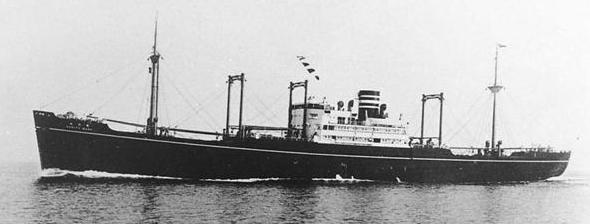
(NARUTO MARU in NYK prewar service)
IJN NARUTO MARU:
Tabular Record of Movement
© 2009 Bob Hackett, Sander Kingsepp and Peter Cundall.
27 October 1933:
Yokohama. Laid down at Mitsubishi’s Yokohama Dock Co.’s
shipyard as a 7,149-ton cargo ship for Nippon Yusen Kabushiki Kaisha (Japan Mail
Shipping Line), Tokyo.
29 August 1934:
Launched and named NARUTO MARU.
10 December 1934:
Completed and placed in NYK service.
7 October 1941:
Departs Yokohama on NYK’s American route with
calls at Manzanillo and Tocopilla, Mexico ports of call.
3 January 1942:
Arrives at Yokohama.
10 February 1942:
Yokohama. Begins conversion at Mitsubishi Heavy
Industries shipyard. Requisitioned by the IJN.
15 February 1942:
Registered in the Maizuru Naval District as an
auxiliary transport ship. Navy Captain Takesaki Takeo is appointed Supervisor.
10 March 1942:
Completes conversion. Navy Captain Katahara Tsunejiro
(37) is appointed Supervisor. Attached to the 11th Naval Air Fleet.
24 March 1942:
Departs Yokosuka.
27 April 1942
Lands No. 6 Kushu Butai (Air Defense Unit).
29 April 1942:
Arrives at Takao.
14 May 1942:
Arrives at Yokkaichi.
3 June 1942:
Arrives at Yokosuka.
11 June 1942:
Arrives at Yokkaichi.
5 July 1942:
Captain (Rear Admiral, posthumously) Chiya Sadae (34) is appointed Supervisor.
14 July 1942:
Arrives at Yokohama.
13 August 1942:
Departs Yokosuka.
20 August 1942:
Arrives at Kavieng.
26 August 1942:
Arrives at Truk
27 August 1942:
Arrives at Buka (sixth air raider landing)
7 September 1942:
Departs Rabaul for Shortland, Bougainville.
23 September 1942:
Arrives at Yokosuka.
29 September 1942:
Departs Yokosuka.
1 October 1942:
Arrives at Tokuyama.
3 October 1942:
Departs Tokuyama.
19 November 1942:
Arrives at Takao.
27 November 1942:
Departs Takao.
2 December 1942:
Arrives at Yokosuka.
12 December 1942:
Departs Yokosuka.
13 December 1942:
Arrives at Yokkaichi.
16 December 1942:
Departs Yokkaichi.
15 March 1943:
Arrives at Yokosuka.
5 April 1943:
Departs Woosung in unknown Convoy A.
6 April 1943:
Arrives at Tomie, Goto Retto.
25 April 1943:
Arrives at Tokyo.
28 April 1943:
Arrives at Yokosuka.
3 May 1943:
Departs Yokosuka.
10 May 1943:
Truk. At 1400, NARUTO and NARUTO MARU depart via the North channel escorted by torpedo boat OTORI.
21 May 1943:
Arrives at Yokosuka.
25 May 1943:
An unknown officer is posted as Commanding Officer.
7 June 1943:
Arrives at Saipan in convoy 4602.
14 June 1943:
Arrives at Yokohama. An unknown officer is posted Supervisor.
19 June 1943:
Departs Yokosuka.
20 June 1943:
Arrives at Yokkaichi.
22 June 1943:
Departs Yokkaichi.
23 June 1943:
Arrives at Kure.
27 June 1943:
Departs Kure.
29 June 1943:
Arrives at Yokosuka.
2 July 1943:
Departs Yokosuka.
8 July 1943:
Arrives at Truk and departs later that same day.
18 July 1943:
Arrives at Rabaul (air fuel, weapon landing)
26 July 1943:
At 0500, NARUTO MARU departs Rabaul for Saipan in
convoy No. 2262 consisting of KEISHO MARU escorted by torpedo boat OTORI and
subchaser CH-30.
29 July 1943:
Arrives at Truk.
31 July 1943:
Convoy No. 2262 departs Truk for Saipan.
3 August 1943:
At about 1700, arrives at Saipan. Disembarks 198 passengers, and unloads 2,000 empty drums, approximately 10,000 sacks of sugar and 100 tons of miscellaneous goods.
5 August 1943:
Departs Saipan, arrives at Tinian and returns to Saipan later that day.
6 August 1943:
At 0900, departs Saipan for Yokohama escorted by destroyer ASANAGI.
8 August 1943:
At 0558, LtCdr Albert C. Burrows’ USS WHALE (SS-239) torpedoes NARUTO MARU at 24-03N, 142-45E. She is hit first in the starboard engine room aft and then a second torpedo hits between No. 5 and No. 6 holds, starboard side. Violent flooding occurs and the ship starts to sink by the stern, then her own depth charges explode. Abandon Ship is ordered. ASANAGI rescues 300 survivors, but 30 passengers and crewmen are KIA.
At 0558, USN codebreakers intercept and decrypt a message from ASANAGI that reads: NARUTO MARU hit by one torpedo. In danger of sinking. Position: 24-10N, 142-45E."
At 0604, codebreakers intercept and decrypt another message from ASANAGI
that reads: NARUTO MARU sank. Am rescuing survivors."
At 1140, a final message from ASANAGI is intercepted and decrypted that
reads: "Conducted depth charge attacks in vicinity of NARUTO MARU. Took aboard 300 men.----"
15 October 1943:
Removed from the Navy List.
Authors' Note:
Thanks go to John Whitman for info on USN decrypts of IJN message traffic.
- Bob Hackett, Sander Kingsepp and Peter Cundall.
Back to
Ammunition Ships Page

