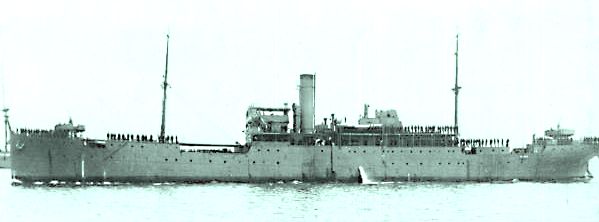
Attached to the Maizuru town prefecture administration.
15 January 1940:
Attached to the Combined Fleet.
10 March 1940:
Captain (later Rear Admiral) Miura Tomosaburo (38) (former CO of SATA) assumes command.
15 November 1940:
Cdr (Rear Admiral, posthumously) Yamataka Matsujiro (44) (former XO of IWATE) is promoted Captain and assumes command the same day.
1941:
MUROTO is refitted as a supply ship. Assigned directly to the Combined Fleet.
17 April 1941:
Captain (later Rear Admiral) Itakura Tokushi (42) (former XO of OKINOSHIMA) assumes command.
1 May 1941:
Captain (later Rear Admiral) Togo Minoru (40) (former XO of KASUGA) assumes command.
1 September 1941:
Attached to the Combined Fleet.
28 October 1941:
Captain (Rear Admiral, posthumously) Kishi Yoshiyuki (former CO of SETA) (47) assumes command.
1 December 1941:
Her callsign is changed to JGAQ.
8 December 1941:
MUROTO is with the Combined Fleet's Supply and Support Unit.
1 February 1942:
Captain (Rear Admiral, posthumously) Yamagata Masaji (43) (former CO of KOMAHASHI) assumes command.
10 February 1942:
Departs Yokosuka.
13 February 1942:
Departs Yokosuka.
1 March 1942:
Departs Camtanh Bay.
2 March 1942:
Arrives at Saigon.
9 March 1942:
Departs Saigon.
12 March 1942:
Arrives at Singapore.
13 April 1942:
Departs Seletar, Singapore.
14 April 1942:
Arrives at Muntok.
16 April 1942:
Departs Muntok, Bangka Island, Sumatra.
17 April 1942:
Arrives at Keppel Harbour, Singapore.
18 April 1942:
Transfers from Keppel Harbour to Seletar.
25 April 1942:
Departs Seletar, Singapore.
28 April 1942:
Arrives at Sabang.
3 May 1942:
Departs Sabang.
5 May 1942:
Arrives at Port Blair.
6 May 1942:
Departs Port Blair.
9 May 1942:
Arrives at Penang.
11 May 1942:
Departs Penang.
13 May 1942:
Arrives at Keppel Harbour, Singapore.
14 May 1942:
Transfers from Keppel Harbour to Seletar.
20 May 1942:
Transfers from Seletar to Keppel Harbour, Singapore and then departs.
23 May 1942:
At 1011 arrives at Saigon.
26 May 1942:
At 1400 departs Saigon.
27 May 1942:
At 1030 arrives at Camranh Bay and departs soon after.
29 May 1942: Operation "AL" - The Seizure of Attu and Kiska:
A large force departs Mutsu Bay in Vice Admiral Hosogaya Boshiro's (36) (former CO of MUTSU) Northern Force with Rear Admiral (later Vice Admiral) Omori Sentaro's (41)(former CO of ISE) Adak-Attu Invasion Force: DesRon 1's light cruiser ABUKUMA, DesDiv 21's HATSUHARU, HATSUSHIMO, WAKABA and NENOHI, transport KINUGASA MARU and minelayer MAGANE MARU.
Admiral Omori’s Adak-Attu Invasion Force accompanies Captain (later Rear Admiral) Ono Takeji's (44) Kiska Invasion Force: CruDiv 21’s TAMA and KISO, destroyers HIBIKI, AKATSUKI and HOKAZE, auxiliary cruiser ASAKA MARU and transports HAKUSAN and KUMAKAWA MARUs.
CruDiv 21 is accompanied by the Main Body's CruDiv 5's NACHI (F), destroyers INAZUMA and IKAZUCHI, oilers FUJISAN MARU and NISSAN MARU, three cargo ships and Rear Admiral (later Vice Admiral) Kakuta Kakuji's (former CO of NAGATO) Carrier Striking Force's CarDiv 4's JUNYO (F) and RYUJO, CruDiv 4/2's TAKAO and MAYA, DesDiv 3's SHIOKAZE and DesDiv 7's AKEBONO, SAZANAMI and USHIO.
That same day at 1300 MUROTO arrives at Samah.
30 May 1942:
At 0800 departs Samah for Yokosuka.
1 June 1942:
The Invasion Force arrives at Paramushiro.
7 June 1942:
Vice Admiral Hosogaya's Fifth Fleet captures Attu and Kiska.
8 June 1942:
MUROTO arrives at Yokosuka.
13 June 1942:
At 0940 MUROTO departs Yokosuka.
17 June 1942:
At 0620 arrives at Kushiro.
20 June 1942:
At 1015 departs Kushiro. Scheduled for installation of new depthcharge installations.
23 June 1942:
At 1430 arrives at Kawauchi Wan.
25 June 1942:
At 0855 transfers from Kawauchi Wan to Ominato, arriving at 1241.
28 June 1942:
At 1500 departs Ominato.
3 July 1942:
At 0300 arrives at Paramushiro.
12 July 1942:
At 1600 departs Paramushiro.
14 July 1942:
MUROTO remains assigned directly to the Combined Fleet.
17 July 1942:
At 0800 arrives at Ominato.
22 August 1942:
At 0803 departs Ominato.
24 August 1942:
At 1600 arrives at Maizuru.
15 September 1942:
Construction of depthcharge installations is completed.
19 September 1942:
At 0956 departs Maizuru.
21 September 1942:
At 1142 arrives at Ominato.
24 September 1942:
At 1500 departs Ominato.
26 September 1942:
At 0816 arrives back at Ominato.
30 September 1942:
At 1600 departs Ominato.
6 November 1942:
At 1055 arrives at Maizuru accompanied by the destroyer HATSUHARU.
13 November 1942:
At 1430 departs Maizuru.
16 November 1942:
At 0740 arrives at Otaru.
20 November 1942:
At 0800 departs Otaru.
23 November 1942:
At 0800 arrives at Maizuru.
25 November 1942:
At 1100 departs Maizuru.
28 November 1942:
At 1000 arrives at Ominato.
24 December 1942:
At 0700 departs Ominato.
30 December 1942:
At 0745 arrives at Paramushiro.
3 March 1943:
At 1645 arrives at Paramushiro.
5 March 1943:
Kashiwabara Bay, Shimushu Island, Kuriles. Undergoes repairs after a collision with Army Transport SAKITO MARU. [1]
14 March 1943:
At 1722 departs Paramushiro.
15 March 1943:
Deactivated as hospital ship. Reassigned to the Navy Ministry Supply Force.
19 March 1943:
At 0350 arrives at Ominato. Undergoes repairs of damaged hull parts and removal of hospital facilities.
21 March 1943:
At 0700 departs Ominato.
23 March 1943:
At 1050 arrives at Maizuru.
6 April 1943:
Starts cooler replacement work.
12 April 1943:
Arrives at Kure. Undergoes repairs.
14 April 1943:
Armament is increased by installation of Type 93 13mm AA guns.
22 April 1943:
A rangefinder is installed.
23 April 1943:
Arrives at Maizuru.
27 April 1943:
Receives instructions for the use of sonar equipment.
3 May 1943:
Receives maintenance service instructions for optical weapons.
4 May 1943:
Receives instructions for construction of underwater listening equipment.
5 May 1943:
Reconstruction of optical weapons is completed.
15 May 1943:
Installation of underwater listening equipment begins.
20 May 1943:
Receives orders for the removal of a burned out dc generator.
21 May 1943:
Begins creating a facility for 600 passengers.
23 May 1943:
Completes installation of underwater listening equipment, port window maintenance and increase of machine guns.
26 May 1943:
Reconstruction (removal of hospital facilities) completed.
27 May 1943:
Construction of passenger facility completed.
28 May 1943:
Repairs are completed. MUROTO departs Maizuru.
10 August 1943:
Departs Sasebo.
11 August 1943:
Arrives at Imari Bay.
20 August 1943:
Captain Furutani Keiji (43) (former CO of GOSHU MARU) is appointed the CO. Later that samne day the ship departs Shanghai carrying 520 POWs.
24 August 1943:
Arrives at Osaka.
7 November 1943:
Departs Kobe.
9 November 1943:
Arrives at Yokosuka.
11 November 1943:
Departs Yokosuka.
29 November 1943:
While sailing in convoy, presumably from Shanghai, met off Taichangtu Shan by auxiliary gunboat HOKOKU MARU and escorted to off Hsiao Pan Is (ENE of Chusan).
15 December 1943:
Departs Shipu at 0759, escorted by auxiliary gunboat DAIGEN MARU No. 7 and arrives later that day at Taichow Islands, at 2139.
24 January 1944:
At 1300 while off Swatow sailing in convoy between Amoy and Hong Kong with KINMON (ex British KIANGSU) and TAKASAKI (ex British SHINHWA) MARUs, MUROTO is attacked by a single B-25. The bombs miss the ships and no damage results.
7 February 1944:
Met by destroyer HASU at sea.
8 February 1944:
Arrives at Kirun.
26 February 1944 :
Departs Moji in convoy MOTA-06 consisting of GOZAN, SAN PEDRO, ISHIKARI, NICHIYO, NICHIAN, TOYOKUNI LONDON, DAISEI and SHIRAHAMA MARUs escorted by kaibokan AWAJI.
29 February 1944:
Anchors at Ssu Chiao Shan.
1 March 1944:
Departs Ssu Chiao Shan.
4 March 1944:
Arrives at Takao.
10 March 1944:
Departs Takao, escorted by torpedoboat HATSUKARI.
12 March 1944:
At 0515 HATSUKARI near Dangan Island, China ends escort and detaches. MUROTO arrives at Hong Kong later this day.
23 March 1944:
At 1600, MUROTO departs Hong Kong in convoy No. 76 consisting of SHINAI (ex British SHINAI) and KINMON MARUs (ex British KIANGSU) escorted by torpedo boat HATSUKARI.
26 March 1944:
At 1000, arrives at Takao.
13 April 1944:
Departs Yahata.
14 April 1944:
Arrives at Maizuru. Construction of new canister emplacement begins.
15 April 1944:
Unloads 301t steel.
21 April 1944:
Moving of gasoline pump begins.
1 May 1944:
Completes construction of new canister emplacement.
2 May 1944:
Completes moving gasoline pump.
7 May 1944:
Completes construction of 25 mm gun equipment.
29 May 1944:
Departs Takao for Hong Kong in convoy No. 89 escorted by HATSUKARI.
1 June 1944:
Arrives at Hong Kong.
6 June 1944:
Departs Hong Kong in convoy No. 90 also consisting of CHEFOO and YURIN (ex HERLEIK) MARUs with unknown, if any escort.
9 June 1944:
At 0800 due to arrive at Yulin. MUROTO is likely diverted to Sana (Samah).
12 June 1944:
At 0800 due to depart Sana (Samah) with Navy Storeship NOZAKI and meet convoy YUSA-Rinji also consisting of CHEFOO and YURIN (ex HERLEIK) MARUs.
15 June 1944:
Due to arrive at Saigon.
21 June 1944:
At 1200 Navy storeships MUROTO and NOZAKI are both due to arrive at Sana.
31 August 1944:
Departs Ebisu Bay and arrives at Ushibuka later that day.
1 September 1944:
At 0516 minesweeper W-15 departs Ushibuka escorting storeship MUROTO. At 1717 arrives at Kagoshima.
1 October 1944:
Receives instructions for radio transmission equipment.
10 October 1944:
Receives a directive for construction of radio transmission equipment.
21 October 1944:
At 1200, MUROTO departs Kagoshima, Kyushu for Naha, Okinawa in convoy KATA-916 consisting of CHOJUSAN, TOMITSU, EDOGAWA, BANSEI, TENSHO, AMAKUSA, SHINTON, SANKA, SANJIN, HAKKA, HAYAMA, TORAI, TAIKYU, SAKISHIMA, RYUKYU, KANKYO and AMOY MARUs and fleet stores ship KINESAKI escorted by torpedo boat MANAZURU, CD-30, subchaser CH-49, minesweeper W-15, auxiliary minesweepers TOSHI MARU No. 7, HIMESHIMA MARU and SHONAN MARU No. 16.
22 October 1944:
At 0730, LtCdr (later Vice Admiral) Vernon L. Lowrance’s (USNA ‘30) USS SEA DOG (SS-401) torpedoes MUROTO at 29-18N, 129-44E. She sinks at 0748. Lowrance also torpedoes and damages TOMITSU MARU. The convoy’s escorts and aircraft subject USS SEA DOG to a long and heavy counter-attack in which 109 depth-charges are dropped, but Lowrance evades and USS SEA DOG escapes. Captain Furutani survives and is later posted CO of HOSHO.
10 December 1945:
Removed from the Navy List.
Authors' Notes:
[1] The extent of damage to MUROTO is unknown; however, the damage to SAKITO MARU was probably superfical because two days later she departed Paramushiro for Attu with ASAKA MARU escorted by cruisers NACHI and MAYA, light cruisers TAMA and ABUKUMA and five destroyers.
Thanks to Mr. Gilbert Casse of France and Berend van der Wal of Netherlands. Thanks also to Mr. Matthew Jones of Missisippi, USA for help in identifying COs.
-Bob Hackett, Sander Kingsepp and Peter Cundall.
Back to
Supply Ships Page