ZATSUYOSEN!
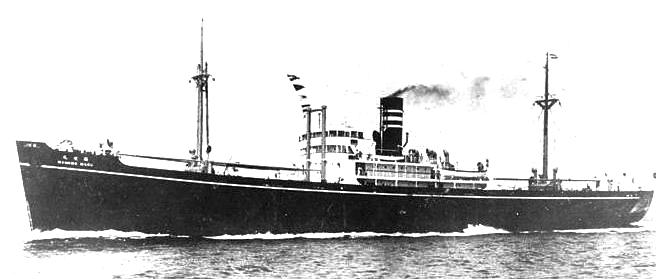 (MANKO MARU prewar)
IJN MANKO MARU:
Tabular Record of Movement
© 2011-2018 Gilbert Casse, Bob Hackett and Peter Cundall
Revision 6
27 September 1934:
Yokohama. Laid down at Yokohama Dock K.K. as a 4,471-ton cargo ship for Kinkai Yusen K. K., (Near Seas Mail Co.) Tokyo.
29 June 1935:
Launched and named MANKO MARU. [1]
30 August 1935:
Completed and placed in Kinkai Yusen's Takao ~ Tokyo commercial service, transporting bananas and other fruits from Formosa to the Keihin (Tokyo – Yokohama) area.
7 July 1937: The Marco Polo Bridge (The "First China Incident") Incident:
Hun River, Lukuokiao, China. Japanese troops at the bridge fire blank cartridges during night maneuvers. Chinese troops fire back. Later, the Japanese discover a soldier missing. They demand entry to the Peking (Beijing) suburb of Wanping to look for him, but the Chinese refuse. The Japanese shell the city and an undeclared war on China begins.
25 August 1937:
With the outbreak of Sino-Japanese conflict, MANKO MARU is requisitioned by the IJN as an auxiliary transport under internal order No. 524 and attached to the Yokosuka Naval District with Yokosuka as home port. Captain Izawa Tetsu (38) is posted Commanding Officer.
27 August 1937:
Reattached to the Sasebo Naval District under internal order No. 537 with Sasebo as home port.
23 September 1937:
Departs Sasebo, operates in the Korean (Chosen) area and proceeds back to Sasebo.
29 September 1937:
Arrives at Sasebo.
15 November 1937:
Captain Kojima Tadashi (40) (former CO of HOZU) assumes command.
22 November 1937:
Departs Sasebo, travels along the Chosen (Korean) south coast and proceeds back to Sasebo.
10 December 1937:
Arrives at Sasebo.
17 December 1937:
Departs Sasebo, operates in the Chosen (Korean) area and proceeds back to Sasebo.
26 December 1937:
Arrives at Sasebo.
30 December 1937:
Departs Sasebo, operates in the Chosen (Korean) area and proceeds back to Sasebo.
11 January 1938:
Arrives at Sasebo.
17 January 1938:
Departs Sasebo, travels along the northern China coast and heads to Dairen, Manchuria (now Dalian, northern China).
24 January 1938:
Arrives at Dairen.
26 January 1938:
Departs Dairen, operates along the northern China coas and heads to Sasebo.
30 January 1938:
Arrives at Sasebo.
14 February 1938:
Departs Sasebo, operates in the Korean area and proceeds back to Sasebo.
14 March 1938:
Arrives at Sasebo.
11 March 1938:
Departs Sasebo, operates along the Korean coast and heads for Kisarazu, Chiba Prefecture.
15 April 1938:
Arrives at Kisarazu, Tokyo Bay.
21 April 1938:
Departs Kisarazu. Travels along the southern China coast and heads for Sasebo.
6 May 1938:
Arrives at Sasebo.
E May 1938:
Departs Sasebo and arrives at an unknown date at Naha, Okinawa.
15 May 1938:
Departs Naha, operates in southern China waters and heads for Mako, Pescadores.
17 May 1938:
Anchors at t 157° and 2800 meters off the Kinmen (Quemoy) gate tower. At 1110 auxiliary gunboat DELHI MARU arrives and lies alongside to port side. From 1215 till 1810 transfers boiler water, and from 1420 till 1510 transfers ammunition to DELHI MARU, that departs later that day.
21 May 1938:
Arrives at Mako and departs the same day for Takao, Formosa (now Kaohsiung, Taiwan).
24 May 1938:
Departs Takao, travels along the southern China coast and proceeds to Takao.
6 June 1938:
Arrives at Takao and departs the same day for Mako.
8 June 1938:
Departs Mako, operates in the southern China area and heads to Sasebo.
10 June 1938:
Recalled Captain (Rear Admiral posthumously) Teragaki Keizo (40)(former XO of Battleship ISE) is appointed Supervisor.
11 June 1938:
At 0900 ~ 1725 auxilary gunboat KAZAN (HUA SHAN) MARU lies alongside MANKO MARU off Wenchow (Wenzhou).
13 June 1938:
Arrives at Sasebo.
19 June 1938:
Departs Sasebo, operates in the Korean area and proceeds back to Sasebo.
7 July 1938:
Arrives at Sasebo.
16 July 1938:
Departs Sasebo, travels along the northern China coast and heads to Dairen.
22 July 1938:
Arrives at Dairen.
E July 1938:
Departs Dairen for Kure at an unknown date.
2 August 1938:
Departs Kure, travels along the southern China coast and heads for Takao.
13 August 1938:
Arrives at Takao and departs the same day to Mako.
15 August 1938:
Departs Mako, travels along the southern China coast and heads for Sasebo.
2 September 1938:
Arrives at Sasebo.
17 September 1938:
Departs Sasebo, travels along the southern China coast and heads for Mako.
21 September 1938:
Arrives at Mako. Departs the same day, travels along the southern China coast and heads to Takao.
3 October 1938:
Arrives at Takao.
E October 1938:
Departs for Sasebo. Date of arrival is unknown.
21 October 1938:
Departs Sasebo, travels along the southern China coast and heads for Mako.
1 November 1938:
At San Hu Anchorage auxiliary gunboat KAZAN (JUA SHAN) MARU lies alongside MANKO MARU.
6 November 1938:
Arrives at Mako. Then heads for Sasebo. Date of arrival is unknown.
3 January 1939:
Departs Sasebo, travels along the southern coast and heads for Mako.
7 January 1939:
Arrives at Mako. Departs the same day for Takao.
10 January 1939:
Departs Takao, travels along the southern coast and heads for Sasebo.
24 January 1939:
Arrives at Sasebo.
E January 1939:
Departs Sasebo for Kure and arrives there at an unknown date.
28 January 1939:
Departs Kure, travels along the southern coast and heads for Mako. At an unknown point, she is diverted to join the Hainan Island Operation.
9 February 1939: Hainan Island Operation:
At midnight, a convoy under Vice Admiral (later Admiral) Kondo Nobutake’s (35) Fifth Fleet, South China Naval Force, enters and anchors in Tsinghai Bay, northern Hainan Island. Kondo lands Special Naval Landing Force (SNLF) troops in southern Hainan. His forces include cruisers MYOYO (F), NAGARA and NATORI and eight destroyers that cover the invasion forces’ transports MANKO KAGU, KATSURAGI, KINUGASA and KOTOKU MARUs. Carrier AKAGI and seaplane tender CHIYODA provide air cover.
10 February 1939:
At 1200, SNLF troops land at Haikow. IJA and IJN forces mop up the northern part of the island.
11 February 1939:
Kondo’s forces land at Samah, southern Hainan and occupy Yulin and Yai-Hsien. Thereafter, the IJN and IJA take control of the entire island.
26 February 1939:
Arrives at Mako. Probably undergoes maintenance. Departs at an unknown date for Sasebo.
13 March 1939:
Captain Sekimoto Orinosuke (38) (current CO of SHINSHO MARU) assumes command as an additional duty.
2 April 1939:
Departs Sasebo, travels along the China coast and heads to Mako.
6 April 1939:
Arrives at Mako. Departs the same day for Takao.
9 April 1939:
Departs Takao, travels along the southern China coast and heads for Mako.
30 April 1939:
Arrives at Mako.
2 May 1939:
Departs Mako, travels along the southern China coast and heads for Nagasaki.
6 May 1939:
Arrives at Nagasaki. Departs the same day for Sasebo.
10 May 1939:
Departs Sasebo, operates in the Korean area and proceeds back to Sasebo.
15 May 1939:
Arrives at Sasebo.
21 May 1939:
Departs Sasebo, travels along the southern China coast and heads for Mako.
26 May 1939:
Arrives at Mako. Departs and arrives the same day at Takao.
1 June 1939:
Departs Takao, travels along the southern China coast and heads for Mako.
22 June 1939:
Arrives at Mako.
23 June 1939:
Departs Mako, travels along the southern China coast and heads for Nakagusuku Bay, Okinawa.
29 June 1939:
Arrives at Nakagusuku Bay. Departs the same day for Sasebo.
7 July 1939:
Departs Sasebo, travels along the southern China coast and heads for Mako.
13 July 1939:
Arrives at Mako. Departs the same day for Takao.
17 July 1939:
Departs Takao, travels along the southern China coast and heads for Mako.
6 August 1939:
Arrives at Mako. Then heads for Sasebo and arrives there at an unknown date.
22 August 1939:
Departs Sasebo, operate in Korean area and proceeds back to Sasebo.
1 September 1939:
Arrives at Sasebo.
6 September 1939:
Departs Sasebo; travels along the southern China coast and heads for Mako.
8 September 1939:
MANKO MARU's owner, Kinkai Yusen, a subsidiary of Nippon Yusen Kaisha (NYK), servicing the near seas to Japan, is absorbed back into NYK. The ship's port of registry remains unchanged as Tokyo.
12 September 1939:
Arrives at Mako. Departs and arrives the same day at Takao.
18 September 1939:
Departs Takao, travels along the southern China coast and proceeds back to Takao.
4 October 1939:
Arrives at Takao. Then heads for Sasebo where she arrives at an unknown date.
23 October 1939:
Departs Sasebo, travels along the southern China coast and heads for Mako.
28 October 1939:
Arrives at Mako. Departs the same day for Takao.
2 November 1939:
Departs Takao, operates in the southern China area and proceeds back to Takao.
21 November 1939:
Arrives at Takao. Then heads for Sasebo where she arrives at an unknown date.
3 December 1939:
Departs Sasebo, travels along the southern China coast and heads for Mako.
8 December 1939:
Arrives at Mako. Departs and arrives the same day at Takao.
12 December 1939:
Departs Takao, operates in the southern China area and heads for Mako.
31 December 1939:
Arrives at Mako.
3 January 1940:
Departs Mako, operates in the southern China area and heads for Takao.
10 January 1940:
Arrives at Takao. Then, departs for Koniya, Amami-Oshima, Ryukyus. Her arrival date is unknown.
28 January 1940:
Departs Koniya, travels along the southern China coast and heads for Mako.
2 February 1940:
Arrives at Mako. Departs the same day for Takao.
6 February 1940:
Departs Takao, travels along the southern China coast and heads for Sasebo.
3 March 1940:
Arrives at Sasebo.
9 March 1940:
Departs Sasebo, travels along the southern China coast and heads for Mako.
15 March 1940:
Arrives at Mako. Departs and arrives the same day at Takao.
18 March 1940:
Departs Takao, operates in southern China waters and proceeds to Takao.
9 April 1940:
Arrives at Takao. Then departs for Sasebo. Her arrival date is unknown.
21 May 1940:
Departs Sasebo, travels along the southern China coast and heads for Mako.
26 May 1940:
Arrives at Mako and departs the same day for Takao.
29 May 1940:
Departs Takao, travels along the southern China coast and heads for Sasebo.
24 June 1940:
Arrives at Sasebo. Then departs for Koniya. Her arrival date is unknown.
6 July 1940:
Departs Koniya. Travels along the southern China coast and heads for Mako.
11 July 1940:
Arrives at Mako and departs the same day for Takao.
16 July 1940:
Departs Takao. Travels along the southern China coast and heads for Sasebo.
5 August 1940:
Arrives at Sasebo.
12 August 1940:
Departs Sasebo, operates in Korean waters and heads for Sakito (near Nagasaki).
20 August 1940:
Arrives at Sakito. Then departs for Mako. Her arrival date is unknown.
2 September 1940:
Departs Mako, operates in southern China waters and heads for Takao.
4 September 1940:
Arrives at Takao.
6 September 1940:
Departs Takao, operates in southern China waters and proceeds back to Takao.
25 September 1940:
Arrives at Takao.
27 September 1940:
Departs Takao, heads south. Then operates in Korean waters and finally proceeds to Sasebo.
7 October 1940:
Arrives at Sasebo.
16 October 1940:
Departs Sasebo, travels along the southern China coast and heads for Mako.
21 October 1940:
Arrives at Mako. Departs and arrives the same day at Takao.
25 October 1940:
Departs Takao, operates in southern China waters and heads for Mako.
7 November 1940:
Arrives at Mako. Then, departs for Sasebo. Her arrival date is unknown.
17 November 1940:
Departs Sasebo, operates in Korean waters and proceeds back to Sasebo.
21 November 1940:
Arrives at Sasebo.
10 December 1940:
Recalled Captain (Rear Admiral posthumously) Wakisaka Johei (38)(former CO of minelayer KATSURIKI) is appointed Supervisor.
E December 1940:
Departs Sasebo for Koniya and arrives there at an unknown date.
16 December 1940:
Departs Koniya, travels along the southern China coast and heads for Takao.
20 December 1940:
Arrives at Takao and departs the same day for Mako.
25 December 1940:
Departs Mako, travels along the southern China coast and heads for Takao.
9 January 1941:
Arrives at Takao.
12 January 1941:
Departs Takao, travels along the southern China coast and heads for Sasebo.
17 January 1941:
Arrives at Sasebo.
E January 1941:
Departs Sasebo for Takao. Arrival date is unknown.
15 February 1941:
Departs Takao, operates in southern China waters and heads for Mako.
2 March 1941:
Arrives at Mako. Departs the same day, travels along the southern China waters and heads for Sasebo.
5 March 1941:
Arrives at Sasebo.
13 March 1941:
Departs Sasebo, travels along the southern China coast and heads for Takao.
17 March 1941:
Arrives at Takao. Departs and arrives the same day at Mako.
22 March 1941:
Departs Mako, Operates in the southern China area and proceeds back to Mako.
6 April 1941:
Arrives at Mako.
8 April 1941:
Departs Mako, travels along the southern China coast and heads for Sasebo.
12 April 1941:
Arrives at Sasebo.
20 April 1941:
Departs Sasebo, operates in Korean waters and proceeds back to Sasebo.
26 April 1941:
Arrives at Sasebo.
30 April 1941:
Departs Sasebo.
1 May 1941:
Arrives in southern China coastal waters.
6 May 1941:
Departs Southern China for Mako and then Takao.
E May 1941:
Departs Takao.
10 May 1941:
Arrives in southern China coastal waters.
1 June 1941:
Departs southern China for Mako and then Sasebo. Arrival date is unknown.
E July 1941:
Departs Sasebo.
10 July 1941:
Arrives in southern China.
15 July 1941:
Departs southern China for Mako and then Takao.
E July 1941:
Departs Takao.
19 July 1941:
Arrives in southern China.
6 August 1941:
Departs southern China for Mako and then Takao.
E August 1941:
Departs Takao.
28 August 1941:
Arrives in southern China.
26 September 1941:
Departs southern China for Takao and then Sasebo.
18 October 1941:
Departs Sasebo, operates in the southern China area and heads for Yokohama.
17 November 1941:
Arrives at Yokohama.
E late November 1941:
Departs Yokohama for the refinery at Yokkaichi, Mie Prefecture.
1 December 1941:
Loads 2,226 aviation gasoline cans and at 1510 departs Yokkaichi for Sasebo.
3 December 1941:
At 1400 arrives at Sasebo.
4 December 1941:
MANKO MARU is assigned to transportation of personnel, ammunition and fuel under Sasebo Naval District Confidential order No. 856. She loads 40-tons of supplies and 100-tons of charcoal fuel.
5 December 1941:
Loads additional 97-tons of supplies and 450-tons of charcoal fuel.
6 December 1941:
Loads additional 325-tons of supplies.
7 December 1941:
Completes her load with additional 98-tons of supplies, 547 postal parcels and two passengers. At 1400 departs Sasebo.
8 December 1941:
Proceeds back to Sasebo and departs later the same day for Ebisu Bay (near Nagasaki).
9 December 1941:
At 2000 arrives at Ebisu Bay.
10 December 1941:
At 0800 departs Ebisu Bay for Mako. Goes to war in her converted auxiliary transport role.
13 December 1941:
At 1100 arrives at Mako. Unloads 88-tons of supplies and postal parcels. Loads 95-tons of charcoal fuel.
14 December 1941:
Unloads 490 cans of aviation gasoline. Loads 83-tons of charcoal fuel. At 1730 departs Mako for Samah, Hainan Island.
17 December 1941:
At 0940 arrives at Samah, unloads 26-tons of supplies.
18 December 1941:
Unloads 335-tons of supplies.
19 December 1941:
Unloads 307-tons of supplies.
20 December 1941:
Unloads 322-tons of supplies.
21 December 1941:
Unloads 1,200 aviation gasoline cans.
22 December 1941:
Unloads 137-tons of supplies and at 2000 departs Samah for Takao.
25 December 1941:
At 0800 arrives at Takao, loads 100-tons of charcoal fuel.
26 December 1941:
Unloads 250 gasoline cans, 4,510 aviation gasoline cans. Loads 1,341 empty drums.
27 December 1941:
Loads 38-tons of weapons and ammunition, and 200-tons of charcoal fuel. Embarks five passengers and at 1445 departs Takao for Sasebo.
1 January 1942:
At 1145 arrives at Sasebo. Her five passengers are disembarked.
2 January 1942:
Unloads 38-tons of weapons and ammunition.
3 January 1942:
Unloads 1,341 empty drums. At 1600 departs Sasebo for Hikoshima, Yamaguchi Prefecture.
4 January 1942:
At 1100 arrives at Hikoshima for maintenance and repair at Mitsubishi Heavy Industries shipyard.
6 January 1942:
At 1430 enters drydock. Undergoes various repairs such as to her rudder, outer hull panels’ coating, hatch adjustments, etc.
9 January 1942:
At 0915 undocked.
11 January 1942:
Repairs are completed. At 1200 departs Hikoshima and arrives at 1740 at Saitozaki.
12 January 1942:
Loads 275-tons of charcoal fuel and at 2400 departs Saitozaki for Sakito.
13 January 1942:
At 1230 arrives at Sakito and at 1600 departs. At 1720 arrives at Sasebo.
15 January 1942:
Loads 765-tons of weapons and supplies.
16 January 1942:
Loads 534-tons of weapons, clothing items and other supplies.
17 January 1942:
Loads 487-tons of weapons, ammunition, building material and other supplies.
18 January 1942:
Loads 287-tons of ammunition, building materials and other supplies and 428 postal parcels. Embarks 267 troops. At 1600 departs Sasebo for Takao.
21 January 1942:
At 1300 arrives at Takao. Disembarks 52 troops. Unloads 52-tons of weapons, ammunition and supplies.
22 January 1942:
Unloads 100-tons of supplies and ammunition. Loads 300-tons of charcoal fuel.
23 January 1942:
Loads 0.1-tons of supplies and 52 postal parcels. Two troops come aboard. At 1700 departs Takao for Samah.
26 January 1942:
At 1030 arrives at Samah. Disembarks 183 troops and lands 23 postal parcels. Unloads 237-tons of food and other supplies.
27 January 1942:
Unloads 299-tons of building material and other supplies.
28 January 1942:
Unloads 129-tons of building material. Loads 54-tons of food supplies.
29 January 1942:
Loads 310-tons of charcoal fuel/aviation gasoline. Embarks 56 troops and at 2000 departs Samah for Camranh Bay, Indochina.
31 January 1942:
At 1330 arrives at Camranh Bay. Disembarks 217 troops. Comes alongside repair ship ASAHI’s starboard side and transfers 45-tons of coal No. 3 Grade.
1 February 1942:
20 troops disembark. Unloads 42-tons of ammunition and assorted goods.
2 February 1942:
Unloads 116-tons of ammunition and 217 postal parcels. Loads 3-tons of ammunition. Takes one funerary urn and related relics aboard. Embarks 21 troops. At 1900 departs Camranh Bay for Saigon.
3 February 1942:
At 1700 arrives at Saigon. Disembarks 60 troops and lands 24 postal parcels. Unloads 11-tons of ammunition and goods.
4 February 1942:
Unloads 201-tons of ammunition and goods and 52 postal parcels.
5 February 1942:
Unloads 728-tons of ammunition.
6 February 1942:
Unloads 385-tons of ammunition.
7 February 1942:
Unloads 48-tons of weapons. Loads 42-tons of building materials and other supplies.
8 February 1942:
Tethered to the fifth buoy. 2,016-tons of white rice are transferred aboard.
9 February 1942:
984-tons of white rice are transferred aboard.
11 February 1942:
Embarks 46 passengers. At 1400 departs Saigon for Takao.
16 February 1942:
At 1630 arrives at Takao. 32 troops are disembarked.
17 February 1942:
Unloads 4-tons of ammunition and other supplies and 1-ton of spare parts. Loads 210-tons of charcoal fuel. At 1830 departs Takao for Moji.
21 February 1942:
At 1000 arrives at Moji. Disembarks 17 troops and unloads 1,827-tons of rice.
22 February 1942:
Unloads 1,173-tons of rice.
23 February 1942:
At 1700 departs Moji for Sasebo.
24 February 1942:
At 1245 arrives at Sasebo. One funerary urn and related relics, and one postal parcel are landed.
25 February 1942:
Unloads 16-tons of weapons, ammunition and other goods.
26 February 1942:
Sasebo. Tethered to the No. 1 pier. Unloads 24-tons of weapons.
27 February 1942:
Departs the pier for Sasebo Naval Yard to be fitted with four 8 cm/40 type-41 guns, 14 7.7 mm AA MGs, a paravane against mines, renewed accommodations in her No. 3 hold for troops, navigation lights on her mizzen mast, etc.
28 February 1942:
Undergoes repairs to her radio antenna cable.
1 March 1942:
Set-up of new ammunition storage for 8 cm/40 gun and a storehouse for gunnery (torpedo) section. Replacement of her provisional latrines block by a new one and repairs made to her provisional kitchen block.
6 March 1942:
New fittings and repairs are completed. Departs Sasebo Naval Arsenal and is tethered to buoy No. 9.
Loads 147-tons of weapons, 225-tons of other supplies and 1,819 shells.
7 March 1942:
Loads 560-tons of weapons and ammunition.
8 March 1942:
Loads 137-tons of ammunition and other supplies.
9 March 1942:
Loads two fully equipped gunboats and weapons for a total of 71-tons.
10 March 1942:
Takes aboard 874 postal parcels. Embarks 150 troops. At 0900 departs Sasebo for the Terashima Suido (Strait) to test her newly installed 8-cm guns and paravanes, then steams for Sakito where she arrives at 1130. Loads 603-tons of charcoal fuel and at 1700 departs Sakito for Takao.
13 March 1942:
At 1430 arrives at Takao. Disembarks 34 troops and lands 139 postal parcels.
14 March 1942:
Unloads 122-tons of weapons, ammunition and other supplies. Loads 28-tons of charcoal fuel. Later in the day loads 160-tons of charcoal fuel. Two troops are embarked.
15 March 1942:
At 0915 departs Takao.
18 March 1942:
At 1840 arrives at the mouth of the Saigon River.
19 March 1942:
At 0330 goes up river and arrives at 0800 at Saigon. Disembarks 14 troops and lands 144 postal parcels. Unloads 17-tons of relief goods. Loads 21-tons of spare parts.
20 March 1942:
Loads 44-tons of other weapons, electrical equipment and harbor material.
21 March 1942:
Unloads the two gunboats craft and their equipment and 4-tons of supplies. Takes aboard 57 postal parcels.
22 March 1942:
Embarks 104 troops. At 0900 departs Saigon for Seletar Naval Base, Singapore.
24 March 1942:
At 1830 arrives at Seletar. Disembarks 209 troops.
25 March 1942:
Tethered at one of the harbor piers, unloads 15-tons of weapons and building materials.
26 March 1942:
Unloads 166-tons of ammunition.
27 March 1942:
Unloads 227-tons of ammunition.
28 March 1942:
Unloads 190-tons of other weapons, ammunition, shells cartridges and harbor materials. Loads 0.65-tons of clothing.
29 March 1942:
Unloads 367-tons of food and assorted supplies.
30 March 1942:
Unloads 292-tons of building material, assorted supplies and other weapons. Loads 2-tons of private owned goods. Later the same day, loads 250-tons of charcoal fuel and takes aboard 150 postal parcels. Embarks 7 troops.
31 March 1942:
At 0800 departs Singapore Naval Base.
E April 1942:
Recalled Captain Inagami Shinjo is appointed Supervisor.
2 April 1942:
At 1050 arrives at the mouth of the Saigon River, goes up river and arrives at 1730 at Saigon. One soldier and 17 postal parcels are landed.
3 April 1942:
Unloads 6-tons of arms. Loads 2,119-tons of rice.
4 April 1942:
Loads 1,127-tons of rice.
5 April 1942:
Loads 257-tons of rice. Takes aboard 23 funerary urns and 52 postal parcels. Embarks 82 troops.
6 April 1942:
At 0900 departs Saigon for Takao.
10 April 1942:
At 1300 arrives at Takao. Unloads 0.32 tons of clothing and 28 postal parcels. Loads 100-tons of charcoal fuel.
11 April 1942:
Embarks a single soldier. At 1015 departs Takao for Ebisu Bay.
14 April 1942:
At 1045 arrives at Ebisu Bay. Lands 23 funerary urns and 157 postal parcels. Embarks 88 troops. Departs later in the day, at 1530, for Moji.
15 April 1942:
At 0930 arrives at Moji. Unloads 2,200 tons of rice.
16 April 1942:
Unloads 143-tons of rice.
17 April 1942:
Unloads 1162-tons of rice and departs at 1730 for Sasebo.
18 April 1942:
At 1145 arrives at Sasebo. Unloads weapons, food and 2-tons of privately owned goods.
19 April 1942:
Loads 250-tons of charcoal fuel.
20 April 1942:
Captain Inagami Shinjo (33) is posted Supervisor. Captain Wakisaka is later posted CO of 16th Minesweeper Division. Loads another 250-tons of charcoal fuel.
21 April 1942:
Loads weapons, ammunition and finished goods for a total of 866-tons.
22 April 1942:
Sasebo Naval district confidential instruction No. 196 confirms previous assignment for MANKO MARU to personnel and munitions transport and fuel. Embarks Captain Inagami. Loads 382-tons of ammunition, building material and food storage supplies.
23 April 1942:
Captain Wakisaka disembarks. Loads 451-tons of ammunition and other supplies.
24 April 1942:
Loads 259-tons of ammunition and other supplies.
25 April 1942:
Loads 189-tons of goods, building material and medical supplies and 925 postal parcels.
26 April 1942:
Embarks 466 troops. At 1700 departs Sasebo for Takao.
29 April 1942:
At 1400 arrives at Takao. Unloads two freight cars, four passenger cars and 250 carrier wagons.
30 April 1942:
Disembarks 89 troops and lands 847 postal parcels. Later the same day, 399-tons of ammunition, bread and other supplies are unloaded.
1 May 1942:
Loads 53-tons of bread and wine supplies and relief goods. Takes aboard 132 postal parcels. Later the same day, embarks 72 troops. At 1845 departs Takao.
5 May 1942:
At 0835 arrives at the mouth of the Saigon River and goes up river, arriving at 1800 at Saigon. Disembarks 11 troops and lands 10 postal parcels.
6 May 1942:
Unloads 48-tons of ammunition, food, assorted supplies and privately owned goods.
7 May 1942:
Unloads 334-tons of supplies, weapons and building materials. 170 postal parcels are landed. Later in the day, embarks 84 cadets.
8 May 1942:
At 0900 departs Saigon for Seletar, Singapore.
10 May 1942:
At 2115 arrives at Seletar.
11 May 1942:
Disembarks 347 troops and cadets. Unloads 553-tons of weapons, ammunition, bread and assorted supplies and privately owned goods. 370 postal parcels are landed.
12 May 1942:
Unloads 30-tons of weapons, ammunition, bread, beverages and assorted supplies and relief goods.
13 May 1942:
Unloads 941-tons of weapons and ammunition.
14 May 1942:
Unloads 153-tons of food, canteen, relief goods and medical supplies. Later the same day, loads 88-tons of weapons, beverages, assorted goods and medical supplies, relief and private goods. Takes aboard 13 funerary urns and 166 postal parcels. Finally, embarks 359 troops.
15 May 1942:
At 0800 departs Seletar.
17 May 1942:
At 1145 arrives at the mouth of the Saigon River and goes up river and arrives at 1645 at Saigon. 12 troops are disembarked. Unloads 22 tons of ammunition.
18 May 1942:
Loads 2,146-tons of white rice.
19 May 1942:
Loads 853-tons of white rice.
20 May 1942:
Loads 5-ton of weapons, relief goods, general and medical supplies. Embarks 12 troops and loads 130 postal parcels.
21 May 1942:
At 0900 departs Saigon for Takao.
25 May 1942:
At 1045 arrives at Takao. Disembarks six troops. Unloads 22-tons of assorted supplies, one crate of medical supplies and one crate of private goods.
26 May 1942:
Embarks four IJA soldiers. At 0830 departs Takao for Ebisu Bay in convoy No. 215 also consisting of IJA transports KINE and KURAMASAN MARUs and six unidentified merchant ships escorted by destroyer FUYO. MANKO MARU sails at 12.6 knots.
29 May 1942:
Arrives at Ebisu Bay. Disembarks 358 troops. Lands 13 funerary urns and 273 postal parcels.
Departs and arrives at 1745 at Nagasaki.
30 May 1942:
Unloads 1,178-tons of white rice.
31 May 1942:
Unloads 1,254-tons of white rice.
1 June 1942:
Unloads 568-tons of white rice.
2 June 1942:
At 0800 departs Nagasaki and arrives at Sasebo at 1115. Unloads 26-tons of weapons, 20-tons of ammunition and 14-tons of other supplies.
3 June 1942:
Sasebo naval district Confidential instruction No. 244 confirms the previous assignment for MANKO MARU to transport personnel, munitions and fuel. Loads 400-tons of oil No. 3 grade and 500-tons of charcoal briquettes.
4 June 1942:
Loads other weapons, relief goods, general, assorted goods and medical supplies.
5 June 1942:
Loads 148-tons of arms, clothing and medical supplies.
6 June 1942:
Loads 361-tons of other supplies and arms.
7 June 1942:
Loads 38-tons of weapons, clothing, general and medical supplies, and relief and private goods. 729 postal parcels are boarded.
8 June 1942:
Embarks 222 troops. At 0900 departs Sasebo for Sakito. Drops anchor outside the harbor at 1000.
9 June 1942:
At 1330 enters Sakito’s harbor. Loads 566-tons of charcoal fuel and departs at 1800 for Takao.
12 June 1942:
At 2000 arrives at Takao and docks at Juban pier.
13 June 1942:
Disembarks 132 troops and lands 115 postal parcels. Later, unloads 400-tons of weapons, other supplies and private goods. Loads 128-tons of charcoal fuel.
14 June 1942:
Loads 128-tons of weapons, clothing, food, assorted goods, general and medical supplies. Takes aboard 6 postal parcels.
15 June 1942:
At 0830 departs Takao for Saigon.
19 June 1942:
At 1200 arrives at Saigon and docks at Pier No. 2. Seven troops disembark and 48 postal parcels are landed, 9 others are taken aboard. Unloads 146-tons of weapons, wine, medical supplies and clothing. Later, unloads 55-tons of weapons, canteen and other supplies.
20 June 1942:
Embarks 40 troops. At 1000 departs Saigon for Singapore.
22 June 1942:
At 1600 arrives at Singapore. Docks at Pier No. 8. Disembarks 175 troops and lands 572 postal parcels.
Later, unloads 55-tons of wine, food, weapons, assorted goods and relief goods.
23 June 1942:
Unloads 128-tons of other supplies, weapons, clothing, raw food, assorted goods and medical supplies.
24 June 1942:
Unloads 292-tons of ammunition and 369-tons of other supplies.
25 June 1942:
Unloads 84-tons of ammunition and other supplies. Takes aboard 5 funerary urns and 73 postal parcels.
Embarks 175 troops.
26 June 1942:
At 0900 departs Singapore.
28 June 1942:
At 1430 arrives at Saigon. Tethers at Buoy No. 5. Disembarks 24 troops. Unloads 163-tons of weapons, other supplies and clothing.
29 June 1942:
Unloads 350-tons of briquette charcoal. Loads 97-tons of white rice.
30 June 1942:
Loads 1,633-tons of white rice.
1 July 1942:
Loads 1,275-tons of white rice.
3 July 1942:
Loads 78-tons of zinc ingots and takes aboard 7 postal parcels. A single troop comes aboard. At 0800 departs Saigon for Takao. On the way, engages in some gunnery practice, firing a total of 3 rounds.
7 July 1942:
At 1000 arrives at Takao Dock’s pier No. 9. One soldier disembarks. Unloads 7-tons of light weapons and clothing.
8 July 1942:
Embarks 38 troops. At 1000 departs Takao for Sasebo.
11 July 1942:
At 1800 arrives at Sasebo. Tethers on buoy No. 2. Disembarks 213 troops and lands 57 postal parcels.
12 July 1942:
Unloads 111-tons of light weapons and other supplies.
13 July 1942:
Unloads 12-tons of weapons, clothing and private goods.
14 July 1942:
At 0550 departs Sasebo for Kobe.
15 July 1942:
At 1815 arrives at Kobe. Tethers to No. 4 buoy.
16 July 1942:
Unloads 50-tons of zinc ingots and 2,329-tons of white rice.
17 July 1942:
Unloads 676-tons of white rice.
20 July 1942:
At 0940 departs Kobe
21 July 1942:
At 1030 arrives at Moji. At 1910, departs Moji for Sasebo.
22 July 1942:
At 1200 arrives at Sasebo.
23 July 1942:
Loads 756-tons of supplies.
24 July 1942:
Loads 597-tons of weapons, food and medical supplies, and privately owned goods.
25 July 1942:
Sasebo Naval District Confidential instruction No. 300 confirms previous assignment for MANKO MARU to transport personnel, munitions and fuel. Loads 428-tons of supplies and other weapons.
26 July 1942:
Loads 187-tons of weapons, other supplies and biscuits, relief and privately owned goods.
27 July 1942:
Loads 200-tons of charcoal fuel. Takes aboard 501 postal parcels.
28 July 1942:
Loads 360-tons of charcoal fuel.
29 July 1942:
Embarks 142 troops. MANKO MARU is fitted with two DC (depth charge) racks at the stern equipped with two DC and with an electrical powered bell to improve communication aboard. At 1000 departs Sasebo for Takao.
1 August 1942:
At 1550 arrives at Takao. Docks at pier No. 16. Disembarks 52 troops. Unloads 189-tons of other supplies and biscuits, relief and privately owned goods.
2 August 1942:
Unloads 135-tons of clothing, food and assorted supplies, mineral oil and relief goods. 68 postal parcels are landed. Embarks 39 troops. At 1900 departs Takao.
4 August 1942:
At 0930 arrives at Hong Kong and docks at the south No. 4 pier on the Kowloon side. Disembarks 109 troops. Unloads 466-tons of food, clothing and other supplies.
5 August 1942:
Unloads 46-tons of supplies.
6 August 1942:
Embarks two troops. One postal parcel is carried. At 1000 departs Hong Kong for Samah, Hainan Island.
7 August 1942:
At 2215 arrives at Samah.
8 August 1942:
Embarks 22 troops and lands 433 postal parcels. Unloads 215-tons of supplies.
9 August 1942:
Unloads 113-tons of ammunition and other supplies.
10 August 1942:
Unloads 179-tons of supplies.
11 August 1942:
Unloads 220-tons of timber.
12 August 1942:
Unloads 100-tons of timber, 150-tons of light oil and 9-tons of metal sheets.
13 August 1942:
Unloads 90-tons of lump charcoal, 110-tons of light oil and 85-tons of utility poles. Loads 39-tons of ammunition, two funerary urns and seven personal relics. At 1500 departs Samah, and at 1830 arrives at Yulin, Hainan Island and tethers on a buoy. Loads 600-tons of iron ore.
14 August 1942:
Loads 2,100-tons of iron ore. Unloads 150-tons of lump charcoal.
15 August 1942:
Loads 300-tons of iron ore and 500 empty drums. 70 troops come aboard. At 1900 departs Yulin for Takao.
18 August 1942:
At 1100 arrives at Takao, docks at No. 8 pier. Disembarks 26 troops. Two funerary urns and seven personal relics are landed. Unloads two passenger cars and three trucks. Loads 170-tons of charcoal fuel.
19 August 1942:
Loads 4,600 empty drums, 4-tons of privately owned goods, 55 funerary urns and 160 personal relics.
20 August 1942:
Embarks 172 troops. At 1000 departs Takao. Later that same day, departs Mako in convoy No. 252 consisting of MANKO MARU and five unidentified merchant ships escorted by destroyer WAKATAKE. [NB unconfirmed]
23 August 1942:
At 1645 arrives at Sasebo. Anchors in Ebisu Wan.
25 August 1942:
At 1000 arrives at Sasebo and tethers at No. 9 buoy. 55 funerary urns and 161 personal relics are landed. Unloads 5,100 empty drums. Disembarks 216 troops.
26 August 1942:
Unloads 34-tons of weapons and other supplies. At 1800 departs Sasebo for Yawata, Fukuoka Prefecture.
27 August 1942:
At 1400 arrives at Yawata.
28 August 1942:
Unloads 1,800-tons of iron ore.
29 August 1942:
Unloads 1,200-tons of iron ore.
30 August 1942:
At 1700 departs Yawata and arrives at Kobe at 1800.
1 September 1942:
Arrives at Mitsubishi Heavy Industries, Ltd. shipyard to undergo the following repairs: Antifouling coating replacement, outer fender coating replacement, repair and adjustment to steering gear, scupper cleaning, coatings, bottom plates part replacement, camouflage pattern restoration and inspection and restoration of anchor chains.
8 September 1942:
At 1330 enters dock.
10 September 1942:
Recalled Captain (Rear Admiral posthumously) Okano Ikkan (36)(former XO of battleship HIEI) is appointed Supervisor.
12 September 1942:
At 1445 undocked.
15 September 1942:
Embarks Captain Okano. Tethered at buoy A.
17 September 1942:
Captain Inagami disembarks. Repairs are completed. At 1740 departs Kobe for Sasebo.
19 September 1942:
At 1200 arrives at Sasebo. MANKO MARU is assigned to a fast transport mission of Army Forces to Solomon Islands by telecommunication order No. 89. Her orders are to steam to Hong Kong and embark elements of 38th Infantry, 10th Infantry, and 19th Independent Engineer Regiments.
20 September 1942:
At 0915 departs Sasebo and arrives at Sakito at 1030. Loads 1,492-tons of charcoal fuel.
21 September 1942:
At 0700 departs Sakito for Hong Kong.
25 September 1942:
At 0915 arrives at Hong Kong. Placed in the Shitai convoy under Southern Army Confidential order No. 26.
26 September 1942:
Confidential No. 1 convoy instruction: Transport Army divisions: main Corps in the Shitai Convoy (2 echelons). 280 Army troops from elements of the 10th Independent Mountain Artillery Regiment and elements of the 19th Independent Engineer Regiment embark with 283 horses. At 1755 departs Hong Kong in the 1st echelon of the Shitai Convoy consisting of MANKO MARU and auxiliary submarine tender HIE MARU escorted by light training cruiser KASHII, light cruiser KUMA and torpedo boat KASASAGI. KASHII has been disguised with a second funnel, perhaps to appear like a U.S. cruiser. JOHORE MARU carries elements of the IJA 2nd Battalion (less 6th Company), 10th Independent Mountain Artillery Regiment, horses and supplies. MANKO MARU carries Headquarters, 10th Independent Mountain Artillery Regiment; 1st Battalion (less 1st Company). Light cruiser KUMA carries troops of the IJA 38th Division.
4 October 1942:
At 0800 arrives at Palau. Loads 200-tons of charcoal fuel and 230-tons of fresh water. KASASAGI is detached and proceeds to Hong Kong.
5 October 1942:
At 0650 departs Palau for Rabaul. At an unknown point, KASHII is detached and proceeds at speed to Rabaul arriving 8 October 1942 where she disembarks troops and proceeds that same day to Davao, Philippines.
10 October 1942:
At 0615 arrives at Rabaul. 165 Army troops and 20 horses are landed. Loads 100 tons of charcoal fuel. KUMA also disembarks troops and is detached that same day for Macassar, Celebes.
11 October 1942:
Dismbarks 115 Army troops and 258 horses.
12 October 1942:
Loads 100-tons of charcoal fuel.
13 October 1942:
USAAF fifth Air Force Boeing B-17 heavy bombers bomb Rabaul. Aboard MANKO MARU, 141 troops fire their 7.7mm machine guns and 100 others with their type 38 rifles at the bombers, but without success. At 1250 MANKO and HIE MARUs depart Rabaul escorted by minesweeper W-15.
14 October 1942:
At 2000, HIE MARU is detached and proceeds to Truk At 2400, W-15 is detached. MANKO MARU proceeds to Guam unescorted.
17 October 1942:
At 1730 arrives at Guam (renamed Omiya Island after its capture).
18 October 1942:
Loads 180-tons of charcoal fuel and 210-tons of fresh water.
19 October 1942:
Loads 120-tons of charcoal fuel. Loads 210-tons of fresh water. At 1600 departs Guam for Moji and passes through the Bungo Suido (Strait).
25 October 1942:
At 0815 arrives at Moji. One soldier disembarks. Unloads horse shoes and other military equipment.
26 October 1942:
At 0630 departs Moji and at 1815 drops anchor at Gonoura.
27 October 1942:
Weighs anchor, and at 0700 departs and arrives at Sasebo at 1035.
28 October 1942:
Loads 100-tons of charcoal fuel.
29 October 1942:
Loads 350-tons of timber, 1000 oils cans and 1500 gasoline cans.
30 October 1942:
Loads 350-tons of timber, 150-tons of pipes and 200 oil cans.
31 October 1942:
Loads 100 cans of foreign mineral oil, 11-tons of external radio equipment, 12-tons of reconditioned products, 95-tons of miscellaneous products, and 150-tons of cables.
1 November 1942:
Loads weapons, general and assorted supplies and arsenal products for a total of 302-tons.
2 November 1942:
Loads 25-tons of food and medical supplies and spare parts. Takes aboard 662 postal parcels.
3 November 1942:
Arrives at Sakito at 1130 and departs there at 1630. 462 troops come aboard and loads 420-tons of charcoal fuel before for Hong Kong.
7 November 1942:
At 1900 arrives at Hong Kong.
8 November 1942:
Embarks 134 troops. Lands 74 postal parcels. Unloads 157-tons of ammunition and other supplies.
9 November 1942:
Unloads 67-tons of arms and other supplies. Loads 2-tons of ammunition and privately owned goods.
10 November 1942:
Loads 150-tons of charcoal fuel.
11 November 1942:
Embarks 87 troops. At 1700 departs Hong Kong for Haikow, Hainan Island.
12 November 1942:
At 1700 arrives at Haikow. Unloads 100 cans of mineral oil, 700 oil cans and 1,500 gasoline cans.
13 November 1942:
Unloads 334-tons of medical supplies. Four troops and 51 postal parcels are landed.
14 November 1942:
Loads 70-tons of privately owned products. Embarks 16 troops. At 1500 departs Haikow for Samah.
15 November 1942:
At 1320 arrives at Samah. Disembarks 172 troops. 265 postal parcels are landed.
17 November 1942:
Unloads 40-tons of timber.
18 November 1942:
Unloads 33-tons of ammunition, clothing medical and other supplies.
19 November 1942:
Unloads 416-tons of goods. Loads 5-tons of weapons.
20 November 1942:
At 0700 departs Samah for Saigon.
22 November 1942:
At 1430 arrives at Saigon. Unloads 30-tons of ammunition, food and other supplies. Disembarks nine troops and lands 31 postal parcels.
23 November 1942:
Unloads 182-tons of canteen (liquor) supplies. Loads 835-tons of weapons, ammunition and other supplies.
24 November 1942:
Loads 52-tons of clothing.
25 November 1942:
Loads 153-tons of assorted supplies. Embarks 108 troops.
26 November 1942:
At 0600 departs Saigon for Singapore.
27 November 1942:
Off Singapore, at 1815 MANKO MARU is attacked by an unidentified submarine on the surface, but sustains no damage. Her 8cm gun fires 6 shells and Singapore’s coastal guns return fire with 60 shells, all without success.
28 November 1942:
At 1450 arrives at Singapore. 343 postal parcels are landed.
29 November 1942:
Unloads 463-tons of clothing and canteen, food, wine, and grain supplies.
30 November 1942:
Disembarks 354 troops. Unloads 2,882 empty drums, 3,630 6-cm shells and 400-tons of rice.
1 December 1942:
Unloads 360-tons of ammunition.
2 December 1942:
Unloads 45-tons of ammunition. Loads 285-tons of charcoal fuel and 210-tons of ammunition and other supplies.
3 December 1942:
Loads 318-tons of weapons, ammunition and other supplies. Takes aboard 126 postal parcels and 14 funerary urns.
4 December 1942:
Embarks 253 troops. At 1015 departs for Saigon.
7 December 1942:
At 1435 arrives at Saigon. Disembarks 49 troops and lands 70 postal parcels. Unloads 57-tons of ammunition and other supplies.
8 December 1942:
Loads 447-tons of white rice.
9 December 1942:
Loads 1,136-tons of white rice.
10 December 1942:
Loads 1,249-tons of white rice.
11 December 1942:
Loads 439-tons of weapons, ammunition and other supplies. Takes aboard four postal parcels. Embarks 57 troops.
12 December 1942:
At 0600 departs Saigon for Takao.
16 December 1942:
At 2200 arrives at Takao.
17 December 1942:
Disembarks 33 troops. Lands one postal parcel. Unloads 115-tons of supplies. Loads 200-tons of charcoal fuel.
18 December 1942:
Embarks three troops. At 1120 departs Takao for Sasebo.
21 December 1942:
At 1430 arrives at Sasebo.
22 December 1942:
Disembarks 231 troops. 59 postal parcels and 14 funerary urns are landed. At 1200 departs Sasebo, makes a call at Azuchi-Oshima (Oshima Island) and departs later in the day for Moji.
23 December 1942:
At 1020 arrives at Moji.
24 December 1942:
Unloads 2,003 tons of rice and 28-tons of special steel plates.
25 December 1942:
At 0700 departs Moji and at 1800 arrives at Arikawa Bay (Nakadori Island).
26 December 1942:
At 0650 departs Arikawa Bay and arrives at Sasebo later at 1100. Unloads 109-tons of weapons.
27 December 1942:
Captain (Rear Admiral posthumously) Okano Ikkan(36)(former XO of battleship HIEI) disembarks. An unknown officer is posted Supervisor. Captain Okano is later posted CO of NICHIEI MARU. Unloads 264-tons of ammunition.
28 December 1942:
Unloads 161-tons of arsenal products, privately owned goods, other supplies and clothing. Loads 353-tons of bombs and timber.
29 December 1942:
Unloads supplies. Loads 192-tons of weapons and other supplies.
30 December 1942:
Loads 373-tons of weapons, ammunition, store, sustenance, medical, other supplies and privately owned goods.
31 December 1942:
Loads 288-tons of weapons, ammunition, medical and other supplies.
1 January 1943:
MANKO MARU shifts category from Zatsuyosen (Ko) to Zatsuyosen (Otsu) [2].
2 January 1943:
Loads 1-ton of privately owned goods. Takes aboard 596 postal parcels.
3 January 1943:
Embarks 597 troops. At 1200 departs Sasebo and arrives at Sakito later at 1330 to load 588-tons of charcoal fuel.
4 January 1943:
At 0730 departs Sakito for Takao.
7 January 1943:
At 1615 arrives at Takao. Six troops and 44 postal parcels are landed. Unloads 73-tons of weapons.
8 January 1943:
Loads 150-tons of charcoal fuel and a fuel truck. Unloads 40 bags of cement and 312-tons of food supplies and clothing.
9 January 1943:
Loads 336-tons of light clothing and other supplies. Takes aboard 770 postal parcels and 6 additional troops. At 1600 departs Takao for Hong Kong.
11 January 1943:
At 0900 arrives at Hong Kong. Disembarks 156 troops and lands 42 postal parcels. One troop comes aboard. Unloads 175-tons of privately owned clothing.
12 January 1943:
Loads 8-tons of supplies and privately owned goods.
13 January 1943:
At 1000 departs Hong Kong for Samah.
14 January 1943:
At 1900 arrives at Samah.
15 January 1943:
Disembarks 183 troops and lands 322 postal parcels. Unloads 286-tons of weapons and other supplies.
16 January 1943:
Unloads 7,000 diesel cans, 65-tons of building material and 58-tons of sustenance supplies, one-ton of medical supplies and 100-kg of privately owned goods.
17 January 1943:
Unload 1,000 diesel cans and 16 engine units. At 1200 departs Samah.
21 January 1943:
At 1515 arrives at Singapore. 825 postal parcels are landed.
22 January 1943:
Disembark 252 troops. Unloads 146-tons of ammunition, food, other supplies and clothing. Loads 280-tons of charcoal fuel.
23 January 1943:
Unloads 80-tons of bread, other supplies and privately owned goods.
24 January 1943:
Loads 326-tons of ammunition and other weapons and two barges. Takes aboard 8 funerary urns and 85 postal parcels.
25 January 1943:
Embark 102 troops. At 0900 departs Singapore.
27 January 1943:
At 1800 arrives at the mouth of the Saigon River.
28 January 1943:
Departs the mouth of the Saigon River, goes up river and arrives at 0700 at Saigon. Disembarks 45 troops and lands 149 postal parcels. Unloads 51-tons of weapons, ammunition and clothing.
29 January 1943:
Loads 1,495-tons of weapons, clothing, rice and other supplies.
30 January 1943:
Loads 1,089-tons of rice.
31 January 1943:
Loads 70-tons of rice, 251-tons of U.S. ammunition. Takes aboard 8 postal parcels and one funerary urn.
2 February 1943:
At 1300 departs Saigon for Takao.
7 February 1943:
At 1230 arrives at Takao. Disembarks seven troops and lands six postal parcels. Unloads two barges and 261-tons of U.S. weapons and ammunition.
8 February 1943:
4 troops come aboard. At 1500 departs Takao for Sasebo in convoy No. 229 consisting also of BOKO MARU and two unidentified merchant ships escorted by destroyer ASAGAO.
12 February 1943:
At 1030 arrives at Sasebo. Disembarks 108 troops and lands 71 postal parcels.
13 February 1943:
At 0800 departs Sasebo for Nagasaki where she arrives at 1200. Unloads 283-tons of rice.
14 February 1943:
Unloads 1,341-tons of rice.
15 February 1943:
Unloads 876-tons of rice and 206-tons of material goods.
16 February 1943:
At 0900 departs Nagasaki and arrives at Sasebo at 1230. Unloads 219-tons of ammunition.
17 February 1943:
Unloads 94-tons of military, clothing, medical supplies and privately owned goods. At 1330 departs Sasebo for Misumi (Kumamoto Prefecture).
18 February 1943:
At 0900 arrives at Misumi. Loads 422-tons of timber.
19 February 1943:
Loads 695-tons of timber.
20 February 1943:
Loads 595-tons of timber.
21 February 1943:
At 1000 departs Misumi and arrives at Sasebo at 1730.
22 February 1943:
Unloads 695-tons of timber.
23 February 1943:
Unloads 422-tons of timber.
24 February 1943:
Unloads 595-tons of timber.
25 February 1943:
Loads 635-tons of ammunition.
26 February 1943:
Loads 330-tons of supplies.
27 February 1943:
Loads 518-tons of weapons, ammunition, medical, assorted goods, other supplies and privately owned goods.
28 February 1943:
Loads 359-tons of weapons, medical, canteen and other supplies. Takes aboard 807 postal parcels.
1 March 1943:
Sasebo. Embarks 609 troops. At 1200 departs and arrives at Sakito at 1250 to load 630-tons of charcoal fuel.
2 March 1943:
At 0700 departs Sakito for Samah.
7 March 1943:
At 1115 arrives at Samah. Disembarks 294 troops and 458 postal parcels. Unloads 300 cans of No. 2 grade oil.
8 March 1943:
Unloads 509-tons of ammunition and other supplies.
9 March 1943:
Unloads 500 cans of oil No. 1 grade and 200 bombs.
10 March 1943:
Unloads 200 bombs, 120 fuses and privately owned goods. A single civilian comes aboard. At 1200 departs Samah for Saigon.
13 March 1943:
At 0830 arrives at Saigon. Disembarks 31 troops and lands 22 postal parcels. Unloads 40-tons of weapons and other supplies. Loads 621-tons of weapons, clothing and other supplies.
14 March 1943:
Loads 5 trucks and 302-tons of clothing garments.
15 March 1943:
Nine troops come aboard. At 0900 departs Saigon for Singapore.
17 March 1943:
At 1600 arrives at Singapore. Disembarks 303 troops and lands 327 postal parcels.
18 March 1943:
Unload 5 trucks, 3-tons of wire and 10-tons of clothing.
19 March 1943:
Unloads 2 boxes of Type 89 8-cm grenade-launcher high explosives grenades, two boxes of Type 89 8 cm standard grenades and 5,001 rice bags.
21 March 1943:
Unloads 400 bombs for land use which 120 are of incendiary type, and 467-tons of supplies.
22 March 1943:
Unloads 361-tons of supplies.
23 March 1943:
Loads 310-tons of supplies.
24 March 1943:
Loads ammunition, medical and other supplies. Takes aboard 68 postal parcels and embarks 172 troops.
25 March 1943:
At 0900 departs Singapore for Saigon in convoy No. 677 also consisting of SUGIYAMA MARU escorted by torpedo boat SAGI.
27 March 1943:
At 1800 arrives at Saigon. Disembarks 31 troops and lands five postal parcels. Unloads 435-tons of ammunition, medical and other supplies.
28 March 1943:
Loads 176-tons of ammunition and other supplies.
29 March 1943:
Loads 100-tons of crude gum, 51-tons of latex and 306-tons of kapok.
30 March 1943:
Loads 281-tons of charcoal fuel and 307-tons of kapok. Takes aboard two postal parcels and embarks 60 troops.
31 March 1943:
At 1050 departs Saigon for Sasebo.
7 April 1943:
At 1530 arrives at Sasebo.
8 April 1943:
Disembarks 196 troops and lands 65 postal parcels. Unloads 249-tons of ammunition and other supplies.
9 April 1943:
Unloads 1,283 bombs and 52-tons of supplies. Loads 50-tons of charcoal fuel.
10 April 1943:
At 0700 departs Sasebo for Osaka.
11 April 1943:
At 1630 arrives at Osaka.
12 April 1943:
Unloads 100-tons of crude gum, 51-tons of latex and 465-tons of kapok.
13 April 1943:
Unloads 141-tons of special steel and 281-tons of leather.
14 April 1943:
At 1100 departs Osaka for Moji.
15 April 1943:
At 1020 arrives at Moji. Loads 420-tons of beer for canteen.
16 April 1943:
At 0600 departs Moji and arrives at 1830 at Sasebo.
17 April 1943:
Loads 400-tons of charcoal briquettes and 46-tons of assorted supplies.
18 April 1943:
Loads 653-tons of ammunition, medical, other supplies, clothing and relief goods.
19 April 1943:
Loads 170-tons of weapons, medical, food and other supplies, and privately owned goods.
20 April 1943:
Loads 225-tons of weapons and charcoal briquettes and 320 postal parcels.
21 April 1943:
Embarks 513 troops. At 1200 departs Sasebo and arrives at Sakito at 1330 to load 0.585-ton of charcoal fuel.
22 April 1943:
At 0800 departs Sakito for Hong Kong.
26 April 1943:
At 1100 arrives at Hong Kong. Disembarks 230 troops and lands 56 postal parcels. Unloads 159-tons of ammunition and other supplies.
27 April 1943:
Loads 150-tons of old cotton and 3-tons of sacks.
28 April 1943:
One soldier comes aboard. At 1600 departs Hong Kong for Bangkok.
4 May 1943:
At 1145 arrives at Bangkok.
8 May 1943:
Unloads 25-tons of weapons.
9 May 1943:
At 0045 departs Bangkok for Singapore.
11 May 1943:
At 1915 arrives at Singapore. Lands 256 postal parcels.
12 May 1943:
Disembarks 275 troops. Unloads 236-tons of weapons.
13 May 1943:
Unloads 1,516-tons of food, wine, medical, other supplies, and clothing.
14 May 1943:
Loads 512-tons of charcoal briquettes, assorted supplies, relief and privately owned goods.
15 May 1943:
Unloads 200-tons of charcoal briquettes.
16 May 1943:
Unloads 200-tons of charcoal briquettes. Loads 0.2-ton of boric acid, 32-tons of tin, 96-tons of scrap copper and 0.6-ton of privately owned goods.
17 May 1943:
Embarks 157 troops and five postal parcels.
18 May 1943:
At 0800 departs Singapore for Saigon.
20 May 1943:
At 1230 arrives at Saigon. Disembarks 11 troops and lands eight 8 postal parcels. Unloads 14-tons of weapons, cargo vehicles and privately owned goods and 12 floor mats (tatami).
21 May 1943:
Loads 300-tons of coal, 150-tons of plaster and 220-tons of rice.
22 May 1943:
Loads 300-tons of coal, 200-tons of plaster and 401-tons of rice.
23 May 1943:
Loads three trucks and 300 empty drums. Takes aboard seven postal parcels.
24 May 1943:
At 0800 departs Saigon for Haiphong, Indochina.
27 May 1943:
At 1315 arrives at Haiphong. Unloads 283-tons of wine, food, canteen, other supplies and goods.
28 May 1943:
Unloads 350-tons of coal, 150-tons of plaster and 349-tons of rice.
29 May 1943:
Unloads 350-tons of coal and 200-tons of plaster.
30 May 1943:
Loads 324-tons of coin, 376-tons of copper ingots, and 100-tons of chrome ore.
31 May 1943:
Loads 206-tons of zinc, 42-tons of lead, 350-tons of chrome ore.
1 June 1943:
Loads 608-tons of intermediate products.
2 June 1943:
Loads 603-tons of intermediate products.
3 June 1943:
Loads 494-tons of jute and other supplies. At 1700 departs Haiphong for Hondo anchorage, arriving at 2015.
4 June 1943:
At 1515, departs Hondo anchorage, and arrives back at Haiphong later in the day, at 1815.
6 June 1943:
At 1800 departs Haiphong for Sasebo.
12 June 1943:
At 2200 arrives at Sasebo.
15 June 1943:
Disembarks 158 troops. Loads one car, 11 fuel trucks, three other vehicles, four propellers, one crane and 12 boats.
16 June 1943:
At 0600 departs Sasebo for Takuma, Shikoku.
17 June 1943:
At 1030 arrives at Takuma. Unloads one car, 11 fuel trucks, three other vehicles, four propellers, one crane and 12 boats.
18 June 1943:
At 0900 departs Takuma for Osaka where she arrives at 1715.
19 June 1943:
Loads 955-tons of intermediate products and privately owned intermediate goods.
20 June 1943:
Loads 914-tons of intermediate products.
21 June 1943:
Loads 1,366-tons of intermediate products.
22 June 1943:
At 1200 departs Osaka for Sasebo.
23 June 1943:
At 2000 arrives at Sasebo.
24 June 1943:
Loads 95-tons of weapons and other supplies.
25 June 1943:
Loads 271-tons of weapons, wine and clothing.
26 June 1943:
Loads 328-tons of weapons and other supplies.
27 June 1943:
Loads 261-tons of building material, clothing, medical supplies and privately owned goods. Takes aboard 382 postal parcels.
29 June 1943:
Loads 600-tons of charcoal fuel.
30 June 1943:
Embarks 531 troops.
1 July 1943:
Takes aboard 127 additional postal parcels.
2 July 1943:
At 0700 MANKO MARU departs Sasebo for Hong Kong in convoy No. 172 that departed Miike at 0100 that same day also consisting of IJA transports KOKI, LIVERPOOL, KASHIMA, HAKUBASAN, KENWA and TAIKOKU MARUs, IJN requisitioned (B-AK) ATLANTIC MARU escorted by destroyer KARUKAYA.
4 July 1943:
20 km NW of Naha, Okinawa. LtCdr (later Rear Admiral) Charles O. Triebel’s (USNA '29) USS SNOOK (SS-279) intercepts the convoy. At 0230 Triebel torpedoes and hits both LIVERPOOL and KOKI MARUs. The latter takes two hits in her No. 2 hold and sinks in seven minutes with the loss of only one crewman at 28-29N, 124-15E.
Hit by three torpedoes on her stern, LIVERPOOL MARU sinks at 0600 about the same position. Three crewmen are KIA.
At 0340 Triebel torpedoes and damages ATLANTIC MARU at 28-40N, 124-10E. TAIKOKU MARU takes the ship in tow and later arrives at Shanghai. The convoy scatters. [3]
6 July 1943:
At 1930 arrives at Hong Kong. 132 postal parcels are landed.
7 July 1943:
Unloads 108-tons of clothing, ammunition, other supplies and privately owned goods. Six troops disembark.
8 July 1943:
Loads 231-tons of charcoal fuel and one boat.
9 July 1943:
128 troops come aboard. At 1200 departs Hong Kong for Samah.
11 July 1943:
At 0930 arrives at Samah. 377 postal parcels are landed. Disembarks 537 troops.
12 July 1943:
Unloads 134-tons of weapons.
13 July 1943:
Unloads 643-tons of weapons, food and other supplies.
14 July 1943:
Unloads 136-tons of food, medical, assorted supplies and privately owned goods. Later, loads 409-tons of weapons and copper ingots.
15 July 1943:
At 0600 departs Samah and arrives at Yulin later in the day, at 1020. Loads 43-tons of supplies, clothing, privately owned goods, and 3,000-tons of iron ore. Takes aboard 56 postal parcels.
16 July 1943:
Embarks 458 troops. At 1200 departs Yulin and proceeds to Takao.
17 July 1943:
At 1858 probably grounds on a reef. Sustains damage to her hull bottom and depth transducer, diverts to Hong Kong for emergency repairs and arrives there at 2230.
18 July 1943:
Undergoes emergency repairs.
19 July 1943:
Takes aboard 10 postal parcels.
20 July 1943:
Embarks 12 troops. Emergency repairs are completed.
21 July 1943:
At 0700 departs Hong Kong for Takao.
22 July 1943:
At 1930 arrives at Takao.
23 July 1943:
Disembarks five troops. Probably undergoes additional repairs to her hull and depth transducer.
29 July 1943:
Embarks 20 troops. Additional repairs are completed.
30 July 1943:
At 1245 departs Takao for Sasebo in convoy HI-02 with auxiliary transport TARUSHIMA MARU and auxiliary oiler TATEKAWA MARU and two unidentified ships that join at Takao escorted by kaibokan SADO.
3 August 1943:
At 1030 arrives at Sasebo.
4 August 1943:
Suffers an outbreak of cholera disease. All ships undergo a disinfection process.
5 August 1943:
Naval quarantine is imposed for all personal aboard.
7 August 1943:
Naval quarantine squads come aboard to carry on disinfection procedure.
8 August 1943:
Again, naval quarantine squads come aboard to carry on disinfection procedure.
11 August 1943:
Inboard disinfection continues.
12 August 1943:
Inboard disinfection continues.
21 August 1943:
Captain and all crew are landed due to disease.
22 August 1943:
A new, but unknown, captain and crew board the ship. Takeover is completed.
23 August 1943:
Unloading operations start. Tethered to buoy No. 3. 66 postal parcels are landed.
24 August 1943:
Unloads 55-tons of ammunition and other supplies. At 1400 departs Sasebo for Wakamatsu, Fukuoka Prefecture.
25 August 1943:
At 1100 arrives at Wakamatsu. Starts to unloads 3000-tons of iron ore. Unloading continues until 27 Aug '43.
27 August 1943:
Unloading is complete. At 1220 departs Wakamatsu. Arrives at 1615 at Mitsubishi Heavy Industries shipyard at Hikoshima and enters Mitsubishi drydock No. 1.
28 August 1943:
Undergoes inspection of her hull bottom.
29 August 1943:
Undergoes repairs to her hull bottom until 13 Sep ‘43.
12 September 1943:
Repairs are completed. Undocked.
13 September 1943:
Loads 36-tons of scrap.
14 September 1943:
At 1020 departs Wakamatsu for Mutsure Jima where she arrives at 1145 on the same day. Later in the day, at 1645 departs Mutsure Jima for Sakito.
15 September 1943:
At 0920 arrives at Sakito to load 584-tons of charcoal fuel. Departs at 1620 and arrives at Sasebo at 1830.
16 September 1943:
Unloads 36-tons of scrap and 29-tons of copper ingots.
17 September 1943:
Loads 95-tons of engineer explosives and 470-tons of other supplies.
18 September 1943:
L
oads 65-tons of weapons and 356-tons of other supplies.
20 September 1943:
At 1035 during a storm, fleet supply ship MUROTO collides and damages MANKO MARU’s stern docking bridge starboard end. Takes aboard 62 postal parcels.
21 September 1943:
Loads 378-tons of machine-guns and other weapons.
22 September 1943:
Loads 16 generator units, 30-tons of carbide and 9-tons of other supplies.
23 September 1943:
Loads two complete Mitsubishi K3M Type 90 "Pine" Crew Training aircraft.
25 September 1943:
592 troops come aboard. At 1620 departs Sasebo.
26 September 1943:
Joins convoy high speed HI-11, that departed Moji for Takao the previous day, consisting of auxiliary oilers ITSUKUSHIMA and KYUEI MARUs, auxiliary transport (ex-seaplane tender) KAGU MARU and one other ship escorted by kaibokan ETOROFU.
28 September 1943:
At 1200 MANKO MARU is detached from the convoy and steams independently to Takao.
29 September 1943:
At 0845 arrives at Takao. One soldier is disembarked.
30 September 1943:
Unloads two Mitsubishi K3M Type 90 aircraft. Loads 39-tons of other weapons and 170-tons of charcoal fuel.
8 October 1943:
At 0810 departs Takao and arrives at 1650 at Mako.
10 October 1943:
At 1040 departs Mako for Samah. Probably joins convoy No. 329 also consisting of IJA transports HOTEN, FRANCE, GYOKO, COLUMBIA, HOKUSHIN and TEIRITSU MARUs IJN transport MANKO MARU and tankers KIYO, HOKKI, ZUIHO, HAKKO MARUs, FUSHIMI MARU No. 3 and nine unidentified merchant ships escorted by destroyer ASAGAO, torpedo boat TOMOZURU and subchaser CH-9.
15 October 1943:
At 1740 arrives at Samah.
18 October 1943:
At 1710 departs Samah for Saigon.
21 October 1943:
At 1945 arrives at Saigon.
26 October 1943:
At 1500 departs Saigon for Singapore.
29 October 1943:
At 1210 arrives at Seletar Naval Base, Singapore.
8 November 1943:
At 1340 departs Seletar and arrives at 1800 the same day at Keppel Harbor, Singapore.
11 November 1943:
At 1010 departs Singapore for Saigon in convoy No. 635 (Part 1) also consisting of IJA shared transport (A/C-APK) TEIRITSU MARU (ex-French LECONTE DE LISLE) and IJA transport RAKUYO MARU and auxiliary tanker EIHO MARU with no escort.
14 November 1943:
At 1030, arrives at St Jacques and at 1630 at Saigon.
23 November 1943:
At 1300 departs Saigon for Takao.
24 November 1943:
At 1300, departs Saint Jacques in convoy No. 444 also consisting of auxiliary transport (ex-submarine tender) SANTOS MARU, IJN transport MANKO MARU (4471 gt)and IJA shared passenger/cargo ship (A/C- APK) TEIRITSU MARU (ex-Vichy French LECONTE DE LISLE), IJN requisitioned tanker (B-AO) TAINAN MARU, IJA shared tanker (A/C-AO) OGURASAN MARU and three unidentified ships escorted by auxiliary gunboat KAZAN (HUASHAN) MARU.
26 November 1943:
At 0445, LtCdr (later Rear Admiral-Ret) Walter T. Griffith's (USNA ’34) USS BOWFIN (SS-287) torpedoes and sinks OGURASAN MARU carrying aviation gasoline, at 13-25N, 109-30E. 30 crewmen are killed and there are only two survivors. That same morning, at about 1000, USS BOWFIN (SS-287) torpedoes and sinks TAINAN MARU in the same vicinity. 24 crewmen are KIA.
1 December 1943:
At 1520 arrives at Takao. The rest of the convoy had arrived earlier at 1100 less the three unidentified ships which had likely already detached.
3 December 1943:
At 1130 departs Takao for Sasebo in convoy No. 224 also consisting of auxiliary oilers SAN LUIS, SAN PEDRO MARUs, civilian (C-AK) INARI and GETSUYO MARUs, IJA transports KOSHIN, YUBAE, MYOGI, MURORAN, MIIKESAN MARUs and possibly others with torpedo boat MANAZURU as escort.
10 December 1943:
At 1345 arrives at Sasebo.
12 December 1943:
At 1325 departs Sasebo for Osaka.
14 December 1943:
At 0800 arrives at Osaka.
21 December 1943:
At 1415 departs Osaka for Sasebo.
23 December 1943:
At 1250 arrives at Sasebo.
9 January 1944:
At 1010 departs Sasebo and arrives at 1200 at Sakito.
11 January 1944:
At 0110 departs Sakito for Takao. Joins convoy HI-33 also consisting of auxiliary tankers YUHO, ASASHIO, ASANAGI MARUs and IJA transport AOBASAN MARU and an unidentified ship escorted by escort carrier KAIYO, kaibokan ETOROFU, minelayer YAEYAMA and subchaser CH-36 [4]
15 January 1944:
At 1310 arrives at Takao and is detached from the convoy.
23 January 1944:
At 1230 MANKO MARU departs Takao for St. Jacques in convoy No. 354 also consisting of IJA transport JUYO MARU and six unidentified merchant ships escorted by destroyer KARUKAYA. The convoy combines with the "Y" convoy of two unidentified ships escorted by torpedo boat KARI and ore convoy TE-01 of (five unidentified ships escorted by destroyer SHIOKAZE) initially.
24 January 1944:
The "Y" convoy is detached for Hong Kong.
26 January 1944:
Ore convoy TE-01 is detached for Yulin.
29 January 1944:
At 0825 arrives at St. Jacques.
31 January 1944:
At 0350 departs St. Jacques for Singapore in convoy No. 544 also consisting of two unidentified ships without escort.
2 February 1944:
At 1435 arrives at Singapore.
15 February 1944:
At 1350 departs Singapore for Saigon.
18 February 1944:
At 1310 arrives at Saigon.
25 February 1944:
At 1740 departs Saigon and arrives the same day at St. Jacques.
28 February 1944:
Departs St. Jacques for Camranh Bay in convoy SATA-07 also consisting of IJA transport KENZUI MARU and one unidentified ship escorted by auxiliary subchasers CHa-21 and CHa-43.
29 February 1944:
Arrives at Camranh Bay. Convoy SATA-06 consisting of civilian (C-AK) SAINEI MARU, IJA transport KOAN MARU and IJN requisitioned tanker UNKAI MARU No. 12 and six other unidentified merchant ships join convoy SATA-07 together with auxiliary submarine chaser CHa-41.
1 March 1944:
At 0755 departs Camranh Bay for Van Phong Bay. Arrives at 1700.
4 March 1944:
At 0745 departs Van Phong Bay for Takao.
12 March 1944:
At 0830 arrives at Takao.
15 March 1944:
At 0740 MANKO MARU departs Takao in TAMO-11 convoy for Moji also consisting of cargo/transports TAITO, MUTSU, HINODE, MANILA, ASAHI, BELGIUM, SORACHI, KOHO, TARUYASU, KENWA, KANO, KOAN, ASAHISAN, KENZUI, SHINNO, BRAZIL and KENNICHI MARUs and UNKAI MARU No. 12 and tankers TAKETSU (BUTSU), TACHIBANA, NITTETSU, SAN DIEGO and SANKO MARUs and OGURA MARU No. 1 escorted by destroyers SHIGURE, SHIRANUI and NOKAZE, minesweeper W-17 and subchasers CH-37 and CH-38.
16 March 1944:
At 1600, IJA transport TOYO MARU and IJA shared transport (A/C-AK) TEIKA (ex-French CAP VARELLA) MARU join the convoy.
19 March 1944:
The minelayer TAKASHIMA joins the convoy as an additional escort.
21 March 1944:
At 0430, MANKO, ASAHI and TOYO MARU are detached from the convoy. Arrives at Nagasaki and departs for Sasebo. TAKASHIMA is also detached for Sasebo.
22 March 1944:
At 0940 arrives at Sasebo.
24 March 1944:
At 1505 departs Sasebo for Osaka.
26 March 1944:
At 0810 arrives at Osaka.
30 March 1944:
At 1725 departs Osaka for Kure.
31 March 1944:
At 0840 arrives at Kure.
3 April 1944:
Departs Kure for Sakito.
4 April 1944:
Arrives at Sakito.
5 April 1944:
Departs Sakito and arrives the same day at Sasebo. Probably undergoes maintenance and repairs.
20 April 1944:
Departs Sasebo for Takao and joins convoy HI-59 bound for Singapore also consisting of tankers NIPPPO, EIHO, MANEI (BANEI), TENEI, OTORISAN and NIYO MARUs, liner TEIRITSU MARU(ex-French LECONTE DE LISLE) and probably KINUGASA, NOSHIRO and tanker NICHINAN MARU No. 2 in ballast, escorted by kaibokan KURAHASHI, CD-10, CD-11 and CD-20. She is later detached at an unknown point and proceeds to Takao independently.
26 April 1944:
IJA shared tanker (A/C-AO) NIYO MARU suffers a major engine breakdown. MANKO MARU tows NIYO MARU and together with Kaibokan CD–11 are detached from the convoy.
28 April 1944:
Arrives at Takao.
29 April 1944:
Departs Takao for Manila.
30 April 1944:
At 2310 arrives at Shanghai. Later departs for Manila.
E May 1944:
Arrives at Manila.
8 May 1944:
Departs Manila for Cebu.
9 May 1944:
Arrives at Cebu.
10 May 1944:
Departs Cebu for Zamboanga, Mindanao.
11 May 1944:
Arrives at Zamboanga.
14 May 1944:
Departs Zamboanga for Manila.
16 May 1944:
Arrives at Manila.
21 May 1944:
Departs Manila. At an unknown point proceeds to Manila.
22 May 1944:
Arrives at Manila.
31 May 1944:
Departs Manila for Takao likely as part of second leg of MI-04 then consisting of auxiliary oilers SHUNTEN and TAKETOYO MARUs, IJA shared tankers (A/C-AO) CHIYODA and ZUIYO MARUs and auxiliary gunboat CHOHAKUSAN MARU and and IJA transport PACIFIC MARU escorted by destroyer SHIOKAZE and torpedo boat HATO.
3 June 1944:
Arrives at Takao and is detached from convoy.
7 June 1944:
MANKO MARU departs Takao for Sasebo in convoy TE-06A also consisting of IJA transport ATLAS MARU, auxiliary transport YAMADORI MARU and IJN requisitioned (B-AK) TATSUURA MARU and five unidentified merchant ships escorted by minelayer SHIRATAKA, kaibokan HIRADO, auxiliary gunboat HUASHAN (KAZAN) MARU and three unidentified warships. The convoy departed Yulin on 3 June.
13 June 1944:
Arrives at Sasebo.
21 June 1944:
Departs Sasebo for Moji.
22 June 1944:
Arrives at Moji.
23 June 1944:
Departs Moji for Osaka.
28 June 1944:
Departs Osaka for Sakito.
1 July 1944:
Departs Sakito for Kure.
2 July 1944:
Arrives at Kure.
9 July 1944:
Departs Kure for Wakamatsu.
10 July 1944:
Arrives at Wakamatsu and then to Moji in convoy HI-69 bound for Manila via Takao.
13 July 1944:
MANKO MARU departs Moji in convoy HI-69 also consisting of escort carriers KAIYO and TAIYO (each loaded with aircraft for Luzon), tankers HAKKO, KOEI, OTOWASAN, OMUROSAN, KUROSHIO, HARIMA, SERIA, TENEI MARUs and transports KIMIKAWA, AKI, ASAMA, SAIGON, KACHIDOKI (ex-PRESIDENT HARRISON) and possibly MANJU MARU escorted by escort carrier SHINYO, light cruiser KASHII and kaibokan CHIBURI, SADO, CD-7 and CD-17. SHINYO's aircraft conduct patrols.
17 July 1944:
Sustains engine malfunction and is detached at an unknown point to Takao.
18 July 1944:
Near Takao, Formosa. HARIMA MARU straggles from the convoy. About 0600, LtCdr (later Cdr) John J. Flachsenhar's (USNA ’35) USS ROCK (SS-274) fires four torpedoes at HARIMA MARU, but misses. At 0850, Cdr Alan Banister's (USNA ’28) USS SAWFISH (USS 276) fires nine torpedoes at the convoy at 21-58N, 119-50E. HARIMA MARU is hit by a single torpedo, but remains able to steam.
At 1055, LtCdr Roger M. Keithy's (USNA ’35) USS TILEFISH (SS-307) torpedoes and heavily damages CD-17 at 20-27N, 119-11E. The convoy continues to Manila without stopping at Takao as originally planned, but damaged CD-17 and HARIMA MARU put into Takao.
MANKO MARU arrives at Takao. Unloads her cargo and loads 5,500-tons of torpedoes, DCs and ammunition. Embarks 517 civilians and Navy personnel.
28 July 1944:
Takao. Joins convoy MI-11 consisting of cargo ships EIKYU, MIHO, ENOSHIMA, HACHIJIN, DAKAR and FUKUJU MARUs and auxiliary storeship BANSHU MARU No. 16, transports YOSHINO, FUSO and TEIRITSU (ex-French LECONTE DE LISLE) MARUs and tankers KOEI, TAKETOYO, AYAYUKI, SHIICHIYO, HARIMA, AYAKUMO MARUs escorted by kaibokan SHIMUSHU and CD-28, minesweepers W-28, W-38, W-39, auxiliary gunboat HUASHAN (KAZAN) MARU and subchaser CH-55.
29 July 1944:
Departs Takao for Miri, Borneo. Soon after leaving, IJA transport EIKYU MARU develops engine problems and proceeds to Takao.
30 July 1944:
At 2200, auxiliary storeship BANSHU MARU No. 16 incurs rudder problems and collides with MANKO MARU damaging her bow, but both proceed in the convoy.
31 July 1944:
Luzon Strait. Convoy MI-11 is intercepted by a wolf pack under Captain (later Rear Admiral) Lewis S. Parks (USNA ’25). The pack consists of LtCdr (later Vice Admiral/MOH/COMSUBLANT) Lawson P. Ramage's (USNA ’31) USS PARCHE (SS-384)(F), LtCdr (later Captain) David L. Whelchel's (USNA ’30) USS STEELHEAD (SS-280) and LtCdr John C. Martin's (USNA ’34) USS HAMMERHEAD (SS-364).
In the ensuing action, USS PARCHE sinks, in sequence: KOEI MARU carrying 1,050 IJA troops of which 150 and 9 crewmen are KIA; YOSHINO MARU sinks with 2,442 soldiers, 18 naval gunners and 35 sailors KIA and a cargo of ammunition; MANKO MARU sinks with about 260 military and other passengers, 20 gunners and 17 crewmen KIA and a cargo of ammunition.
USS STEELHEAD sinks transport (ex-hospital ship) FUSO MARU with 1,384 troops and crewmen and a cargo of 36 railway carriages and 1,120-tons of other military supplies. USS STEELHEAD also torpedoes, but does not sink, DAKAR MARU.
The ships take down thousands of military personnel, crewmen, and their cargoes of ammunition and other supplies. Thousands of troops are left floating in the waters of Balintang Channel. All together, there are probably between 4,000 and 5,000 KIAs with total casualties probably between 5,000 and 15,000. A disaster for the Japanese, but a major wartime victory for America's "Silent Service."
10 September 1944:
MANKO MARU is removed from the Navy List under internal instruction No. 1067.
Author’s Note:
[1] Also known as BANKO MARU.
[2] There were two categories of Zatsuyosen. The (Ko) category with an IJN Captain as supervisor aboard and the (Otsu) category without an IJN Captain as supervisor.
[3] It is unclear whether the convoy fully reforms or if MANKO MARU sails independently.
[4] Auxiliary oiler TARAKAN MARU joined at Takao.
Thanks go to Sander Kingsepp and to Gengoro S. Toda of Japan for information on Convoy HI-11 and to Matthew Jones of Mississippi, USA.
-Gilbert Casse, Bob Hackett and Peter Cundall
Back to
IJN Transports Page

