© 2008-2018 Bob Hackett, Sander Kingsepp and Peter Cundall
Revision 14
1917:
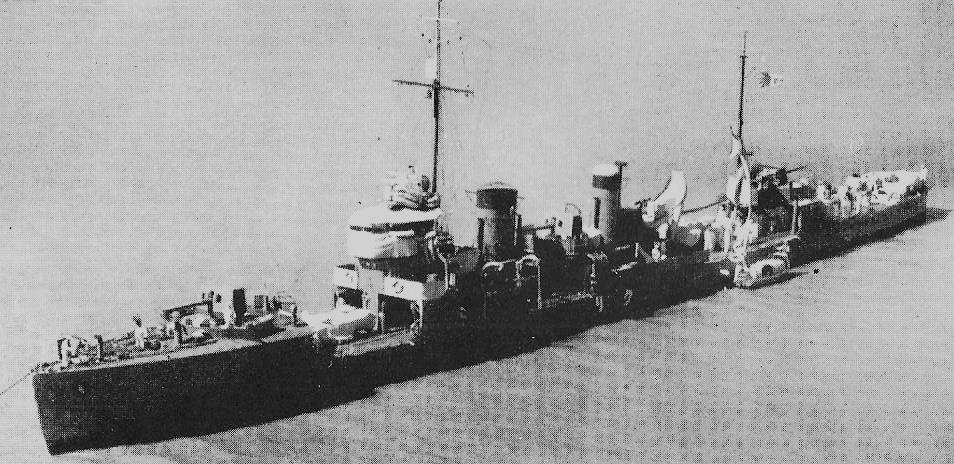
A MOMI-class destroyer is ordered from Kure Navy Yard.
24 January 1918:
The destroyer is tentatively named KURI.
5 December 1919:
Kure. Laid down.
15 March 1920:
LtCdr (later Captain) Harada Fumikazu (35) is appointed Chief Equipping Officer (CEO).
19 March 1920:
Launched.
30 April 1920:
Completed and registered in the Sasebo Naval District. Assigned to DesRon 26. LtCdr Harada is the Commanding Officer.
1 December 1920:
LtCdr (later Cdr) Negishi Seihachi (36) is appointed CO.
1 December 1921:
LtCdr (later Vice Admiral) Sakamoto Ikuta (36) is appointed CO.
1 December 1922:
LtCdr (later Captain) Kumazawa Masuzo (37) is appointed CO.
1 December 1924:
Lt (later Rear Admiral) Ozumi Tokusaburo (40)(former navigator of UMIKAZE) is appointed CO.
1 December 1925:
LtCdr (Captain, posthumously) Yasutomi Yoshisuke (38) is appointed CO.
1 December 1927:
LtCdr (Rear Admiral, posthumously) Izaki Shunji (42)(former CO of NARA) is appointed CO.
30 November 1929:
LtCdr (Rear Admiral, posthumously) Sakiyama Shakao (42)(former CO of ASHI) is appointed CO.
26 May 1930:
LtCdr (later Rear Admiral) Kojima Hitoshi (43)(former CO of NARA) is appointed CO.
1 December 1930:
LtCdr (later Cdr) Yoshida Yoshiyuki (46) is appointed CO.
1 December 1931:
LtCdr (later Captain) Fujita Shunzo (42) is appointed CO.
1 December 1932:
Lt (Vice Admiral, posthumously) Nakahara Giichiro (48)(former CO of MIKAZUKI) is appointed CO.
15 November 1933:
Assigned to the DesDiv 11, Third Fleet. Performs security missions along coastal China.
1 November 1934:
LtCdr (later Captain) Kokufuda Kiyoshi (49) is appointed CO.
31 October 1935:
LtCdr (later Captain) Shintani Kiichi (50)(former CO of KURETAKE) is appointed CO.
1 December 1936:
LtCdr Okawara Hajime (50) is appointed CO.
7 July 1937: The Marco Polo Bridge (The"First China Incident") Incident:
Hun River, Lukuokiao, China. Japanese troops fire blank cartridges during night maneuvers at the bridge. Chinese troops fire back, but cause no injuries. Later, the Japanese discover a soldier missing and demand entry to the Peking (Beijing) suburb of Wanping to look for him. The Chinese refuse, so the Japanese shell the city. An undeclared war on China begins.
12 November 1937:
Shanghai is captured.
1 December 1937:
LtCdr (later Cdr) Ogawa Tsunayoshi (50)(former CO of FUYO) is appointed CO.
13 June 1938 - The Battle of Wuhan:
Midway up the Yangtze River. KURI is in Rear Admiral (later Vice Admiral) Kondo Eijiro’s (36) 11th Sentai with destroyers TSUGA and HASU. The Japanese begin the Battle of Wuhan to annihilate the Chinese Army and force them to surrender. The Japanese make a naval landing at Anqing supported by 100 vessels, including more than 40 destroyers, mine sweepers, naval and river gunboats and blockade boats. The landing force totals about 12,000 men and 80 to 90 guns. The battle rages over four months and ends in a stalemate.
15 December 1938:
LtCdr (Captain, posthumously) Kohiga Masaru (53) is appointed CO.
1 March 1939:
Lt (Cdr, posthumously) Ota Takeshi (55) is appointed CO.
1 November 1939:
Lt (Captain, posthumously) Watanabe Katsuji (55) is appointed CO.
1 March 1940:
LtCdr Kanai Hiroshi (55) is appointed CO.
10 February 1941:
LtCdr (later Cdr) Terauchi Masamichi (55) is appointed CO.
November 1941:
KURI is in Vice Admiral (Fleet Admiral, posthumously) Koga Mineichi’s(34)(former CO of ISE) China Area Fleet in Vice Admiral Makita Kakusaburo's (38)(former CO of KIRISHIMA) Shanghai Area Base Force with HASU and TSUGA.
5 December 1941:
Departs Shanghai and arrives at Woosung.
7 December 1941:
Departs Woosung on patrol.
16 December 1941:
Arrives back at Shanghai.
17 December 1941:
Departs Shanghai on an escort mission.
18 December 1941:
At 1630 departs Woosung escorting a two part convoy consisting of SUWA, MANJU, TOTAI and SHINGO MARUs (first part) and departing almost three hours later, at 1920, HOKKO, ERIE and HOLLAND MARUs. The ships sail at 10 knots bound for Mako.
20 December 1941:
The escort mission ends and KURI undertakes patrols.
30 December 1941:
Arrives back at Shanghai.
31 December 1941:
Together with destroyer HASU meets up with liner NITTA MARU that has left Shanghai at 1100 and is en route to Wake Island. Escvorts the liner for an unknown duration.
1942:
KURI’s midships 4.7 mount is landed and replaced with two triple 25mm Type 96 AA mounts.
9 January 1942:
HASU meets up near Shanghai with convoy bound for Mako consusting of WAKATSU, SHINAI and THAMES MARUs.
12 January 1942:
Arrives back at Shanghai from patrol.
29 January 1942:
Departs Shanghai on patrol.
31 January 1942:
At 1000 near Tungting Tao meets up with convoy consisting of KINKASAN, YURI and NICHIRAN MARUs and escorts the ships south towards Takao. The ships sail at 9 knots.
6 February 1942:
Takes over from destroyer TSUGA and escorts KASAGISAN MARU and prize-ships HALLDOR (later HARUTA MARU) and ARGUS (later SHINNAN MARU) up the central China Coast.
8 February 1942:
KURI departs Woosung escorting a convoy consisting of SHINTEN, ISSHIN, KANKO and KEIKI MARUs bound for Moji. At an unknown point and date KURI is detached.
E 12 February 1942:
At 31-36N 123-00E meets up with convoy from Takao consisting of HOKURYU, FUKUSHU and TOTTORI MARUs.
13 February 1942:
The convoy arrives at Shanghai.
16 February 1942:
At 1100 arrives at Shanghai.
21 February 1942:
At 1300 departs Shanghai with destroyer HASU escorting No.1 Convoy consisting of HAWAII, MEIU, SHINGO, HAKUSAN (2197 gt) and MURORAN MARUs.
27 February 1942:
At 1030 arrives in Lingayen Gulf escorting the convoy.
Late February 1942:
Philippines. KURI assists with the escort of shipping in Philippine waters and joins the blockade of Manila and Corregidor.
2 March 1942:
At 2130, departs Olongapo.
4 March 1942:
At 0700, arrives at Puerto Galera, Mindoro, and departs there at 1700.
7 March 1942:
At 0830, arrives in Ilin Straits and begins patrolling there.
10 March 1942:
At 1200, arrives back at Olongapo.
13 March 1942:
At 1800, departs Olongapo.
18 March 1942:
At 0700, arrives at Puerto Galera and departs at 1630.
19 March 1942:
At 1930, arrives back at Puerto Galera.
23 March 1942:
At 2300, departs Puero Galera.
24 March 1942:
At 0900, arrives at Subic Bay.
31 March 1942:
At 0740, departs Subic Bay.
5 April 1942:
At 1430, arrives at Nasugbu Bay after patrolling mouth of Manila Bay area.
8 April 1942:
At 0600, departs Nasugbu Bay and resumes patrols in mouth of Manila Bay area.
11 May 1942:
Departs Manila area for east Pescadores.
15 May 1942:
At 1200 arrives back at Shanghai.
24 May 1942:
Departs Shanghai on patrol.
6 June 1942:
Arrives back at Shanghai and remains there for the rest of the month.
21 July 1942:
Departs Shanghai on patrol.
August 1942:
Escorts convoys between Shanghai and Mako, Pescadores.
15 September 1942:
Lt (Cdr, posthumously) Yonei Tsuneo (60) is appointed CO.
17 September 1942:
Arrives at Shanghai.
21 September 1942:
Departs Shanghai on patrol.
18 October 1942:
Breaks off patrol to undertake an escort mission.
20 October 1942:
The escort mission ends. Resumes patrolling.
22 October 1942:
Arrives Shanghai.
26 October 1942:
Departs Shanghai on patrol.
28 October 1942:
Escorts MYOHO MARU from off Wenchow.
10 November 1942:
NIKKI MARU departs Shanghai for Sasebo and is met and escorted part way by KURI.
11 November 1942:
NYK passenger liner KOBE MARU is sunk in collision with TENZAN MARU. KURI is despatched to rescue survivors.
15 November 1942:
Arrives at Shanghai.
17 November 1942:
Departs Shanghai on patrol.
20 November 1942:
Arrives at Shanghai.
25 November 1942:
Departs Shanghai on an escort mission.
27 November 1942:
Arrives at Mako.
28 November 1942:
Departs Mako on patrol.
1 December 1942:
At Shanghai.
21 December 1942: No. 6 Go Transportation Operation:
Convoy No. 35 assembles at Shanghai to transport the IJA’s 6th Infantry Division via Truk to Guadalcanal (after the decision is made to evacuate Guadalcanal, the convoy’s destination is changed to New Guinea).
The convoy consists of troop convoy Parts A, B and C. Part A consists of TEIYO, MYOHO MARUs and SHINSEI MARU No. 1; Part B consists of OIGAWA, KENKON, KYOKUSEI and PANAMA MARUs and Part C consists of MEIU, SOMEDOMO, SURABAYA and SHINAI MARUs. Second-class destroyer HASU departs Shanghai for New Guinea escorting Part A and KURI departs escorting Part B.
24 December 1942:
PArt B arrives at Mako and KURI is detached.
25 December 1942:
Part C departs Shanghai consisting of MEIU, SOMEDONO, SURABAYA and SHINAI MARUs escorted by second-class destroyer TSUGA. KURI departs Mako (perhaps with HASU) on patrol.
5 January 1943:
Parts A and B arrive at Mako, Pescadores. The old China Area Fleet second-class destroyers are detached and replaced by the Southwest Area Fleet’s destroyers HOKAZE and NAGATSUKI tasked to escort the convoy to 136 degrees E longitude. The escort is further augmented by destroyer SHIRAYUKI, subchasers CH-2 and CH-11 and auxiliary gunboat CHOAN MARU No. 2.
15 January 1943:
Arrives at Shanghai.
20 January 1943:
Departs Shanghai on patrol.
27 January 1943:
At 1630 departs Ssu Chiao Shan.
19 February 1943:
Arrives back at Shanghai.
24 February 1943:
Departs Shanghai on patrol.
22 March 1943:
Arrives at Shanghai.
25 March 1943:
While berthing at Kiangnan shipyard, Shanghai KURI collides with stern of repair ship HAYASE resulting in minor damage to both vessels. The next three days were spent repairing the damage.
31 March 1943:
At 1530 departs Woosung escorting a convoy consisting of TAIAN, JUNYO, KOKI, YUZAN, MIYAZAKI and RYOYO MARUs. The convoy saiils at 8 knots for Tomie and Ukujima, from where it disperses.
3 April 1943:
Arrives at Sasebo.
5 April 1943:
Departs Sasebo and off Tomie meets up with convoy No. 144 bound for Takao and consisting of TAMON, NIKKAKU, SHINSHU, SHOEI (2764 grt), WAZAN, SHOTO and ZUIYO MARUs escorted by Patrol Boat No.36 and convoy SA-1 consisting of MALAY, TOYOURA, CHINZEI, TOTAI, HAKOZAKI, KENAN and NICHIMAN MARUs.
E 6 April 1943:
Off Hi Niao Shan No. 144 convoy separates.
7 April 1943:
At 1300 arrives at Shanghai with SA-1 convoy.
9 April 1943:
Departs Shanghai on patrol.
20 April 1943:
Arrives at Shanghai.
24 April 1943:
Departs Shanghai.
26 April 1943:
At 0600 departs Woosung escorting No. 10 Go Army convoy consisting of RYOYO and KOZAN MARUs. The ships sail at 11 knots.
28 April 1943:
Arrives off Takao. KURI detaches off Wenchow before arrival. Destroyer TSUGA then takes over.
29 April 1943:
Ceases escort missions and undertakes patrols.
4 May 1943:
Arrives at Shanghai.
5 May 1943:
Departs Shanghai on patrol.
19 May 1943:
Arrives at Shanghai.
24 May 1943:
Departs Shanghai on patrol.
29 May 1943:
At 31-20N 122-39E convoy SA-25 consisting of TAKAMISAN, HAKOZAKI, TAMAHIME, WAZAN (ex British VITORLOCK), MALAY, MUNAKATA MARUs and TAMON MARU No. 8 escorted by submarine chaser KAII is attacked by USS SAURY and TAKAMISAN MARU is torpedoed and sunk. KAII rescues survivors. KURI joins the hunt for the enemy submarine with KAII.
30 May 1943:
At 1400 the hunt for USS SAURY ends.
5 June 1943:
Arrives at Shanghai.
9 June 1943:
Departs Shanghai escorting a convoy consisting of GYOTEN, TAKAOKA, KANSEI, ROZAN (ex British ANALOCK), TOZAN (ex Brirish SOOCHOW), YAMAYURI and ROKKO MARUs.
13 June 1943:
At 1000 due to arrive at Mako escorting the convoy.
14 June 1943:
Departs Mako on patrol.
22 June 1943:
Arrives at Shanghai.
23 June 1943:
At 1600 departs Shanghai escorting convoy Ta-302 consisting of BISAN (ex British MING SANG) and CHEFOO MARUs bound for Mako.
24 June 1943:
KURI runs aground off Nanchishan Is after colliding with CHEFOO MARU, which strikes the ship on the port side.
25 June 1943:
Auxiliary gunboat SHINKO MARU No. 1 GO arrives and tows the destroyer from Tachow Islands at 0430 to Chikou Sea (near Yuet Ching Bay) at 1600. Destroyer HASU is despatched from Shanghai to assist.
28 June 1943:
Salvage Tug KASASHIMA arrives and the tow of KURI is handed over by auxiliary gunboat SHINKO MARU No. 1 GO to the salvage tug, which tows the destroyer to Shihpu, arriving later that day.
29 June 1943:
Arrives at Konan (Kiangnan) for repair. Spends the entire months of July and August under repair.
13 September 1943:
Departs Shanghai on an anti submarine sweep.
14 September 1943:
Arrives at Woosung.
19 September 1943:
Departs Woosung escorting convoy TA-803 consisting of three unidentified merchant ships.
20 September 1943:
Auxiliary gunboat SHINKO MARU No. 1 GO joins the convoy as an additional escort.
21 September 1943:
SHINKO MARU No. 1 is detached. At about 1700, arrives at Mako still escorting convoy TA-803.
24 September 1943:
Departs Mako escorting a convoy, probably No. 206 consisting of tanker SEINAN MARU, cargo ship HIDA MARU and nine unidentified merchant ships also escorted by destroyer SHIOKAZE.
26 September 1943:
Detaches from the convoy and begins patrolling, with auxiliary gunboat pennant no. 141 and possibly with TSUGA.
29 September 1943:
Arrives at Shanghai.
4 October 1943:
Departs Shanghai on patrol.
17 October 1943:
Begins a convoy escort mission.
29 October 1943:
Ceases escort mission and resumes patrolling.
30 October 1943:
Together with auxiliary gunboat HOKOKU MARU despatched to scene of sinking of short sea passenger ship SHANGHAI MARU that has been sunk in collision with SAKITO MARU. At 1200 arrives at Kuangchang.
4 November 1943:
Departs Shanghai on patrol.
9 November 1943:
Arrives at Shanghai.
12 November 1943:
Departs Shanghai on patrol.
4 December 1943:
Arrives at Mako escorting a convoy (possibly TA-904).
6 December 1943:
Departs Mako on patrol.
7 December 1943:
Begins escorting convoy TA-603 with auxiliary gunboat HOKOKU MARUs consisting of CHEFOO, YULIN and SAINAN MARUs. At 0800 Naval tug KASASHIMA joins convoy from Chiu Shan Liehtao. HOKOKU MARU apparently detaches later that day at Nan Jiu Shan.
8 December 1943:
At 0715 the convoy arrives at Fuyan Tao. Convoy escort by KASASHIMA ceases.
10 December 1943:
At 1600 due to arrive at Mako.
14 December 1943:
Departs Mako on patrol.
18 December 1943:
Arrives at Shanghai.
24 December 1943:
Departs Shanghai on patrol.
26 December 1943:
Ceases patrolling and begins escorting convoy TA-602 from Woosung consisting of SETSUZAN (ex Norwegian HELIOS) and SHOZAN (ex British CHEKIANG) MARUs. The convoy sails at 9 knots via Fuyan Tao. At 1900 the convoy is met near Taichow Liehtao by Naval tug KASASHIMA that joins escort.
27 December 1943:
At 1210 KASASHIMA arrives at Tinghai.
29 December 1943:
Arrives at Mako.
2 January 1944:
Departs Mako and later that day arrives at Takao.
3 January 1944:
Departs Takao on patrol.
6 January 1944:
Meets up with and begins escorting a convoy (possibly NICHIREI MARU convoy).
7 January 1944:
Arrives at Kirun.
11 January 1944:
Departs Kirun on patrol.
15 January 1944:
At 1930, departs Naha for Takao with kaibokan KARUKAYA and minesweeper W-27 escorting convoy No. 127 consisting of NIKKI, HOKOKU, KINREI, ROKKO and IKUTAGAWA MARUs.
18 January 1944:
At 1455, arrives at Takao.
19 January 1944:
Arrives at Mako.
24 January 1944:
Departs Mako on patrol.
12 February 1944:
Ceases patrolling and begins escorting a convoy.
15 February 1944:
Arrives at Mako.
20 February 1944:
Departs Mako on an escort mission.
22 February 1944:
At 0300, departs Takao with patrol PB-38 escorting convoy TAMO-12 consisting of HAKOZAKI, FUSO, KUROGANE, YOZAN, SEATTLE, CLYDE, CHINZEI, SHINYO, MISAKI, SHINKOKU (cargo), KAIKO, TSUKUBA, SAINEI, SHONAN and YAMAHAGI MARUs. [1]
23 February 1944:
KAMO MARU and an unidentified ship joins from Keelung and KAIKO MARU and six other unidentified ships split away from the convoy and depart escorted by KURI.
25 February 1944:
Arrives at Shanghai.
26 February 1944:
Departs Shanghai escorting the old cruiser IZUMO.
28 February 1944:
Arrives at Sasebo.
1 March 1944:
Reserve Lt Takane Kineji (later Rear Admiral, JMSDF) assumes command.
6 March 1944:
Departs Sasebo.
9 March 1944:
Arrives at Shanghai.
11 March 1944:
Departs Shanghai escorting a convoy.
18 March 1944:
Arrives at Takao.
22 March 1944:
Departs Takao escorting a convoy (possibly TAMO-12).
25 March 1944:
Arrives at Shanghai.
1 April 1944:
Patrolling China sea area.
2 April 1944:
Ceases patrolling and begins escorting a convoy.
5 April 1944:
Arrives at Takao.
7 April 1944:
Departs Takao escorting a convoy (possibly Rin Toku).
8 April 1944:
Arrives at Kirun.
10 April 1944:
Departs Kirun on patrol.
11 April 1944:
Arrives at Shanghai.
17 April 1944:
Departs Shanghai on an anti submarine sweep.
19 April 1944:
The sweep concludes and KURI begins patrolling.
20 April 1944:
Arrives at Shanghai.
21 April 1944:
Departs Tungchiaoshan (near Shanghai ) in the "Take" convoy carrying troops of the IJA's 32nd and 35th divisions from China to New Guinea via Manila. The convoy consists of KAZUURA, MITSUKI, BRAZIL, AMATSUSAN (TENSHINZAN), TAJIMA, ADEN, YOZAN, MANSHU, FUKUYO, KANAN, TEIKAI (ex-GERMAN FULDA), and TEIKA (ex-Vichy French CAP VARELLA) MARUs, YOSHIDA MARU No. 1, UNKAI MARU No. 12 and two unidentified ships escorted by destroyers ASAKAZE, SHIRATSUYU and FUJINAMI, kaibokan KURAHASHI, CD-20 and CD-22, minelayer SHIRATAKA (F), minesweeper W-22, subchasers CH-37, CH-38, gunboats UJI, ATAKA and auxiliary minesweeper TAMA MARU No. 7.
E 25 April 1944:
Arrives at Takao.
26 April 1944:
Departs Takao.
26 April 1944:
At about 0600, LtCdr (later Rear Admiral-Ret) Thomas M. Dykers' (USNA ’27) USS JACK (SS-259) makes a radar-assisted surface attack on the convoy. Dykers torpedoes and sinks YOSHIDA MARU No. 1 . She breaks in two and sinks quickly at at 18-06N, 119-40E taking down 61 crewmen, two passengers and 2586 of 3400 soldiers of the IJA's 210th Infantry Regiment including its commander.
28 April 1944:
Arrives at Manila and is detached from the Take convoy. KURI, KURAHASHI and CD-20 depart Manila, the latter two to join the escort of convoy HI-59 then in the South China Sea.
4 May 1944:
KURI departs Manila with kaibokan KURAHASHI, CD-20, minesweeper W-17 and auxiliary subchaser TAKUNAN MARU No. 3 escorting convoy MATA-19 consisting of TETSUYO MARU and eight unidentified merchant ships.
9 May 1944:
Arrives at Takao.
11 May 1944:
Departs Takao escorting convoy TAMO-19 consisting of eight unidentified merchant ships escorted minesweeper W-17 and auxiliary subchaser TAKUNAN MARU No. 3.
15 May 1944:
KURI is detached and arrives at Shanghai.
20 May 1944:
TAMO-19 arrives at Moji.
14 June 1944:
Departs Shanghai on weapons testing exercises.
17 June 1944:
Begins patrollings.
21 June 1944:
Arrives back at Shanghai.
24 June 1944:
Departs Shanghai escorting convoy TA-406 to Takao via Hong Kong (convoy No.91 from Hong Kong to Takao) with torpedo boat HATSUKARI escorting convoy No. 91 consisting of GYOYU, GYOUN and NITTO MARUs and KYODO MARU No. 28. All are carrying troops of the IJA's 22nd Division bound for Saigon, Indochina. NITTO MARU is carrying elements of the 86th Infantry Regiment and the 1st Platoon, 1st Company of the 22nd Transport Regiment. KYODO MARU No. 28 is carrying the main force of the 86th Infantry Regiment of the 22nd Division.
30 June 1944:
Arrives at Takao.
1 July 1944:
At 1127 departs Takao.
3 July 1944:
SE of Hong Kong. About midnight, LtCdr (later Captain) Slade D. Cutter's (USNA ’35) USS SEAHORSE (SS-304) attacks the convoy at 20-18N, 115-02E. Cutter torpedoes and sinks GYOYU (ex-British JOAN MOLLER) (one crewman KIA) and NITTO (541 men and seven crewmen KIA.) MARUs.
4 July 1944:
SE of Hong Kong. USS SEAHORSE attacks the convoy again. Cutter torpedoes and sinks KYODO MARU No. 28 at 20-20N, 114-54E. The escorts drop five depth charges, but USS SEAHORSE evades and escapes.
5 July 1944:
At 1540 arrives at Kowloon, Hong Kong.
9 July 1944:
At 2300 departs Hong Kong presumably escorting a convoy.
11 July 1944:
At 2142 arrives at Takao.
17 July 1944:
At 0950 departs Takao.
18 July 1944:
At 0718 arrives at Hong Kong.
19 July 1944:
At 1052 departs Hong Kong.
20 July 1944:
At 0920 arrives at Takao.
23 July 1944:
At 1150 departs Takao.
24 July 1944:
At 0942 arrives at Hong Kong.
25 July 1944:
At 1655 departs Hong Kong.
26 July 1944:
At 2330 arrives at Takao.
28 July 1944:
At 0900 departs Takao escorting convoy No. 92 consisting of TOSAN (ex British SOOCHOW), BOKO (ex British SAGRES), BISAN (ex British MING SANG) and SAINAN MARUs also escorted by torpedo boat HATSUKARI.
30 July 1944:
At 0705 arrives at Hong Kong.
Mid-late August 1944:
Enters drydock at Mako.
10 September 1944:
At 0928 departs Mako and at 1455 arrives at Takao.
15 September 1944:
At 0933 departs Takao escorting convoy HO-504 consisting of four unidentified merchant ships.
17 September 1944:
At 0129 in 21.55N 116.30E the convoy is attacked by a B-24 but suffers no damage. At 1728 arrives at Hong Kong.
23 September 1944:
At 0248 departs Hong Kong escorting Rinji convoy consisting of JOSHU GO and Army ship HAKKO MARU.
25 September 1944:
At 1256 arrives at Mako.
3 October 1944:
Departs Mako and arrives late that day at Takao.
5 October 1944:
Departs Takao and later that day arrives at Mako.
7 October 1944:
Departs Mako probably escorting a small convoy or a single ship.
8 October 1944:
Late in the day arrives at Hong Kong.
21 October 1944:
At 1850 KURI departs Hong Kong with HASU and auxiliary subchasers CHa-176, CHa-177 escorting convoy HOTA-01 consisting of HOKUSEN, HOKUYU, SHONAN, SHOEI (2764gt), MIYAJIMA, ASOKAWA, KONEI and HISHIGATA MARUs. HASU is probably detached later this day.
25 October 1944:
While attacking a convoy, Cdr (later Rear Admiral-Ret/MOH) Richard H. O’Kane’s (USNA ’34) USS TANG (SS-306) is sunk in shallow water by a circular run of his last Mark-18 torpedo. O'Kane and eight crewmen are captured and made POWS. Later, they are transported to Formosa and then to Japan. After USS TANG's sinking, secret Secretariat Order No. 021619 is issued to execute an expedition consisting of KURI and salvage ships KASUGA and NABURI MARUs to find and explore USS TANG. Later that day at 1305 KURI and HOTA-01 arrive at Takao. [2]
26 October 1944:
Departs Takao.
30 October 1944:
Arrives at Takao.
4 November 1944:
At 1802 departs Takao with torpedo boat HATSUKARI escorting convoy HO-402 consisting of YOKAI and DAIKYU MARUs.
6 November 1944:
At 1521 arrives at Tsin Shui Wan (Repulse Bay), Hong Kong.
7 November 1944:
At 1250 KURI and HATSUKARI depart Tsin Shui Wan and at 1541, arrive at Hong Kong.
13 November 1944:
At 1900 KURI departs Hong Kong.
14 November 1944:
At 1905 arrives at Amoy.
15 November 1944:
At 1140 departs Amoy. Later that day KURI locates USS TANG’s wreck at 25-02-06N, 119-15E near Mao Yu Rock.
22 November 1944:
At 0353 KURI departs area and arrives at Takao at 1440.
24 November 1944:
At 1002 departs Takao and at 1854 arrives back in Mao Yu Rock area.
28 November 1944:
Divers examine the outside of the wreck, but do not enter it. Bad weather and American aircraft activity force the operation to be called off. USS TANG's bow is marked with a buoy.
30 November 1944:
KURI arrives back at Takao.
2 December 1944:
At 0825 departs Takao to meet up with convoy HO-03 consisting of CHEFOO, YULIN and HOKOKU MARUs that had previously departed Ssu Chiao Shan.
3 December 1944:
At 1040 off Fuyan Tao KURI meets up with convoy.
4 December 1944:
At 1434 arrives at Hong Kong.
9 December 1944:
At 0743 departs Hong Kong escorting convoy TA-902 consisting of HOKUYU and OKINOYAMA MARUs.
11 December 1944:
At 1617 arrives at Amoy.
12 December 1944:
At 0745 departs Amoy.
22 December 1944:
At 1506 arrives at Kirun.
24 December 1944:
At 0650 departs Kirun.
26 December 1944:
At 2110 arrives at Hong Kong.
29 December 1944:
At 1745 departs Hong Kong escorting TA-901 consisting only of FUKEI MARU bound for Kirun via Amoy.
23 March 1945:
Mouth of the Yangtze River. KURI is damaged by mine.
April 1945:
Undergoes repairs, probably at Shanghai.
19 April 1945:
At 0710 departs Seito with kaibokan OKI, gunboat OKITSU, auxiliary submarine chasers CHa-220 and CHa-240 and submarine chaser CH-21 escorting MO-705 convoy Part 1 consisting of YAMAZONO, AWA, TOYOKAWA, SHINYO and KEIZO (KEIJO?) MARUs. Meets up with minesweeper W-20 on or soon after departure.
20 April 1945:
At 1330 the convoy arrives at Daito Wan and departs at 1500.
21 April 1945:
At 1155 CH-21 and W-20 are detached.
24 April 1945:
At 0600 TOYOKAWA MARU is detached direct for Chinkai.
25 April 1945:
At 1016 arrives at Hikin Do. The convoy departs at 2330 with submarine chaser CH-21 now as additional escort.
27 April 1945:
At 1440 the convoy arrives at Chinkai.
11 June 1945:
On that day, FRUMEL decrypts the following message from Shanghai Base Force: "Convoy of 6 ships escorted by KURI and HABUSHI, which was due to leave on 10th, remained in port because of desertion of Chinese members of the crews. Some will be able to leave on 13th."
25 June 1945:
Arrives at Tsingtao (now Qingdao), China.
15 August 1945:
Tsingtao. KURI is intact. Lt Takane notifies his crew of the end of hostilities.
16 September 1945:
Tsingtao. KURI is surrendered.
8 October 1945:
Off Pusan, South Korea. KURI is conducting minesweeping duties when she hits a mine and sinks.
25 October 1945:
Removed from the Navy List.
Author's Notes:
[1] After almost three years at war, and the debacle of the Mark-14 torpedo, BuOrd and its contractors were still sending defective
and inadequately tested torpedoes to the fleet, in this case, the Mark-18.
Special thanks go to Hans Mcilveen of the Netherlands for info on FRUMEL intercepts. Thanks go to Gilbert Casse of France and also to the late John Whitman and Fontessa-san of Japan for info about 1937 troop movement.
-Bob Hackett, Sander Kingsepp and Peter Cundall
Back
to the Second Class Destroyers Page