SENSUIKAN!
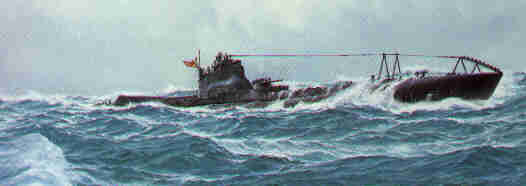
IJN Submarine I-52: Tabular Record of Movement
© 2001-2014 Bob Hackett & Sander Kingsepp
Revision 4
18 March 1942:
Laid down at Kure Navy Yard as Submarine No. 625.
20 August 1942:
Renumbered I-52 and provisionally attached to Kure Naval District..
10 November 1942:
Launched..
5 October 1943:
LtCdr Teramoto Iwao (59)(current CO of I-156) is appointed Chief Equipping Officer.
15 November 1943:
Cdr Uno Kaneo (53)( former CO of I-175) is appointed Chief Equipping Officer.
28 December 1943:
I-52 is completed, registered in the IJN and attached to Kure Naval District. Assigned to SubRon 11, Sixth Fleet. Cdr Uno is the CO.
6 January 1944:
Refuels at the 3rd Fuel Depot in Tokuyama.
24 January 1944:
The C-in-C, Combined Fleet, Admiral Koga Mineichi issues Special Naval Order (Taikai-rei) No. 322, announcing that I-52 will depart the Inland Sea for Europe in early March. .
February 1944:
The aft deck gun is replaced by two 25-mm twin AA guns. A Type 22 air-search radar is installed just forward of the conning tower. [2]
10 March 1944:
I-52 is reassigned to SubRon 8, Sixth Fleet, at Penang, Malaya. At 0850 she departs Kure via Sasebo for Singapore on a "Yanagi" mission. [3]
Prior to the departure I-52 embarks 2 tons of gold in 146 bars, packed in 49 metal boxes, delivered from the Osaka branch of the Bank of Japan. The gold is to be used as a payment for the drawings and samples of advanced German weaponry I-52 also carries.
Among her 14 passengers are engineers and technicians from Nihon Kogaku K.K. who are to study German AA gun sights and from the Mitsubishi Electric and the Mitsubishi Instrument Company, who are to study German HA directors. Another engineer aboard is to study Daimler Benz's techniques for building engines for torpedo boats.
21 March 1944:
Arrives at Singapore, where she is dry-docked for the the installation of additional cargo. She embarks strategic metals including 120 tons of tin in ingots, 102 tons of tungsten, 54 tons of raw rubber (caoutchouc) in bales, 9.8 tons of molybdenum, 11 tons of tungsten, 3.3 tons of quinine, 2.88 tons of opium, and 58 kg of caffeine.
23 April 1944:
1-52 sorties from Singapore via the Sunda Strait for the Indian Ocean to attempt a passage around Cape Horn, Africa, enroute to the German U-boat base at Lorient, France. I-52, originally code-named "Momi"/"Tanne" ("Fir") and redesignated as "Ginmatsu"/"Föhre" on 23 June, is the fifth IJN submarine to attempt such a passage to France.Cdr Uno travels submerged during the day and surfaces at night to charge I-52's batteries.
15 May 1944:
After passing the Cape of Good Hope and entering the Atlantic, Cdr Uno sends his first message to the Germans.
22 May 1944:
Kapitänleutnant Kurt Lange's submarine U-530 departs Lorient to operate off Trinidad, West Indies. She is scheduled to rendezvous with I-52 in the area W of the Cape Verde Islands for the transfer of 3 German sailors..
2 June 1944:
The six-strong Task Group 22.2, led by Capt. Aurelius B. Vosseler's escort carrier USS BOGUE (CVE-9), departs Casablanca. .
4 June 1944:
I-52 crosses the equator. .
6 June 1944:
Berlin. Rear Admiral Kojima Hideo (former CO of KASHII), the Naval Attache, signals Tokyo and I-52.
He indicates that the Allies have landed at Normandy. Kojima notes that arrival at Lorient will be dangerous and, depending on the situation, I-52 may have to proceed to Norway. He further instructs the Captain of the Momi to rendezvous on 22 June with a U-boat at 2115 (GMT) at 15N, 40W.
Kojima indicates that on 6 June I-52's position is approximately 35N, 23W. The radio transmission is intercepted, decoded and passed by special- intelligence "Ultra" signals to an American ASW group operating near the Azores.
9 June 1944:
U-530 is advised that the rendezvous with I-52 would take place after sundown on the 22 June. .
12 June 1944:
On that day, FRUMEL provides the following information based on a Japanese Embassy message transmitted on 9 June:.
"MOMI (a Japanese blockade-running submarine) has been informed that, consequent upon Allied landings in France, her destination may be changed from Lorient to Norway. She is to be in position 15N 40W at 2115 GMT on 22nd June to rendezvous with a German U-boat. If rendezvous is not affected, she is to return to that position at the same time until 25th when a signal is to be made if still unsuccessful. After rendezvousing, she is to proceed along the meridian of 40W as far as 38N, then proceed to 43N 30W, and then close the Spanish coast as directed by the Germans."
15 June 1944:
TG 22.2 is redirected to the area 15N, 40W and instructed to intercept and destroy both enemy submarines scheduled to rendezvous in that area on the 22nd. .
16 June 1944:
Off Western Africa. I-52 sends a coded transmission that her position is 10N, 31W and she is making 11 knots.
20 June 1944:
The Japanese Embassy in Berlin transmits a warning to the Naval Affairs Bureau of the Navy Ministry in Tokyo, informing about the Allied advance in northern France and the appearance of an aircraft carrier in vicinity of 15N, 30W, probably related to the loss of two German U-boats in that area. .
22 June 1944:
850 miles W of the Cape Verde Islands. At 2115, I-52 makes a rendezvous with Kapitanleutnant Kurt Lange's U-530 that departed Lorient on 22 May 1944 for Trinidad, West Indies.
I-52 takes Leutnant Schafer aboard to help navigate the end-leg of the journey. I-52 also takes aboard two radio operators, Petty Officers Schulze and Behrendt and a Naxos FuMB 7 radar detector. The Naxos is to be installed and operational by the time I-52 reaches European waters. The exchange goes well except the radar detector falls into the sea, but a Japanese seaman jumps in and retrieves it.
U-530 is detached and heads for Trinidad.
23 June 1944:
870 miles W of the Cape Verde Islands (approximately 15N, 40W). Around 2115 (GMT), I-52 makes a rendezvous with Kapitänleutnant Lange's U-530.
I-52 embarks a German officer, two radio operators, a current German naval code and a FuMB 7 "Naxos" radar detector. KpLt. (Cdr) Alfred Schäfer acts as the liaison officer for the trio to Lorient, while the two radio operators (OFkMt. Kurt Schultze and Rolf Behrendt) are in charge of the radar detector and communications with the Kriegsmarine. .
The exchange goes well except the radar detector falls into the sea, but a Japanese seaman jumps in and retrieves it..
U-530 is detached and heads for Trinidad while I-52 heads towards Lorient, running on the surface. [4] .
At 2339 (ship time), a Grumman TBF-1C "Avenger" torpedo bomber of VC-69 from USS BOGUE, piloted by LtCdr Jesse D. Taylor, picks up I-52 on radar in 15-16N, 39-55W. Taylor drops flares that illuminate the huge 2,564-ton submarine, making about 15 knots. He drops two 354-lb Mark 54 depth bombs, but I-52, already diving, successfully evades the first attack. .
Taylor and his crew lay sonobuoys over a square mile of sea and track the submarine. Within minutes, the "Avenger"'s crew can hear clearly I-52's propellers in their headsets. Taylor maneuvers into position and drops a new top-secret Mark 24 "Fido" acoustic homing torpedo. At 2350, after a long wait, Taylor's crew hears a loud explosion.
24 June 1944:
At 0054 another "Avenger", piloted by Lt. William D. Gordon, arrives and drops more sonobuoys. They pick up the sounds of the damaged submarine's propellers. At 0154 Gordon drops another "Fido" that finds the submarine. Gordon and his crew hear the submarine breaking up underwater at 0213. .
I-52 sinks with all 95 crewmen, 14 passengers and the three German sailors near 15-16N, 39-55W. [5].
In the morning ,USS JANSSEN (DE-396) and HAVERFIELD (DE-393), both destroyer escorts in BOGUE's hunter-killer group, find a large oil slick at the site of the sinking. A boat from JANSSEN salvages over a ton of raw rubber bales, a rubber sandal, a piece of Philippine mahogany, a black silk fishing line and other debris floating on the surface. A large number of sharks are also observed in the area.
30 July 1944:
A garbled QWF signal is received by a German radio station near Lorient, indicating that I-52 is 36 hours from port. Two identical signals are received on the following day.
1 August 1944:
Lorient. By 0430 three German M-class minesweepers and a T-class torpedo boat arrive at Point Leben and stand by, waiting to escort I-52. She never makes contact. .
At dockside, 35-40 tons of secret documents and a strategic cargo await loading for I-52's return trip to Japan: T-5 acoustic torpedoes, a Jumo 213-A motor used on the long-nosed FW-190D, radars, vacuum tubes, ball bearings, bombsights, chemicals, alloy steel, optical glass and 1,000-lbs of uranium oxide. [6]
8 August 1944:
Berlin. Rear Admiral Kojima radios in the blind to I-52 that since the Allied landings at Normandy in June, arrival at Lorient is too dangerous and directs I-52 to proceed to Norway .
30 August 1944:
The Kriegsmarine officially declares I-52 as presumed sunk in the Bay of Biscay as of 25 Jul 1944 with her crew of 95 and 14 passengers. After the failure of I-52's mission, the Imperial Japanese Navy no longer tries to send its submarines to Europe.
10 December 1944:
Removed from the Navy List.
3 May 1995:
1,200 miles W of the Cape Verde islands. A team of Americans led by Mr. Paul Tidwell charter Russian research vessel AKADEMIK MSTISLAV KELDYSH and using a MAK-1M side-scan sonar find the wreck of I-52 virtually intact at a depth of 17,000 feet. [4]
Authors' Notes:
[1] Several sources suggest that I-52 was completed on 18 December 1943 but this is not confirmed by wartime records, including the IJN personnel transfer and promotion records. .
[2] No wartime photos of I-52 have survived. The famous picture, appearing in several publications and purportedly showing I-52, actually depicts a totally different Kaidai-class submarine, completed in 1925 as I-52 and renumbered I-152 in May 1942. .
[3] When Japan enters the war, the Axis Tripartite agreement is amended to provide for an exchange of strategic materials and manufactured goods between Europe and the Far East. Cargo ships make the initial "Yanagi" exchanges, but when that is no longer possible submarines are used..
[4] Several sources incorrectly state that I-52 was refueled by U-530 during the same rendezvous. .
[5] Meridian Sciences locates I-52's wreck and determines that the U. S. Navy's sinking coordinates are inaccurate "by tens of miles"..
A recent theory suggests that Lt. Gordon's "Avenger" might have unsuccessfully attacked the departing U-530, still followed by the sonobuoys by sound of her screws.
Special thanks go to Hans Mcilveen of the Netherlands for info on FRUMEL intercepts.
-Bob Hackett and Sander Kingsepp
Back to Submarine Page

