SENSUIKAN!
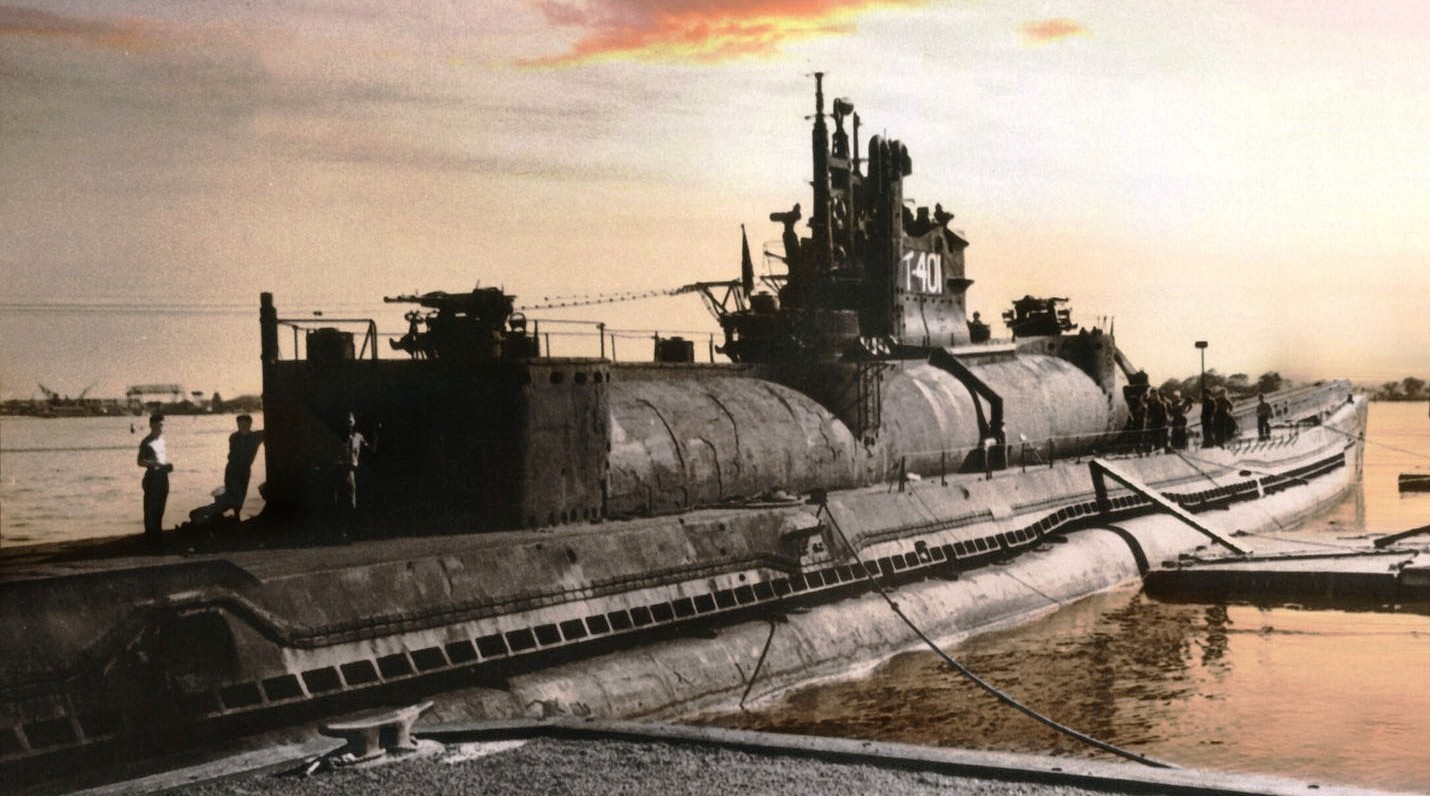 (I-401)
IJN Submarine I-401:
Tabular Record of
Movement
© 2001-2011 Bob Hackett & Sander Kingsepp
Revision 7
26 April 1943:
Sasebo Navy Yard. The Sen-Toku class I-401 is laid down one of the largest submarines in the world. The Sen-Toku class will carry three two-seat Aichi M6A1 "Seiran" (Mountain Haze) float torpedo-bombers capable of carrying either 1,764 lbs. of bombs or a 45 cm. (17.7-inch) torpedo 654 miles.[1][2]
During her construction it is planned to use the Sen-Toku to launch a surprise air strike against the Panama Canal. The plan calls for ten Seiran to strike the Gatun Locks from the east with six torpedoes and four bombs. Destroying these locks would empty Gatun Lake and block the passage of shipping for months.
11 March 1944:
Launched.
11 December 1944:
LtCdr (later Rear Admiral, JMSDF) Nambu Nobukiyo (former CO of I-174) is posted as Chied Equipping Officer (CEO).
15 December 1944:
The 631st Kokutai is organized for the purpose of attacking the Panama Canal. Only two M6A1 Seiran
are available for the air unit.
8 January 1945:
I-401 is completed and registered in the Kure Naval District. I-401 is assigned to Vice Admiral Miwa Shigeoshi's (former CO of CL KINU) Sixth Fleet as flagship of Captain Ariizumi Tatsunosuke's (former CO of I-8) SubDiv 1 with I-13, I-14 and I-400. LtCdr (later Rear Admiral, JMSDF) Nambu is the Commanding Officer (CO).
Western Inland Sea. I-401 departs Sasebo for workup and battle training in SubRon 11 with I-400 and I-13.
9/10 March 1945: The First Fire Bombing of Tokyo:
B-29s of MajGen (later Gen/CSAF) Curtis E. LeMay's Twentieth Air Force's XXI Bomber Command take off from Guam, Tinian and Saipan. 280 B-29's bomb Tokyo by radar at night. Dropping 1,900-tons of incendiaries from altitutes of 4,500 to 9,000 feet, they burn out about one-fourth of the city. At least 83,000 people die in the raid, the highest death toll of any day in the war, including deaths caused by the atomic bombs.
March - April 1945:
In retaliation for the fire bombing of Tokyo, the Imperial Naval General Staff considers a proposal from the Sixth Fleet to use the I-400's to bomb San Francisco. The proposal is opposed by Vice Admiral Ozawa Jisaburo (former CO of HARUNA), Vice Chief, NGS.
19 March 1945:
Vice Admiral (later Admiral) Marc A. Mitscher's Task Force 58 carriers USS ESSEX (CV-9), INTREPID (CV-11), HORNET (CV-12), WASP (CV-18), HANCOCK (CV-19), BENNINGTON (CV-20) and BELLEAU WOOD (CVL-24) make the first carrier attack on the Kure Naval Arsenal. More than 240 aircraft (SB2C "Helldivers", F4U "Corsairs" and F6F "Hellcats") attack the battleships HYUGA, ISE, YAMATO, HARUNA, carriers AMAGI, KATSURAGI, RYUHO, KAIYO and other ships. I-13 crash-dives and escapes damage.
The I-400, in drydock, and I-401 are strafed but not damaged.
1 April 1945:
Vice Admiral (later Admiral) Raymond A. Spruance's Fifth Fleet, including more than 40 aircraft carriers, 18 battleships, 200 destroyers and over 1,000 support ships surround Okinawa. LtGen Simon B. Buckner Jr's Tenth Army (7th, 77th, 96th Infantry, 1st, 6th Marine divisions) makes amphibious landings and begins the campaign to take the island from LtGen Ushijima Mitsuro's 32nd Army.
11 April 1945:
I-401 departs Kure with ComSubDiv 1 aboard for Dairen, Manchuria to obtain fuel. I-401 runs aground just after departure from the harbor, but later breaks free.
12 April 1945:
Iyo Nada, 750 meters from the Himejima lighthouse, bearing 037. Early in the morning, I-401's stern grazes a mine laid by a Boeing B-29. Some instruments and aft ballast tank valves are damaged. I-401 is forced to return to Kure for repairs. I-400 completes the tanker mission and returns with 1,700-tons of fuel oil.
May 1945:
I-401 undergoes repairs. A "snorkel" breathing tube is installed to allow operation of the diesel engines while submerged.
1 June 1945:
All four of SubDiv 1's boats are fueled and equipped with snorkels.
Departs Kure through the heavily mined Shimonoseki and Tsushima Straits in the Sea of Japan and heads N for Nanao Bay on the west coast of Honshu near Takaoka.
4 June 1945:
Arrives at Nanao Bay for battle training. Six Seiran of the 631st NAG follow from Kure via Fukuyama.
6 June 1945:
Night flight training begins. A team of four trained men can prepare a floatplane for launch in seven minutes. All three Seiran carried aboard each submarine can be assembled, fueled, armed and catapulted in 45 minutes.
SubDiv 1's training is hampered by mines, American submarines and shortages of aviation gasoline, material and aircraft, but they manage to launch a number of simulated air strikes.
12 June 1945:
Before SubDiv 1 can depart, the Imperial High Command decides to attack the American naval anchorage at Ulithi Atoll because of the imminent fall of Okinawa and the carrier raids on Japan. The Panama Canal operation is formally discarded despite protests by Captain Ariizumi.
13 June 1945:
An M6A1 Seiran, being ferried from the Aichi factory to Nanao Bay crashes destroying the aircraft and killing its two crewmen.
19 June 1945:
Last day of flight training. All Seiran take off from the water, but one aircraft fails to return. Later, the bodies of its two crewmen are wash ashore at Sadoga Island.
21 June 1945:
Eighty-two days after the initial landings, Okinawa is declared secure.
25 June 1945: Operation "Arashi" (Mountain Storm): The Seiran Bombing Attack on Ulithi:
At 1325, Vice Admiral Ozawa, now CINC, Combined Fleet, issues Battle Order No. 95 that details the impending operation. The bombing attack is designated as Operation Arashi.
The "Hikari" (Shining Light) part of Operation Arashi calls for I-13 and I-14 to proceed to Truk in late July and deliver their Nakajima C6N1 Saiun ("Myrt") long range reconnaissance aircraft. The aircraft will then be assembled and used to reconnoiter Ulithi. The Myrt's will relay target information on American aircraft carriers and troop transports to I-400 and I-401's six Seiran torpedo-bomber crews for a strike on 17 August.
The attack is to be made under a full moon. Prior to the start of the attack, the pilots are to receive a special hormone injection to enhance their night vision. The Seiran are tasked to each carry an 800-kg bomb and land near their submarines. After the attack, all four of SubDiv 1's boats are to proceed to Singapore, refuel and embark new planes for the new attack. Ten Seiran are to be stationed there prior to the attack on Ulithi.
13 July 1945:
Departs Nanao, enters Maizuru harbor on the evening of the same day to evade air attacks. Embarks provisions for three months and ammunition.
18 July 1945:
Maizuru. A departure ceremony is held at the Shiraito Inn. Vice Admiral, the Marquis, Daigo Tadashige (former CO of ASHIGARA), CINC, Sixth Fleet, greets the 631st Kokutai aviators of I-401 and I-400 for a farewell sake toast and wishes them success.
20 July 1945:
Departs Maizuru for Ominato with I-400, escorted by a minesweeper. Just before the departure, Lt Asamura Atsushi's 631st Ku pilots receive their ritual short swords from Captain Ariizumi. Their unit is designated "Shinryu Tokubetsu Kogekitai" (Divine Dragon Special Attack Unit). I-401's pilots and navigators of Seiran No. 1 are Lt Asamura (Hikocho) and Ensign Takano, No. 2 are Lt (j.g.) Takeuchi Hiroo and CPO Nishino and No. 3 are Lt (j.g.) Takahashi Kazuo and CPO Noro.
21 July 1945:
Arrives at Ominato. One-day of liberty is granted to all crews. Japanese markings are deleted from Seiran and fake American "Stars and Bars" markings are applied. A model of the anchorage at Ulithi is taken aboard as a training aid for the pilots.
23 July 1945:
At 1400, I-400 departs Ominato for Ulithi, followed at 1600 by I-401. They take separate tracks far to the east for a rendezvous at sea on 16 August off Ponape Island, Carolines.
At 2015, while I-401 is negotiating Tsugaru Strait, she becomes the target of two Imperial Army 150-mm Type 96 coastal batteries on Shiokubi Cape, Hokkaido, mistaking her for an enemy submarine. After one shell lands within 300 meters off her port quarter, I-401 crash-dives. ComSubDiv 1 sends a protest after he clears the area.
24 July 1945:
At 0630, I-401 exits Tsugaru Strait and surfaces again.
28 July 1945:
During the next two days, I-401 endures a heavy storm with typhoon-like conditions.
Late July 1945:
I-401 sights an American tanker sailing without escort, but makes no attack so as not to endanger her mission.
31 July 1945:
Off Minami-Torishima (Marcus) Island. Captain Ariizumi orders LtCdr Nambu to run surfaced at 19 knots to make up the lost time.
14 August 1945:
Aboard I-401, ComSubDiv 1 Captain Ariizumi decides to make a detour E of the Marshall Islands because of American air and surface activity. He sends a coded message to I-400 of the change and designates a new rendezvous point 100 miles S of Ponape. I-400 fails to receive the message and misses the rendezvous.
Half an hour after sunset, I-401 surfaces in the ew rendezvous area, but I-400 is nowhere in sight. According to the plan, both submarines are to proceed to the west and rendezvous again S of Ulithi at 0300 on 17 August to launch a combined strike. ComSubDiv 1 reports the situation to the Sixth Fleet HQ. They decide to postpone the attack until 25 August.
15 August 1945:
The Imperial Palace, Tokyo. Emperor Hirohito (Showa) broadcasts an Imperial Rescript that calls for an end to the hostilities. The news of the surrender is received on I-401, but her senior officers decide to ignore it as lacking credibility.
16 August 1945:
Early in the morning, I-401 heads towards Ulithi to rendezvous with I-400 and to carry out the attack.
18 August 1945:
After sunset, I-401 surfaces again. Captain Ariizumi receives an order from Vice Admiral Daigo to cancel the operation. Later that day, she and I-400 receive an order to return to Kure.
The crew of I-401 is inclined to head for Truk and continue fighting. ComSubDiv 1 suggests that I-401 should return to either Ominato or Nanao where she should be scuttled. I-401 heads toward home waters.
26 August 1945:
I-401 receives an order to hoist a black flag of surrender with a black balland to disarm the boat. The three M6A1 Seiran, with false American markings, are run out of the hangar, their bombs detached, then the aircraft are assembled, run up and catapulted unmanned into the sea. I-400s derrick drops the bombs into the ocean. All 20 Type 95 torpedoes are fired out and codes, logs, charts and secret documents are destroyed.
29 August 1945:
E of Honshu, off Sanriku Bight. Around midnight, I-401's lookouts sight a suspicious vessel. LtCdr Nambu attempts to avoid it at full speed. At dawn, I-401's port engine fails.
I-401 is picked up by radar by LtCdr (later Captain) Stephen L. Johnson's USS SEGUNDO (SS-398). At dawn, I-401 is ordered to halt. Cdr Nambu sends his Navigation Officer, Lt Bando Muneo, over to SEGUNDO. At 0500, after he returns, Nambu contacts Tokyo for instructions. He is told to surrender his ship to SEGUNDO. A prize crew of Lt J. E. Balson and five enlisted men comes aboard. The Americans are presented with a bottle of Suntory whiskey after they arrive aboard, but none of them go below decks.
I-401's hatches are secured with chains to prevent the submarine from diving. As the Japanese understand it, the Americans want them to proceed to Yokosuka. ComSubDiv 1 insists that I-401 should sail to Ominato, but LtCdr Nambu disagrees. Ariizumi then suggests the submarine be scuttled at once. Lt Balson, USN, assumes command and I-401 proceeds to Tokyo Bay.
30 August 1945:
Off Izu Oshima Island. Early in the morning, Captain Ariizumi commits suicide with his pistol in his cabin. His body is wrapped in a flag and dumped overboard through hatch No. 2. None of SEGUNDO's men see Ariizumi's body, nor a burial at sea. [3]
Tokyo Bay. Vice Admiral Charles A. Lockwood, Jr., COMSUBPAC, arrives on board Captain Charles N. Day's submarine tender USS PROTEUS (AS-19) to attend the formal surrender ceremony to be held three days later aboard battleship MISSOURI (BB-63).
Twelve American submarines are present to represent the submarine force. They tie up on either side of PROTEUS. They are the USS ARCHER-FISH (SS-311), PILOTFISH (SS-386), CAVALLA (SS-244), RAZORBACK (SS-394), GATO (SS-212), RUNNER (SS-476), HADDO (SS-255), SEA CAT (SS-399), HAKE (SS-256), SEGUNDO (SS-398), MUSKALLUNGE (SS-262) and TIGRONE (SS-419).
31 August 1945:
At 0500, I-401 and SEGUNDO arrive at Sagami Wan and the American flag is raised aboard I-401. At 1100, LtCdr Nambu Captain delivers two samurai swords, as a symbol of surrender, to Lt Balson, SEGUNDO'S XO and Prize Crew officer.
Cdr (later Captain) Arthur C. Smith (former CO of TRUTTA (SS-421) and a prize crew proceed from PROTEUS to I-401 and relieve SEGUNDO's prize crew. I-401 proceeds to Yokosuka.
I-400 and I-14 are tied up near Captain J. A. Jordan's PROTEUS and the 12 American submarines. The huge Japanese I-boats dwarf the much smaller American fleet boats.
1 September 1945:
At 0800, the IJN battle flag is lowered.
2 September 1945: The Formal Surrender of the Empire of Japan.
Admiral Lockwood, aboard MISSOURI for the surrender, orders his personal flag hoisted over I-400 during the time the ceremony is held.
15 September 1945:
I-401 is removed from the Imperial Navy List.
29 September 1945:
Vice Admiral (later Admiral) John H. Towers (former CO of LANGLEY (CV-1), new Commander of Task Force 38, conducts an inspection aboard I-401.
29 October 1945:
I-401, under Cdr (later Captain) Edward D. Spruance (former CO of USS LIONFISH (SS-298) and son of Admiral Raymond A. Spruance) and a skeleton 40-man American crew, departs Yokosuka for Sasebo with I-400 and I-14 escorted by submarine rescue vessel USS GREENLET (ASR-10).[4]
A heavy storm arises while the ships are enroute south. The Americans find that I-401 rides remarkably smoothly even in rough seas due to her double hull construction.
1 November 1945:
Arrives at Sasebo.
11 December 1945:
I-401 departs Sasebo for Pearl Harbor with I-400 under Cdr (later Captain) Joseph M. McDowell and I-14 under Cdr (later Rear Admiral) Hiram H. Cassedy and DENTUDA (SS-335), son of Vice Admiral (Admiral posthumously) John S. McCain. They are escorted by GREENLET. Cdr Cassedy is the Squadron Commander.
18 December 1945:
Arrives at Apra Harbor, Guam.
21 December 1945:
Departs Guam for Eniwetok, Marshall Islands.
December 1945:
Arrives at Eniwetok.
26-27 December 1945:
Stops at Kwajalein to take on fuel and supplies.
6 January 1946:
Arrives at the Submarine Base, Pearl Harbor. I-400, I-401 and I-14 are met by a Navy band and local celebrities.
16 January 1946:
Pacific. Off Pearl. Cdr C. R. Dwyer's USS PUFFER (SS-268) conducts exercises with I-401 at sea.
16 January 1946:
Pacific. Off Pearl. Cdr R. B. Byrne's USS STEELHEAD (SS-280) conducts radar test exercises with I-401 and I-14.
26 March 1946: Submarine Officers Conference, Washington, DC:
The attendees, including former ComSubPac Vice Admiral Charles A. Lockwood, are told that "orders are being issued to dispose of all Japanese submarines by sinking. Those in Japan will be sunk at once, those in Pearl Harbor when authorized by SCAP and at the discretion of CinCPAC
dispose of all captured Japanese submarines by sinking." [5]
31 May 1946:
I-401 is a target ship in the Pacific off Pearl Harbor for tests of the Mark 10-3 exploder. At 1059, she sinks by the stern at 21-12N, 158-07W after being hit by two Mark-18 electric torpedoes fired by Cdr O. R. Cole's USS CABEZON (SS-334).
17 March 2005:
Oahu, Hawaii. The Hawaii Undersea Research Laboratory's (HURL) deep-diving submersibles Pisces IV and V locate I-401 off the coast of Kalaeloa. I-401 lies in about 870 meters (2827feet) off the coast of Barbers Point. The bow is broken off just forward of the aircraft hangar. The two pieces are not far apart and are connected by a debris field. The main hull is sitting upright on the bottom and the numbers "I-401" are clearly visible on the sides of the conning tower. Her 25-mm antiaircraft guns are in almost perfect condition.
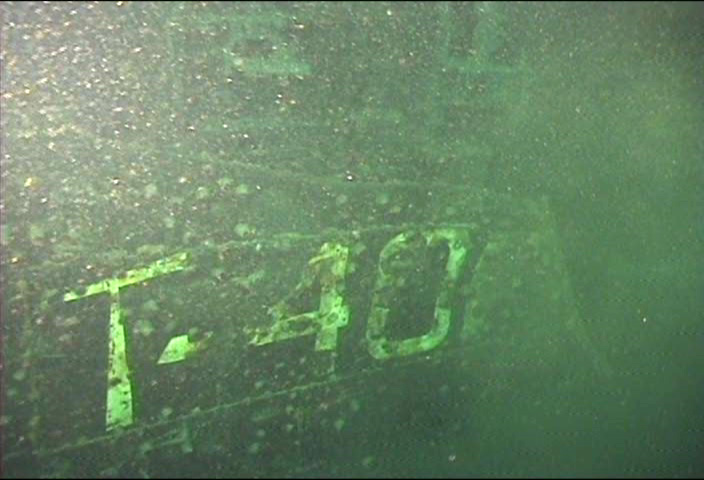 >
>
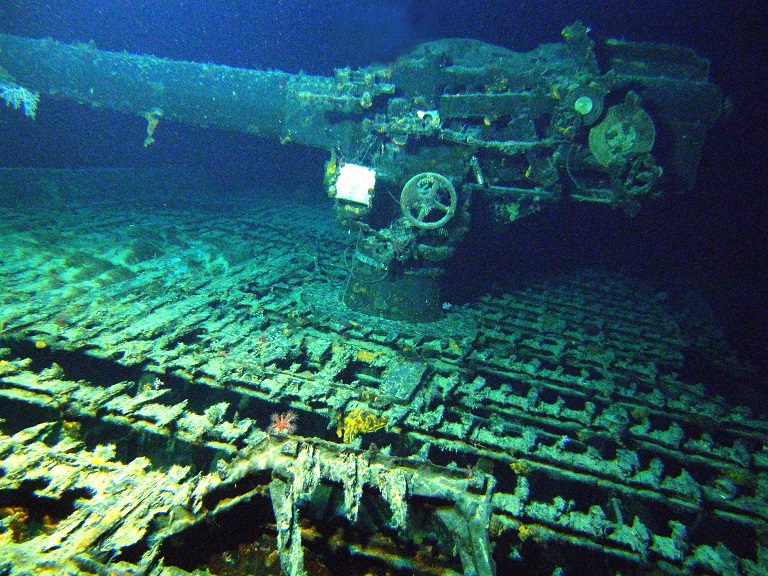

Conning tower with "I-401" character and numerals
5.5 inch (140 mm)/50 cal. deck gun and triple mounted 25-mm AAA
(Hawaii Undersea Research Laboratory)
Authors' Notes:
[1] The Sen-Toku remained the largest submarine class in the world until the deployment of the 425-foot USS BENJAMIN FRANKLIN (SSBN-640) class ballistic missile nuclear submarines in 1965.
[2] See www.combinedfleet.com/ijna/m6a.htm
[3] Ariizumi committed war crimes when he was CO of I-8. (See her TROM for details) Later, suspicions arise that before 1-401 was captured, Ariizumi was put ashore near Sendai, northern Honshu, or swam ashore after entering Tokyo Bay, but these theories seem to have little credence.
[4] The I-400 class was designed to normally carry a crew of 157 men; however, for some operations they carried in excess of 200 men.
[5] It has been reported that I-400, I-401, I-14 and I-200 class submarines were sunk to prevent their technology being surrendered to the Russians under a war end agreement.
Thanks go to Andrew Obluski of Poland and Dr. Higuchi Tatsuhiro of Japan.
Special thanks for photos of I-401's wreck go to Steve Price of the Hawaii Undersea Research Laboratory. Thanks also go to Derek Waller of UK for info about the Submarine Officers Conference.
– Bob Hackett and Sander Kingsepp
Back to Submarine
Page

