SENSUIKAN!
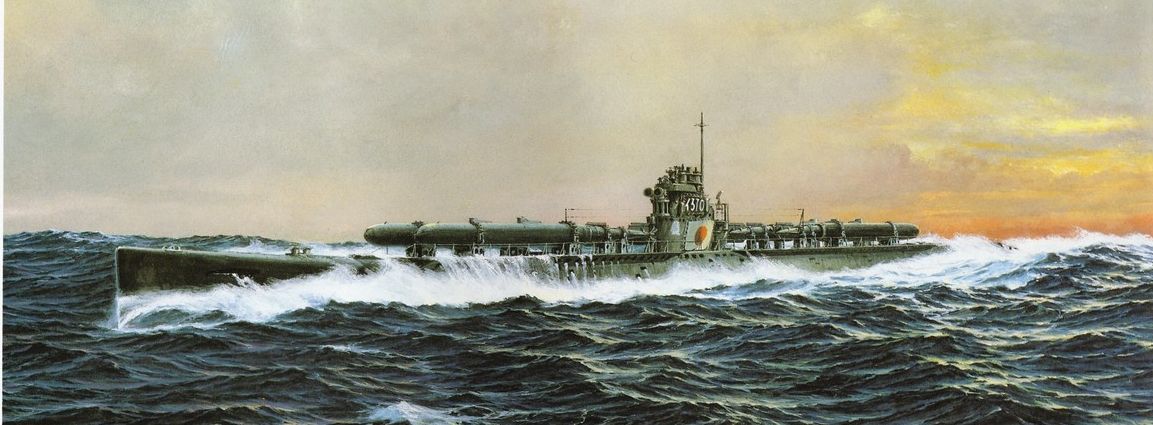 (Type D1 submarine by Takeshi Yuki )
IJN Submarine I-372:
Tabular Record of
Movement
© 2001-2017 Bob Hackett & Sander
Kingsepp
Revision 4
10 February 1944:
Laid down at Yokosuka Navy Yard as
a Type D1 "Tei-gata"
transport submarine No. 2961.
26 June 1944:
Launched and numbered I-372.
15 September 1944:
Lt Matsushita Hiroshi (67)(former torpedo officer
of I-37) is appointed the Chief Equipping Officer (CEO).
8 November 1944:
Yokosuka Navy Yard. I-372 is completed and attached
to Sasebo Naval District. Assigned to SubRon 11. Lt Matsushita Hiroshi is the
Commanding Officer.
8 January 1945:
Reassigned to Rear Admiral Owada Noboru's (former CO
of BB YAMASHIRO) SubRon 7, Sixth Fleet.
9 January 1945: American Operation "Mike One" - The Invasion of
Luzon:
Vice Admiral (later Admiral) Thomas C. Kinkaid's Task Force 77 lands
almost 175,000 men of Lt Gen (later Gen) Walter Krueger's Sixth Army at Lingayen
Gulf, Philippines under the cover of Vice Admiral (later Admiral) Jesse B.
Oldendorf's TG 77.2 bombardment force and aircraft of Rear Admiral (later Vice
Admiral) Calvin T. Durgin's TG 77.4. In a five-month campaign, the Sixth Army
defeats General Yamashita Tomoyuki's 14th Area Army defenders.
8 February 1945:
Departs Yokosuka for Takao, Taiwan. I-372 is slated
to participate in the rescue of the stranded Army pilots from Batulinao,
northern Luzon, Philippines. After the loss of RO-112 and RO-113, the mission is
canceled and I-372 is recalled to Kure.
14 February 1945:
Arrives at Kure. The IJN intends to send I-372 to
Iwo Jima with a cargo of artillery shells, but the situation there turns
hopeless.
16 February 1945:
Kure Navy Yard. I-372 commences a conversion to
carry aviation gasoline. Probably during the same conversion a snorkel tube is
fitted.
Mid-March 1945:
Transferred to Yokosuka.
20 March 1945:
SubRon 7 is deactivated. Reassigned to SubDiv 16 with
I-369, HA-101, HA-102 and HA-104.
1 April 1945:
Departs Yokosuka on a supply run to Wake Island.
4 April 1945:
On that day, FRUMEL provides the following information:
"A Japanese submarine will arrive Wake Island on 17 April and will carry out
loading and unloading operations at sunrise and sunset for several days there."
16 April 1945:
At 0400, Cdr Carter L. Bennett's USS SEA OWL (SS-405)
enroute to Pearl Harbor is alerted by an "Ultra" signal from Guam to a Japanese
submarine making a supply run from the Empire to Wake Island.
18 April 1945:
SEA OWL's radar picks up a surfaced submarine about
seven miles NW of Wake. Bennett begins tracking. I-372 puts into Wake and begins
unloading her cargo. Bennett closes the anchorage. At 1,600 yards, he fires
three torpedoes. Two do not explode but the third torpedo demolishes the pier.
I-372 crash-dives and remains underwater until 19 April. Lt Matsushita is
astonished that his E-27 radar detector had not given any warning. [1]
19 April 1945:
I-372 completes unloading and departs with 29
evacuees. Her cargo of rice lasts the garrison for the next ten days.
29 April 1945:
Arrives at Yokosuka.
15 May 1945:
Lt Takahashi Shingo (68)(former CO RO-67) is appointed
the CO.
15 June 1945:
Departs Yokosuka on her second supply run
to Wake. Later that day, USN Fleet Radio Unit, Melbourne, Australia (FRUMEL)
provides the following information: "A Japanese submarine left Tokyo Bay at 0900
on 15th to pass 5 miles south of Nojima Saki at 2000 on passage to Wake Island."
28 June 1945:
Arrives at Wake, unloads her cargo.
10 July 1945:
Returns to Yokosuka.
18 July 1945:
I-372 suffers a near miss during an attack on Yokusuka
by Grumman TBF "Avenger" torpedo-bombers and F6F "Hellcat" fighter-bombers from
Task Force 38's USS ESSEX (CV-9), RANDOLPH (CV-15), SHANGRI-LA (CV-38) and
BELLEAU WOOD (CVL-24). A near miss amidships ruptures I-372's starboard cargo
hold. She sinks slowly despite the desperate efforts of her crew to keep her
afloat. One sailor is killed in the attack.
Lt Takahashi is not at Yokosuka that day, but Captain Imaizumi Yoshijiro,
ComSubDiv 16/commandant of the Yokosuka Submarine Base, and I-372's torpedo
officer arrive immediately after the attack to assess the damage. The submarine
is found to be beyond salvage and abandoned.
15 September 1945:
Removed from the Navy List.
September 1945:
The wreck of I-372 is examined by divers from
submarine tender USS PROTEUS (AS-19).
August 1946:
The hulk of I-372 is raised, towed to deep water and
scuttled.
Authors' Notes:
[1] Postwar, the Joint Army-Navy Assessment Committee
(JANAC) erroneously credits SEA OWL with sinking RO-56.
Special thanks for help in preparing this TROM go to Dr. Higuchi
Tatsuhiro of Japan.
Thanks for help with the COs in Rev 1 also go to Steve Eckhardt of
Australia.
– Bob Hackett & Sander Kingsepp
Back to Submarine
Page

