SENSUIKAN!
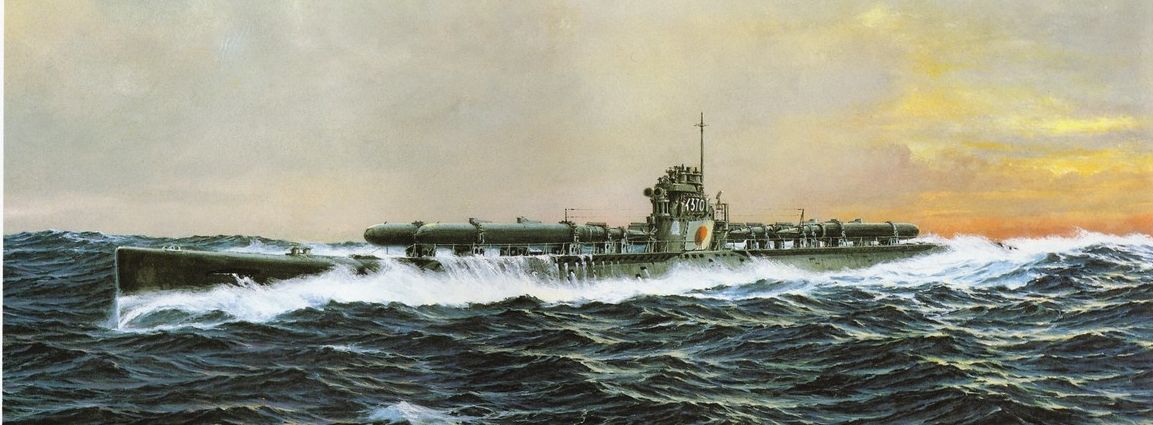 (Type D1 submarine by Takeshi Yuki)
IJN Submarine I-361: Tabular Record of
Movement
© 2001-2017 Bob Hackett & Sander Kingsepp
Revision 3
16 February 1943:
Laid down at Kure Navy Yard as a
Type D1 "Tei-gata"
transport submarine No. 5461.
20 October 1943:
Renumbered I-361 and provisionally attached to
Yokosuka Naval District.
30 October 1943:
Launched and officially attached to Yokosuka Naval
District.
17 April 1944:
Cdr (later Captain) Ikezawa Masayuki (52)(former CEO
of I-53) is appointed the Chief Equipping Officer (CEO).
23 April 1944:
Reattached to Kure Naval District.
30 April 1944:
Lt (Cdr, posthumously) Okayama Noboru (64)(former CO
of RO-64) is appointed the CEO.
25 May 1944:
I-361 is completed, commissioned in the IJN and attached
to Yokosuka Naval District. Lt Okayama Noboru is the CO. Assigned to SubRon 11
for working-up.
15 August 1944:
Assigned to Rear Admiral Owada Noboru's (former CO of
YAMASHIRO) SubRon 7 (transports).
23 August 1944:
Departs Yokosuka on her first supply mission to Wake
Island.
7 September 1944:
Arrives at Wake, delivering 80 tons of cargo.
Embarks 30 passengers and departs that same day for Yokosuka.
17 September 1944:
Returns to Yokosuka.
4 October 1944:
During a training cruise, I-361 is briefly grounded
at an unknown location.
17 October 1944:
I-361 departs on her second supply mission to Wake
Island.
29 October 1944:
Arrives at Wake, delivering 67 tons of ammunition.
Embarks 5 passengers and departs for Yokosuka on that same day.
9 November 1944:
Arrives at Yokosuka.
11 December 1944:
Lt (LtCdr, posthumously) Matsuura Masaharu
(67)(former torpedo officer of I-44) is appointed the CO.
9 January 1945:
Departs Yokosuka on her third supply mission to Wake
Island.
22 January 1945:
Arrives at Wake, delivering her cargo. Embarks an
unknown number of passengers and departs for Yokosuka.
7 February 1945:
Returns to Yokosuka. I-361's deck gun and Daihatsu
landing craft fittings are removed and she is converted to carry five "Kaiten"
human torpedoes.
20 March 1945:
SubRon 7 is deactivated. I-361 is reassigned to SubDiv
15, Sixth Fleet.
26 March 1945: American Operation "Iceberg" - The Invasion of
Okinawa:
The 77th Infantry Infantry Division lands on the Kerama Islands and
by 29 March captures advance bases and anchorages. On 1 April, Vice Admiral
(later Admiral) Raymond A. Spruance's Fifth Fleet, including more than 40
aircraft carriers, 18 battleships, 200 destroyers and over 1,000 support ships
surround Okinawa. Lt Gen Simon B. Buckner Jr's Tenth Army (7th, 77th, 96th
Infantry, 2nd, 6th Marine divisions) makes amphibious landings and takes the
island from Lt Gen Ushijima Mitsuru's 32nd Army.
24 May 1945: The Eighth "Kaiten" Mission:
I-361, still under Lt Matsuura
is in the "Todoroki" (Thunderclap) group with I-36, I-165 and I-363. She
departs Hikari with five "Kaitens" aboard for an area SE of Okinawa.
28 May 1945:
I-361 is detected by an American minesweeper. The
minesweeper alerts the nearby Task Unit 32.1.1's USS ANZIO (CVE-57) and her four
screening destroyer escorts of a possible Japanese submarine in the area. ANZIO
heads for the contact's last reported position and launches a series of searches
by Composite Wing VC-13's aircraft.
31 May 1945:
400 miles SE of Okinawa. At 0436, the radar operator of
Lt(j.g.) Sam L. Stovall's Grumman TBM-3E "Avenger" torpedo-bomber picks up a
contact. Stovall drops out of the cloud cover and spots a submarine on the
pre-dawn surface at about 6,000 yards. He fires four 5-inch rockets at the
submarine and thinks he gets two hits. Stovall identifies his target as an I-161
class submarine without a deck gun. No "Kaitens" are sighted during the attack.
Lt Matsuura crash-dives, but Stovall drops sonobouys and a Mark 24 "Fido"
acoustic tracking torpedo that homes in on the Type D1's propeller sounds
and explodes. Fifteen miles away, the crew of the approaching USS OLIVER
MITCHELL (DE-417) feels a heavy underwater shock. When MITCHELL and TABBERER
(DE-418) arrive on the scene they find a heavy oil slick, bits of deck planking
and other debris. I-361 sinks at 20-22N, 134-09E with all 76 crewmen and five
kaiten pilots.
25 June 1945:
Presumed lost SE of Okinawa.
10 August 1945:
Removed from the Navy List.
Authors' Notes:
Special thanks go to Dr. Higuchi Tatsuhiro of Japan.
Thanks for help with the COs in Rev 1 also go to Steve Eckhardt of Australia.
– Bob Hackett & Sander Kingsepp
Back to Submarine
Page

