ZATSUYOSEN!
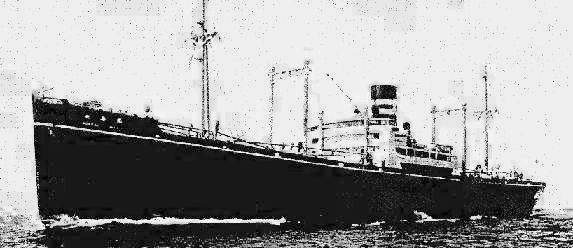 (HOKKAI MARU prewar)
IJN HOKKAI MARU:
Tabular Record of Movement
© 2011-2017 Gilbert Casse, Bob Hackett and Peter Cundall
Revision 3
15 November 1931:
Nagasaki. Laid down by Mitsubishi Zosen K.K. Nagasaki Zosensho shipyard as the last of six diesel-driven high speed cargo ship, for Osaka Shosen K.K., Osaka. HOKKAI and NANKAI MARUs are improved versions of 1930 built KINAI MARU and her three sisters. As opposed to KINAI MARU’s Swiss made Sulzer engines, HOKKAI MARU is powered by Mitsubishi MS-type diesels that give better performance with less fuel oil consumption.
3 September 1932:
Launched and named HOKKAI MARU. [1]
4 March 1933:
Completed and registered at Osaka. Her gross and net registered tonnages are respectively 8,416-tons and 5,114-tons.
E March 1934:
NANKAI MARU is placed on O.S.K.’s Kobe Line ~ New York service via the Panama Canal. Rotations are usually three times a year.
Places of call are:
For the outbound leg: Philippines ~ Hong Kong ~ Kirun, Formosa (now Keelung, Taiwan) ~ Shanghai ~ Guangzhou ~ Kobe ~ Ise Wan (Bay) ~ Yokohama ~ Los Angeles ~ Cristobal, Panama ~ Puerto Colombia, Colombia ~ New York ~ Hampton Roads ~ Savannah.
For the inbound leg: Cristobal ~ Los Angeles ~ Yokohama ~ Osaka ~ Kobe ~ Dairen (now Dalian) ~ Shanghai ~ Hong Kong ~ Philippines.
30 October 1938:
Placed on European Lines: Kobe ~ New York. One round cruise usually takes five months.
E 1940:
Her net registered tonnage is changed for 5,105-tons.
5 April 1941:
Starts her sixth voyage on European Lines: Kobe ~ New York ~ Europe.
July 1941:
In retaliation to Japan’s occupation of French Indochina, the United States closes the Panama Canal to Japanese shipping.
23 September 1941:
Requisitioned by the IJN as a transport (Ippan Choyosen). [2]
2 October 1941:
Yokohama. Starts conversion to her military role in Mitsubishi Heavy Industries K.K. shipyard.
10 November 1941:
Registered in the IJN as an auxiliary transport under internal order No. 1391 and attached to the Yokosuka Naval District as an auxiliary transport, (Ko) category. Her home port is Yokosuka. [3]
20 November 1941:
Conversion is completed.
E November 1941:
Assigned to the Vice Admiral (later Admiral) Kondo Nobutake's (35) Southern Force's Borneo Invasion Group led by Rear Admiral (later Vice Admiral) Kurita Takeo (38), in Rear Admiral (later Vice Admiral) Hashimoto Shintaro's (41) Miri and Seria Invasion unit. HOKKAI MARU carries Captain (later Rear Admiral posthumously) Tomonari Kiyoshi's (49) No. 2 Yokosuka Naval Landing Force (SNLF).
28 November 1941:
Departs Canton, China.
3 December 1941:
Arrives at Mako and departs the same day.
5 December 1941:
Arrives at Sana.
E December 1941:
Arrives at Camranh Bay, Indochina.
13 December 1941: Operation "B" - The Invasion of British Borneo (Sarawak):
The occupation of British Borneo is a combined IJN/IJA operation which involves Gen (later Field Marshal) Count Terauchi Hisachi’s command’s Southern Expeditionary Army. The 25th Army, under LtGen Yamashita Tomoyuki fields MajGen Kawaguchi Kiyotake’s “Detachment” of about 2,500 men consisting of the 35th Infantry Brigade HQ, the 124th Infantry Regiment led by Col Oka Akinosuke, 18th Signal Unit platoon, 18th Medical Unit and 18/4 Field Hospital Medical Unit. In addition, five specialized and supply units are embarked on the transports: 21st Field Ordnance Depot Coy and 1st, 2nd, 3rd & 4th Field Well drilling Coys of about 120 men each (oil well repairs if needed). Finally, one AA and one Signal Regiment are stationed on IJA transports.
The invasion units are embarked on IJA transports KATORI, HIYOSHI, MYOHO, KENKON and NICHIRAN MARUs.
The Navy force consists of Vice Admiral (later Admiral) Kondo Nobutake's (35)(former CO of KONGO) Southern Force, Borneo Invasion Group that includes Rear Admiral (later Vice Admiral) Kurita Takeo's (38), Support Unit. Rear Admiral (later Vice Admiral) Hashimoto Shintaro's (41) Invasion Unit consists of his 4th Naval Construction Unit of about 260 men and materials aboard TONAN MARU No 3, the No.2 Yokosuka Special Naval Force (SNLF) aboard HOKKAI MARU. Other transports are UNYO MARU No. 2, KAMIKAWA and MITAKESAN MARUs transporting equipment, material and supplies.
The convoy’s close escort consists of minesweepers W-3 and W-6 and subchaser CH-7. Other escorts include CruDiv 7’s KUMANO and SUZUYA, light cruisers YURA and KINU, Desdiv 11’s FUBUKI, DesDiv 12’s MURAKUMO, SHINONOME, SHIRAKUMO and USUGUMO and DesDiv 20’s SAGIRI. Seaplane tender KAMIKAWA MARU with six Mitsubishi Type 0 F1M “Petes” (plus two in reserve) and four Aichi E13A1 “Jakes” (plus one in reserve) provides air cover.
At 0730, the Invasion Convoy departs Camranh Bay.
14 December 1941:
The Invasion Convoy crosses the South China Sea without being sighted. MITAKESAN MARU is detached to the Philippines.
15 December 1941:
At 2330, the main body of the convoy arrives at Miri anchorage. At midnight, HIYOSHI MARU arrives at Seria anchorage. About the same time, all IJN transports arrive at Lutong. Because of a rainstorm, three
Daihatsu barges capsize when lowered into the water. 19 IJA landing troops are KIA and 15 are MIA.
16 December 1941:
At 0440, troops land at Miri, Seria and Lutong. Despite worsening weather conditions, landings are made without opposition from British defending units and Miri, Seria and Lutong oilfields as well as Miri airfield are all secured in the morning.
17 December 1941:
N of Miri, near Seria. Destroyer SHINONOME is attacked by Dutch Dornier Do-24 K-1 flying-boat X-32 of Aircraft Group GVT-7 based at Tarakan, E Borneo. Of five 200-kg bombs she drops, the X-32 scores two direct hits and a near-miss. An explosion severs SHINONOME's stern and she sinks quickly with all hands - the first FUBUKI-class destroyer sunk in WWII.
A Do-24 X-34 flying boat of GVT-7 attacks a vessel, but is intercepted by a Type O Mitsubishi F1M2 ‘Pete’ from KAMIKAWA MARU. The Dornier is forced to make an emergency landing with two of its crew dead. Two hours later, in bad weather conditions, six Dutch Glenn Martin bombers of 2-VIG-I also attack. A Pete from KAMIKAWA MARU attacks the Dutch bomber formation, but they escape. [4]
19 December 1941:
Miri. In the morning, Martin B-10 medium bombers from 1-VIG-I and 2-VIG-I based at Samarinda and Singkawang attack the invasion shipping. Four KAMIKAWA MARU’s F1M2 “Pete” floatplanes intercept separate trios of bombers that appear at 15-minute intervals. The Petes’ pilots claim downing Martin M-571 of 2-VIG-I.
20 December 1941:
Miri. About midday, six Martins of 2-VIG-I escorted by two obsolete Brewster “Buffalo” fighters attack Japanese shipping off Miri. The bomber crews miss a cruiser. F1M2s from KAMIKAWA MARU intercept
and claim one bomber. The Buffaloes escape with heavy damage.
That same day, an E13A1 Jake from KAMIKAWA MARU fails to return from a reconnaissance mission.
22 December 1941: The Invasion of Sarawak (British Borneo) :
The main body of the Japanese invasion force (two battalions) re-embarks at Miri. The invasion convoy departs for Kuching, Sarawak. The invasion convoy consisting of HOKKAI, KATORI, HIYOSHI, MYOHO, KENKON and NICHIRAN MARUs, UNYO MARU No. 2, TONAN MARU No. 3 and KAMIKAWA MARUs escorted by light cruiser YURA, DesDiv 12's SHIRAKUMO, MURAKUMO and USUGUMO and minesweepers W-3 and W-6.
The invasion convoy is transporting the Kawaguchi Detachment (minus one battalion) and the Yokosuka No. 2 Special Naval Landing Force (SNLF) aboard HOKKAI MARU. TONAN MARU No. 3 is carrying the 21st Field Ordnance Depot, the 48th Anchorage HQ, the 4th Naval Construction Unit of about 260 men.
CruDiv 7/1's KUMANO and SUZUYA, light cruiser KINU and destroyers FUBUKI and SAGIRI provide the covering force. West of the covering force is CruDiv 7/2's MIKUMA and MOGAMI with destroyer HATSUYUKI. Seaplane tender KAMIKAWA MARU provides air cover.
23 December 1941:
Early morning, about 150 miles from Kuching, a Dutch reconnaissance aircraft spots the Invasion Convoy.
At 11.40 that morning twenty-four Japanese aircraft bomb Singkawang II airfield, so damaging the runways that a Dutch striking force which had been ordered to attack the convoy is unable to take off with a bomb load.
At 1800, the convoy approaches the mouth of the Santubong river. Subsequent landings are made again with little opposition from British Forces although four Daihatsu landing craft are sunk. Moreover, both convoy and escorts do not escape unscathed.
Off Kuching. At 2040, Dutch Ltz I Carel A. J. van Well Groeneveld's submarine K-XIV attacks the anchored transports. He torpedoes and sinks in sequence IJA transport HIYOSHI MARU with five crewmen KIA, and IJN transport KATORI MARU with the loss of 10 crewmen and many troops. IJN transports HOKKAI MARU and TONAN MARU No. 3 are also damaged by K-XIV’s torpedoes. HOKKAI MARU is heavily damaged and beached to prevent her sinking. [5]
23/24 December 1941:
Near Kuching. About midnight, LtCdr L. J. Jarman's Dutch submarine HMNS K-XVI torpedoes destroyer SAGIRI. The destroyer's own torpedoes catch on fire and SAGIRI blows up, killing 121 officers and men. W-3 and destroyer SHIRAKUMO rescue 120 survivors.
25 December 1941:
Off Kuching. At 2300, Dutch Ltz I Carel A. J. van Well Groeneveld's submarine HMNS K-XIV torpedoes and damages IJA transport NICHIRAN MARU. At about 1640, the Japanese troops completely secure Kuching airfield.
26 December 1941:
Off Kuching. Dutch Army Glenn Martin B-10 bombers from Samarinda, Borneo bomb and sink minesweeper W-6 and IJN transport/collier UNYO MARU No. 2 at 01-34N, 110-21E. Minesweeper W-3 participates in the rescue of an unknown number of W-6’s survivors.
15 February 1942:
HOKKAI MARU is removed from the Navy List under internal order No. 287.
E September 1942:
Refloated by auxiliary transport HEITO MARU.
21 September 1942:
Departs Kuching for Singapore, towed by HEITO MARU and auxiliary minesweeper TOSHI MARU No. 2.
23 September 1942:
Arrives at Singapore’s naval port. Docks at the naval shipyard for temporary repairs by No. 101 Naval Construction and Repair Unit.
7 September 1943:
12 months after entering the naval shipyard, temporary repairs are finally completed.
8 September 1943:
Departs Singapore arriving that same day at Bintang Island, S of Singapore.
9 September 1943:
Departs Bintang arriving back at Singapore. HOKKAI MARU is probably placed under Civilian Administration (Sempaku Uneikai) control.
14 September 1943:
Departs Singapore for Saint Jacques, Indochina in convoy No.620 also consisting of five unidentified merchant ships without escort.
17 September 1943:
Arrives at Saint Jacques.
20 September 1943:
Departs Saint Jacques for Kobe. Apparently joins up at some point with convoy SA-20 also consisting of KACHIDOKI (ex PRESIDENT HARRISON), GOYO, TATSUHARU MARUs without escort.
27 September 1943:
Arrives at Takao. TATSUHARU and HOKKAI MARUs are detached from the convoy.
29 September 1943:
Departs Takao arriving that same day at Mako, Pescadores.
4 October 1943:
Departs Mako for Osaka possibly in convoy No.209 (that departed Mako 5 October) also consisting of TONAN and RYUKO MARUs and seven unidentified ships escorted by auxiliary gunboat CHOHAKUSAN MARU.
12 October 1943:
Arrives at Moji. Departs later that same day for Osaka.
13 October 1943:
Arrives at Osaka.
15 October 1943:
Departs Osaka for Shimizu, Shizuoka Prefecture.
17 October 1943:
Arrives at Shimizu.
19 October 1943:
Departs Shimizu. At 1337, joins convoy No. 7019 consisting of MAGANE and SHOEI (2,764 gt) MARUs (joining from Yokosuka) escorted by patrol boat PB-2. At 1630, PB-2 detaches due to a generator failure at 128 degrees and 5 nautical miles off the Tsurugisaki lighthouse and returns to Yokosuka, arriving at 1830.
20 October 1943:
Departs Shimizu for Kobe.
21 October 1943:
Arrives at Kobe.
22 October 1943:
Enters Mitsubishi Heavy Industries K.K. shipyard to undergo permanent repairs.
30 January 1944:
Repairs are completed.
13 February 1944:
Departs Kobe for Kure.
14 February 1944:
Arrives at Kure.
20 February 1944:
Departs Kure arriving that same day at Mutsure.
22 February 1944:
Departs Mutsure for Takao. Likely sails following day in convoy HI-49.
26 February 1944:
Arrives at Takao.
27 February 1944:
Undergoes some engine repairs.
20 March 1944:
Repairs are completed.
7 April 1944:
Departs Takao for Camranh Bay.
11 April 1944:
Arrives at Camranh Bay.
12 April 1944:
Departs Camranh Bay for Seletar naval base, Singapore.
16 April 1944:
Arrives at Seletar.
19 April 1944:
Departs Seletar for Surabaya.
24 April 1944:
Arrives at Surabaya.
3 May 1944:
Departs Surabaya for Macassar, Celebes (now Sulawesi).
5 May 1944:
Arrives at Macassar.
14 May 1944:
Departs Macassar for Balikpapan, Borneo.
15 May 1944:
Arrives at Balikpapan.
28 May 1944:
At 0800, departs Balikpapan for Palembang, Sumatra in convoy also consisting of tanker NIPPO MARU escorted by patrol boat PB-2. At 2137, arrives at Kotabaru, Laut Island.
29 May 1944:
At 0755, departs Kotabaru.
30 May 1944:
HOKKAI MARU suffers steering problems and a long delay is experienced. Arrives at Palembang and is detached from the convoy.
2 June 1944:
Departs Palembang for Bintang.
3 June 1944:
Arrives at Bintang.
5 June 1944:
Departs Bintang.
7 June 1944:
Arrives at Singapore.
17 June 1944:
At 0400, departs Singapore for Moji in fast convoy HI-66 also consisting of tanker OMUROSAN MARU and transports/cargo SANUKI and AWA MARUs escorted by escort carrier KAIYO, light cruiser KASHII and kaibokan
CHIBURI, CD-7 and CD-11. The convoy hugs the continental coast avoiding deep water as much as possible.
26 June 1944:
At 1300, arrives at Moji.
28 June 1944:
Departs Moji for Niihama, Shikoku.
29 June 1944:
Arrives at Niihama.
3 July 1944:
Departs Niihama for Kobe.
4 July 1944:
Arrives at Kobe.
18 July 1944:
Departs Kobe for Kure.
19 July 1944:
Arrives at Kure.
24 July 1944:
Departs Kure for Sasebo.
25 July 1944:
Arrives at Sasebo.
8 August 1944:
Departs Sasebo for Imari, Saga Prefecture, Kyushu. The ship carries the 7th Transport Party.
9 August 1944:
Arrives at Imari.
10 August 1944:
At 0500, departs Imari Wan (Bay) for Singapore in fast convoy HI-71 also consisting of new fleet oiler HAYASUI, storeship IRAKO, oilers TEIYO, ZUIHO, KYOKUTO, NIYO, NISSHO and EIYO MARUs and HAKKO MARU No. 2, transports AWA, NOSHIRO, TEIA (ex-French Liner ARAMIS) and NOTO MARUs, cargo ships KASHII and ORYOKU MARUs and IJA landing craft depot ships TAMATSU and MAYASAN MARUs.
The convoy's screen is provided by Rear Admiral (Vice Admiral, posthumously) Kajioka Sadamichi (39) (former CO of KISO), 6th Escort Convoy Commander with destroyers FUJINAMI and YUNAGI, kaibokan HIRADO, KURAHASHI, MIKURA, SHONAN, CD-11 and escort carrier TAIYO. The 931st Naval Air Group provides air cover with 12 Nakajima B5N “Kates”.
15 August 1944:
HI-71 arrives at Mako, Pescadores. NIYO, HAKKO No. 2 and ORYOKU MARUs and IRAKO are detached from the convoy. NIYO MARU is later reallocated to convoy.
17 August 1944:
HI-71 sorties from Mako for Manila in Typhoon weather transporting troops and supplies for the defense of the Philippines. Kajioka's escort forces are augmented by old destroyer ASAKAZE and kaibokan SADO, ETOROFU, MATSUWA and HIBURI sent from Takao by the 1st Surface Escort Division. After two hours out, NIYO MARU suffers an engine breakdown and returns to Mako.
18 August 1944:
At 0524, LtCdr (later Rear Admiral-Ret) Louis D. McGregor's (USNA ’30) USS REDFISH (SS-395) torpedoes and damages EIYO MARU. ASAKAZE and her sister YUNAGI are detached to escort her back to Takao.
Off Cape Bolinao, Luzon. At 2222, LtCdr (later Captain) Henry G. Munson's (USNA ’32) USS RASHER (SS-269) attacks carrier TAIYO, bringing up the rear of the convoy. TAIYO is hit by three torpedoes and sinks quickly. 747 crewmen and passengers are KIA. At 2310, RASHER, still on the surface, hits transport TEIA MARU with three torpedoes using radar bearings. The ex-French liner is set afire and sinks, taking with her 2316 troops, 275 other passengers and 74 crewmen and gunners.
19 August 1944:
The convoy splits into two groups. Just past midnight, USS RASHER, still running on the surface, closes on an eastbound group of three large ships and one escort. At 0033, LtCdr Munson puts two radar-directed torpedoes into the port sides of AWA and NOSHIRO MARUs at 18-11N, 119-58E. Both ships beach themselves near Port Currimao.
LtCdr (later Cdr) Charles M. Henderson's (USNA ’34) USS BLUEFISH (SS-222) and LtCdr (later Captain) Gordon W. Underwood's (USNA ’32) SPADEFISH (SS-411), on her first patrol, join in the attack on HI-71. At 0320, USS BLUEFISH hits HAYASUI. Set afire, she sinks by the stern. Underwood's USS SPADEFISH hits TAMATSU MARU with two torpedoes and the big landing craft depot ship rolls over and takes down 4,755 troops and 135 crewmen.
At 0420, Henderson’s USS BLUEFISH hits oiler TEIYO MARU. She is set afire an abandoned by her crew. At 0510 Henderson attacks again the crippled ship and finishes her off. She sinks by the stern with the loss of 99 crewmen and passengers.
Admiral Kajioka orders HI-71 to make for San Fernando. SADO, MATSUWA and HIBURI are ordered to cover the convoy's flight with antisubmarine sweeps.
21 August 1944:
Under tow, AWA MARU arrives in Manila after the main body of the convoy arrives.
25 August 1944:
At 1650, departs Manila for Singapore in convoy HI-71 from now also consisting of oilers AZUSA, KYOKUTO, KYOKUHO and ZUIHO MARUs, and transport AWA MARU escorted by destroyer FUJINAMI, kaibokan HIRADO, MIKURA and KURAHASHI and subchaser CH-28. At 1845, KYOKUHO MARU develops engine trouble and drops behind escorted by FUJINAMI. Later, they catch up with the convoy but are finally detached for Miri.
27-28 August 1944:
Crosses Palawan offshore.
1 September 1944:
At 1356, arrives at Singapore. The ship docks at Seletar.
9 September 1944:
At 1050 departs Seletar, Singapore for Surabaya with SANUKI MARU.
10 September 1944:
Arrives Banka Straits and anchors off Pulau Dapur.
11 September 1944:
Departs Pulau Dapur.
12 September 1944:
Anchors off Japara. Departs later that same day.
13 September 1944:
At 1530 arrives at Surabaya.
21 September 1944:
Departs Surabaya escorted by gunboat NANKAI (ex-Dutch REGULUS).
23 September 1944:
15 nms E of Sebuku (Seboefoe) Island, SE of Borneo, in position 03-36S, 116-35E, HOKKAI MARU and NANKAI both strike mines. HOKKAI MARU goes dead in the water. [6]
24 September 1944:
Towed to Sebuku Island by KITA MARU (ex-Dutch GEMMA) and beached to prevent her sinking. Minesweeper W-11 is despatched to provide protection and arrives at 1135.
27 September 1944:
W-11 departs for Balikpapan.
29 September 1944:
W-11 returns from Balikpapan.
6 October 1944:
W-11 departs from rescue scene to Balikpapan.
E September-November 1944:
Undergoes emergency repairs.
16 November 1944:
Refloated. At 0830, departs Sebuku in convoy, towed by requisitioned rescue tug AKITSU MARU, salvage ship KAIKO MARU and IJN auxiliary netlayer SHUNSEN MARU (latter shown as HARUKAWA MARU in some sources, an alternate reading of the same name characters). Minesweeper W-12 and auxiliary subchasers CHa-2 and CHa-3 provide escort to the convoy.
18 November 1944:
At 2345, arrives in the swept eastern channel to Surabaya Port.
19 November 1944:
At 1530, arrives at Surabaya. Enters Harima Dock shipyard.
5 December 1944:
Undergoes repairs.
15 August 1945:
Still under repairs at the termination of hostilities, due more than likely to an acute shortage of materials.
2 October 1945:
Seized by the Indonesian People’s Front. All crewmembers are taken to a concentration camp. Seven die in captivity.
12 November 1945:
A fire breaks out of her engine room. Despite firefighting work from a British patrol boat, HOKKAI MARU is engulfed in flames and settles on the seabed.
April 1960:
A photograph is taken of a ship in Surabaya Port by a foreign visitor. In the background lying against the Surabaya Dockyard Wharf is a derelict ship, apparently HOKKAI MARU lying sunken with the hulk of an unknown smaller vessel tied up alongside. The bridge, amidship accommodation and funnel of HOKKAI MARU are missing.
1960s:
At an unknown date presumed scrapped locally. Surabaya is visited by various shipping photographers from the early 1970's and none note sightings of the wreck.
Authors Notes:
[1] Not to be confused with Dairen Kisen’s (2278 GRT ’40), IJA small repair ship (457 GRT, ’42) and auxiliary IJN supply ship (407 GRT, ’34).
[2] See Zatsuyosen home page for full explanation.
[3] There were two categories of Zatsuyosen. (Ko) category with an IJN Captain as supervisor aboard and (Otsu) category without.
[4] The survivors float in their dinghy for three weeks, finally getting ashore 260 miles to the south, where they become POWs. In 1945, shortly before the Japanese capitulation, the crew is executed.
[5] One source indicates that TONAN MARU No. 3 made Saigon a few days later for temporary repairs.
[6] Sources are conflicting whether mines were Mk 12 Type laid by LtCdr (later Rear Admiral-Ret) Walter T. Griffith’s (USNA ’34) USS BOWFIN (SS-287) in Jan ’44 or aerial mines dropped by a B-24 aircraft.
Thanks go to Gengoro S. Toda of Japan, Erich Muehlthaler of Germany.
Gilbert Casse, Bob Hackett and Peter Cundall
Back to
IJN Transports Page

