TOKUSETSU SENSUI-BOKAN!
|
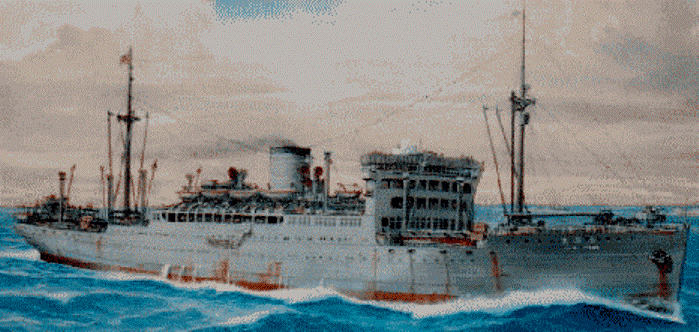
(Hie Maru in wartime colors by Ueda Kihachiro)
IJN Auxiliary Submarine Depot Ship
HIE MARU: Tabular Record of Movement
© 1998-2017 Bob Hackett, Sander Kingsepp and Peter Cundall.
Revision 11
25 May 1929:
Yokohama. Laid down as a 11,621-ton passenger-cargo liner at Mitsubishi Heavy Industries, Ltd's shipyard for Nippon Yusen K.K. (NYK) (Japan Mail Steamship Company), Tokyo.
12 February 1930:
Launched and named HIE MARU. The ship is a sister ship of HEIAN MARU and HIKAWA MARU.
31 July 1930:
Completed.
23 August 1930:
Departs Kobe for Seattle, Washington on her maiden voyage.
15 September 1930:
The City of Yokohama presents to the City of Seattle an eight-ton Taiko-Gata stone lantern in gratitude for Seattle's assistance after the Great Kanto Earthquake of 1923. The lantern is placed in Seward Park.
1931:
As a return gift, the City of Seattle sends 1,000 rose shrubs, comprising about 50 varieties, on HIE MARU to the City of Yokohama.
20 January 1938
Seattle. A plot is discovered to blow up HIE MARU at the Great Northern Dock by a 28-year-old school teacher from British Columbia, Canada. The conspirators, in protest against the war in China and the shipment of scrap metal and other materials to Japan, improvise a bomb made of 369 sticks of dynamite and connect it to a clock timer device. Upon HIE MARU’s arrival at Vancouver, it is planned to float the bomb to the ship's side. The plot is later moved to Seattle where the teacher's body is found floating.
1940:
In service on the South America-Saigon route.
22 September 1940:
Vichy France cedes airfields and agrees to admission of Japanese troops into northern Indochina (Cambodia, Laos and Vietnam).
26 September 1940:
President Franklin D. Roosevelt, in response to Japanese actions in Indochina, bans the export of steel and aviation fuel to Japan and declares an embargo on scrap steel effective 15 October 1940.
11 October 1940:
The Seattle "Post-Intelligencer" newspaper reports that old rails from city’s street car lines are being loaded on HIE MARU. The mayor asks U.S. Customs to stop the ship and the city council asks for federal intervention, but the ship sails before the embargo goes into effect.
June 1941:
Departs Kobe carrying some Polish Jewish refugees fleeing Soviet internment.
7 July 1941:
Arrives at Seattle.
22 September 1941:
Departs Kobe for India.
21 November 1941:
Returns to Kobe.
26 November 1941:
Requisitioned by the IJN.
30 November 1941:
Departs Yokosuka.
8 December 1941:
Departs Kwajalein.
9 December 1941:
Arrives at Emidj.
12 December 1941:
Departs Emidj.
13 December 1941:
Arrives at Wotje.
16 December 1941:
Departs Wotje.
18 December 1941:
Arrives at Kwajalein.
20 December 1941:
Departs Kwajalein and later that day arrives at Roi.
23 December 1941:
Departs Roi.
27 December 1941:
Arrives at Minami Torishima and departs later the same day.
30 December 1941:
Arrives at Yokosuka.
7 December 1941:
At Kwajalein, Marshall Islands.
1 January 1942:
Departs Yokosuka.
3 January 1942:
Arrives at Tokuyama.
4 January 1942:
Departs Tokuyama.
22 January 1942:
Arrives at Davao.
2 February 1942:
Departs Davao.
5 February 1942:
Arrives at Tarakan.
15 February 1942:
Arrives at Tarakan, Borneo. Unloads machinery for oil field development.
That same day, HIE MARU is designated for conversion to a submarine depot ship assigned to the Yokosuka Naval District. Captain (Rear Admiral, posthumously) Shinoda Kiyohiko (43) is posted as the Commanding Officer.
28 February 1942:
Departs Tarakan.
8 March 1942:
Arrives at Yokosuka.
9 March 1942:
Arrives at Yokosuka Navy Yard. Begins conversion. Four 5.9-inch (150-mm) single mount guns, one 3.5 m range finder, two two Type 93 dual 13.2-mm machine guns, one 1100-mm diameter and one 900-mm diameter search light are fitted.
10 March 1942:
Assigned to 8th Submarine Squadron.
10 April 1942:
HIE MARU is assigned to Vice Admiral, the Marquis, Komatsu Teruhisa's (37) (former CO of CA NACHI) Sixth Fleet (Submarines) in Captain (later Rear Admiral) Ishizaki Noboru's (42) (former CO of HYUGA) SubRon 8 as tender for flagship I-10 and SubDiv 1 (I-16, I-18, I-20), SubDiv 3 (I-21, I-22, I-24) and SubDiv 14 (I-27, I-29, I-29, I-30).
25 April 1942:
Completes conversion.
11 June 1942:
Departs Yokosuka.
19 June 1942:
Arrives at Kwajalein.
14 July 1942:
HIE MARU is in Captain (later Rear Admiral) Ishizaki Noboru's (42) (former CO of HYUGA) SubRon 8 as tender for flagship I-10 and SubDivs 1, 3 and 14.
18 July 1942:
Departs Kwajalein.
25 July 1942:
At 0900 arrives at Yokosuka. Prior to arrival the ship is met by destroyers KAWAKAZE and AMATSUKAZE.
20 September 1942:
At 1730 departs Yokohama.
26 September 1942:
At 0523 arrives at Hong Kong. At 1800, departs Hong Kong in No.1 Shitai Convoy consisting of HIE MARU and MANKO MARU 280 Army troops from elements of the 10th Independent Mountain Artillery Regiment and elements of the 19th Independent Engineer Regiment and 283 horses escorted by light training cruiser KASHII, light cruiser KUMA and torpedo boat KASASAGI. KASHII has been disguised with a second funnel, perhaps to appear like a U.S. cruiser. JOHORE MARU carries elements of the IJA 2nd Battalion (less 6th Company), 10th Independent Mountain Artillery Regiment, horses and supplies. MANKO MARU carries Headquarters, 10th Independent Mountain Artillery Regiment; 1st Battalion (less 1st Company). Light cruiser KUMA carries troops of the IJA 38th Division.
Confidential No. 1 convoy instruction: Transport Army divisions: main Corps in the Shitai Convoy (2 echelons). 280 Army troops from elements of the 10th Independent Mountain Artillery Regiment and elements of the 19th Independent Engineer Regiment embark with 283 horses. At 1800 departs Hong Kong in the 1st echelon of the Shitai Convoy consisting of---------------
4 October 1942:
At 0800, arrives at Palau. KASASAGI is detached and proceeds to Hong Kong.
5 October 1942:
At 0700, departs Palau. At an unknown point, KASHII is detached and proceeds at speed to Rabaul arriving 8 Oct ’42 where she disembarks troops and proceeds that same day to Davao, Philippines.
8 October 1942:
At 0615, arrives at Rabaul. Disembarks 165 Army troops and 25 horses.
9 October 1942:
At 0200 departs Rabaul.
10 October 1942:
At 0530 arrives at Shortland.
11 October 1942:
At 0700 departs Shortland.
12 October 1942:
At 1015 arrives at Rabaul.
13 October 1942:
USAAF fifth Air Force Boeing B-17 heavy bombers bomb Rabaul. HIE MARU sustains no hits. At 1300, HIE MARU and MANKO MARU depart Rabaul escorted by minesweeper W-15.
14 October 1942:
W-15 and MANKO MARU separate. HIE MARU proceeds to Truk unescorted.
16 October 1942:
At 1500 arrives at Truk Island. Remains there throughout November and December.
11 November 1942:
Supports submarine operations to replenish IJA units on Guadalcanal but does not apparently leave Truk
28 December 1942:
Captain Arima Naoshi (36) assumes command. Later, Captain Shinoda assumes command of ISUZU.
1 January 1943:
Penang. HIE MARU is SubRon 8's tender for flagship 1-10 and SubDivs 1 (I-16, I-18, I-20, I-21, I-24) and 14 (I-27, I-29).
27 January 1943:
Truk. Provisioned by auxiliary storeship SHINYO MARU.
21 March 1943:
Departs Truk in convoy with ight cruiser KATORI and survey ship TSUKUSHI escorted by destroyer KAWAKAZE.
27 March 1943:
Arrives at Yokosuka.
19 May 1943:
At 1130 departs Yokohama in convoy No. 7519A with Seaplane carrier SAGARA MARU escorted by patrol boat PB-101.
20 May 1943:
At 1330 arrives off Kobe where the convoy is dissolved.
25 May 1943:
Arrives at Kure
1 June 1943:
HIE MARU departs Kure with submarines I-8 and I-10. I-8 is on the first leg of a Yanagi ("Willow") blockade-runner mission bound for Lorient, France.
10 June 1943:
Arrives at Singapore.
12 June 1943:
Departs Penang for the Indian Ocean carrying the IJA's 122nd Regiment and 65th Brigade's engineer troops.
16 August 1943:
Captain (Rear Admiral posthumously) Harada Bunichi (35) assumes command.
24 August 1943:
Departs Manila for Palau in convoy 8283 also consisting of tanker TOA and FUJISAN MARUs with unknown escort. The TOA MARU is possibly carrying the 65th Brigade of the 122th Infantry Regiment. In addition to an oil cargo it is believed FUJISAN MARU carried 700 small mines as deck cargo.
27 August 1943:
Arrives and later that day departs Palau for Truk still in convoy 8283 now escorted by destroyer TAMANAMI.
31 August 1943:
Target ship YAKAZE departs Saipan and joins the convoy. Later that day arrives at Truk.
3 September 1943:
At 1500 departs Truk likely carrying troops of 122nd Infantry Regiment in convoy with tanker FUJISAN MARU escorted by light cruisers ISUZU and NAKA.
7 September 1943:
At 0700 arrives at Kwajalein.
12 September 1943:
Departs, but later that day returns to Kwajalein.
19 September 1943:
Departs Kwajalein escorted by light cruisers NAKA and ISUZU.
20 September 1943:
At 0700 lands troops and supplies at Mille.
21 September 1943:
At 1200 departs Mille with same escort.
22 September 1943:
At 0700 arrives at Wotje.
23 September 1943:
At 1400 departs Wotje still with same escort.
24 September 1943:
At 0545 arrives at Kwajalein.
25 September 1943:
At 0700 departs Kwajalein in convoy No. 7131 with tanker FUJISAN MARU escorted by light cruisers NAKA and ISUZU.
26 September 1943:
At 0515 arrives at Jaluit.
29 September 1943:
At 0600 departs Jaluit still in convoy.
1 October 1943:
Rerated a transport assigned to the Yokosuka Naval District.
3 October 1943:
Arrives at Truk.
11 October 1943:
At 0530 departs Truk in convoy with AWATA MARU escorted by light cruisers NAKA and ISUZU and destroyer YAMAGUMO.
18 October 1943:
At 0730 arrives at Shanghai.
20 October 1943:
At 0600, HIE and AWATA MARUs depart Shanghai for Truk in a fast troop convoy carrying three Corps of troops as part of the TEI 4th Reinforcement Movement (third echelon) to Rabaul. They are escorted by destroyers MAIKAZE and NOWAKI. HIE MARU carries 2,100 soldiers, baggage, and supplies including most of the 54th Infantry (17th Division), a company of artillery, a company of engineers, and medical personnel. AWATA MARU carries 1,015 troops: 1st Battalion, 81st Infantry (17th Division); 6th Company of the artillery regiment; and engineers, signal, and hospital personnel. Destroyers MAIKAZE and NOWAKI each carry sixty men.
21 October 1943:
East China Sea. LtCdr (later Cdr) David C. White's (USNA ’27) USS CERO (SS-225), LtCdr (later Captain) Edgar J. MacGregor's (USNA ’30) USS SHAD (SS-235) and LtCdr John A. Moore's (USNA ’32) USS GRAYBACK (SS-208) are patrolling W of Okinawa. The three submarines had formed up at Midway under SubRon 2's Captain (later Vice Admiral) Charles B. Momsen (USNA ’19) as the first of COMSUBPAC's wolfpacks. They receive an "Ultra" signal based on code-breaking intelligence that alerts them that a convoy will pass through their patrol area.[1]
At 1627, Moore's submerged USS GRAYBACK spots the masts of the convoy north of her position. USS GRAYBACK tracks the convoy, but loses it at 1800 in the darkness. Moore surfaces and acquires the convoy on his SJ radar.
22 October 1943:
Off Kirun, Formosa (now Keelung, Taiwan). LtCdr Moore makes a long "end-around" run and sets up ahead of the convoy. At 0327, USS GRAYBACK submerges. At 0347, the submarine fires six torpedoes. Four torpedoes hit AWATA MARU. One touches off a magazine and creates an enormous explosion. AWATA MARU sinks N of Miyako-jima at 26-32N, 125-05E. 1,087 men of the 17th Division and 223 navy crewmen are KIA. MAIKAZE and NOWAKI unsuccessfully counterattack. Later, the destroyers rescue 76 troops and 88 crewmen. HIE MARU escapes and makes for Rabaul via Truk.
At 1045, USN codebreakers at Fleet Radio Unit, Melbourne, Australia (FRUMEL) intercept and decode a message from the 4th Destroyer Division that reads "When No 3 Group and TEI 4 Transport Force were at 24-45N, 125-00E at 0348 on 22nd October course 150 degrees speed 14 knots, AWATA MARU was hit by 4 torpedoes from an enemy submarine and sank immediately. MAIKAZE attacked whilst NOWAKE searched. Good contact obtained but result unknown. Picked up survivors at 0940 and resumed passage to Rabaul. Survivors: Naval, Commanding Officer, 2 Officers, 85 ratings. Military, 1 Captain, 4 junior officers, 71 men."
30 October 1943:
At 0830 arrives at Truk.
3 November 1943:
At 0430 departs Truk in convoy TEI 4 3rd section also consisting of KAMIKAZE MARU and ammunition ship NICHII MARU escorted by destroyers NOWAKE, MAIKAZE and YAMAGUMO.
4 November 1943:
Avoids a torpedo attack at 00-45N, 152-05E.
5 November 1943:
An air attack occurs at 01-05N, 151-15E. The ships are undamaged, but turn back to Truk.
7 November 1943:
At 1100 arrives at Truk.
9 November 1943:
At 0430 departs Truk for Rabaul in convoy No. 2102 also consisting of repair ship HAKKAI MARU and Ammunition ship NICHII MARU and allegedly cargo ship KANAYAMASAN MARU escorted by destroyers NOWAKE, MAIKAZE and YAMAGUMO.
11 November 1943:
190 miles NNW of Kavieng, New Ireland. LtCdr (later Captain) Delbert F. Williamson's (USNA ’27) USS DRUM (SS-228) is on patrol between the Carolines and New Ireland to intercept expected Japanese reinforcements during the forthcoming invasion of Tarawa. Alerted by an Ultra message, Williamson sights a convoy, sets up and fires six Mark-14 steam torpedoes at HIE MARU at 01-00N, 149-20E. The first torpedo explodes prematurely. Transport KANAYAMASAN MARU reports three torpedo explosions astern. NOWAKE counterattacks unsuccessfully. The convoy suffers no damage in the attack.
At 1029 that day, a USAAF Fifth Air Force B-24 "Liberator" bombs the convoy and damages HIE MARU. 31 crew and passengers are KIA, 28 badly wounded, 110 lightly wounded.
12 November 1943:
The convoy and damaged HIE MARU make port at Rabaul.
15 November 1943:
Departs Rabaul for Truk in fleet convoy No. 2152 consisting of HIE MARU carrying 3,000 troops aboard, auxiliary submarine depot ship NAGOYA MARU escorted by subchasers Ch-29 and Ch-30.
16 November 1943:
Transport TAMASHIMA MARU departs Kavieng and joins at some point convoy No. 2152.
17 November 1943:
385 miles SW of Truk. LtCdr (later Captain) Delbert F. Williamson's (USNA ’27) USS DRUM again sights and identifies HIE MARU steaming in the convoy. At 1245, in a submerged attack, Williamson fires four torpedoes at HIE MARU. Only one hits in hold No. 3. HIE MARU takes on a list to port. The escorts mount a heavy counter-attack that almost sinks USS DRUM. Depth charges knock paint off her bulkheads.
At 1250, USN codebreakers intercept a message from HIE MARU that reads: “At 1245, November 17, in position 01-45 N, 148- [blurred print] E. received 1 torpedo hit in No. 3 hold; No. 2 and No. 3 holds flooded. At present no danger of sinking. -----.”
At 1730, HIE MARU sinks at 01-45N, 148-45E. There are no casualties among the 3,000 troops aboard. The other ships in the convoy are unscathed.
5 January 1944:
Removed from the Navy List.
Authors' Note:
[1] LtCdr (later Vice Admiral) C. B. "Swede" Momsen invented the Momsen Lung and McCann Rescue Chamber submarine escape devices.
Thanks go to Cdr John D. Alden, USN-Ret. Thanks also go to the late John Whitman for information on intercepted Japanese messages and information on Japanese units.
Thanks go to Toda Gengoro of Japan for information in Revision 4 and to Gilbert Casse of France for general assistance. Also to Kiipu for online post on 6th Fleet War Diary.
Photo credit goes to Gilbert Casse of France.
- Bob Hackett, Sander Kingsepp and Peter Cundall.
Back
to Submarine Tender Page

