KUSENTEI!
|
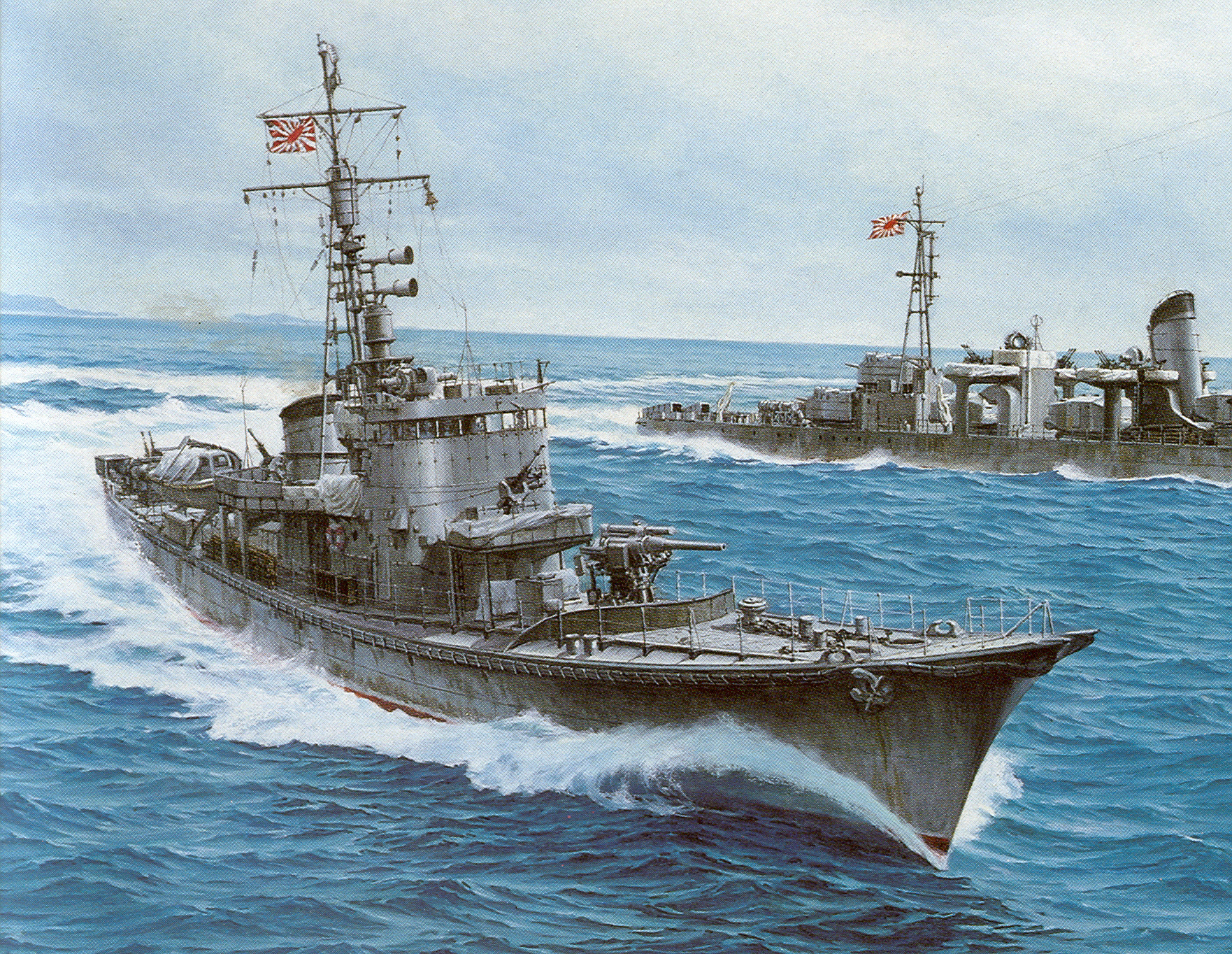
(Subchaser No. 46 by Takeshi Yuki scanned from "Color
Paintings of Japanese Warships")
IJN Subchaser CH-60:
Tabular Record of Movement
© 2005-2019 Bob Hackett, Sander Kingsepp and Peter Cundall
Revision 7
9 August 1943:
Laid down at the Niigata Engineering Co., Ltd. Niigata factory.
10 January 1944:
Launched and numbered CH-60.
28 March 1944:
Completed and registered in the Kure Naval District. Assigned to the Kure Guard Unit. Undergoes training.
April 1944:
Kitagisi, Kyushu. Conducts continuous patrols. Escorts convoys.
16 April 1944:
Departs Sasebo.
18 April 1944:
Arrives at Saiki.
4 May 1944:
Reassigned to Vice Admiral (Admiral, posthumously) Yamagata Seigo’s (39)(former CO of HOSHO) 4th Southern Expeditionary Fleet’s 26th Special Base Force. Performs fleet guardship duties at Manila and Davao. Later, escorts convoys out of Ambon.
29 May 1944:
At 0600, CH-60, light cruiser KASHII, escort carriers SHINYO and KAIYO, kaibokan AWAJI, CHIBURI, CD-19 and minelayer TSUBAME depart Moji escorting convoy HI-65 consisting of oilers ITSUKUSHIMA, OMUROSAN, ZUIHO and TOHO MARUs, naval oiler SHIRETOKO, cargo liners ARIMASAN, MANILA, KASHII and TATSUWA MARUs and troop transport SHINSHU MARU.
2 June 1944:
Formosa Straits. AWAJI is torpedoed by LtCdr (later Captain) Albert L. Raborn's (USNA ’34) USS PICUDA (SS-382) and sinks near Yasho Island at 22-48N, 121-24E. Her CO, Cdr Niki Kouzou, and 75 crewmen are KIA. CHIBURI and CD-19 rescue the remaining crewmen, but several die of their wounds. Raborn fires two torpedoes at ARIMASAN MARU that cause her to collide with SHINSHU MARU's stern. This causes a depth charge explosion that kills about 70 men and damages her rudder. KASHII takes SHINSHU MARU in tow. ARIMASAN MARU is lightly damaged in the attack and heads for Kirun with KASHII and SHINSHU MARU.
E of Formosa. The convoy is attacked by LtCdr (later Captain) Enrique D. Haskins' (USNA ’33) new USS GUITARRO (SS-363) enroute from Pearl to Fremantle. At 0519 and 0527, Haskins makes a moonlight periscope approach and fires six torpedoes at an oiler. One of the torpedoes makes a circular run and USS GUITARRO is forced deep. Later, USS GUITARRO avoids depth charge and aircraft attacks and escapes to Australia.
At 1800 CH-60 arrives at Takao and departs soon after at 2400.
4 June 1944:
At 0900 arrives at Takao, Formosa. KAIYO rejoins the convoy after brief stop at Saei. Oiler JINEI MARU joins the convoy at sea.
5 June 1944:
At 1900 CH-60 departs Takao.
6 June 1944:
At 1930 arrives at Manila. Apparently at this point the ship is detached from HI-65.
8 June 1944:
At 0830 departs Manila and at 0930 arrives at nearby Cavite.
10 June 1944:
At 1400 departs Cavite and at 1500 arrives at Manila.
14 June 1944:
At 0030, departs Manila escorting convoy C-143 consisting of TATSUWA MARU, one unidentified Army merchant ship and one unidentified Navy merchant ship.
16 June 1944:
At 0810 arrives at Cebu.
17 June 1944:
At 1155 departs Cebu.
18 June 1944:
At 1525 arrives at Cebu.
20 June 1944:
At 0643 CH-3 and CH-60 departs Cebu escorting HAKUSAN MARU.
22 June 1944:
At 0445 arrives at Davao.
3 July 1944:
At 0500 CH-60, minesweeper W-5, auxiliary submarine chaser KYO MARU No. 13 and auxiliary minesweeper YACHIYO MARU depart Davao in a convoy consisting of TATEBE (KEMBU) and TATSUYASU MARUs. The latter two auxiliaries are detached at an unknown place and time.
8 July 1944:
At 2000 arrives at Kau.
11 July 1944:
At 0900, CH-60 and minesweeper W-5 depart Kau, Halmahera Island escorting M-26 convoy consisting of HAMBURG, NARUO, CLYDE, CHINKAI MARUs and SHINSEI MARU No. 5 en route to Manila.
13 July 1944:
At 1830, the convoy arrives Bitung NE Celebes.
16 July 1944:
At 0730, CH-60 and minesweepers W-5 and W-8 depart Bitung in a convoy consisting of CELEBES, TAIAN, TAIKAI and TOYO MARUs.
22 July 1944:
At 1720, the convoy arrives at Ambon.
24 July 1944:
At 0820 CH-60, minelayer WAKATAKA, minesweeper W-22 and auxiliary minesweeper WA-3 depart Ambon escorting TOYO, TAIKAI and SHINSEI MARUs.
1 August 1944:
At 1800 arrives at Bitung.
2 August 1944:
At 1700 departs Bitung.
5 August 1944:
At 1030 arrives at Ambon.
7 August 1943:
At 1300, departs Ambon with submarine chasers CH-26 and CH-60 and auxiliary submarine chaser CHa-116 escorting a convoy consisting of auxiliary cargo ship KEMBU (TATEBE) MARU (4,519 grt), TAIAN and KINREI MARUs and UNKAI MARU No. 12.
9 August 1944:
At 1600 arrives at Staring Bay.
11 August 1944:
At 0300 departs Staring Bay.
12 August 1944:
At 1100 arrives at Ambon.
17 August 1944:
At 1200 arrives at Ambon.
18 August 1944:
At 1235 departs Ambon on a transport mission escorting Navy transports T-149 and T-151.
19 August 1944:
At 2330 arrives at Toeal (Tual).
20 August 1944:
At 0015 departs Toeal.
21 August 1944:
At 0430 arrives at Ambon.
23 August 1944:
At 1300 departs Ambon on an escort mission with auxilary minesweeper Wa-104 escorting Navy transports T-149 and T-151.
27 August 1944:
At 1425 arrives at Macassar.
1 September 1944:
At 0740 departs Macassar escorting a convoy consisting of landing ships T-149 and T-151.
5 September 1944:
At 0635, the convoy arrives at Ambon.
6 September 1944:
At 1200 departs Ambon escorting a convoy consisting of landing ships T-149 and T-151.
8 September 1944:
At 1005 arrives at Kendari.
10 September 1944:
At 1800 departs Kendari.
12 September 1944:
At 0645 arrives at Ambon and departs at 1400.
14 September 1944:
At 1035 arrives at Kendari.
21 September 1944:
At 0700 departs Kendari.
23 September 1944:
At 1700 arrives at Macassar.
26 September 1944:
At 1600 departs Macassar with auxiliary submarine chaser SHONAN MARU No. 1 escorting Naval landing ships T.101 and T.149.
29 September 1944:
At 1200 arrives at Surabaya.
30 September 1944:
At 1500 CH-53 and CH-60 depart Surabaya.
October 1944:
Reassigned to Vice Admiral Mikawa Gunichi’s (38) 3rd Southern Expeditionary Fleet’s 31st Special Base force at Manila. Conducts patrols and escorts convoys.
14 December 1944:
At 0440, CH-60 and destroyer MOMO depart Manila’s “Million Dollar Pier” (No.7) for Moji, escorting the “ORYOKU MARU” convoy likely also consisting of ARIMASAN, TEIHOKU (ex French PERSEE) and NISSHO MARUs. ORYOKU MARU is carrying general goods and 3,511 evacuees including 1,619 Allied POWs, most of whom are field grade officers. Japanese civilians occupy the passenger cabins. The POWs are crammed into three cargo holds.
7 miles S of Napo Point. At 0650, air attacks begin by Vice Admiral (later Admiral) Marc A. Mitscher’s (USNA ’10)(former CO of USS HORNET, CV-8) Task Force 38's USS HORNET (CV-12). Between six and 13 TBF "Avengers" attack the ORYOKU MARU convoy in eleven waves that day. ORYOKU MARU is hit by bombs and her hull opened in many places by near misses. The ship begins taking on water and develops a 15 degree list to port. Her captain decides to strand her in shallow water. At 1020, ORYOKU MARU is beached at Suesute Point. The engine room is urgently repaired to allow the ship to be refloated on the high tide.
Subic Bay, Philippines. At 2150, the ship drops anchor inside Olongapo Port. The dead and passengers are offloaded, but the POW’s are left on board with guards. At the same time, the ship begins taking in water again and her list increases. The convoy is dissolved at, or prior to this time, and CH-60 and MOMO head north.
15 December 1944:
Subic. ORYOKU MARU is again bombed by 12 waves of aircraft from USS HORNET. At 0800 another prolonged air raid begins with 16 aircraft from USS HORNET attacking. Direct bomb hits start fires and wreck fire fighting pumps. Manual efforts to douse the fires are to no avail. At 1030, Abandon Ship is ordered. At 1630, off Caiman reef, the ship’s bow lodges in a group of rocks. ORYOKU MARU heels over and sinks about 300 yards offshore from the former Olongapo Naval Base at 14-45N, 120-13E. 48 men on the ship were killed defending the ship, including 10 of the crew. 111 people were wounded. The ship had loaded at Manila general goods and 3511 POWs and evacuees for Japan, of whom 728 were killed, including 286 POWs.
140 miles WSW of Cape Bolinao, Luzon. At about 1900 that same day, CH-60 and MOMO are attacked by LtCdr Francis W. Scanland's (USNA ’34) USS HAWKBILL (SS-366) probably while still escorting ARIMASAN, TEIHOKU and NISSHO MARUs. Scanland fires three torpedoes by radar and sinks MOMO at about 16-00N, 117-39 E taking down 92 of her crew including her CO, LtCdr Minagawa Yoshio (63). CH-60 escapes.
February 1945:
CH-60 is reassigned to the 1st Marine Escort Division. Escorts convoy between Formosa (Taiwan) and Sasebo.
14 February 1945:
At 1100 CH-60 together with kaibokan UKU, CD-72, CD-150 and minesweeper W-21 depart Moji escorting MOTA-37 convoy consisting of DAIKO, DAIIKU MARUs and three unidentified merchant ships.
18 February 1945:
At 1700 arrives at Ssu Chiao Shan. W-21 is detached.
19 February 1945:
At 0800 departs Ssu Chiao Shan. At 1800 arrives at Niubi Shan.
20 February 1945:
Departs Niubi Shan.
21 February 1945:
Off Wenchow, China. CD-150 and CD-72 are damaged in a collision.
22 February 1945:
Arrives at Tanshui, Formosa.
23 February 1945:
At 0700 departs Tanshui and at 1200 arrives at Kirun (Keelung).
25 February 1945:
Departs Mako escorting damaged destroyer HARUKAZE.
1 March 1945:
Arrives at Mazu Shan (Matsu Island).
3 March 1945:
Departs Mazu Shan.
4 March 1945:
At 1830 arrives at Ssu Chiao Shan, probably still escorting HARUKAZE.
5 March 1945:
CH-60 is reassigned to the General Escort Command’s First Escort Fleet’s 31st Subchaser Division with CH-19, CH-20, CH-21 and CH-26.
9 March 1945:
At 1220 arrives at Mutsure. At 2300 transfers to Moji.
14 March 1945:
At 1035 CH-60 departs Moji with kaibokan KURAHASHI and CD-205 escorting convoy MOTA-42 consisting of two unidentified merchant ships. At 1125 arrives at Mutsure and at 1200 departs.
18 March 1945:
At 1930 anchors at Ta Changtu Shan, north of the Chusan Islands group.
20 March 1945:
Departs Ta Changtu Shan.
23 March 1945:
Arrives at Wenchow.
26 March 1945:
Departs Wenchow.
27 March 1945:
At 1700 arrives at Kirun.
31 March 1945:
At 0300 CH-60 departs Kirun with kaibokan KURAHASHI and CD-205 escorting convoy TAMO-52 consisting of two unidentified merchant ships possibly PEKING and SANJIN MARUs.
Early April 1945:
Arrives at Moji.
15 August 1945: Cessation of Hostilities:
At Sasebo.
5 October 1945:
Removed from the Navy List. Attached to the Allied Repatriation Service and designated a special cargo ship.
11 October 1945:
Departs Sasebo. Later that day arrives at Pusan and departs port that evening.
12 October 1945:
Arrives at Hakata.
15 October 1945:
Departs Hakata.
16 October 1945:
Arrives at Pusan and departs port later that day arriving at Hakata late the same day.
19 October 1945:
Departs Hakata.
20 October 1945:
Arrives at Pusan and departs later that day.
21 October 1945:
Arrives at Hakata.
24 October 1945:
Departs Hakata.
25 October 1945:
Arrives at Pusan and departs later that day.
26 October 1945:
Arrives at Hakata.
8 November 1945:
Departs Hakata.
9 November 1945:
Arrives at Pusan and departs later that day.
10 November 1945:
Arrives at Hakata.
12 November 1945:
Departs Hakata.
13 November 1945:
Arrives at Pusan and departs later that day.
14 November 1945:
Arrives at Hakata.
18-29 November 1945:
Undergoes repairs.
20 December 1945:
Departs Hakata.
21 December 1945:
Arrives at Pusan and departs later that day.
22 December 1945:
Arrives at Hakata.
24 December 1945:
Departs Hakata.
25 December 1945:
Arrives at Pusan and departs later that day.
26 December 1945:
Arrives at Hakata.
10 January 1946:
Departs Hakata.
13 January 1946:
Arrives at Shanghai and departs later that day.
15 January 1946:
Arrives at Hakata.
17 January 1946:
Departs Hakata.
21 January 1946:
Arrives at Shanghai.
22 January 1946:
Departs Shanghai.
25 January 1946:
Arrives at Hakata.
26 January 1946:
Departs Hakata.
27 January 1946:
Arrives at Shanghai.
30 January 1946:
Departs Shanghai.
1 February 1946:
Arrives at Hakata.
6 February 1946:
Departs Hakata.
10 February 1946:
Arrives at Shanghai.
12 February 1946:
Departs Shanghai.
15 February 1946:
Arrives at Hakata.
20 February 1946:
Departs Hakata.
22 February 1946:
Arrives at Shanghai and departs later that day.
26 February 1946:
Arrives at Hakata.
1 March 1946:
Departs Hakata.
3 March 1946:
Arrives at Shanghai.
4 March 1946:
Departs Shanghai.
7 March 1946:
Arrives at Kagoshima.
25 March 1946:
Departs Sasebo.
27 March 1946:
Arrives at Shanghai and departs later that day.
29 March 1946:
Arrives at Hakata.
3 April 1946:
Departs Sasebo.
5 April 1946:
Arrives at Shanghai.
10 April 1946:
Departs Shanghai.
12 April 1946:
Arrives at Hakata.
19 April 1946:
Departs Hakata.
23 April 1946:
Arrives at Shanghai and departs later that same day.
28 April 1946:
Arrives at Hakata.
30 April 1946:
Departs Hakata.
4 May 1946:
Arrives at Korojima, near Tientsin
13 May 1946:
Departs Korojima
17 May 1946:
Arrives at Hakata.
23 May 1946:
Departs Hakata.
27 May 1946:
Arrives at Korojima.
28 May 1946:
Departs Korojima.
31 May 1946:
Arrives at Hakata.
3 June 1946:
Departs Hakata.
6 June 1946:
Arrives at Korojima.
7 June 1946:
Departs Korojima.
9 June 1946:
Arrives at Hakata.
13 June 1946:
Departs Hakata.
16 June 1946:
Arrives at Korojima.
20 June 1946:
Departs Korojima.
22 June 1946:
Arrives at Hakata.
26 June 1946:
Departs Hakata.
30 June 1946:
Arrives at Korojima.
1 July 1946:
Departs Korojima.
4 July 1946:
Arrives at Hakata.
13 July-20 August 1946:
Undergoes repairs.
26 September 1946:
Departs Kure.
30 September 1946:
Arrives at Okinawa.
1 October 1946:
Arrives at Okinawa.
4 October 1946:
Arrives at Kure.
6 October 1946:
Departs Kure.
8 October 1946:
Arrives at Okinawa.
10 October 1946:
Departs Okinawa.
13 October 1946:
Arrives at Kure.
15-31 October 1946:
Under repair at Kure.
4 November 1946:
Departs Kure.
6 November 1946:
Arrives at Okinawa and departs later that day.
8 November 1946:
Arrives at Kure.
22 November 1946:
Departs Kure.
25 November 1946:
Arrives at Okinawa and departs later that day.
27 November 1946:
Arrives at Kure.
1948:
Scrapped.
Authors' Note:
[1] On 27 December, the remaining POWs were loaded aboard BRAZIL and ENOURA MARUs and departed for Takao, Formosa. On 13 January 1945, after more bombings at Takao - again by aircraft from HORNET- the 900 remaining POWs sailed from Takao aboard BRAZIL MARU and arrived at Moji, Japan on 29 January 1945. Of the original 1,619 POWs, 1,348 died enroute from various causes including starvation, dehydration, disease and physical abuse by their captors. Different authors give different figures for the number of POWs still alive when BRAZIL MARU arrived in Moji, but most agree only 271 men survived to be repatriated.
Thanks to Mr. Gilbert Casse of France, Berend van der Wal of Netherlands and "Fontessa" of Japan.
-Bob Hackett, Sander Kingsepp and Peter Cundall.
Back to
Subchaser Page

