KUSENTEI!
|
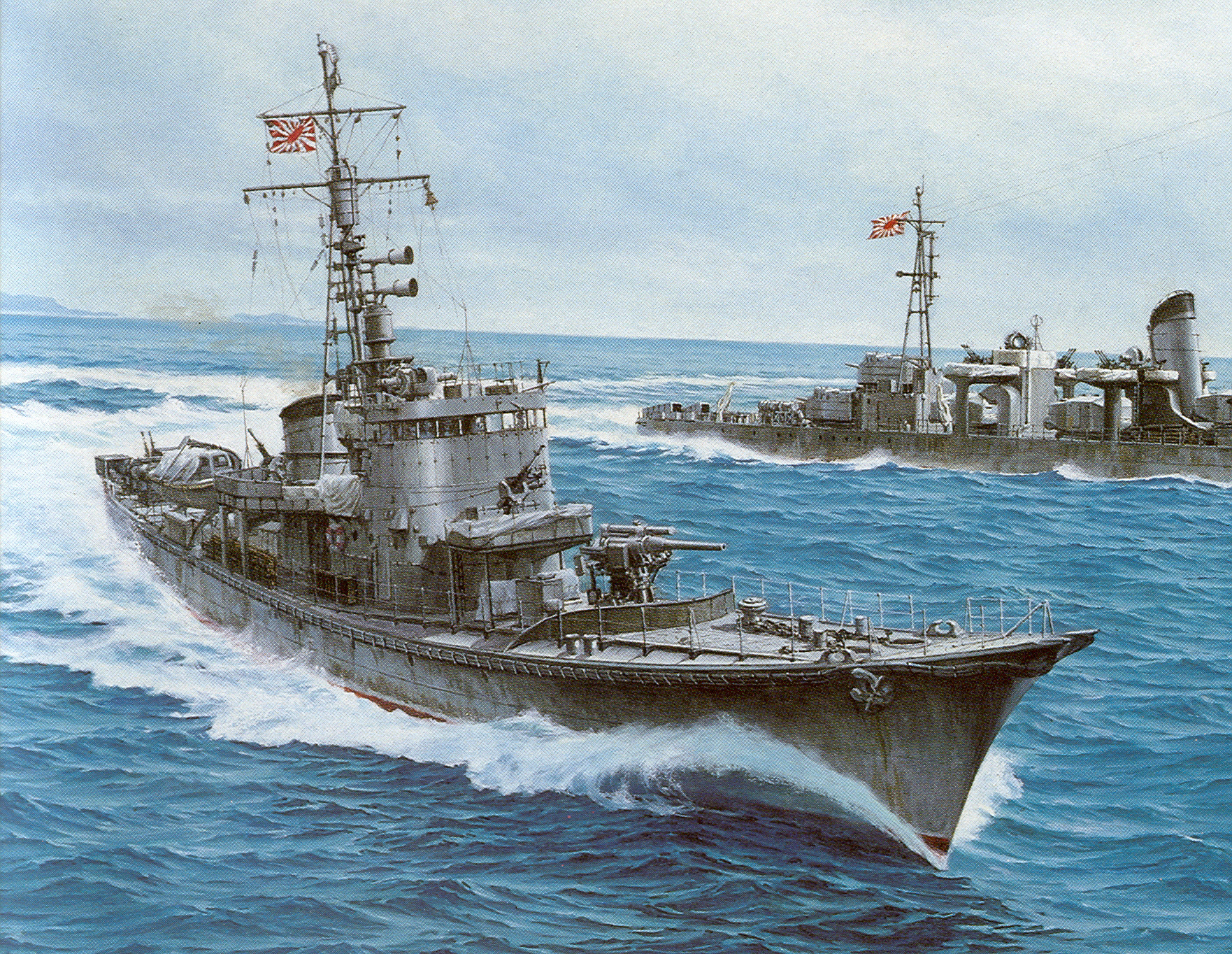
(Subchaser No. 46 by Takeshi Yuki scanned from "Color Paintings of
Japanese Warships")
IJN Subchaser CH-46:
Tabular Record of Movement
© 2005-2017 Bob Hackett, Sander Kingsepp and Peter Cundall
Revision 7
15 January 1943:
Innoshima. Laid down at Hitachi Zosen Co., Ltd's shipyard.
25 June 1943:
Launched and numbered CH-46.
30 September 1943:
Completed and registered in the Yokosuka Naval District. Attached to the Yokosuka Guard Unit.
17 October 1943:
Escorts convoy No. 7017 consisting of one unidentified merchant ship from Tokyo to the Inland Sea. The convoy sails at 9.5 knots.
October 1943:
Attached to the Chichi-Jima Special Base Force. Conducts patrols in the Chichi-Jima area.
December 1943:
CH-46 is reassigned to Vice Admiral Oka Arata's (40) (former CO of KISO) 3rd Southern Expeditionary Fleet based at Manila with CH-36 and CH-45. Performs guardship duties and escorts convoys to Davao and Palau.
5 December 1943:
Arrives at Moji with CH-45.
10 December 1943:
At 1600 CH-45 and CH-46 depart Moji escorting convoy No. 120 consisting of an unknown number of merchant ships.
17 December 1943:
Arrives at Takao. At 1330 CH-46 departs Takao escorting convoy No.782 consisting of GOZAN, TAITO, SHOZUI, KAIRYU, JUICHISEI (HOSHI MARU No. 11), NITTAI, NISSHU, TACOMA, BUNZAN, TSUKIKAWA and RAIZAN MARUs and one unidentified merchant ship also escorted by the destroyer FUYO, auxiliary minesweeper Wa-7 and auxiliary gunboat BUSHO MARU.
20 December 1943:
At 0915 (JST) LtCdr Frank G. Selby's (USNA’33) USS PUFFER (SS-268) torpedoes and hits FUYO's stern with two torpedoes. She sinks in two minutes in 14-45N, 119.45E. Her commander Lt.Kakumo is among the survivors rescued by the escorts. Losses are unknown.
At 0950 USS PUFFER again attacks the convoy. GOZAN MARU reports torpedo tracks at 14-40N, 119.55E, but one prematures and the other four miss. CH-46 and Wa-7 counter-attack while BUSHO MARU retires with the convoy. Later that day the convoy arrives at Manila.
23 December 1943:
CH-46 arrives at Manila, presumably after a submarine sweep.
27 December 1943:
Departs Manila.
30 December 1943:
At 0800, CH-46 departs Zamboanga, Philippines escorting a convoy consisting of oiler ATAGO MARU and cargo ship SHOZUI MARU. At 1800, the convoy arrives at Jolo.
31 December 1943:
At 0700, departs Jolo. At 1700, arrives at Tawi Tawi.
1 January 1944:
Departs Tawi Tawi.
5 January 1944:
Arrives at Manila.
7 January 1944:
CH-46 and torpedo boat TOMOZURU escort a convoy from Miri, Borneo to Manila consisting of oilers OGURA MARU No. 2 and FUSHIMI MARU No. 3. At 2200, the convoy is attacked by LtCdr (later Cdr) Herbert L. Juke's (USNA’32) USS KINGFISH (SS-234). Jukes hits and sinks FUSHIMI MARU No. 3 with two of four torpedoes in a radar-assisted attack. 39 of the crew are KIA. TOMOZURU commences an antisubmarine sweep. Meanwhile, CH-46 escorts OGURA MARU No. 2 out of the area.
9 January 1944:
Arrives at Manila.
15 January 1944:
Departs Manila.
17 January 1944:
Arrives at Manila.
20 January 1944:
At 0900, CH-46 and patrol boat P-103 depart Manila escorting convoy H-14 to Kau, Halmahera consisting of TONEGAWA, KUROGANE, MOJI, MITSUKI, ADEN, KENWA, UGO and RYOCHI MARUs.
22 January 1944:
At 1150, arrives at Cebu, Philippines.
23 January 1944:
At 0900, departs Cebu.
27 January 1944:
At 1456, arrives at Kau.
On that day, FRUMEL decrypts the following message from the 6th Guard Force:
"An enemy submarine was in 01-32N, 128-20E at 1030 with Subchaser No 46 attacking.
WAKATAKA and Minesweeper 105 are to join in the attack and seaplanes from Daru are to cooperate."
30 January 1944:
At 0800, departs Kau for Manila escorting the "M" convoy consisting of KAZUURA, YAMAMIYA, TSUKIKAWA and ODATSUKI MARUs also escorted by patrol boat P-103 and auxiliary subchaser KYO MARU No. 13.
31 January 1944:
Arrives at Cebu.
2 February 1944:
Departs Cebu.
5 February 1944:
Arrives at Manila.
3 March 1944:
Arrives at Zamboanga.
5 March 1944:
Departs Zamboanga.
7 March 1944:
Arrives at Davao.
12 March 1944:
Departs Davao.
15 March 1944:
Arrives at Palau.
21 March 1944:
Departs Palau.
27 March 1944:
Arrives at Davao.
29 March 1944:
Departs Davao.
31 March 1944:
Arrives at Davao.
1 April 1944:
Departs Davao with minesweepers W-5 and W-30 and torpedo boat HAYABUSA escorting part of convoy H-22 now consisting of three Army merchant ships (names unknown though either ATLAS, ANSHU, TOYOOKA, KURAMASAN and MITO MARUs).
Meanwhile minelayer MAESHIMA departs Keelung this day escorting convoy TAPA-08 consisting of an unidentified merchant ship. CH-46 apparently meets the convoy en route.
7 April 1944:
Arrives at Palau. A submarine was sighted immediately before arrival.
3 June 1944:
Submarine chasers CH-41 and CH-46 and kaibokan CD-3 depart Manila escorting convoy H-28 consisting of GENKAI, ATSUTA, HINODE, TSUKUBASAN, KANKYO, YUKI and PACIFIC MARUs.
5 June 1944:
At 0900 off Cebu, minesweeper W-28 meets up with the convoy.
13 June 1944:
At 1200 arrives at Kau.
16 June 1944:
At 0600 submarine chasers CH-41 and CH-46, minesweeper W-5 and kaibokan CD-3 depart Kau for Manila escorting joint convoy M-23 and M-24 consisting of GENKAI, ATSUTA, HINODE, TSUKUBASAN, BELGIUM, TEIYU (Ex Italian CARIGNANO), MURORAN, KANKYO, YUKI and PACIFIC MARUs.
17 June 1944:
Arrives at Menado where W-5 and the M-23 section of three ships (including YUKI MARU) are detached.
21 June 1944:
At 0700 minesweeper W-28 departs Manila to meet up with M-23 and M-24 convoy which it escorts part way.
2 July 1944:
Departs Manila with CH-41 and patrol boat PB-104 escorting convoy H-31 consisting of TOSHO, ASAHISAN, SHINKOKU and MINO MARUs. TOSHO MARU is towing the hyoteki (midget sub) HA-58.
11 July 1944:
Arrives at Bitung, Celebes.
13 July 1944:
At 0600 departs Bitung.
14 July 1944:
Arrives off Kau Bay. Because of reports of enemy minelaying the ships wait at the northern entrance to the bay. As TOSHO MARU slows to anchor HA-58 comes to the surface and is sighted by a patrolling aircraft that mistakes the midget submarine for an enemy submarine and attacks it with bombs, inflicting minor damage. At 1330 the ships arrive at Kau.
15 July 1944:
At 0500 departs Kau with CH-41 and Patrol Boat PB-104 escorting convoy M-27 consisting of HAVRE, SHIRAHAMA, RYOCHI MARUs and possibly others.
16 July 1944:
At 0100 arrives at Bitung.
21 July 1944:
Departs Bitung for Manila.
August 1944:
Philippines. Escorts convoys to Borneo.
15 August 1944:
At 0550, CH-46 and minesweeper W-28 depart Manila escorting convoy H-33 (stage 1) consisting of MEXICO, HAVRE, KUNIYAMA, HACHIJIN, OLYMPIA, MISAKI, CHINEZI, TOYO and IWASHIRO MARUs.
17 August 1944:
Arrives at Cebu.
18 August 1944:
At 1830, CH-46, minesweeper W-28 and patrol boat P-105 depart Cebu escorting convoy H-33 (stage 2) consisting of MEXICO, HAVRE, KUNIYAMA and HACHIJIN MARUs.
21 August 1944:
Arrives at Zamboanga. Later that day, CH-46, CH-31, minesweeper W-28 and patrol boat P-105 depart Zamboanga escorting convoy H-33 (stage 3) consisting of MEXICO and HAVRE MARUs.
24 August 1944:
Arrives at Jolo Island.
27 August 1944:
At 0625, CH-46, CH-31, minesweeper W-28 and patrol boat PB-105 depart Jolo escorting convoy H-33 (stage 4) consisting of MEXICO and HAVRE MARUs en route to Menado.
29 August 1944:
At 0225, LtCdr (later Captain) Arthur E. Krapf's (USNA ’34) USS JACK (SS-259) torpedoes and sinks MEXICO MARU at 02-15N 122-29E. The ship is loaded with 1000 tons coal, 3246 tons general goods, 4041 Communications Troops of the 26th Regiment and Reserve troops and also 1600 tons rice, 1000 cans filled with heavy oil or concentrated sulphuric acid, 103 cans filled with gasoline, 200 tons coal, 8 tons yellow gunpowder, 1000 tons clothing and 19 motor vehicles. 825 Troops, a gunner and 21 crewmen are killed. CH-31 rescues 760 men, CH-46 935 men and PB-105 1609 men, a total of 3304 survivors.
At about 0400, Krapf makes another surface attack on the convoy. He fires nine torpedoes by radar bearings of which three hit and sink minesweeper W-28 at 02-15N, 123-29E. No counterattacks are made and USS JACK safely departs the scene.
23 October 1944:
At 1230 CH-46 and auxiliary submarine chaser CHOUN MARU No. 21 conduct a submarine sweep north of Lubang Island in advance of arrival of damaged heavy cruiser AOBA being towed by light cruiser KINU, and destroyer URANAMI. CH-46 then escorts AOBA on starboard side with URANAMI on port side.
24 October 1944:
Tug KEISHU MARU (ex British HENRY KESWICK) arrives in Manila Bay and tows AOBA to Cavite Naval Yard.
9 November 1944: Operation "TA No. 3" - The Reinforcement of Leyte:
In the early dawn, reinforcement convoy TA No. 3 departs Manila consisting of CELEBES, TAIZAN, MIKASA, SAIHO and TENSHO MARUs escorted by destroyers SHIMAKAZE, HAMANAMI, HATSUHARU, TAKE, minesweeper W-30 and CH-46.
10 November 1944:
Bondoc Peninsula. CELEBES MARU runs aground and is left behind. Meanwhile, after convoy TA No. 4 is badly mauled by an American air attack, Admiral Kimura transfers destroyers ASASHIMO, NAGANAMI and WAKATSUKI to join convoy TA No. 3 to augment its AA protection. [1]
That evening, USS PT-321 and PT-324 unsuccessfully attack the convoy, but are driven off by HAMANAMI. The PT-boats seek shelter in San Isidro Bay, but both run aground. To prevent capture, scuttling charges are prepared. PT-321's charges blow her up, but PT-324's charges fail to detonate. The stranded crews, assisted by 100 Philippine guerillas reboard the boat the following day. They eventually refloat her and safely make it back to Allied lines.
11 November 1944:
Task Force 38 launches a total of 347 planes to attack the convoy. At 1050. the first of the attacking aircraft are detected while the convoy is within one mile of its destination - the beach at Ormoc Bay. Over the next few hours, all of the convoy's ships, except ASASHIMO and CH-46, are sunk. At 1630, the last ship, SHIMAKAZE sinks. Of 4,000 troops carried on the four transports only about 500 troops survive. The survivors wading ashore are strafed and killed by American planes that suffer very few casualties in turn.
12 November 1944:
CH-46 and ASASHIMO arrive at Manila.
23 November 1944: Operation "TA No. 5" - The Reinforcement of Leyte:
CH-46 departs Manila escorting convoy TA No. 5's first echelon of landing ships T-111, T-141 and T-160.
24 November 1944:
Masbate Island. Arrives at Port Cataingan early in the morning and takes shelter. Shortly after noon, P-40 "Warhawks" and P-47 "Thunderbolts" fighter-bombers of the 13th Air Force attack and set the three landing ships and their cargos on fire. CH-46 rescues the survivors and heads towards Manila.
25 November 1944:
Carrier aircraft from Task Groups 38.1 and 38.2 find CH-46 enroute back to Manila and sink her at 12-00N, 123-58E.
10 January 1945:
Removed from the Navy List.
Authors' Note:
[1] CELEBES MARU is later bombed and sunk. Convoy TA No. 4 left Manila before TA No. 3.
Grateful thanks for assistance go to Mr. Gilbert Casse of France and Mr. John Whitman of USA. Special thanks go to Hans Mcilveen of the Netherlands for info on FRUMEL intercepts.
-Bob Hackett, Sander Kingsepp and Peter Cundall.
Back to Subchaser
Page

