KUSENTEI!
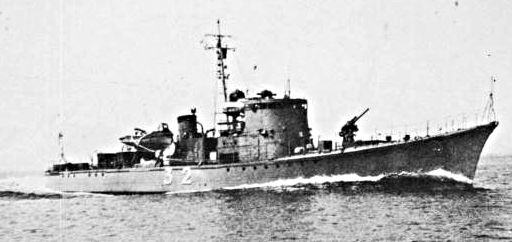
IJN Subchaser CH-42:
Tabular Record of Movement
© 2008-2017 Bob Hackett, Sander Kingsepp and Peter Cundall
Revision 5
20 May 1942:
Innoshima. Laid down at the Hitachi Zosen K.K. shipyard.
5 March 1943:
Launched and numbered CH-42.
31 May 1943:
Completed and registered in the Yokosuka Naval District. Attached to the Yokosuka Guard Force. Escorts convoys between Yokosuka and Kobe.
12 June 1943:
Escorts convoy No. 5614 consisting of unidentified ships.
12 July 1943:
Survey ship escort KOMAHASHI and CH-42 depart Tokyo Bay escorting westbound convoy No. 7712 consisting of NIIGATA and YAMAGIRI MARUs. The convoy sails at 13.5 knots bound for Yokkaichi and Nagoya.
30 July 1943:
CH-42 departs Inland Sea escorting eastbound convoy No. 8730 consisting of five unidentified merchant ships. Later the convoy is met by auxiliary netlayer KASHI MARU.
August 1943:
Escorts convoys between Hachinohe, Honshu and Onagawa.
31 December 1943:
Relinquishes escort of convoy No. 2229 consisting of unidentified ships to auxiliary subchaser CHa-1.
February 1944:
Yokosuka. Undergoes maintenance. Thereafter, escorts convoys to Chichi-Jima, Bonin Islands.
23 February 1944:
120 miles NNW of Chichi-Jima, Bonins. At 2240 rescues 142 survivors from KOYO (KAYO) MARU (5471 GRT), torpedoed by USS SNOOK (SS-279) at 28-49N, 141-13E.
March 1944:
Off Sanriku, NE Honshu. Conducts patrols.
1 June 1944:
Arrives at Yamada after escorting convoy No. 2601B from off Hachinohe.
2 June 1944:
Departs Yamada.
5 June 1944:
Arrives at Yamada escorting convoy No. 2604.
6 June 1944:
Departs Yamada.
7 June 1944:
Arrives at Yamada.
11 June 1944:
Departs Yamada escorting convoy No. 1609. Then joins up with convoy No. 1612.
15 June 1944:
Arrives at Yamada.
17 June 1944:
Departs Yamada.
19 June 1944:
Arrives at Yamada.
20 June 1944:
Departs Yamada and later that day returns to port.
23 June 1944:
Departs Yamada escorting water tanker SHINSUI MARU.
24 June 1944:
Arrives at Yamada escorting convoy No. 1623.
25 June 1944:
Departs Yamada.
26 June 1944:
Arrives at Yamada.
29 June 1944:
Departs Yamada and meets up with convoy No. 1629.
1 July 1944:
Arrives at Yamada.
6 July 1944:
Departs Yamada and meets up and escorts ARAOSAN MARU in convoy No. 2708.
9 July 1944:
Arrives at Yamada.
10 July 1944:
Departs Yamada and with auxiliary minesweeper FUKUEI MARU No. 7 meets up with convoy No. 2710 consisting of two unidentified merchant ships.
11 July 1944:
Arrives at Onagawa.
12 July 1944:
Departs Onagawa and later that day arrives at Yamada.
15 July 1944:
Departs Yamada.
17 July 1944:
Arrives at Yamada and departs later that day.
18 July 1944:
Arrives at Yamada and departs later that day escorting RYUHO MARU No. 1.
19 July 1944:
Arrives at Onagawa.
20 July 1944:
Departs Onagawa and later that day arrives at Yamada.
23 July 1944:
Departs Yamada.
24 July 1944:
Arrives at Onagawa and departs later that day.
25 July 1944:
Arrives at Yamada.
28 July 1944:
Departs Yamada.
30 July 1944:
Arrives at Yamada.
2 August 1944:
Departs Yamada escorting SHINRYU MARU (482 grt).
3 August 1944:
Arrives at Yamada.
6 August 1944:
Departs Yamada.
7 August 1944:
At 0800 arrives at Yamada with auxiliary picket boat KOSHO MARU No. 2.
8 August 1944:
Departs Yamada but later that day returns to Yamada.
12 August 1944:
Departs Yamada escorting YUZUKI MARU.
13 August 1944:
Arrives at Yamada.
14 August 1944:
Departs Yamada but later that day returns to Yamada.
16 August 1944:
Departs Yamada.
18 August 1944:
Yokosuka. Undergoes repair and maintenance.
18 September 1944:
CH-42, Navy transport landing ship T-134 and the light cruiser ISOJIMA (ex Chinese NING HAI) departs Yokosuka. ISOJIMA is towing midget submarine HA-75.
85 nms from Hachiji Jima. At about 0553, LtCdr Lawrence V. Julihn’s USS SHAD (SS-235) fires four Mark-23 steam torpedoes and gets three hits on ISOJIMA. She sinks at 33-40N, 138-20E. LtCdr Hukuchi is KIA. Other losses are unknown. SHAD endures a lengthy depth charging by CH-42 and possibly auxiliary submarine chaser CHa-170. Meanwhile, HA-75 has torn loose from the sinking ISOJIMA and is later recovered 3 days later and towed into Yokosuka.
22 September 1944:
CH-42 arrives at Yokosuka.
27 September 1944:
At 1300, CH-42 departs Yokosuka for Chichi-Jima with minelayer AJIRO escorting convoy No. 3927 consisting of SEIAN and KISARAGI MARUs.
1 October 1944:
NW of the Ogasawara (Bonin) Islands. At 0903, LtCdr William W. Walker's (USNA ’34) USS SNAPPER (SS-185) torpedoes and sinks SEIAN MARU at 28-20N 139-25E. The ship had loaded approximately 100 troops at Yokosuka as well as gasoline, rations and war supplies, and four troops and 12 crewmen are killed. At 0914, USS SNAPPER also torpedoes and sinks AJIRO. CH-42 launches depth charge attacks without success.
2 October 1944:
CH-42 and KISARAGI MARU are attacked by nine B-24 bombers, but suffer no damage. That evening, they arrive safely at Chichi-Jima.
4 October 1944:
CH-42 and Auxiliary submarine chaser SHONAN MARU No. 8 depart Chichi-Jima escorting Convoy No. 4004A consisting of KISARAGI MARU.
12 October 1944:
Arrives at Yokosuka and undergoes repairs.
24 October 1944:
At 1050 CH-42 and kaibokan CD-12 depart Yokohama escorting convoy No. 3024 consisting of JUZAN MARU I GO and RYUJIN MARU. The ships later arrive at Tateyama.
25 October 1944:
At 0600 departs Tateyama.
29 October 1944:
At 1755 arrives at Haha Jima. RYUJIN MARU is joined by auxiliary minesweeper KEINAN MARU and proceeds to Chichi-Jima. The rest of the convoy remains at Haha-Jima.
30 October 1944:
At 1700 CH-42 and kaibokan CD-12 depart Haha Jima escorting convoy No. 4030 consisting of JUZAN MARU I GO bound for Yokosuka.
3 November 1944:
At 1345 arrives at Shimoda.
4 November 1944:
Departs Shimoda and later that day at 1300 arrives at Uraga.
8 November 1944:
Departs Uraga and transfers to Yokosuka.
16 November 1944:
Departs Yokosuka.
25 November 1944:
Arrives at Yokosuka.
29 November 1944:
Departs Yokosuka and later that day arrives at Tateyama.
30 November 1944:
CH-42, kaibokan CD-56 and AMAKUSA with auxiliary minesweepers Wa-12, Wa-14 and auxiliary submarine chaser TAKUNAN MARU No. 2 depart Tateyama escorting convoy No. 3129 consisting of HIYOSHI MARU No. 2 GO bound for Haha Jima (with AMAKUSA and CD-56 as designated escorts) and YAEI and SHIBAZONO MARUs bound for Chichi-Jima. At 1600 heavy seas cause damage to YAEI MARU's hull and wash a Daihatsu landing barge overboard. The ship returns to Tateyama via Hachijo Jima escorted by TAKUNAN MARU No. 2 while the convoy continues its voyage. At some point CH-42 is detached and returns to Yokosuka.
5 December 1944:
Arrives at Yokosuka.
9 December 1944:
Departs Yokosuka and later that day arrives at Tateyama.
12 December 1944:
At 1415, CH-42 departs Tateyama for Chichi-Jima with kaibokan CD-6, CD-12 and minesweeper W-29 escorting convoy No. 3209 consisting of JUZAN, YAEI, KAIKO and SHOTO MARUs.
13 December 1944:
The convoy encounters bad weather and at 1136 puts into Hachijo-Jima. At 1653, the same day, it departs.
16 December 1944:
44 miles W of Chichi-Jima. At 0229, in a night surface radar attack, LtCdr Robert R. Williams' (USNA ’34) USS FINBACK (SS-230) torpedoes and sinks JUZAN MARU I GO at 27-24N, 141-44E. 33 crewmen are killed. Williams also fires torpedoes at minesweeper W-29 and subchaser CH-42 for no results, but the escorts do not counter-attack. At 1249, the convoy enters Futami Harbor, Chichi-Jima. Unloading is begun immediately.
17 December 1944:
Unloading is finished by mid-morning. At about 1530, the same ships, now renumbered as convoy No. 4217, departs Chichi-Jima for Tateyama.
20 December 1944:
Enroute stormy weather is encountered. The convoy again shelters at Hachijo-Jima.
21 December 1944:
At 0700, departs Hachijo Jima.
22 December 1944:
At 0314, arrives at Tateyama and later that day at Yokosuka.
26 December 1944:
Departs Chichi-Jima and later that day arrives at Tateyama.
27 December 1944:
CH-42 departs Tateyama with kaibokan CD-12 and minesweeper W-29 in convoy No. 3226 consisting of YAEI, SHIBAZONO, YONEYAMA MARUs and NANYO MARU No. 1.
31 December 1944:
Arrives at Chichi-Jima.
1 January 1945:
At 1700, departs Chichi-Jima with kaibokan CD-12 and minesweeper W-29 escorting convoy No. 4101 consisting of SHIBAZONO, YONEYAMA, YAEI MARUs and NANYO MARU No. 1.
3 January 1945:
At 2030, LtCdr Talbot E. Harper's (USNA ’37) USS KINGFISH (SS-234) torpedoes and sinks SHIBAZONO and YAEI MARUs at 30-21N, 142-15E. 57 crewmen on SHIBAZONO MARU and two passengers, two gunners and 27 crewmen on YAEI MARU are killed. CH-42 and CD-12 launch unsuccessful depth charge attacks.
6 January 1945:
At 0918, arrives at Tateyama.
7 January 1945:
Departs Tateyama and later that day arrives at Yokohama.
15 January 1945:
Departs Yokohama and later that day arrives at Tateyama.
16 January 1945:
At 1200, CH-42 departs Tateyama with kaibokan CD-12, CD-56 and minesweeper W-29 escorting convoy No. 3115 consisting of KURETAKE, YONEYAMA MARUs and NANYO MARU No. 1 and UNYO MARU No. 6.
19 January 1945:
At 1046, the convoy is attacked by a group of large American aircraft, but the attack is beaten off. At 1142, arrives at Futami Port, Chichi-Jima.
22 January 1945:
Of Chichi-Jima. CH-42 is damaged by a mine.
28 January 1945:
At 0200 submarine chasers CH-42 and CH-44, kaibokan CD-4 and AMAKUSA and auxiliary submarine chaser SHONAN MARU No. 8 depart Chichi-Jima for home islands, escorting Convoy No. 4127 consisting of NAGATSU, MIYO MARUs and OIL TANKER No. 3998.
S of Yome Jima, Bonins. After 2110, the convoy is attacked by a single Boeing B-29 "Superfortress". During the brief encounter one sailor from CD-4 is lost in the dark, probably washed overboard during an evasive manoeuvre.
30 January 1945:
Off Mikura Island. At 0735, Cdr. John J. Foote's USS THREADFIN (SS-410) torpedoes and sinks the 1,864-ton ISSEI MARU in 33-30N, 135-34E. The submarine is spotted by a Nakajima B5N2 "Kate" torpedo bomber from the 903rd NAG, who alerts the passing convoy. CD-4 is detached to the scene of attack. She conducts a depth-charge attack, forcing the submarine to the depth of 462 ft.
1 February 1945:
Arrives at Tateyama.
February-March 1945:
Yokosuka. Undergoes battle damage repairs throughout these months.
8 April 1945:
Repairs completed. Transfers to Yokosuka.
13 April 1945:
Departs Yokosuka.
18 April 1945:
Arrives at Yokosuka.
24 April 1945:
Departs Yokosuka.
25 April 1945:
Arrives at Yokosuka.
May 1945:
Off Sanriku. Escorts convoys.
12 May 1945:
Departs Yokosuka escrting ammunition ship SOYA.
13 May 1945:
Arrives at Onagawa.
14 May 1945:
Departs Onagawa still escorting SOYA.
15 May 1945:
Arrives at Hachinohe where SOYA is detached.
16 May 1945:
Departs Hachinohe and later that day arrives at Muroran.
17 May 1945:
Departs Muroran escorting AWA MARU (4523 grt) and later that day arrives at Onagawa.
18 May 1945:
Departs Onagawa.
19 May 1945:
Arrives at Yokosuka with AWA MARU detaching for Yokohama, and remains there for the rest of the month.
22 July 1945:
At 1600, CH-42 departs Yokohama for Hakodate, Hokkaido with minesweeper W-1 escorting a convoy consisting of ENBUN MARU and HAKUTETSU MARU No. 5. The convoy assembles at Tateyama and departs at 2100. At 2350, off Cape Nojima, the convoy comes under fire from eight American destroyers of DesRon 61 at 34-50N, 139-50E. At a range of 3.5 miles, both ENBUN MARU and HAKUTETSU MARU No. 5 are hit. Fires are started on HAKUTETSU MARU No. 5.
23 July 1945:
Early morning. Carrier-based planes arrive and bomb and strafe the convoy. ENBUN MARU reverses course back to Tateyama. HAKUTETSU MARU No. 5 sinks while under tow to Yohohama. The convoy is dissolved.
3 August 1945::
Onagawa Bay. At 1040, LtCdr Richard Holden’s (USNA 37) USS GATO (SS-212) picks up three pingers of sonar. One heads, north and the other two head south. At 1315, GATO fires two Mark 27 “Cutie” acoustic torpedoes and gets one hit that damages CH-42 at 38-24N, 141-15E. [1]
10 August 1945:
Yamada Bay, Iwate, Japan. Carrier-based planes from Task Force 38 of Admiral (later Fleet Admiral) William F. Halsey's (USNA ’04) Third Fleet, probably Curtiss SB2C-3 “Helldiver” dive-bombers of USS RANDOLPH's (CV-15) VB-16, attack and sink CH-42 and minesweeper W-1 at 38-26N, 141-30E. [2]
15 August 1945:
The End of Hostilities.
15 September 1945:
Removed from the Navy List.
Authors' Note:
[1][2] Sources conflict on the damage of CH-42. Some say CH-42 was damaged on 31 Jul 45 at Osaka Bight, Honshu by USS THORNBACK (SS-418) and then badly damaged and beached on 9 Aug ’45 at Onagawa Bay by fighter-bombers of the British Pacific Fleet’s TF 37.
Thanks go to readers Berend of Belgium and George Kernahan of UK, a USN carrier aircraft researcher for info in Rev 3. Thanks also to Gilbert Casse of France for general assistance.
-Bob Hackett, Sander Kingsepp and Peter Cundall.
Back to Subchaser
Page

