KUSENTEI!
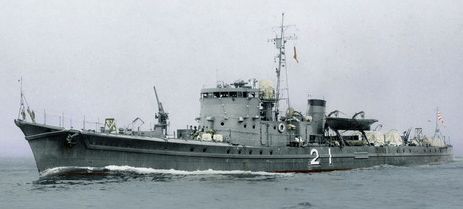
IJN Subchaser CH-26:
Tabular Record of Movement
© 2005-2018 Bob Hackett, Sander Kingsepp and Peter Cundall
Revision 13
1941:
Tsurumi. Laid down at the Nippon Kokan K.K. shipyard as Subchaser No. 193.
30 June 1941:
Renumbered CH-26.
28 August 1941:
Launched.
20 December 1941:
Completed and registered in the Kure Naval District. Assigned to the Kure Guard Unit. Lt (later LtCdr) Matsushima Minoru is the Commanding Officer.
January 1942:
Patrols the Bungo Strait.
2 April 1942:
At 1500 arrives at Saiki after patrolling the Bungo Suido.
4 April 1942:
At 1000 departs Saiki and patrols the Bungo Suido area.
5 April 1942:
Arrives at Saiki after patrolling the Bungo Suido.
6 April 1942:
Departs Saiki and patrols the Bungo Suido area.
8 April 1942:
Arrives at Saiki after patrolling the Bungo Suido.
9 April 1942:
Departs Saiki and patrols the Bungo Suido area.
8 April 1942:
Arrives at Saiki after patrolling the Bungo Suido.
9 April 1942:
Departs Saiki and patrols the Bungo Suido area. Later that day arrives back at Saiki
10 April 1942:
Departs Saiki and patrols the Bungo Suido area.
11 April 1942:
Arrives at Saiki after patrolling the Bungo Suido.
12 April 1942:
Departs Saiki and patrols the Bungo Suido area.
13 April 1942:
Arrives at Saiki after patrolling the Bungo Suido. Later that day departs Saiki on another patrol.
14 April 1942:
At 1830 arrives at Sukumo.
17 April 1942:
At 0900 departs Sukumo patrolling the Hyuga Nada.
18 April 1942:
Arrives back at Sukumo.
19 April 1942:
Departs Sukumo and patrols the Bungo Suido area.
20 April 1942:
Arrives at Saiki.
23 April 1942:
At 1000 departs Saiki and at 1730 arrives at Kure.
1 May 1942:
Assigned to Vice Admiral Hosogaya Boshiro's (36) (former CO of MUTSU) 5th Fleet in SubChasDiv 13 with CH-25 and CH-27.
18 May 1942:
At 0900 CH-25, CH-26 and CH-27 depart Kure.
20 May 1942:
At 1600 CH-24 and at 1700 CH-25 arrive at Nagaura. CH-26 and CH-27 arrive at Yokosuka at 1400.
21 May 1942:
SubChasDiv 13 departs Yokosuka. Patrols in the Aleutians.
22 May 1942:
At 0900 SubChasDiv 13 (CH-25, CH-26 and CH-27) and CH-24 departs Yokosuka.
23 May 1942:
At 1100 the escorts arrive at Ominato.
26 May 1942:
At 0910 CH-25, CH-26 and CH-27 depart Ominato and at 1530 arrive at Kawauchi Wan.
28 May 1942:
At 1200 CH-25, CH-26 and CH-27 depart Kawauchi Wan.
1 June 1942:
The escorts arrive at Paramushiro.
2 June 1942:
The escorts depart Paramushiro.
5 June 1942: Operation “AL”- The Invasion of the Aleutians:
Twenty ships of 5th Fleet, including light cruisers KISO and TAMA, three destroyers and four transports carry the Adak-Attu and Kiska Occupation Forces to the Western Aleutians. The Adak occupation is cancelled and the Adak-Attu Occupation Force is directed to seize only Attu.
6 June 1942:
At 1500, Captain (later Rear Admiral) Ono Takeji’s (44) Occupation Force lands a battalion of Special Naval Landing Force troops at Reynard Cove on Kiska without opposition.
7 June 1942:
At 0300, Rear Admiral (later Vice Admiral) Omori Sentaro's (41) (former CO of ISE) Adak-Attu Occupation Force lands a battalion of Army troops on Attu, also without opposition. That evening CD-25, CD-26 and CD-27 arrive off Kiska.
15 July 1942:
W of Sredni Point, Kiska. LtCdr Mannert L. Abele‘s (USNA ’26) (former CO of USS S-31) USS GRUNION (SS-216), on her first war patrol, attacks three warships Abele takes to be destroyers, but are actually CH-25, CH-26 and CH-27. Abele torpedoes and sinks CH-25 and CH-27 and possibly damages Lt Matsushima Minoru's CH-26, all at 52-02N, 177-42E. CH-26 searches for survivors in the Artic waters, but none are found.
20 July 1942:
SubChasDiv 13 is disbanded.
29 July 1942:
Holtz Bay, Attu. At noon, CH-26 departs for Kiska escorting cargo ship KANO MARU that arrived the previous day from Shimushu, Kuriles carrying building materials, coal, four Daihatsu landing craft and a floatplane for Kiska. CH-26 loses contact with KANO MARU.
30 July 1942:
At 0800, KANO MARU arrives 22 miles N of Kiska, but heavy fog prevents her approach into Kiska Harbor. She drifts most of the day. At 1530, a float fighter, probably an A6M-N2 Rufe carried to Kiska aboard CHIYODA earlier that month, ditches nearby KANO MARU. The pilot is picked up and KANO MARU winches the fighter aboard with her derrick.
31 July 1942:
Off Kiska, Aleutians. At 0547, LtCdr Mannert L. Abele's (former CO of USS S-31) USS GRUNION (SS-216), on her first war patrol, torpedoes freighter KANO MARU and gets a hit on the starboard machinery room. Abele fires three more unreliable Mark-14 torpedoes. One runs deep and the others hit, but fail to explode. Abele attempts to surface and sink KANO MARU by gunfire, but an old 8-cm/40 (3-inch) Type 41 gun on KANO MARU opens fire on GRUNION's periscope. Her 84th shot hits the conning tower. GRUNION crash dives, but Abele's green crew loses depth control. USS GRUNION exceeds crush depth, implodes and is lost. [1]
Later, CH-26, minelayer ISHIZAKI and cable layer UKISHIMA arrive on scene and observe much oil, a piece of lifeguard buoy, submarine deck material and other things.
August 1942:
At Kure. Undergoes repairs and refit until December 1942. An unknown officer assumes command. Lt.Matsushima assigned as Chief Equipping Officer of HABUSHI.
28 August 1942:
At 1600 arrives at Nagaura.
30 August 1942:
At 1015 departs Nagaura.
December 1942:
CH-26 is reassigned to the 2nd Base Force, 8th Fleet at Rabaul. Escorts convoys and patrols to and from Shortland, Bougainville.
29 December 1942:
At 1400, CH-26 and CH-34 depart Yokosuka escorting a convoy consisting of SHINSEI MARU No. 18 and TERUSHIMA MARU.
4 January 1943:
CH-26 and CH-34 and the convoy arrive at Saipan.
6 January 1943:
CH-26 and CH-34 and the convoy depart Saipan.
11 January 1943:
At 0530, arrives at Rabaul.
13 January 1943:
Departs Rabaul.
15 January 1943:
At 0500 begins escorting an unidentified ship.
17 January 1943:
At 1500, arrives at Kavieng, New Ireland, Bismarcks. TERUSHIMA MARU remains there. SHINSEI MARU No. 18 steams on to Rabaul arriving the following day. [1]
18 January 1943:
At 0700 arrives at Shortland then departs escorting KAGU MARU and YAMASHIMO MARU bound for Shortland.
19 January 1943:
Arrives at Rabaul.
21 January 1943:
At 0700 departs Rabaul.
23 January 1943:
Arrives at Buin.
26 January 1943:
Escorts NOSHIRO MARU from Shortland to Munda.
27 February 1943:
NE of Vella Lavella, Solomons. USN SBD "Dauntless" dive-bombers and F4U "Corsair"fighter-bombers, escorted by USAAF P-38 "Lightning" and P-40 "Warhawk" fighters, attack a convoy and heavily damage transport KIRIKAWA MARU, whose cargo of ammunition catches fire. Either CH-26 or minesweeper W-22 scuttles the burning ship with three shots. Losses are unknown.
6 April 1943:
At 1630, CH-26 and CH-34 depart Palau with destroyers TANIKAZE and AMATSUKAZE escorting the “Hansa No. 28” convoy consisting of TEIRYU (ex German AUGSBURG), INDIA, TOHO, SYDNEY, TAISEI and TAIYU MARUs.
12 April 1943:
At 0800, arrives at Hansa Bay (near Madang), Eastern New Guinea. At 1530, twenty USAAF B-17s and B-24s of the USAAF's 5th Air Force bomb the ships. While unloading, SYDNEY MARU, is set afire and beached. Later, she is abandoned at 03-18S, 143-38E. Five gunners and 38 crewmen are killed.
13 April 1943:
At 0900, departs Hansa Bay and begins the return journey to Palau.
14 April 1943:
At 0700, TEIRYU (ex German AUGSBURG) and TOHO MARUs, escorted by AMATSUKAZE and CH-34, split from the convoy and head to Palau. The remaining ships sail on to Wewak where they arrive that evening and discharge their remaining cargoes. The following day, while leaving for Palau, INDIA MARU is bombed and sunk. Three gunners and seven crewmen are killed.
18 April 1943:
TEIRYU and TOHO MARUs, AMATSUKAZE and CH-34 arrive at Palau.
20 April 1943:
CH-26, TANIKAZE and TAISEI and TAIYU MARUs arrive at Palau.
26 April 1943:
At 0830, CH-26 and CH-34 depart Palau with destroyers URAKAZE and AMATSUKAZE escorting "Wewak No. 3" convoy consisting of SHINSEI MARU No. 1, BUNZAN, HANKOW and HOFUKU MARUs, HAKUTETSU MARU No. 13 and SAN FRANCISCO MARU. The ships are carrying 6,000 soldiers of the 41st Infantry Division together with shells, provisions, aircraft and supplies.
6 May 1943:
At 0630, arrives at Palau.
16 May 1943:
At 0640 CH-26 arrives at Wewak escorting large transports (ex AMC's) GOKOKU and KIYOZUMI MARUs and unknown escorts that had departed Singapore on 5 May. The date and meeting place CH-26 rondezvous with the convoy is unknown. At 1010, after a rapid unloading the transports depart Wewak.
18 May 1943:
CH-26 departs Hollandia escorting an Army convoy consisting of HANKOW and TAIRIN MARUs.
22 May 1943:
Arrives at Palau.
27 June 1943:
Arrives at Hansa Bay near Wewak escorting convoy Hansa No. 4 consisting of DENMARK, NAGANO, HANKOW, YUBAE and SHINYU MARUs also escorted by the destroyers AMATSUKAZE and URAKAZE. It is unclear if CH-26 had accompanied the convoy from Palau or left Wewak/Hansa Bay to meet the incoming convoy.
20 August 1943:
CH-26 and CH-34 depart Palau escorting convoy "Wewak No. 7" consisting of NAGATO, NAGANO, HANKOW (KANKO), ADEN, SHINYU and YUBAE MARUs.
23 August 1943:
The convoy is ordered back to Palau because of increased Allied air activity over Wewak.
28 August 1943:
At 0945, convoy "Wewak No. 7" again departs Palau, less YUBAE MARU.
2 September 1943:
At 0045, the convoy anchors at Wewak. Later that day, the convoy is attacked by about 30 B-25 “Mitchell” medium bombers escorted by P-38 “Lightning” fighters. NAGATO and HANKOW MARUs are sunk and ADEN and NAGANO MARUs are damaged. NAGATO MARU is carrying 100 soldiers, pioneering farmers, 8000 drums aviation gasoline, 10 vehicles, 2000 cases general cargo, and 101,000 bags rice and three soldiers and two crewmen are killed. HANKOW MARU is also loaded with troops and war supplies. 23 soldiers and two crewmen are killed. Late that day the surviving ships depart Wewak.
7 September 1943:
Arrives at Palau.
19 September 1943:
CH-26 and CH-32 depart Palau escorting convoy "Wewak No. 9" consisting of ADEN, TAISEI and YASUKUNI MARUs.
23 September 1943:
Arrives at Wewak. The convoy unloads its cargo.
24 September 1943:
Departs Wewak for Palau.
27 September 1943:
Convoy Wewak No. 9 on the return journey to Palau is attacked by American aircraft that sink TAISEI MARU. Seven crewmen and six gunners are killed. Later that day, the convoy is intercepted by minelayer SHIRATAKA and CH-34 that provide escort back to Palau. CH-26 and CH-32 take over the escort of convoy "Wewak No. 10" consisting of MAYA, BENGAL and YAMAGATA MARUs.
28 September 1943:
CH-26 and CH-32 and convoy "Wewak No. 10"arrive at Wewak.
29 September 1943:
CH-26 and CH-32 depart Wewak with Wewak No.10 convoy.
4 October 1943:
Arrives at Palau.
17 October 1943:
CH-26 and CH-35 depart Palau escorting convoy "Wewak No. 11" consisting of MAYA, YASUKUNI, ASO and NISSHIN MARUs.
22 October 1943:
Arrives at Wewak less NISSHIN MARU that detached for Hollandia the previous day. The convoy unloads its cargo.
23 October 1943:
Departs Wewak for Palau.
28 October 1943:
LtCdr (later Rear Admiral) William B. Sieglaff 's (USNA ’31) USS TAUTOG (SS-199) attacks the convoy. Sieglaff fires six unreliable Mark XIV torpedoes and fails to get any hits. CH-26 and CH-35 counterattack and drop eight depth charges, but without damage to USS TAUTOG. That same day, at 1800,
convoy "Wewak No. 11"arrives at Palau.
1 November 1943:
CH-26 and CH-35 depart Palau with minelayer SHIRATAKA escorting convoy "Hollandia No. 2" consisting of ASO, RYUWA, FUKOKU and KIZUGAWA MARUs with SHINSEI MARU No. 5.
E 3 November 1943:
SHIRATAKA detaches from convoy and returns alone to Palau. That same day FUKOKU MARU develops engine trouble and returns to Palau escorted by CH-35.
5 November 1943:
Arrives at Hollandia, New Guinea.
6 November 1943:
Departs Hollandia.
7 November 1943:
CH-32 joins the escort.
10 November 1943:
Arrives at Palau.
15 November 1943:
Departs Palau with auxiliary submarine chaser CHa-3 escorting a convoy consisting of KIBI and FUKOKU MARUs.
20 November 1943:
Arrives at Hollandia.
21 November 1943:
Departs Hollandia.
27 November 1943:
Arrives at Wewak.
29 November 1943:
Departs Wewak escorting Wewak No. 14 with CH-35 then consisting of FUKKAI, UMEKAWA and HOZAN MARUs.
4 December 1943:
Arrives at Palau.
13 December 1943:
At 0530 departs Palau with auxiliary submarine chaser CHa-10 escorting Wewak- Hollandia Tandoku Yuso No. 5 Convoy consisting of KIBI and FUKKAI MARUs. At 0741 in position 07-06N 134-30E FUKKAI MARU is torpedoed and sunk by LtCdr Ralph M. Metcalf's (USNA '35) USS POGY (SS-266) and sinks three minutes later. 52 troops from the 41st Mountain Gun Regiment of 21st Army Division, five gunners and one crewman are KIA.
17 December 1943:
At 2000 arrives at Wewak.
18 December 1943:
At 2000 CH-26 departs Wewak escorting KIBI MARU and is joined en route by Auxiliary sub chaser CHa-47.
23 December 1943:
At 1000 arrives back at Palau.
26 December 1943:
At 0800 departs Palau escorting TAIEI MARU.
30 December 1943:
At 0800 arrives at Wewak.
31 December 1943:
At 1500 departs Wewak escorting Wewak- Hollandia Tandoku Yuso convoy No. 6 consisting of TAIEI and KIBI MARUs.
5 January 1944:
At 1400 arrives at Palau still escorting Wewak- Hollandia Tandoku Yuso No. 6 convoy. CH-35 and Auxiliary sub chaser CHa-10 arrives from Palau and assists in escort.
9 January 1944:
At 0800 CH-26 and torpedo-boat SAGI depart Palau for Saeki, Japan escorting convoy FU-905 consisting of SORACHI, SHIRANESAN, TOKOKAWA, HIDAKA and KURAMASAN MARUs.
20 January 1944:
SE of Cape Muroto. At 0103, LtCdr Wayne R. Merrill's (USNA ’34) USS BATFISH (SS-310) attacks the convoy on the surface. Merrill fires eight torpedoes and gets two hits that sink HIDAKA MARU carrying about 1000 troops and 2230-tons of bauxite ore at 31-32N, 135-58E. 14 passengers, one escort trooper and one crewman are killed.
21 January 1944:
At 0100 arrives at Saeki and departs at 0600. At 1530 arrives at Kure.
23 January 1944:
At 1030 transfers from Kure to Innoshima, arriving at 1600. Undergoes repairs and refit.
23 March 1944:
CH-26 and kaibokan KURAHASHI depart Moji for Takao escorting convoy MOTA-13 consisting of tanker YOKO MARU and MATSUMOTO, HIGANE, BIZEN, SHOKA, SHINEI, PACIFIC, CHIHAYA, HENG SHAN (KOZAN), YOKO and YULIN MARUs and TOYO MARU No. 2 and YAMAMIZU MARU No.2.
30 March 1944:
Arrives at Takao.
26 May 1944:
Departs Kau Bay, Halmahera in convoy consisting of BUNZAN MARU escorted by CH-26 and destroyer HOKAZE.
27 May 1944:
Arrives at Manokwari.
31 May 1944:
Arrives at Kau Bay, Halmahera Island, probably from Manokwari, in a convoy consisting of YOZAN MARU escorted by destroyer HOKAZE and CH-26.
2 June 1944:
At 0500 departs Wasile.
3 June 1944:
At 2030 arrives at Manokwari and departs there at 2200.
5 June 1944:
At 0900 arrives at Kau.
6 June 1944:
At 0600 departs Kau.
7 June 1944:
At 0700 arrives at and immediately departs Beo.
8 June 1944:
At 0800 arrives at Davao.
10 June 1944:
At 0600 departs Davao with minesweeper W-4 and auxiliary patrol boats TONAN MARU and KAIO MARU No. 3 escorting SHINSEI MARU and arives at Tsumanao later that day.
11 June 1944:
Departs Tsumanao and arrives at Talaud later that day.
12 June 1944:
Departs Talaud and arrives at Morotai later that day.
13 June 1944:
Departs Morotai and at 1500 arrives at Kau Bay. Scheduled to escort IJA BUNZAN MARU and RYOCHI MARU from Wasile to Sorong and back under sixth guard force instruction No. 153.
15 June 1944:
At 0300 CH-26, auxiliary minesweeper Wa-105, minesweeper W-4 and auxiliary NITTO MARU No. 18 depart Kau, Halmahera for Ambon, Moluccas escorting a convoy consisting of BUNZAN, RYOCHI and KOHOKU MARUs. Arrives at Holi and later that evening arrives at Teluk Buli.
16 June 1944:
Departs Teluk Buli with auxiliary minesweeper Wa-105 escorting BUNZAN and RYOCHI MARUs.
18 June 1944:
At 1130 arrives at Kofiau.
19 June 1944:
At 1600 departs Kofiau.
20 June 1944:
At 0600 arrives at Sorong.
24 June 1944:
At 0600 CH-26 and auxiliary minesweeper Wa-105 depart Sorong, New Guinea for Banka Island, Celebes escorting a convoy consisting of BUNZAN and RYOCHI MARUs.
26 June 1944:
At 1126, the convoy is attacked by a lone B-24 "Liberator" heavy-bomber, BUNZAN MARU is hit and damaged, but able to continue and later that day arrives at Wasile.
30 June 1944:
At 0100 departs Wasile with auxiliary minesweeper Wa-105 escorting TOSHO MARU and later arrives off Sorong. Wa-105 is detached later that day.
1 July 1944:
At 1700 enters Sorong Port.
2 July 1944:
At 0500 departs Sorong escorting TOSHO MARU.
3 July 1944:
At 1900 arrives at Wasile.
6 July 1944:
At 0400 departs Wasile escorting KANTO MARU.
7 July 1944:
At 1830 arrives at Sorong.
8 July 1944:
At 0600 departs Sorong escorting KANTO MARU.
9 July 1944:
At 1900 arrives at Wasile.
12 July 1944:
At 0600 departs Kau Bay escorting Naval transport T-149.
13 July 1944:
At 1800 arrives back at Kau.
15 July 1944:
At 1100 departs Kau Bay escorting Naval transport T-149.
18 July 1944:
At 1200 arrives at Palau.
21 July 1944:
At 0700 departs Palau with CH-12 escorting Naval transport T-149.
24 July 1944:
At 1400 arrives at Kau.
26 July 1944:
At 0700 CH-9, CH-26, CH-34 and CH-35 and auxiliary submarine chaser SHONAN MARU No. 17 depart Kau escorting a convoy consisting of TOSHO, KANTO and KEMBU (TATEBE) MARUs. At 1700 CH-35 is detached for Morotai. For reasons unknown CH-26 returns to Kau at 1430.
27 July 1944:
At 0400 CH-26 departs Kau and later catches up with the convoy.
1 August 1944:
At 1850 arrives at Ambon.
4 August 1944:
At 1330, CH-26, CH-34 and CH-35 and minesweeper W-12 depart Ambon for Kendari, Celebes escorting an unnamed convoy consisting of TATSUYASU, KANTO and KURAMASAN MARUs.
5 August 1944:
CH-26 is detached and returns to Ambon, arriving back at 2240.
7 August 1944:
At 1300, departs Ambon with submarine chasers CH-26 and CH-60 and auxiliary submarine chaser CHa-116 escorting a convoy consisting of auxiliary cargo ship KEMBU (TATEBE) MARU (4,519 grt), TAIAN and KINREI MARUs and UNKAI MARU No. 12.
9 August 1944:
At 1600 arrives at Staring Bay.
10 August 1944:
At 1600 departs Staring Bay.
12 August 1944:
At 1300 arrives at Menado.
14 August 1944:
At 1800 departs Menado escorting a convoy consisting of BUNZAN, TAIKAI, CELEBES, RYOCHI, KYOKUZAN and KOHOKU MARUs.
16 August 1944:
Arrives at Tolitoli.
17 August 1944:
At 1300 arrives at Bitung.
19 August 1944:
At 1500 departs Bitung to undertake installation of mine detection equipment (?)
22 August 1944:
At 1430 returns to Bitung.
24 August 1944:
At 0400 departs Bitung.
26 August 1944:
At 0845 arrives at Ambon and departs from there escorting a convoy at 1800.
28 August 1944:
At 1000 arrives at Bitung.
1 September 1944:
At 1600 departs Bitung.
3 September 1944:
At 0700 arrives at Lombong and departs at 1400.
5 September 1944:
At 0900 arrives at Staring Bay.
6 September 1944:
At 0700 departs Staring Bay.
7 September 1944:
At 0600 arrives at Menado.
8 September 1944:
At 0700 departs Menado.
10 September 1944:
At 1000 arrives at Macassar.
11 September 1944:
At 0200 departs Macassar.
13 September 1944:
At 1900 arrives at Surabaya. Undergoes hull and engine repairs.
25 September 1944:
At 1200 CH-26 and CH-35 depart Surabaya escorting a convoy consisting of KANTO and DAI MARUs.
29 September 1944:
At 1800 arrives at Macassar.
October 1944:
CH-26 is reassigned to the Philippines. Escorts convoys.
17 October 1944:
Java Sea. E of Bawean Island. Lookouts aboard Ltz I Hendrikus A. W. Goossens' Dutch submarine HNMS ZWAARDVISCH (ex-British HMS TALENT) spot minelayer ITSUKUSHIMA flanked by CH-26 and minelayer WAKATAKA, probably heading for Surabaya. Goossens sights a tugboat a mile and half away dragging a towline that leads to the minelayer. Goossens fires three torpedoes at ITSUKUSHIMA and two at an escort. ITSUKUSHIMA is hit and sinks at 05-23S, 113-48E. Her CO, Captain Oishi Shinichi (49) and an unknown number of crewmen survive the sinking. WAKATAKA is also hit and damaged, possibly by a dud torpedo. CH-26 counter-attacks, dropping 18 depth charges, but HMNS ZWAARDVISCH escapes.
22 October 1944:
At 1805, USN codebreakers intercept a message that says: “At 1058, 17th, Subchaser No. 2 in command of Subchaser No. 26 detected and attacked the enemy submarine which attacked ITSUKUSHIMA and WAKATAKA with torpedoes. Subchasers sank the submarine definitely at 1337, 18th in position 05-22 S., 113-55 E.”
1 November 1944:
CH-26, CH-1, CH-19 and CH-36 depart Singapore for Manila escorting convoy SIMA-04 consisting of tanker AYAGIRI MARU and HACHIJIN, ATSUTA and TOYO (YUTAKA) MARUs.
2 November 1944:
225 miles E of Singapore. At 1717, Lt (later Vice Admiral Sir) Hugh "Rufus" MacKenzie's British submarine HMS TANTALUS attacks the convoy. In heavy weather, MacKenzie torpedoes and sinks cargo ship HACHIJIN MARU, loaded with 3000 tons of aviation gasoline, cars, petroleum and foodstuffs, and damages CH-1 at 00-45N, 107-441E. 6 crewmen on HACHIJIN MARU are killed.
14 November 1944:
Rear Admiral (later Vice Admiral) Frederick C. Sherman (USNA ’10), in temporary command of Task Force 38, launches air strikes against shipping in the Philippines. Off Sablayan Island, Mindoro, convoy SIMA-04 is attacked by F6F “Hellcat” fighter-bombers from USS YORKTOWN (CV-10). The Hellcats sink merchant oiler AYAGIRI MARU at 12-40N, 120-41E with the loss of 57 passengers and 4 of the crew were killed and her cargo of 4879 tons aviation gasoline, and damage CH-26, CH-1, CH-19 and CH-36 and IJA cargo ship TOYO MARU.
17 November 1944:
At 1600, CH-26 and CH-19 depart Manila for Takao escorting convoy MATA-33 consisting of ESASHI MARU.
17 November 1944:
N San Fernando. The convoy is joined by DORYO MARU from Manila. Later that moring, the convoy is attacked by eight American aircraft. ESASHI MARU is set afire, beached and abandoned. Three crewmen and one gunner are KIA and 55 wounded. CH-26 and DORYO MARU head for Takao, but because of air raids there, are diverted to Hong Kong.
23 November 1944:
At 1115, arrives at Hong Kong.
23 November 1944:
At 1000, departs Hong Kong.
28 November 1944:
At 1720, arrives at Takao.
December 1944:
CH-26 is at Kure. Probably undergoes servicing and repairs.
3 March 1945:
At 0600 CH-26 departs Moji with kaibokan SAKITO, CD-57 and CD-67 escorting convoy MOTA-41 consisting of one unidentified merchant ship.
5 March 1945:
CH-26 is reassigned to the General Escort Command’s First Escort Fleet’s 31st Subchaser Division with CH-19, CH-20, CH-21 and CH-60.
7 March 1945:
At 1600 arrives at Wenchow.
8 March 1945:
At 0600 departs Wenchow and at 1829 arrives at Mazu Shan. Departs at 2300.
11 March 1945:
At 1800 arrives at Kirun (Keelung).
20 March 1945:
At 2010 arrives at Hikin Do, Chosen from an anti submarine patrol.
21 March 1945:
At 1110 departs Hikin Do and shortly after arrives at Moppo (Mokpo).
25 March 1945:
At 0045 departs Moppo and soon after arrives at Hikin Do. At 1130 departs Hikin Do on patrol.
27 March 1945:
At 1240 arrives at Hikin Do but soon after, at 1310 departs on an anti submarine patrol for the rest of the month.
1 April 1945:
At 1158 arrives at Chinri Wan.
2 April 1945:
At 1340 departs Chinri Wan on an anti submarine sweep.
4 April 1945:
At 1655 arrives at Hikin Do.
7 April 1945:
At 0825 departs Hikin Do and arrives at Moppo (Mokpo) at 1140.
10 April 1945:
At 0900 departs Moppo on an anti submarine sweep.
12 April 1945:
At 1759 arrives at Chinri Wan.
13 April 1945:
At 0800 departs Chinri Wan on an anti submarine sweep.
15 April 1945:
At 1750 arrives at "Waiyen" Do (unknown location-characters shown in Chinese not Korean).
18 April 1945:
At 0700 departs unknown location on an anti submarine sweep.
19 April 1945:
At 1504 arrives at Hikin Do.
23 April 1945:
At 0830 departs Hikin Do and at 1345 arrives at Moppo.
26 April 1945:
At 0955 departs Moppo on an anti submarine sweep.
28 April 1945:
At 1123 arrives at Chinri Wan.
6 May 1945:
At 1520, Yellow Sea Area Force DesOpOrd No. 43 orders CH-26 to sortie and investigate the bombing of two merchant ships, one to the south of Funan Island (35-05N, 125-55) and one to the south of Kogunzan Island (35-49N, 126-25E).
30 July 1945:
O
Off Chinkai (Chinhae), Korea Strait. Vice Admiral (Admiral posthumously) John S. McCain's (USNA ’06) Task Force 38 planes sink CH-26 at 34-47N, 128-27E.
15 September 1945:
Removed from the Navy List.
Authors' Notes:
[1] On 16 Aug 2006, the wreck of USS GRUNION was found at more than 2000 ft N of McArthur Reef, Kiska by fishing vessel AQUILA out of Dutch Harbor using a towed side-scan sonar. The vessel was chartered by the three sons of LtCdr Abele. The cause of USS GRUNION's sinking is based on an Hypothesis Report published on the GRUNION Blog. The hypothesis was developed by experts on the GATO class submarine using pictures of USS GRUNION's wreck taken by an ROV in 2007.
The characterization of USS GRUNION's crew as "green" is not meant to be disparaging, but factual. Although LtCdr Abele was a well-experienced submariner, his and other members of his crew's expertise was on earlier "S" type boats, not on the newer GATO type. This was the first patrol on USS GRUNION for all aboard.
The Japanese beached the torpedo damaged KANO MARU in Kiska Harbor off the shore of South Head. A week later, she was bombed and sunk by USN PBY "Catalinas".
On 22 August 2007, AQUILA returned to Kiska and relocated the wreck using an Oceaneering ROV. The wreck was photographed and extensively video-taped revealing a USS GATO-type submarine with a missing bow - undoubtedly USS GRUNION. Months of analyses will follow to determine the most likely cause of her sinking; however, the malfunctioning of several of her Mark 14 torpedoes is known to be a major contributor to USS GRUNION's loss. Much more information and pictures of the wreck are available at Bruce Abele's GRUNION Blog.
Thanks go to Bruce Abele, son of LtCdr Abele, for identifying CH-26's CO at the time of her engagement with USS GRUNION. Thanks also go to John Whitman of the USA for info on CNO intercepts of Japanese messages and to Mr. Gilbert Casse of France for general assistance.
-Bob Hackett, Sander Kingsepp and Peter Cundall.
Back to
Subchaser Page

