© 2007-2017 Bob Hackett and Peter Cundall
Revision 6
1 November 1943:
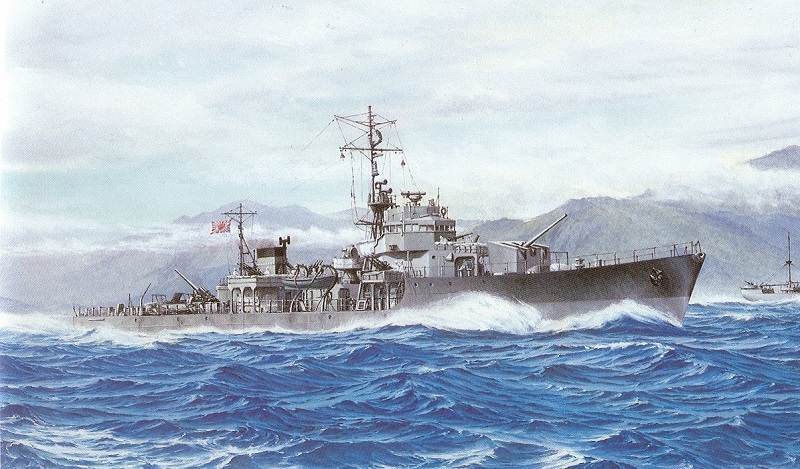
Nagasaki. Laid down at Mitsubishi Heavy Industries’ shipyard.
11 January 1944:
Launched and numbered CD-20.
29 February 1944:
Reserve LtCdr Kawamoto Genzo (former Chief Equipping Officer of CD-8) is appointed the CO of CD-8 and the CEO of CD-20 as an additional duty.
1 March 1944:
Reserve Lt (promoted LtCdr 1 May; Cdr, posthumously) Kuwabara Madoka (former mine officer of ITSUKUSHIMA) is appointed the CEO.
11 March 1944:
Completed and registered in the IJN. Reserve Lt Kuwabara Madoka is the CO.
9 April 1944:
At 0800 departs Kure and at 1800 arrives at Moji.
13 April 1944:
At 2355, departs Moji in convoy MOTA-17 consisting of MANSHU, FUKUYO, TEIKAI (ex-German FULDA), KANAN and TEIKA (ex-French CAP VARELLA) MARUs escorted by destroyer ASAKAZE, minesweeper W-22 and kaibokan
CD-20.
14 April 1944:
At 1748, arrives Chinkai (Chinhae), Korea, where the convoy is dissolved. These ships subsequently formed part of the "Take" convoy.
16 April 1944:
At 1000 departs Chinkai with CD-20, minelayer SHIRATAKA, and auxiliary minesweeper TAMA MARU No. 7 escorting the "Take" convoy (MOTA-17) - see 21 April for details.
18 April 1944:
At 1400 arrives at Ssu Chiao Shan.
19 April 1944:
At 1200 departs Ssu Chiao Shan.
21 April 1944:
CD-20 steams to Tungchiaoshan (Tangjiqiozshan) near Shanghai, where the escort joins the "Take" convoy consisting of transports KAZUURA, MITSUKI, BRAZIL, TENSHINZAN (AMATSUSAN), ADEN, TAJIMA, YOZAN, MANSHU, FUKUYO, TEIKAI (ex-German FULDA), KANAN, TEIKA (ex-French CAP VARELLA) MARUs and UNKAI MARU No. 12 and YOSHIDA MARU No. 1 and an unidentified merchant ship escorted by minelayer SHIRATAKA, destroyers ASAKAZE, SHIRATSUYU, KURI and FUJINAMI, kaibokan CD-22, KURAHASHI, minesweeper W-22, subchasers CH-37, CH-38, gunboats UJI, ATAKA and auxiliary minesweeper TAMA MARU No. 7.
26 April 1944:
Off NW Luzon, Philippines. LtCdr (later Rear Admiral) Thomas M. Dykers' (USNA '27) USS JACK (SS-259) intercepts the convoy. Dykers makes three separate attacks and fires 18 torpedoes at the convoy. At about 0600, from two to four torpedoes hit YOSHIDA MARU No. 1 portside. She breaks in two and sinks quickly at 18-06N, 119-40E, taking down 61 crewmen, two passengers and 2586 of 3400 soldiers of the IJA's 210th Infantry Regiment including its CO.
Tokyo. Prime Minister and Army General Tojo Hideki learns of the losses inflicted upon convoy "Take" No. 1. Fearing further attacks by American skip-bombers, like those suffered earlier in the Battle of the Bismarck Sea, Tojo orders the convoy diverted from Manokwari, New Guinea to Halmahera,
Moluccas.
27 April 1944:
At 1200 arrives Manila and detaches from "Take".
28 April 1944:
Both KURAHASHI (the following morning) and at 2200, CD-20 leave Manila to meet up with HI-59, consisting of tankers OKIKAWA, NIPPO, EIHO, TENEI, MANEI (BANEI), OTORISAN and NIYO MARUs and transports MANKO, TEIHOKU (ex-French PERSEE) and AOBASAN MARUs and tanker NICHINAN MARU No. 2, then in the South China Sea.
2 May 1944:
At 1200, HI-59 arrives at Singapore.
4 May 1944:
At 0400 CD-20 departs Manila with kaibokan KURAHASHI and KURI, minesweeper W-17 and auxiliary subchaser TAKUNAN MARU No. 3, escorting convoy MATA-19 consisting of TETSUYO, NICHIZUI, TEIRYU, RAKUYO, SHOGEN, DAKAR MARUs, BANSHU MARU No. 32 and two unidentified merchant ships.
7 May 1944:
NICHIZUI, TEIRYU (ex-German AUGSBURG), RAKUYO, SHOGEN, DAKAR MARUs and BANSHU MARU No. 32 and CD-20 detach for Kirun (Keelung), Taiwan.
9 May 1944:
At 0600 arrives at Kirun. Later that day CD-20 departs port with convoy TE-05 that had departed Kirun that morning, consisting of YAMADORI, HIYORI, HIOKI, KOKUSEI, HIKACHI, NICHIWA, SHONAN MARUs and KYOEI MARU No. 2 also escorted by kaibokan CD-1 and CD-8 and old destroyer ASAGAO.
10 May 1944:
At 1040 arrives at Takao. At 1800 departs Takao, still escorting TE-05.
13 May 1944:
Off Hong Kong YAMADORI MARU is detached and proceeds to that port.
14 May 1944:
At 1800 arrives at Yulin.
19 May 1944:
At 1700 CD-20, kaibokan CD-1 and CD-8 and auxiliary netlayer KAINAN MARU depart Yulin, escorting convoy HO-01 consisting of SHONAN MARU (5401 GRT), HIYORI MARU and four unidentified merchant ships.
26 May 1944:
At 0900 arrives at Singapore. Departs almost immediately with CD-8 and CD-1 and some time after joins up with convoy MISHI-02 consisting of MEXICO, IMAHARU and IIDA MARUs and NANSHIN MARU No. 2 and NANSHIN MARU No. 6 also escorted by minesweeper W-18 and auxiliary minesweeper CHOUN
MARU No. 7.
29 May 1944:
At 1200 arrives at Singapore.
3 June 1944:
At 1000, CD-20 departs Singapore with kaibokan CD-1, CD-8, CD-15 escorting convoy HO-02 consisting of TAMAHOKO, TAINAN, KENNICHI, SHONAN, TEIHOKU (ex-French PERSEE), HIOKI, HIYOERI (NICHIWA), KOKUSEI, HONAN (ex British WAR SIRDAR), CELEBES, BIYO, HOZAN MARUs and KONAN MARU No. 1 and four unidentified ships. TAMAHOKO MARU is carrying 772 Allied POWs from camps at Batavia, Java, including 42 American POWs. HIOKI, KOKUSEI and BIYO MARUs are also carrying POWs.
6 June 1944:
160 miles off Cape St. Jacques, Indochina. LtCdr (later Cdr) James W. Davis' (USNA '30) USS RATON (SS-270) attacks the convoy. At 2225, Davis torpedoes CD-15. She breaks in two and sinks S of Nishinotorishima Island at 08-57N, 109-17E. CD-20 and CD-8 rescue 34 survivors. The escorts counter attack. USS RATON is damaged by depth charges, but remains on patrol.
11 June 1944:
At 1600 arrives Manila. NASUSAN MARU joins the convoy. HOZAN and SEISHIN MARUs are detached. CD-8 is also detached. Minelayer AOTAKA joins the convoy.
14 June 1944:
At 1330, departs Manila still escorting HO-02.
19 June 1944:
At 0915, arrives at Takao.
20 June 1944:
At 1000, departs Takao.
21 June 1944:
Arrives and departs Kirun. Eight of the convoy's ships are detached and a further 11 join including probably TAINAN MARU, all unidentified. It is probable CD-20 is detached.
24 June 1944:
Koshiki Straits, 40 miles SW of Nagasaki, Kyushu. At 2350, LtCdr (later Rear Admiral-Ret) Richard H. O'Kane's (USNA '34) USS TANG (SS-306) attacks the convoy. At 2354, Kane torpedoes and sinks NASUSAN, TAMAHOKO, KENNICHI and TAINAN MARUs at 32-24N, 129-38E. Eleven crewmen on NASUSAN MARU, Two Auxiliary Gunners and 34 crewmen on KENNICHI MARU and 39 crewmen on TAINAN MARU are KIA. For TAMAHOKO MARU the whaling ship picks up some survivors, but 560 POWs are lost including 15 American soldiers and sailors. A further two gunners and 33 crewmen are also killed.
25 June 1944:
At 1030 CD-20 detaches from the convoy and heads for Sasebo.
26 June 1944:
At 1400, the remainder of convoy HO-02 arrives at Moji. That same day CD-20 arrives at Sasebo.
3 July 1944:
At 2000, CD-20 departs Moji with destroyer HARUKAZE and kaibokan CD-11, CD-26, CD-28 and subchaser CH-28 escorting convoy MOMA-01 consisting of KASHII, TAMATSU, TOSAN, NISSHO, MAYASAN, MIZUHO, NICHIRAN, ARABIA
and RAKUYO MARUs. The convoy is transporting the IJA's 5th Field Heavy Artillery and 58th Independent Mixed Brigade.
7 July 1944:
Formosa Straits. Convoy MOMA-01 is ordered to turn back to Keelung, Formosa.
9 July 1944:
Departs Keelung escorting MOMA-01. ARABIA MARU may have joined the convoy at this point.
12 July 1944:
Bashi Strait. At 0330, LtCdr (later Cdr) Walter P. Schoeni's (USNA '31) USS APOGON (SS-308) fires a full bow spread of torpedoes at MAYASAN MARU. Schoeni fails to damage her, and USS APOGON is rammed during the attack. At 0720, LtCdr Harold E. Rubles' (USNA '33) USS PIRANHA (SS-389) torpedoes and sinks NICHIRAN MARU at 18-50N, 122-40E. KASHII MARU rescues survivors, but 1238 troops, one ship's gunner and 15 crewmen are KIA. The convoy seeks shelter in Aparri Harbor, Philippines.
13 July 1944:
At 0800, departs Aparri.
15 July 1944:
At 1400, arrives at Manila.
24 July 1944:
At 0600, CD-20 departs Manila for Moji with escort carrier KAIYO, kaibokan CD-11, HIRADO (F), MIKURA, ISHIGAKI, KURAHASHI, KUSAGAKI and torpedo boat HIYODORI escorting convoy HI-68. The convoy sails in
three columns consisting of IJA landing craft depot ship MAYASAN MARU, oilers OTORISAN MARU and NICHINAN MARU No. 2 and escort carrier TAIYO in column No. 1; landing ship TAKATSU MARU (a.k.a KOZU MARU) and transports TOSAN, KASHII, NISSHO and AKI MARUs in column No. 2 and ex-seaplane tender KIYOKAWA MARU and oilers ITSUKUSHIMA, TOA, TOHO and SHIMPO MARUs in column No. 3. [Note 1]
A three-submarine wolf pack of Cdr (later Rear Admiral) Reuben T. Whitaker's (USNA '34) USS FLASHER, LtCdr Franklin Hess's (USNA '35) USS ANGLER (SS-240) and LtCdr (later Captain) Francis D. Walker's (USNA '35) USS CREVALLE (SS-291) tracks the convoy.
25 July 1944:
Off NW Luzon. At 1540, transports AKI and TOSAN MARUs successfully evade an attack by USS CREVALLE.
26 July 1944:
Off Luzon. The wolfpack attacks and sinks TOSAN, AKI and OTORISAN MARUs and damages KIYOKAWA MARU. Nine crewmen, eight gunners; 18 passengers on TOSAN MARU are KIA. 46 men aboard OTORISAN MARU are KIA. On AKI MARU some 24 passengers are killed as are 14 gunners, and 3 crewmen; a total of 41 dead.
27 July 1944:
At 1100, arrives at Takao.
28 July 1944:
At 1800, departs Takao to reinforce convoy MI-10 consisting of DAIZEN, HIDA, HINAGA and FUYUKAWA MARUs KENZUI, TEIFU (ex-French BOUGAINVILLE), KAKOGAWA, TSUKUBASAN, ROKKO, RASHIN, FRANCE, MYOGI MARUs and UNYO
MARU No. 7, WAKO GO and tankers SHUNTEN, TAKETSU (BUTSU), CHIYODA, SHIMOTSU, KOSHIN, KOTOKU, NICHINAN (1945 GRT), OEI MARU and SHIMOTSU MARUs and KYOEI MARU No. 6 plus 11 unidentified ships escorted by CD-3, YASHIRO and destroyer ASAKAZE.
E 30 July 1944:
CD-20 joins the convoy escort.
2 August 1944:
At 1000 arrives at Takao, Formosa. MATSUMOTO MARU, ASAKAZE and YASHIRO are detached. FRANCE and RASHIN MARUs are probably also detached. SEIGA and HAKOZAKI MARUs join as do destroyer KURETAKE, kaibokan
CD-17, minelayer MAESHIMA and auxiliary gunboats CHOJUSAN, PEKING and KAZAN MARUs.
4 August 1944:
At 1300 departs Takao.
10 August 1944:
At 0700 arrives at Sasebo after detaching from the convoy earlier that day at 0200. Undergoes repairs.
14 August 1944:
At 0730 departs Sasebo and later that day arrives at Moji.
15 August 1944:
At 0600, CD-20 departs Moji for Takao with destroyer HATSUSHIMO, kaibokan CD-10, torpedo boat HIYODORI, minesweeper W-20 and subchaser CH-63 escorting convoy MOTA-23 consisting of FUKUREI, EDOGAWA, DAIJO, EIJI, MANSHU, ATSUTA, CHINA, ROZAN, EIMAN, TOYOOKA, KOGYO, AWAJI MARUs, YOSHIDA MARU No. 3, TOYO MARU No. 3 and an unidentified ship.
16 August 1944:
S of Kyushu. A floatplane from Saeki NAG directs CD-20 to depth-charge a suspected submarine contact detected in that area on the 15th. At 1237 CD-10, W-20 and CH-63 execute an anti submarine sweep. CD-20 then rejoins the convoy.
17 August 1944:
CH-63,CD-10 and W-20 follow the convoy meanwhile continuing anti submarine sweeping. At 2000 they catch up with the convoy and end anti submarine sweeping.
18 August 1944:
At 0900 arrives at Kagoshima.
20 August 1944:
At 0200 departs Kagoshima.
24 August 1944:
At about 0700, off the coast of Sancho Point, Formosa (now cape Sandiajiao, Taiwan), LtCdr Henry S. Monroe's (USNA '33) USS RONQUIL (SS-396) torpedoes and sinks YOSHIDA MARU No. 3 with 96 out of 99 troops, 10 gunners and all 70 of the crew being KIA. At about the same time, Monroe torpedoes and damages FUKUREI MARU with troops, coal and war supplies aboard. She floods and drifts ashore where she is abandoned about three months later. 210 of the 1445 troops on board and four of the crew are killed.
25 August 1944:
At 1400, the convoy arrives at Kirun (Keelung).
27 August 1944:
At 0900 the convoy departs Kirun.
28 August 1944:
At 1900 arrives at Saei (Tsoying).
29 August 1944:
The convoy departs Saei and it arrives at Takao later that day.
30 August 1944:
At 1500, CD-20 departs Takao for Manila with minelayer SHIRATAKA, minesweeper W-21, and kaibokan CD-10 escorting reorganized convoy MI-15 that now consists of RIKKO, TAISHO, OKUNI (TAIKOKU), EIKYU, auxiliary storeship SHINYO, NANSEI, HOSEN and CHIYODA MARUs with UNKAI MARU No. 5, OKINOYAMA MARU No. 5 and KYOEI MARU No. 10.
31 August 1944:
Luzon Strait, S of Formosa. At about 0220, LtCdr (later Rear Admiral) Charles E. Loughlin's (USNA '33) USS QUEENFISH (SS-393) hits CHIYODA MARU with four torpedoes and sets her afire. At 0240, as the moon sets, CHIYODA MARU sinks. She was carrying 430 passengers, coal briquettes and drummed gasoline. 382 passengers and 15 of the crew are KIA. Loughlin also damages oiler RIKKO MARU steaming in ballast.
LtCdr (later Vice Admiral) Eli T. Reich's (USNA '35) USS SEALION (SS-315), a member of "Ben's Busters" with USS GROWLER (SS-215) and USS PAMPANITO, enters the Bashi Strait. USS SEALION's SJ radar picks up the convoy and Reich makes a night surface approach. He sets up and fires six torpedoes,
but they all run erratically. About 0500, Reich swings USS SEALION and fires his four stern torpedoes at a large tanker. He claims two hits.
Alerted by code-breaker's "Ultra" signals, LtCdr (later Rear Admiral) Eugene B. Fluckey's (USNA '35) USS BARB (SS-220) intercepts the convoy. At about 0700, Fluckey torpedoes OKUNI MARU. She sinks stern first with three of her crewmen dead. Fluckey also sinks the 45th Minesweeper Squadron's HINODE MARU No.
20 that was patrolling in the area. Two crewmen are KIA.
USS SEALION evades the convoy's escorts. Still surfaced, LtCdr Reich makes an "end-around" approach and works his way ahead of the convoy. At 0715 (JST), SHIRATAKA's lookouts spot a submarine on the surface at at 21-05N, 121-26E. Reich misidentifies SHIRATAKA as a destroyer. He begins a submerged approach. At 0730, Reich hits SHIRATAKA with two of three torpedoes. At 1115, SHIRATAKA sinks at 20-55N, 121-07E. Captain Miki Takahide (46) is KIA. He is promoted Rear Admiral, posthumously.
1 September 1944:
At 2120 CD-20 arrives at Tungchiang escorting NANSEI and TAISHO MARUs.
2 September 1944:
At 2355 the convoy departs (less TAISHO MARU that returns to Takao).
5 September 1944:
At 1900 arrives at North San Fernando.
6 September 1944:
At 0800 departs North San Fernando.
7 September 1944:
At 1000, the convoy arrives at Manila.
10 September 1944:
CD-20 departs Manila for Moji with CD-10 escorting fleet convoy MAMO-03 consisting of GOKOKU, KAGU and KIBITSU MARUs.
11 September 1944:
Minesweeper W-21 joins the convoy. At 0830 CD-20 responds to a submarine contact and begins a submarine hunt. Later at 0910 in S China Sea. 100 miles NE of the Paracel Islands. Convoy MAMO-03 joins fleet
convoy HI-72 that departed Singapore on 6 September for Moji. HI-72 includes ASAKA, NANKAI, KIMIKAWA, RAKUYO, ZUIHO, KIBITSU and KACHIDOKI MARUs (ex-US-PRESIDENT HARRISON). HI-72 carries oil, drummed aviation gasoline, bauxite, mercury and rubber. RAKUYO MARU also carries 1,317 Allied POWs and KACHIDOKI MARU carries another 950 POWs. Destroyer SHIKINAMI and kaibokan HIRADO, MIKURA and KURAHASHI are in the escort.
12 September 1944:
At 0200, HIRADO is torpedoed by Cdr Thomas B. Oakey's (USNA '34) USS GROWLER (SS-215). The kaibokan blows up and sinks. Rear Admiral Kajioka Sadamichi (39) (former CO of KISO), victor of Wake Island, now
CO of the 6th Escort Convoy Command is killed. He is promoted Vice Admiral, posthumously.
At 0500, RAKUYO MARU is torpedoed by LtCdr (later Vice Admiral) Eli T. Reich's USS SEALION and hit in the No. 1 hold and engine room. RAKUYO MARU is carrying 1,318 POWs (601 British, 716 Australian and several US POWs), of whom 1,051 POWs and nine crewmen are KIA. About the same time, USS SEALION also
torpedoes NANKAI MARU carrying 525 passengers, 6,500-tons of bauxite, 4,000 drums of gasoline, 170-tons of oil, 77 mail packages and ashes of 18 war dead. She is hit in holds Nos. 3 and 6 and sinks about 0800. 196 passengers on the ship and three crewmen are KIA. [Note 2]
240 miles south of Hong Kong. Just before 0700, SHIKINAMI is torpedoed by GROWLER and sinks at 18-16 N, 114-40 E. Eight officers and 120 men are rescued by MIKURA. At 2300, KACHIDOKI MARU carrying 487 IJA troops, 608 patients, gunners, ashes of 582 dead, 950 POWs and a cargo of 6,000-tons of bauxite is
hit by USS PAMPANITO (SS-383) and sinks. 431 POWs as well as 45 other passengers and 12 crewmen, a total of 488 people perish. USS PAMPANITO also sinks ZUIHO MARU with the loss of all crew. The Japanese rescue a few POWs from the two prison ships. The survivors are transferred to KIBITSU MARU and taken to
Japan. CD-20 rescues survivors. [Note 2]
15 September 1944:
At 1020 the remainder of the convoy arrives at Yulin, Hainan Island.
16 September 1944:
At 2000 CD-10 departs Yulin for Moji with kaibokan MIKURA, ETOROFU, CD-18 and CD-26 escorting the 1st echelon of reorganized convoy HI-72 consisting of ASAMA, KIBITSU MARU, GOKOKU and KAGU MARUs.
20 September 1944:
Off Formosa. At 0110, USAAF B-24 "Liberator" heavy bombers attack the convoy's first (Moji-bound) echelon at 23-20N, 119-12E. GOKOKU MARU is damaged by a direct hit and ASAMA MARU suffers a near miss aft. Both are towed into nearby Mako for repairs. KAGU MARU suffers hull damage by near-misses. Kaibokan MIKURA is damaged and towed to Mako by CD-18. The bombers also damage cargo vessels ASAKA and SHINCHO MARUs. KAGU MARU heads for Kirun (some sources say Takao) for repairs escorted by CD-20, CD-10 and CD-11. At 1745 CD-20 arrives at Kirun.
23 September 1944:
At 1200 CD-10, CD-20 and CD-11 depart Kirun to meet incoming elements of HI-72 convoy.
24 September 1944:
At 1045 they rendezvous with KIBITSU MARU and arrive at Kirun at 1320.
25 September 1944:
At 1300, CD-20 departs Takao for Moji with kaibokan CD-10 and CD-11 escorting modified convoy HI-72 (partial) consisting of KIBITSU and KAGU MARUs.
27 September 1944:
East China Sea, 100 miles NNW of Amami-Oshima. LtCdr Clyde B. Stevens Jr's (USNA '34) USS PLAICE (SS-390) torpedoes and sinks CD-10 at 29-26N, 128-50E. CD-11 rescues rescues survivors.
28 September 1944:
At 0900 arrives at Mutsure, and departs almost immediately at 0910. At 2100 arrives at Sasebo.
8 October 1944:
At 1000 CD-14 and CD-20 depart Sasebo with ships to make up convoy MI-23.
9 October 1944:
At 1500 arrives at Miike.
14 October 1944:
Departs Miike.
15 October 1944:
Arrives at Sasebo.
18 October 1944:
At 0700, CD-20 departs Imari Bay near Sasebo via Cape St. Jacques, Indo-China for Miri with kaibokan CD-14, CD-34, CD-39, CD-46 and patrol boats PB-102 and PB-38 escorting convoy MI-23 consisting of EBARA, MUNEKATA, HIKACHI (NISSHO), MATSUMOTO, KOSHIN, EININ, RITSUEI, YAMASONO, ENREKI (ENRYAKU), SHOEI (2854 gt), HIROTA, UNZEN, YOKAI and SHIROTAE MARUs and YUZAN MARU No. 2. and survey ship HAKUSA.
20 October 1944:
Anchors in Raro Bay off South Korea.
22 October 1944:
At the Shushan anchorage, E of Shanghai.
24 October 1944:
75 miles ENE of Foochow, China. At 1000, HIROTA, UNZEN and YOKAI MARUs are detached for Takao escorted by PB-103 and PB-38.
25 October 1944:
Formosa Strait. At 0208, Cdr (later Rear Admiral-Ret) Richard H. O'Kane's USS TANG (SS-306), running on the surface, torpedoes and sinks EBARA MARU at 25-04N, 119-35E. Eleven crewmen are KIA.
MATSUMOTO MARU, following behind EBARA MARU, alters course intent on ramming USS TANG, but one of the torpedoes fired at EBARA MARU strikes onrushing MATSUMOTO MARU’s No. 1 hold. Her bow plunges under and she comes to a halt. Two machine guns on her bridge open fire and drive the submarine under where the
water depth is a mere 131 feet.
The convoy speeds onward. CD-34 drops a few depth-charges. Nine American submariners are found drifting on the surface including Captain O'Kane. CD-34 rescues the survivors and later claims to have sunk USS TANG, but, in fact, the submarine was sunk by one of BuOrd's defective Mark 18 torpedoes. CD-34 is detached with the POWs for Takao, Formosa. At 2000, convoy MI-23 arrives at Chuanchow Bay where MATSUMOTO MARU is successfully grounded; however, she lists heavily. CD-20 probably is detached at this time.
26 October 1944:
MATSUMOTO MARU capsizes and becomes a total loss. No casualties have been sustained in the preceding action. At 0600, the convoy anchors outside Amoy Harbor, and departs the same day at 1800.
27 October 1944:
At 0800 the convoy arrives at Mako. YUZAN MARU No. 2 is detached and an unidentified ship joins the convoy.
29 October 1944:
At 1700 CD-20 departs Mako to rendezvous with convoy SATA-01 from St Jacques consisting of FUKUJU MARU and two unidentified merchant ships escorted by subchaser CH-41 and stores ship KURASAKI.
1 November 1944:
At 1200 meets up with the convoy.
3 November 1944:
Arrives at Yulin. KURASAKI is detached but the escort is increased by Kaibokan CD-34, auxiliary netlayer KAINAN MARU and auxiliary subchaser KASUGA MARU. A further two unidentified merchant ships also
join. At 1330 CD-20 arrives at nearby Sana (Samah).
4 November 1944:
Departs Yulin. At 1800 CD-20 departs Sana (Samah).
11 November 1944:
At 0900 CD-20 arrives at Kirun (Keelung). At 1100 (perhaps after bunkering), CD-20 departs Kirun to meet the inbound convoy. At 1700 meets up with the convoy near Kirun.
12 November 1944:
At 1130 arrives at Kirun.
16 November 1944:
At 0600, CD-20 departs Kirun (Keelung) for Moji with kaibokan CD-39 and subchaser CH-61 escorting convoy TAMO-29 consisting of SHUYO, FUKUJU, MIYAJIMA, MELBOURNE MARUs and one unidentified ship.
18 November 1944:
Arrives at Ssu Chiao Shan.
19 November 1944:
At 1720 departs Ssu Chiao Shan.
23 November 1944:
At 0348, LtCdr (later Cdr) Evan T. Shepard's (USNA '35) USS PICUDA (SS-382) torpedoes and sinks SHUYO MARU at 34-14N, 128-28E. 60 passengers and 25 crewmen are killed.
At 0348, USN codebreakers intercept and decrypt a message from CD-20 that reads: "Convoy attacked by enemy submarine. One vessel sunk [SHUYO MARU] in position 34-26 N, 128-20 E."
At 0845, after tracking the convoy and making an "end-around", Shepard torpedoes and sinks FUKUJU MARU at 34-10N, 128-58E. 28 of the crew are killed.
At 0845, codebreakers decrypt another message from CD-20 that reads:
"Positive sub contact and torpedo attack on JQFU [FUKUJU MARU] in position 34-12N, 128-57E."
The escorts counter-attack and drop 23 depth charges on USS PICUDA, but she escapes undamaged.
24 November 1944:
At 1340 arrives at Moji. CD-20 immediately departs.
25 November 1944:
At 0830 arrives at Kure. Undertakes repairs.
14 December 1944:
CD-20 departs Miike with kaibokan MIYAKE, CD-39, CD-138 escorting convoy MOTA-28 consisting of MURORAN, TEIKAI MARUs and tankers DAINAN, SHINGI, OEI, DAIGYO, OESAN and YAMAZAWA MARUs. NOMI meets the convoy soon after departure.
22 December 1944:
At 2200 arrives at Takao.
30 December 1944:
Lingayen Gulf, Luzon. USAAF Fifth Air Force North American B-25 "Mitchell" medium bombers, Douglas A-20 "Havocs" and Curtiss P-40 "Warhawks" attack shipping in the approaches to the Gulf and sink CD-20 at
06-30N, 120-18E. 52 sailors, including her CO, are lost.
25 May 1945:
Removed from the Navy List.
Authors' Note:
[Note 1] The specialist Landing craft depot ship TAKATSU MARU's name can also be rendered as KOZU MARU, KOTSU MARU or KOSHIN MARU.
[Note 2] The Japanese rescue some of the POWs from these two ships. All are transferred to KIBITSU MARU and taken to Japan. The American submarines later return to rescue a number of British and Australian POWs.
Thanks go to John Whitman for info on USN decrypts of coded Japanese messages and to Mr. Gilbert Casse of France.
-Bob Hackett and Peter Cundall
Back to
Escort Page