BYOINSEN
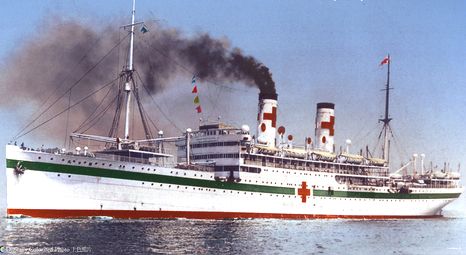 Asahi Maru prewar
IJN Hospital Ship ASAHI MARU:
Tabular Record of Movement
© 1998-2018 Bob Hackett, Sander Kingsepp and Peter Cundall.
Revision 10
September 1914:
Riva Trigoso, Italy. Laid down as a passenger ship by Società Esercizio Bacini.
28 November 1914:
Launched and named DANTE ALIGHIERI.
28 February 1915:
Completed as a 9,754 GRT passenger ship for the Transatlantica Italiana Società Anonima di Navigazione owned by the Hamburg America Line. There are accommodations for 100 1st-class, 260 2nd-class and 1,825 3rd-class passengers.
1915:
Departs Genoa on her maiden voyage for Palermo, Naples and New York.
1915-1927:
In service between Italy and New York with calls at Lisbon, Gibraltar, Azores and Boston and between Italy and South America.
October 1927:
Departs Genoa on her last voyage on this service.
5 November 1927:
Arrives at New York.
15 November 1927:
Departs New York for Lisbon, Naples and Genoa.
15 February 1928:
DANTE ALIGHIERI is purchased by Kinkai Yusen K.K. of Tokyo and renamed ASAHI MARU.
23 July 1928:
ASAHI MARU begins service on the Kobe-Keelung, Formosa route.
7 July 1937: The Marco Polo Bridge (The First "China") Incident:
Lugouqiao, China. Japanese troops are on night maneuvers at the bridge. They fire blank cartridges. Chinese troops fire back, but do not cause injuries. At morning roll call, the Japanese discover a soldier missing and assume the Chinese captured him. The Japanese demand entry to Beijing to look for the soldier. The Chinese refuse. The Japanese then shell the city. An undeclared war on China begins.
7 August 1937:
ASAHI MARU is at sea on the Kobe-Formosa route when she receives a radio signal from Kobe that she has been requisitioned by the IJN.
17 August 1937:
Kure. ASAHI MARU begins conversion to a specially installed hospital ship. Work begins to construct an X-ray room, operating room, infectious disease isolation room and accommodations for 120 patients, in addition to accommodations for officers and military personnel.
ASAHI MARU is registered (commissioned) in the Kure Naval District.
17 August 1937:
Captain/Surgeon (later Vice Admiral/Surgeon) Wakao Yoshiho (Surgeon/1914) is posted Director of Medicine of ASAHI MARU.
25 August 1937:
Construction is completed. Departs Kure.
27 August 1937:
Arrives at Woosung (now Wusung), China.
29 August 1937:
Departs Woosung.
30 August 1937:
Arrives at Kure.
1 September 1937:
Departs Kure for Ssu Chiao Chan (Raffles Island, now Sijiao Shan), China.
3 September 1937:
Departs Ssu Chiao Chan.
5 September 1937:
Attached to the 3rd China Fleet.
8 September 1937:
Arrives at Kure.
9 September 1937:
Departs Kure for central Chinese waters.
17 September 1937:
Arrives at Kure.
19 September 1937:
Departs Kure.
27 September 1937:
Arrives Off the coast of Shidongkou,China.
28 September 1937:
Departs Off the coast of Shidongkou.
30 September 1937:
Arrives at Sasebo.
1 October 1937:
Departs Sasebo.
17 October 1937:
Arrives Off the coast of Woosung.
18 October 1937:
Departs Off the coast of Woosung.
20 October 1937:
Arrives at Sasebo. Attached to the China Fleet.
22 October 1937:
Departs Sasebo.
10 November 1937:
Departs Woosung.
13 November 1937:
Departs Woosung.
15 November 1937:
Arrives at Shanghai. Thereafter, ASAHI MARU makes 14 round trips between Shanghai and Japan and transports approximately 10,000 personnel.
16 November 1937:
Arrives at Kure.
22 November 1937:
Departs Sasebo.
24 November 1937:
Arrives at Shanghai and departs later this day.
27 November 1937:
Arrives at Kure.
29 November 1937:
Departs Kure for Mid Chinese waters.
1 December 1937:
Captain/Surgeon (later Vice Admiral/Surgeon) Takagi Takashi (Surgeon/1912) is posted Director of Medicine.
4 December 1937:
Arrives at Sasebo.
5 December 1937:
Departs Sasebo for Mid Chinese waters.
10 December 1937:
Arrives at Sasebo.
12 December 1937:
Departs Sasebo for Mid Chinese waters.
17 December 1937:
Arrives at Kure.
26 December 1937:
Departs Mako, Pescadores.
27 December 1937:
Arrives at Tongao Tao (near Hong Kong).
28 December 1937:
Departs Tongao Tao.
2 January 1938:
Arrives at Sasebo.
5 January 1938:
Departs Nagasaki for Mid Chinese waters.
9 January 1938:
Arrives at Sasebo.
23 January 1938:
Departs Sasebo for Woosung.
29 January 1938:
Arrives at Sasebo.
14 February 1938:
Departs Sasebo for Southern Chinese waters.
24 February 1938:
Arrives at Mako.
26 February 1938:
Departs Southern Chinese waters.
4 March 1938:
Arrives at Sasebo.
25 March 1938:
Kobe. Undergoes hull inspection at Pier No. 1 of Mitsubishi Heavy Industries, Ltd. shipyard. ASAHI MARU enters drydock. The ship is inclined in order to inspect her hull, but as a result of filling too many tanks the list grows rapidly, so that by the next morning, the promenade deck is awash. The hull is flooded next and the ship settles to the ground. The accident damages her forward smoke stack. It is removed and replaced by a dummy smokestack.
That same day, ASAHI MARU is attached to the 2nd special duty force of the China Fleet.
3 May 1938:
Refloated out of drydock by Nippon Salvage K. K.
9 June 1938:
Restoration is complete. Departs Kobe for Kure.
12 June 1938:
Departs Kure for Shanghai.
15 July 1938:
Arrives at Sasebo. From this date, ASAHI MARU makes 32 round trips to China, mainly the southern area with frequent stops at Mako, Kirun (Keelung) and Takao in Formosa and some visits to Ryojun (Lushun, previously Port Arthur) and other northern and central China ports. Sasebo remains her principal base.
17 July 1938:
Departs Sasebo.
22 July 1938:
Departs Hou’ao, Canton, China.
26 July 1938:
Arrives at Mako and departs for Southern China water later that day.
29 July 1938:
Arrives at Kirun, Formosa (now Keelung, Taiwan).
30 July 1938:
Departs Kirun for Mid China waters.
7 August 1938:
Arrives at Sasebo.
22 August 1938:
Departs Sasebo for Mid China waters.
6 September 1938:
Arrives at Sasebo.
7 September 1938:
Departs Sasebo for Mid China waters.
28 September 1938:
Arrives at Sasebo.
1 October 1938:
Departs Sasebo for Mid China waters.
15 October 1938:
Arrives at Sasebo.
18 October 1938:
Departs Sasebo for Southern China waters.
2 November 1938:
Departs Mako for Kirun.
5 November 1938:
Departs Kirun for Mid China waters.
15 November 1938:
Captain/Surgeon (later Rear Admiral/Surgeon) Uehara Junnosuke (Surgeon/1915) is posted Director of Medicine.
25 November 1938:
Arrives at Sasebo.
9 December 1938:
Arrives at Michireishima (Dao ling dao), China.
16 December 1938:
From 0845 till 0920 alongside to port of auxiliary gunboat DELHI MARU.
17 ~ 24 December 1938:
Departs Michireishima.
25 December 1938:
Arrives at Ryojun, Manchuria (ex Port-Arthur , now Lushun, Northern China).
1 January 1939:
Departs Sasebo for Southern Chinese waters.
13 January 1939:
Arrives at Mako.
16 January 1939:
Departs Mako for Mid Chines waters.
24 January 1939:
Arrives at Sasebo.
29 January 1939:
Enters drydock.
5 February 1939:
Departs Sasebo.
14 February 1939:
Arrives at Sana (Samah, now Ya Xian), Hainan Island, China.
20 February 1939:
Departs Sana.
25 February 1939:
Arrives at Mako.
27 February 1939:
Departs Mako for Southern China waters.
2 March 1939:
Arrives at Kirun.
3 March 1939:
Departs Kirun for Central then Northern China waters.
14 March 1939:
Arrives at Ryojun.
20 March 1939:
Departs Sasebo for Mid China waters.
12 April 1939:
Arrives at Sasebo.
20 April 1939:
Departs Kure for Southern China waters.
6 May 1939:
Under Government pressure to rationalize services as the war in China (Nikka Jihen) drags on, Kinkai Yusen, a subsidiary of NYK servicing the near seas to Japan, is absorbed back into NYK. The ship's port of registry remains unchanged as Tokyo.
14 May 1939:
Arives at Mako.
17 May 1939:
Departs Mako for Southern Chinese waters.
22 May 1939:
Arrives at Sasebo.
30 May 1939:
Depart Sasebo.
1 June 1939:
Departs Shanghai, China for Northern China waters.
12 June 1939:
Arrives at Sasebo.
20 June 1939:
Departs Mako for Southern China waters.
1 July 1939:
Arrives ar Kirun.
4 July 1939:
Departs Kirun for Southern China waters.
16 July 1939:
Arrives at Mako.
19 July 1939:
Arrives at Shanghai.
31 July 1939:
Anchors.
11 August 1939:
Departs Kure.
14 August 1939:
Departs Shanghai.
4 September 1939:
Arrives at Kirun.
8 September 1939:
Departs Kirun for Southern then Mid China waters. Ownership changes to Nippon Yushen Kaisha (NYK).
20 September 1939:
Arrives at Takao, Formosa (now Kaoshiung, Taiwan).
25 September 1939:
Departs Mako for Mid China waters.
6 October 1939:
Arrives at Sasebo.
9 November 1939:
Departs Sasebo for central then Northern China waters.
15 November 1939:
Captain/Surgeon (later Vice Admiral/Surgeon) Tanabe Yutaka (Surgeon/1915) is posted Director of Medicine.
17 November 1939:
Arrives at Sasebo.
19 November 1939:
Departs Sasebo for Mid then Northern China waters.
26 November 1939:
Arrives at Sasebo.
7 December 1939:
Departs Kirun for Southern China waters.
18 December 1939:
Departs Takao for Mako.
22 December 1939:
Departs Mako for Southern then central China coast waters.
28 December 1939:
Arrives at Sasebo.
14 January 1940:
Departs Sasebo for central China coast waters.
22 January 1940:
Arrives at Kirun.
23 January 1940:
Departs Kirun for Southern China waters.
9 February 1940:
Arrives at Mako.
11 February 1940:
Departs Mako for central China coast waters.
18 February 1940:
Arrives at Sasebo.
26 February 1940:
Departs Kirun for Southern China waters.
27 March 1940:
Departs Takao for Kirun.
13 April 1940:
Departs Kirun for Southern China waters.
10 May 1940:
Arrives at Sasebo.
15 May 1940:
Departs Sasebo for central China coast waters.
22 May 1940:
Arrives at Sasebo.
9 June 1940:
Departs Kirun for Southern China waters.
2 July 1940:
Arrives at Mako and departs later that day for Southern China waters.
6 July 1940:
Arrives at Sasebo.
10 July 1940:
Departs Sasebo for central China coast waters.
17 July 1940:
Arrives at Sasebo.
25 July 1940:
Departs Kirun for Southern China waters.
19 August 1940:
Arrives at Mako.
21 August 1940:
Departs Mako for Southern China waters.
27 August 1940:
Departs Sasebo.
12 September 1940:
Departs Sasebo for Northern China waters.
19 September 1940:
Arrives at Ryojun.
1 October 1940:
Departs Kirun for Southern China waters.
9 October 1940:
Departs Takao for Mako.
11 October 1940:
Departs Mako for Southern China waters.
15 October 1940:
Arrives at Sasebo.
19 October 1940:
Departs Sasebo for central China coast waters.
24 October 1940:
Arrives at Sasebo.
26 October 1940:
Departs Sasebo for central China coast waters.
31 October 1940:
Arrives at Sasebo.
4 November 1940:
Departs Sasebo for central China coast waters.
9 November 1940:
Arrives at Sasebo.
15 November 1940:
ASAHI MARU is attached directly to the Combined Fleet. An unknown officer is appointed supervisor and commanding officer.
E 15 ~ 30 November 1940:
At Yokohama. Undergoes modifications and alterations at Mitsubishi Heavy Industries, Ltd. shipyard. Enters dock for reconstruction and repairs. The dummy funnel is removed.
E 1 December 1940 ~ 13 January 1941:
Fitted out for medical mission, epidemic prevention and patient transport.
14 January 1941:
Departs Yokosuka for Southern China waters.
16 February 1941:
Arrives at Yokosuka.
25 February 1941:
Departs Yokosuka for Southern China waters.
3 March 1941:
Arrives at Takao.
6 June 1941:
Departs Sasebo.
22 June 1941:
Arrives at Mako.
24 June 1941:
Departs Mako.
1 July 1941:
Departs Takao for Mako.
26 August 1941:
Arrives at Sasebo.
20 September 1941:
Captain/Surgeon (later RAdm/Surgeon) Kandatsu Kinsaku (Surgeon 1917) (former Chief of the 1st Ward, Yokosuka Naval Hospital) is appointed Director of Medicine of ASAHI MARU.
29 September 1941:
Departs Sasebo for Southern China waters.
12 October 1941:
Arrives at Mako.
15 October 1941:
Departs Mako for central then Southern China coast waters.
23 October 1941:
Arrives at Sasebo.
1 December 1941:
Attached to Southern Forces. Departs Beppu and arrives at Saeki later this day.
2 December 1941:
Loads 250t water.
3 December 1941:
Departs Saeki for Palau.
9 December 1941:
Arrives at Palau. Remains at Palau throughout December.
23 December 1941:
The Ministry of Foreign Affairs is requested to notify the warring countries that ASAHI MARU is a designated hospital ship.
2 January 1942:
Provisions medical supplies to the First Gunboat Division.
4 January 1942:
At 1400 departs Palau.
6 January 1942:
At 2330 arrives at Davao.
10 January 1942:
Provisions heavy cruiser ASHIGARA with health care products.
12 January 1942:
Provisioned by auxiliary transport SENKO MARU.
14 January 1942:
Provisions heavy cruiser ASHIGARA with health care products and is replenished with 350- tons water by auxiliary water tanker GORYU MARU.
16 January 1942:
Provisions light cruiser NAKA with health care products.
17 January 1942:
Dispatches a rescue boat each time when a flying boats lands. Provisions DesDiv 24 and others with health care products.
19 January 1942:
Davao. Provisioned with health care products by auxiliary transport TOKYO MARU. Provides medical supplies to subchaser CH-24.
19 ~ 21 January 1942:
Provisioned with 6-tons fresh food by auxiliary stores ship KOSEI MARU.
20 January 1942:
Provisions the 1st Gunboat Division with health care products.
22 January 1942:
Replenished at Davao by KIRISHIMA MARU.
23 January 1942:
Replenished at Davao by NICHIYU MARU.
25 January 1942:
Provisions auxiliary transport HINO MARU No. 5 with health care products.
28 January 1942:
Provisions the 54th Submarine chaser Squadron with health care products. Loads 275-tons water.
29 January 1942:
Provisions patrol boat PB-38 with health care products. Replenished with 125-tons water by auxiliary water tanker ASAYAMA MARU.
31 January 1942:
Provisions submarine tender CHOGEI with health care products.
4 February 1942:
Provisions the 1st Gunboat Division with health care products.
5 February 1942:
At 0800 departs Davao.
11 February 1942:
At 1300 arrives at Sasebo.
12 February 1942:
At 1500 departs Sasebo.
13 February 1942:
At 1630 arrives at Hashira Jima.
14 February 1942:
At 0530 departs Hashira Jima and at 0800 arrives at Kure.
21 February 1942:
At 0940 departs Kure.
27 February 1942:
At 2140 arrives at Davao.
1 March 1942:
At 0600 departs Davao.
2 March 1942:
At 0800 arrives at Menado and departs later that day at 2210.
4 March 1942:
At 0900 arrives at Staring Bay near Kendari.
5 March 1942:
Provisioned by auxiliary aircraft transport KEIYO MARU.
6 March 1942:
Provisioned by storeship IRAKO.
16 March 1942:
At 0600 departs Staring Bay.
17 March 1942:
At 1630 arrives at Macassar.
22 March 1942:
Provisioned by auxiliary transport KUMAGAWA MARU.
24 March 1942:
Macassar. Provisioned by auxiliary storeship KOSEI MARU. Departs later that day at 1700.
26 March 1942:
At 0830 arrives at Kupang, Timor Island. That same day, ASAHI MARU is erroneously bombed by British planes.[2]
27 March 1942:
At 2300 departs Kupang.
29 March 1942:
At 1440 arrives at Macassar.
12 April 1942:
At 0700 departs Macassar.
13 April 1942:
At 0950 arrives at Balikpapan.
14 April 1942:
At 0700 departs Balikpapan.
15 April 1942:
At 1500 arrives at Tarakan.
16 April 1942:
At 0700 departs Tarakan.
18 April 1942:
At 0650 arrives at Davao and departs at 1700 the same day.
22 April 1942:
At 1430 arrives at Takao.
25 April 1942:
At 0630 departs Takao and arrives at Mako at 1400, before departing that evening at 1730.
28 April 1942:
At 1130 arrives at Sasebo.
29 April 1942:
At 0600 departs Sasebo.
30 April 1942:
At 1504 arrives at Hashira Jima, near Kure and departs at 2000.
1 May 1942:
At 0700 arrives at Kure. Loads 150t water.
3 May 1942:
Loads food. At 1800 departs Kure.
4 May 1942:
At 1200 arrives at Aioi. Construction of degaussing cable begins, Repositioning of the red crosses on the ships hull sides and funnels begins. Changing the red lights in the funnels red crosses begins and installing 14 meter boat (unfinished) begins.
6 May 1942:
Loads 60-tons of water.
8 May 1942:
Loads 60-tons of water.
9 May 1942:
Loads 75-tons of water.
12 May 1942:
Scheduled to receive new equipement for deck equipment.
14 May 1942:
Enters the second dock of Harima Shiyard.
16 May 1942:
Loads 300-tons of water.
17 May 1942:
Loads 375-tons of water.
18 May 1942:
Loads 70-tons of water.
19 May 1942:
Leaves the dock.
20 May 1942:
Loads 220-tons of water.
22 May 1942:
Loads 570-tons of water.
24 May 1942:
Construction of degaussing cable, repositioning of the red crosses on the ships hull sides and funnels, changing the red lights in the funnels red crosses and installing 14 meter boat is completed. At 1900 departs Aioi.
25 May 1942:
At 0900 arrives at Kure. Loads 150-tons of water and liquor products.
26 May 1942:
Loads 1,8000-tons of stored goods and medical supplies, 150-tons of water, 2220-tons of coal and liquor products.
27 May 1942:
Loafs 150-tons of fresh food, 450-tons of coal and 300-tons of water.
28 May 1942:
Loads 10-tons of ice, 104 fuel cans and 500-tons of coal.
29 May 1942:
Loads 600-tons of water, 550-tons of coal, and medical supplies.
31 May 1942:
Loads 175-tons of coal. At 0700 departs Kure.
10 June 1942:
At 1420 arrives at Truk.
12 June 1942:
Loads 155-tons of water.
13 June 1942:
Loads 180-tons of water.
18 June 1942:
Loads 250-tons of coal from auxiliary collier/oiler YODOGAWA MARU.
19 June 1942:
Loads 350-tons of coal from auxiliary collier/oiler YODOGAWA MARU.
20 June 1942:
At 1000 departs Truk.
22 June 1942:
At 0720 arrives at Guam.
23 June 1942:
Loads 250-tons of water. At 1530 departs Guam.
28 June 1942:
At 1340 temporarily anchors off Hashira Jima. At 1900 arrives at Kure.
2 July 1942:
Loads 150-tons of water.
3 July 1942:
Loads fuel and liquor products.
5 July 1942:
Loads 280-tons of water and 270-tons of coal.
6 July 1942:
Loads 265-tons of water, 350t coal and medical supplies.
7 July 1942:
Loads 290-tons of water and 400-tons of coal.
8 July 1942:
Loads 100-tons of water and 430-tons of coal.
9 July 1942:
Loads 100-tons of water.
13 July 1942:
Loads medical products, liquor products and food.
14 July 1942:
The 14 meter boat is lifted. Transfers 102 patients from Kure Naval Hospital to Beppu Naval Hospital. At 0900 departs Kure and at 1730 arrives at Beppu.
16 July 1942:
At 0000 departs Beppu
17 July 1942:
and at 1040 arrives at Hashira Jima. Remains there throughout July.
19 July 1942:
Provisions heavy cruiser ATAGO with medical supplies.
20 July 1942:
Provisions heavy cruiser MAYA with medical supplies.
21 July 1942:
Loads 1435-tons of fresh food from supply ship MAMIYA.
5 August 1942:
Loads 150-tons of water. At 0530 departs Hashira Jima and at 0830 arrives at Kure.
6 August 1942:
Loads 150-tons of water.
7 August 1942:
Loads 150-tons of water.
8 August 1942:
Loads 220-tons of water.
9 August 1942:
Loads 300-tons of water.
10 August 1942:
Loads medical supplies.
11 August 1942:
Loads 260-tons of water.
20 August 1942:
Loads Sushi products.
21 August 1942:
Loads 5-tons of stored goods.
22 August 1942:
Loads 280-tons of water, fuel and liquor products.
23 August 1942:
Loads 270-tons of water and 380-tons of coal.
24 August 1942:
Loads 420-tons of coal.
26 August 1942:
Loads 230-tons of water.
27 August 1942:
Loads 15-tons of ice.
28 August 1942:
Loads 100-tons of water and 10-tons of fresh food. Completes the new cooling system for the military refrigerator.
29 August 1942:
At 0600 departs Kure.
4 September 1942:
At 2020 arrives at Davao.
5 September 1942:
Loads 60-tons of water and 50-tons of coal.
6 September 1942:
Loads 70-tons of water and 150-tons of coal. At 0600 departs Davao.
8 September 1942:
At 1130 arrives at Menado.
9 September 1942:
Loads 60-tons of water. At 1800 departs Menado.
11 September 1942:
At 1000 arrives at Ambon. Loads 230-tons of water.
12 September 1942:
At 0800 departs Ambon.
13 September 1942:
At 1220 arrives at Kendari.
14 September 1942:
At 1400 departs Kendari.
16 September 1942:
At 0810 arrives at Kupang and departs there at 1600.
18 September 1942:
At 1100 arrives at Macassar.
19 September 1942:
Loads 750-tons of water and 180-tons of coal.
20 September 1942:
Loads 270-tons of water.
21 September 1942:
Loads 328-tons of water. At 1600 departs Macassar.
23 September 1942:
At 0930 arrives at Balikpapan. Loads 75-tons of coal.
24 September 1942:
Loads 225-tons of coal.
25 September 1942:
Loads 170-tons of coal.
27 September 1942:
At 0700 departs Balikpapan.
29 September 1942:
At 1000 anchors outside Surabaya port.
30 September 1942:
At 0940 enters Surabaya port. Loads 200-tons of water and 100-tons of coal.
3 October 1942:
Departs Surabaya for Singapore and Saigon.
1 November 1942:
Arrives at Kure. Captain Noda Toshihiko assumes command. Captain/Surgeon Kandatsu is appointed chief of Kasumigaura Naval Hospital.
7 November 1942:
Completes conversion.
10 November 1942:
Re-rated a transport. Departs Kure escorted by minelayer NASAMI.
22 November 1942:
Arrives at Kavieng, New Ireland, and departs later this day.
7 December 1942:
Arrives at Kure. Remains based out of Kure for next six months.
16 December 1942:
Departs Kure.
19 January 1943:
Arrives at Kure.
3 February 1943:
Departs Kure.
5 March 1943:
Departs Truk with sick and wonded men from the Maizuru 4th SNLF.
14 March 1943:
Arrives at Saipan.
20 March 1943:
Arrives at Kure.
2 April 1943:
Departs Kure.
4 May 1943:
Arrives at Kure.
13 May 1943:
Departs Kure for Saipan.
23 May 1943:
At 1700, arrives at the North Channel, Truk.
1 July 1943:
Arrives at Kure.
1 October 1943:
Kure Naval Yard. Undergoes further conversion.
7 November 1943:
Completes conversion.
10 November 1943:
Attached to the Kure Naval district as an auxiliary transport (Otsu) category. Conversion to auxiliary transport and regular inspection begins. [3]
28 November 1943:
Completes conversion. Departs Kure.
29 November 1943:
Departs Kanmon for Sasebo and Takao.
19 December 1943:
At 1200, departs Singapore for Moji in fleet convoy HI-24 consisting of ASAHI MARU, passenger/cargo ship TERUKUNI MARU, cargo liner ARABIA MARU and oilers BOKUEI and ASASHIO MARUs escorted by kaibokan KANJU.
28 December 1943:
Arrives at Takao.
4 January 1944:
Near Moji, BOKUEI MARU collides with TERUKUNI MARU and sinks at 34-04N, 130-32E with unknown casualties. ASAHI MARU is detached for Sasebo and arrives and departs Sasebo later that day. Later that day, the rest of the convoy arrives at Moji.
7 January 1944:
Arrives at Osaka.
9 January 1944:
Departs Osaka for Miike.
13 January 1944:
Arrives at Sasebo.
19 January 1944:
At 0730, departs Moji for Takao in convoy No. 130 consisting of ASAHI MARU, passenger/cargo liner TERUKUNI MARU, cargo ships PANAMA, ATSUTA, MAYA and YASUKUNI MARUs [4] and oilers OGURA MARU No. 1 and SAN DIEGO MARU escorted by salvage tug KASASHIMA, auxiliary guard boat MYOJIN MARU No. 2 and small auxiliary patrol boat SHINEI MARU.
23 January 1944:
China coast. 14th Air Force North American B-25 "Mitchell" medium bombers attack the convoy at 27-15N 120-45E. PANAMA MARU, carrying 2,229 men of the 82nd Division, is sunk with one crewman and two gunners KIA. YASUKUNI and ATSUTA MARUs are damaged.
24 January 1944:
The convoy anchors off Incog Island. B-25's attack again. Escort MYOJIN MARU No. 2 is bombed and sunk with unknown casualties and patrol boat SHINEI MARU is hit and damaged. Lighthouse tender RYUSEI (ex-Chinese LIU HSING), nearby but not part of the convoy, is also sunk with unknown casualties. ASAHI MARU is not damaged in these attacks. [5]
25 January 1944:
MAYA MARU and OGURA MARU No. 1 collide. MAYA MARU is moderately damaged. Tug KASASHIMA and auxiliary gunboat SHINKO MARU No. 1 that happens to be in the area, steam to render assistance, but are attacked by five B-25's. KASASHIMA is sunk with unknown casualties. The rest of the convoy is diverted from Takao and arrives at Kirun later that day.
4 February 1944:
Arrives at Kure and at 1700, departs Kure for Kobe.
5 February 1944:
Inland Sea. W of Ushijima, 1.25 miles off Bizan Seto. At 0253, ASAHI MARU collides with oiler MANJU MARU at 34-21N, 133-46E. Captain Noda orders her beached after the collision. All personnel are rescued.
19 February 1944:
A crack occurs in the ASAHI MARU's hull.
24 February 1944:
ASAHI MARU's hull breaks. She is abandoned as a constructive total loss.
27 February 1944:
Salvaging of cargo begins.
29 February 1944:
Salvaging of cargo is completed.
15 July 1944:
Removed from the Navy List.
December 1949:
Scrapped.
Authors' Note:
[1] ABDAFLOAT = American, British, Dutch and Australian Naval Command. In reality, a non-unified command.
[2] This marks the first known instance of an Allied attack on a Japanese hospital ship during the Pacific War.
3] There were two categories of Byoinsen. (Ko) category with an IJN Captain as supervisor aboard and (Otsu) category without.
[4] This IJN shared 5,794-ton collier (B/C-AC) YASUKUNI MARU was not IJN Sub Tender YASUKUNI MARU.
[5] The absence of damage to the larger ships in the convoy suggests they may have detached for Kirun (Keelung) before the attack with only the slower escorts and cripples left behind.
Thanks go to the late John Whitman and also Don Kehn, Jr. and Matt Jones of USA and Gilbert Casse of France and Berend van der Wal of Netherlands.
- Bob Hackett, Sander Kingsepp and Peter Cundall.
Back to
Hospital Ship Page

