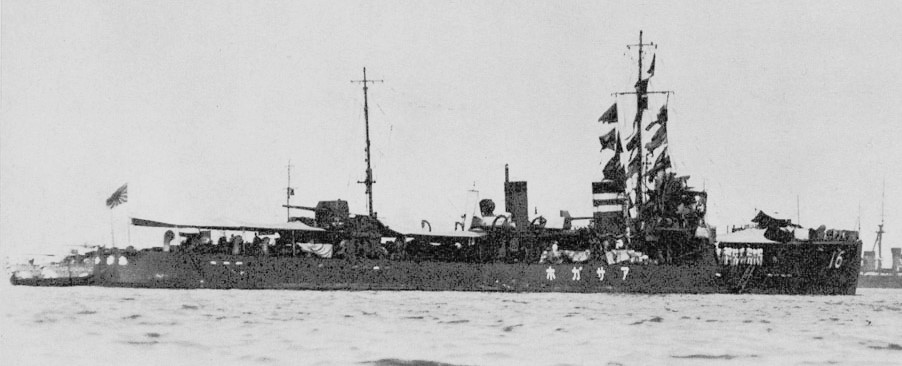
© 2008-2018 Bob Hackett, Sander Kingsepp and Peter Cundall
Revision 22
14 March 1922:
Tokyo. Laid down at Ishikawajima Shipbuilding as a second-class WAKATAKE-class destroyer named No. 10. KAKITSUBATA (water iris) was a tentative name proposed for No. 10, but rejected before she received a numeral designation.
4 November 1922:
Launched.
1 December 1922:
LtCdr (later Rear Admiral) Yoshida Tsunemitsu (36)(former CO of KAYA) is appointed the Chief Equipping Officer.
10 May 1923:
Completed and registered in the IJN. LtCdr Yoshida Tsunemitsu is the Commanding Officer.
24 April 1924:
Designated destroyer No. 10.
1 December 1924:
LtCdr Sakano Minbu (38) is appointed CO.
1 December 1925:
LtCdr (later Captain) Koga Shichisaburo (36) is appointed CO.
1 November 1926:
LtCdr Nanba Hiroyuki (39) is appointed CO.
1 August 1928:
Renamed ASAGAO. An unknown officer is appointed CO.
10 December 1928:
LtCdr (later Vice Admiral) Nakazawa Tasuku (43) is appointed CO.
30 November 1929:
LtCdr (later Rear Admiral) Araki Tsuto (45) is appointed CO.
1 April 1932:
LtCdr (later Vice Admiral) Nakatsu Seiki (44) (former CO of HAYATE) is appointed CO.
15 November 1933:
LtCdr Nakatsu is appointed CO of FUYO “on paper” as an additional duty.
11 January 1934:
LtCdr Nakatsu also is appointed CO of KARUKAYA “on paper” as an additional duty.
1 February 1934:
LtCdr Nakatsu is relieved of “paper” command of KARUKAYA, but retains command ASAGAO and “paper” command of FUYO.
15 May 1934:
LtCdr Sei Tsuneo (48)(current CO of KARUKAYA) is appointed CO as an additional duty.
20 August 1934:
LtCdr (Rear Admiral, posthumously) Watanabe Yasumasa (49)(current CO of ASAKAZE) is appointed CO as an additional duty.
15 November 1935:
LtCdr (Captain, posthumously) Yoshii Goro (50) is appointed CO .
24 February 1936:
LtCdr (Captain, posthumously) Aoki Kyuji (50) is appointed CO.
7 July 1937: The Marco Polo Bridge (The First "China") Incident:
Lugouqiao, China. Japanese troops on night maneuvers at the bridge fire blank cartridges. Chinese troops fire back, but do not cause injuries. The Japanese discover a soldier missing and demand entry to Beijing to look for him, but the Chinese refuse. The Japanese shell the city and an undeclared war on China begins.
August 1937: The Evacuation of Japanese residents in South China:
Japanese residents in South China are under the protection of Rear Admiral Okuma Masakichi's DesRon 5 composed of flagship YUBARI, destroyer ASAGAO, DesDiv 16's MAWEI, DesDiv 13's SWATOW and SANAE at
Canton. DesRon 5 is assigned to protect about 12,000 Japanese residents in Fuchow, Amoy, Swatow and Canton. With the outbreak of the North China Incident, DesDiv 16 is dispatched to the north. DesDiv 5 from Mako and DesDiv 29 from Japan are put under the command of Rear Admiral (later Vice Admiral) Okuma Masakichi (37).
12 August 1937:
The situation in South China shows a drastic change for the worse. Residents in Swatow start evacuation that day. After the clash in Shanghai, residents in Canton begin evacuating on 15
August and those in Fuchow on 17 August. All of them reach Formosa safely. The evacuation of residents from Amoy, delayed for various reasons, is completed in late August.
15 November 1937:
Lt (Rear Admiral, posthumously) Nakamura Noboru (52) is appointed CO .
10 May 1938:
DesDiv 16’s FUYO, ASAGAO and KARUKAYA participate in an amphibious assault on Amoy (Xiamen) with Vice Admiral (later Admiral) Koichi Shiozawa’s (32)(former CO of FURUTAKA) 5th Fleet consisting of CruDiv
9's MYOKO (F) and light cruiser TAMA, CruDiv 10's light cruisers TATSUTA and TENRYU, DesRon 5's light cruiser NAGARA, DesDiv 3’s NADAKAZE, SHIMAKAZE, SHIOKAZE, CarDiv 1's KAGA, DesDiv 29’s HAYATE and OITE, SORYU with DesDiv 30’s YAYOI and KISARAGI, auxiliary seaplane tender KAMIKAWA MARU, collier MUROTO, CarDiv 3's seaplane tender KAMOI, auxiliaries SYURI, CHOJU, DELHI, EIKO, IKUTA, KAZAN, KURI, HAYA MARUs and DAIICHI MARU No. 8, NANSHIN MARU No. 8, NANSHIN MARU No. 31, TAIKO, YODATI and auxiliary minelayers ENOSHIMA and ENTO (MAROSHIMA).
At dawn, the Fifth Fleet’s warships, including DesDiv 16, bombard Ho-tsu, Ni-chin, and Wu-tung and cover an amphibious assault landing by more than 2,000 troops of the Yokosuka, Kure and Sasebo Special Naval Landing Forces (SNLF). At the same time, NE of Xiamen (Amoy), Japanese aircraft from tenders KAMOI and KAMIKAWA MARU bomb bridges, roads, ferries and ships. The poorly equipped Nationalist Chinese 75th Division defenders suffer heavy casualties, are overrun by the SNLFs and withdraw.
12 May 1938:
That night, Chinese forces abandon Amoy to the Japanese.
15 October 1940:
Lt Kimotsuki Masaaki (56) is appointed CO.
25 January 1941:
Placed in 4th reserve at Maizuru.
10 April 1941:
Lt (later Cdr) Sugihara Yoshiro (57) is appointed CO.
1941-1942:
Undergoes refit. The center 4.7 gun, between the funnels, is removed. The remaining two 4.7/45 cal, low angle guns are replaced with improved dual purpose 4.7/50 cal. mounts. Two triple 25mm mounts replace the center 4.7 mount. Mine sweeping gear is removed and the number of depth charges is increased by 36 with 4 throwers. One of ASAGAO's torpedo mounts is also removed.
8 December 1941:
ASAGAO is assigned to Rear Admiral Owada Yoshinosuke’s (35)(former CO of NACHI) Chinkai (Korea) Guard Force in Cdr (Rear Admiral, posthumously) Yamamoto Iwata’s (46)(former CO of KAGERO) DesDiv 32 with KARUKAYA and FUYO. Patrols the Tsushima Straits area.
21 January 1942:
DesDiv 32's ASAGAO, KARUKAYA and FUYO depart Mutsure with CruDiv 9's light cruiser OI escorting transports TATSUNO, FUSHIMI, SOMEDOMO, TAKETOYO, TOFUKU, BRAZIL, COLUMBIA, MAEBASHI, GENOA, HOEISAN, ATSUTA, DAINICHI, TOKIWA, SYDNEY, MOMOYAMA, PACIFIC, KIZAN, REIYO and TSUYAMA MARUs. The transports are carrying the 2nd Infantry Division.
26 January 1942:
Arrives at Mako, Pescadores. Later, the convoy departs for Camranh Bay to mobilize for the Invasion of Java.
17 February 1942:
At 0800 ASAGAO departs Mutsure with destroyer KARUKAYA and minelayer HIRASHIMA escorting No. 56 Army Division Convoy No. 1 Section consisting of NAGARA, NAKO, AOBASAN, HARUNA, KYUSHU and SAKITO MARUs bound south and two ships KINKASAN and TAISHO MARUs bound only for Mako.
20 February 1942:
At 1100 arrives at Mako.
10 April 1942:
ASAGAO is assigned to Cdr (Rear Admiral, posthumously) Amaya Yoshishige’s (47) DesDiv 13 of Rear Admiral Inoue Yasuo’s (38) 1st Surface Escort Division organized this day as a unit of the Southwest Area Fleet. At the time ASAGAO is undergoing repairs at maintenance at Pusan.
18 April 1942:
At 0730 undocked and departs and at 1730 arrives at Chinkai.
19 April 1942:
At 1830 departs Chinkai.
20 April 1942:
At 0700 arrives at Mutsure.
21 April 1942:
At 1400 convoy No. 101 departs Mutsure. The convoy, the first of the Empire-Formosa convoys, consists of BUENOS AIRES MARU, REKIZAN MARU and four unidentified merchant ships escorted by torpedo boat SAGI and destroyers ASAGAO, FUYO and KARUKAYA.
25 April 1942:
LtCdr Onishi Yuji (57) is appointed CO.
26 April 1942:
At 1230 arrives at Mako.
30 April 1942:
ASAGAO departs Mako escorting convoy No. 302 consisting of one unidentified merchant ship.
5 May 1942:
At 2300 arrives at St Jacques.
8 May 1942:
At 1200 departs St Jacques likely escorting convoy No. 401 consisting of KIBI, BUJUN and TAIYU MARUs and possibly others. Later when 230 Ri E of Nha Trang in 12-18N 111-17E BUJUN MARU is torpedoed and sunk by USS SKIPJACK and TAIYU MARU is hit and damaged.
13 May 1942:
At 1200 arrives at Mako.
21 May 1942:
At 1200 departs Mako escorting convoy No. 703 consisting of three unidentified merchant ships.
25 May 1942:
At 0800 arrives at Manila.
27 May 1942:
At 1200 departs Manila escorting convoy No. 803 consisting of KUNITAMA MARU, UNYO MARU No. 3 and four unidentified merchant ships.
30 May 1942:
At 1200 arrives at Mako.
5 June 1942:
At 1200 departs Mako escorting convoy No. 311 consisting of two unidentified merchant ships.
12 June 1942:
At 0800 arrives at St Jacques.
14 June 1942:
AT 1200 departs St Jacques escorting convoy No. 412 consisting of seven unidentified merchant ships.
20 June 1942:
At 1200 arrives at Mako.
25 June 1942:
At 1900 departs Mako escorting convoy No. 316 consisting of COLUMBIA, KINKASAN, GENKAI MARUs and two unidentified merchant ships.
1 July 1942:
At 1200 arrives at St Jacques.
6 July 1942:
At 0800 departs St Jacques escorting convoy No. 511 consisting of KINKASAN, SHINYU and COLUMBIA MARUs and one unidentified merchant ship.
9 July 1942:
At 1100 arrives at Singapore. KINKASAN MARU has detached en route for Palembang.
13 July 1942:
At 1000 departs Singapore escorting convoy No. 616 consisting of tanker OGURA MARU No. 2 and four unidentified merchant ships.
16 July 1942:
At 1200 arrives at St Jacques.
18 July 1942:
At 1500 departs St Jacques escorting convoy No. 421 consisting of tanker OGURA MARU No. 2 and seven unidentified merchant ships.
23 July 1942:
At 1500 arrives at Mako.
30 July 1942:
At 1200 departs Mako escorting convoy No. 324 consisting of DELAGOA, SHINANOGAWA and MIIKE MARUs and one unidentified merchant ship.
5 August 1942:
At 0600 arrives at St Jacques.
7 August 1942:
At 1400 departs St Jacques escorting convoy No. 426 consisting of tanker ITSUKUSHIMA MARU and three unidentified merchant ships.
10 August 1942:
At 1400 arrives at Mako. docked for repairs.
27 August 1942:
At 1400 departs Mako escorting convoy No. 331 consisting of TOYOOKA, OIGAWA, HAVRE MARUs, YOSHIDA MARU No.1 and one unidentified merchant ship.
2 September 1942:
Arrives at St Jacques.
7 September 1942:
At 1400 departs St Jacques escorting convoy No. 523 consisting of TOYOOKA and BRISBANE MARUs.
10 September 1942:
At 1500 arrives at Singapore.
13 September 1942:
At 1200 departs Singapore escorting convoy No. 631 consisting of two unidentified merchant ships.
16 September 1942:
At 0800 arrives at St Jacques.
20 September 1942:
At 0800 departs St Jacques escorting convoy No. 437 consisting of SHOYO, KENKOKU, and RASHIN MARUs, FUSHIMI MARU No. 2 and two unidentified merchant ships.
23 September 1942:
FUSHIMI MARU No. 2 is detached for Sana.
26 September 1942:
At 1200 arrives at Mako.
30 September 1942:
Departs Mako escorting convoy No. 269 consisting of PACIFIC, TAGA, MIE, TAKASAGO MARUs and four unidentified merchant ships.
6 October 1942:
At 1300 arrives at Moji. Departs Moji and later arrives Maizuru. Dtydocked for repairs and maintenance.
28 October 1942:
At 1000 departs Maizuru.
29 October 1942:
At 1000 arrives at Mutsure.
30 October 1942:
At 1200 departs Mutsure escorting convoy No. 180 consisting of TAITO, TAIRYU, YONEYAMA MARUs and three unidentified merchant ships.
5 November 1942:
At 1200 arrives at Mako.
8 November 1942:
At 1400 departs Mako escorting convoy No. 288 consisting of eight unidentified merchant ships.
14 November 1942:
At 0930 arrives at Moji.
17 November 1942:
At 1500 departs Mutsure escorting convoy No. 189 consisting of three unidentified merchant ships.
21 November 1942:
At 1100 arrives at Mako.
26 November 1942:
At 1500 departs Mako escorting convoy No. 297 consisting of FUKKAI MARU and eight unidentified merchant ships.
1 December 1942:
At 1400 arrives at Chinkai and departs at 1630.
2 December 1942:
At 0800 arrives at Moji.
7 December 1942:
At 1300 departs Mutsure escorting convoy No. 198 consisting of FUKUYAMA MARU.
10 December 1942:
DesDiv 13 is disbanded.
11 December 1942:
At 1200 arrives at Mako.
18 December 1942:
At 1400 departs Mako escorting convoy No. 209 consisting of tanker TONAN MARU, cargo ship MOMOHA MARU, and four unidentified merchant ships.
19 December 1942:
Hospital ship YOSHINO MARU apparently joins from Kirun.
24 December 1942:
At 1200 arrives at Moji.
29 December 1942:
At 1500 departs Mutsure escorting convoy No. 109 consisting of four unidentified merchant ships.
3 January 1943:
At 1800 arrives at Mako.
9 January 1943:
At 1400 departs Mako escorting convoy No. 361 consisting of three unidentified merchant ships.
15 January 1943:
At 1200 arrives at St Jacques. At 1400 departs St Jacques and at 1800 arrives at Saigon.
21 January 1943:
At 1530 departs Saigon and at 1915 arrives at St Jacques.
22 January 1943:
At 1400 departs St Jacques escorting convoy No. 467 consisting of four unidentified merchant ships.
28 January 1943:
At 1000 arrives at Takao.
8 February 1943:
At 1130 departs Takao escorting convoy No. 229 consisting of BOKO (ex-British SAGRES), MANKO MARUs and two unidentified merchant ships.
12 February 1943:
At 1050 ASAGAO, having detached, arrives at Sasebo. The ship is docked for the rest of the month and March.
13 February 1943:
The rest of the convoy arrives at Moji.
28 March 1943:
At 0818 departs Sasebo and at 1600 arrives at Imari Wan.
30 March 1943:
At 0615 departs Imari Wan and at 1545 arrives at Moji.
3 April 1943:
At 1400 departs Moji escorting convoy E consisting of BOKO (ex British SAGRES), KOZUI, TAMON and NICHIRYO MARUs and one unidentified merchant ship. The convoy split into two parts shortly after departing port.
8 April 1943:
At 1100 arrives at Takao.
10 April 1943:
Reassigned directly to the 1st Surface Escort Division of the Southwest Area Fleet.
15 April 1943:
At 0900, ASAGAO departs Takao escorting convoy No. 745 consisting of FUSEI, AWAJI, KOZUI and FUSEI MARUs and four unidentified merchant ships at 8.5 knots.
18 April 1943:
At 1500 arrives at Manila.
22 April 1943:
At 0900 departs Manila in convoy No. 3103 consisting of MAYA and FUSEI MARUs ex British FAUSANG and two unidentified ships.
27 April 1943:
At 1500 arrives at Palau.
1 May 1943:
At 1000 departs Palau in convoy No. 3206 consisting of BENGAL, ADEN, MIYADONO, TOYAMA, KIZAN and ASO MARUs.
6 May 1943:
At 0930 arrives at Manila.
11 May 1943:
At 1000 departs Manila.
13 May 1943:
At 1000 arrives at Takao.
17 May 1943:
At 1850 departs Takao in convoy No. 750 consisting of KUNISHIMA, NANREI and KINUGASA MARUs.
19 May 1943:
At 2100 arrives at Manila.
23 May 1943:
At 0900 departs Manila in convoy No. 3106 consisting of EIKO MARU No. 2 GO and four unidentified ships.
29 May 1943:
At 1100 arrives at Palau.
1 June 1943:
At 1600 departs Palau in convoy No. 2503 consisting of YONEYAMA and SHINYU MARUs.
5 June 1943:
At 0900 arrives at Menado.
7 June 1943:
At 1845 departs Menado.
10 June 1943:
At 0900 arrives at Balikpapan.
12 June 1943:
At 1000 departs Balikpapan in convoy No. 2601 consisting of three unidentified merchant ships.
18 June 1943:
At 1000 arrives at Palau.
20 June 1943:
At 1600 departs Palau in convoy No. 3212 consisting of KAYO, KAMJO and HEIMEI MARUs.
26 June 1943:
At 0900 arrives at Manila.
28 June 1943:
At 1300 departs Manila in convoy "Y" consisting of FUJISAN and HOKUROKU MARUs.
30 June 1943:
At 1900 arrives at Mako.
1 July 1943:
At 0500 departs Mako and at 1200 arrives at Takao.
3 July 1943:
At 0930 departs Takao in convoy "F" consisting of tanker FUJISAN MARU and one unidentified merchant ship.
7 July 1943:
At 0800 arrives at Moji.
10 July 1943:
At 1500, departs Moji escorting convoy No. 175 consisting of DAINICHI, CHINA, WAKATSU, MACASSAR, TEIRITSU (ex-Vichy French LECONTE DE LISLE) and KASHU MARUs and tankers NITTATSU, KOZUI and TATSUNO MARUs.
16 July 1943:
At 1900 arrives at Mako.
17 July 1943:
At 0700 departs Mako and at 1200 arrives at Takao.
26 July 1943:
At 1100 departs Takao escorting convoy No. 286 consisting of tanker GOYO and SEINAN MARUs and eight unidentified merchant ships.
31 July 1943:
At 1600 arrives at Moji.
4 August 1943:
Departs Moji escorting convoy No. 183 consisting of auxiliary ammunition ship KOGYO MARU and tankers SHOYO MARU, OGURA MARU No. 1 and OGURA MARU No.2 and transports NIKKO, SAIHO and MANSHU MARUs and four unidentified merchant ships. The convoy split into two parts shortly after departing port.
8 August 1943:
Arrives at Takao.
13 August 1943:
Departs Takao escorting convoy No. 292 consisting of KUNISHIMA, HAKUBASAN and KOSHIN MARU’s and six unidentified merchant ships bound for Moji.
E 16 August 1943:
ASAGAO is detached and turns towards Takao.
17 August 1943:
Convoy No. 293 consisting of ICHIYO, YAMASACHI, KOZUI, HEIWA, HAKKO, HOFUKU, ASAKA, ROKKOSAN and RYUOSAN MARUs departs Takao. ASAGAO joins as an escort shortly after departure.
19 August 1943:
Convoy 292 arrives Moji. As noted above ASAGAO had detached from the convoy about half way to escort convoy No. 293.
23 August 1943:
Convoy No. 293 arrives at Moji. Upon arrival, ASAGAO departs Moji in convoy No. 189 consisting of HIMALAYA, AMAGI, KOKAI and KOSEI MARUs (2205 tons) and two unidentified merchant ships.
28 August 1943:
Arrives at Takao.
30 August 1943:
Departs Takao escorting convoy No. 319 consisting of AMAGI, HIMALAYA and NORFOLK MARUs and eight unidentified merchant ships.
7 September 1943:
At 1100 arrives at St Jacques. The same day at 1511 arrives alone at Saigon.
10 September 1943:
At 1300 departs Saigon and at 1600 arrives at St Jacques.
11 September 1943:
At 1900 departs St Jacques escorting convoy No. 425 consisting of ARGUN, HOKUYO, GINYO, SHOYO MARUs and tankers KIYO MARU and OGURA MARU No. 1 and six unidentified merchant ships.
13 September 1943:
TEIKA MARU (ex-Vichy French CAP VARELLA) joins from Haikow.
18 September 1943:
At 0620, GINYO MARU reports a torpedo attack that missed the ship. At 1500 the convoy arrives at Mako.
20 September 1943:
At 1300 departs Mako escorting the Rinji B convoy with fleet oiler SHIRIYA for Moji consisting of oilers TAKETSU and SHOYO MARUs and OGURA MARU No. 1 and freighters ARGUN, MANTAI, KIYO, GYOKU and HOKUYO MARUs.
21 September 1943:
East China Sea. NE of Keelung, Formosa. LtCdr (later Captain) Robert E. Dornin's (USNA ’35) USS TRIGGER (SS-237) is patrolling submerged 30 miles N of the Hoka Sho light. At 2058, Dornin makes a visual surface attack. At 1500 yards, he fires three torpedoes at the lead oiler and three at the second oiler. One hits the lead ship, SHIRIYA. She is carrying aviation gasoline and a sheet of white flame shoots up to 1,000 feet. The crew, dressed in whites, runs forward to escape the blaze. SHIRIYA explodes and sinks at 26-27N, 122-40E. Captain Nakao Hachiro (40) is KIA. He is promoted Rear Admiral, posthumously. The second ship, freighter ARGUN MARU is hit by a torpedo amidships, breaks in half and sinks immediately. Two crewmen are KIA.
LtCdr Dornin brings USS TRIGGER about. He fires three stern tubes at the OGURA MARU No. 1, but misses. Dornin crash-dives to escape gun fire from a third oiler. He comes to periscope depth and fires two bow torpedoes at SHOYO MARU that send her down by the bow. Dornin makes two more attacks on a freighter, but all of his Mark 14 torpedoes either miss or are duds. Nevertheless, GYOKU MARU is damaged in the attacks. The remainder of the convoy arrives at Moji. USS TRIGGER returns safely to Midway Island for refit.
The auxiliary netlayer WAKAMIYA MARU is instructed to take on board rescued survivors by sASAGAO and return to Kirun under Takao Guard Office Wireless No. 286.
25 September 1943:
At 0830 arrives at Moji.
3 October 1943:
At 1000 ASAGAO departs Moji with destroyers SHIOKAZE (that departs Sasebo) escorting convoy No. 103 consisting of tanker KIYO MARU and HAKKO, COLUMBIA, HOKUSHIN, HOKKI, MINRYO MARUs and six unidentified merchant ships. The convoy split into two parts shortly after departing port.
7 October 1943:
At 2015 the first part including ASAGAO arrives at Mako.
8 October 1943:
The second part including the SHIOKAZE arrives at Mako.
9 October 1943:
At 0830 departs Mako and at 1330 arrives at Takao.
11 October 1943:
At 0800 departs Takao and at 1100 arrives at Mako.
12 October 1943:
At 0900 ASAGAO departs Mako with torpedo boat TOMOZURU escorting convoy No. 329 consisting of tankers HAKKO, HOKKI and KIYO MARUs, FUSHIMI MARU No.3 and transports FRANCE, GYOKO, HOKUSHIN, COLUMBIA, HOTEN, TEIRITSU, MANKO MARUs and nine unidentified merchant ships.
15 October 1943:
MANKO MARU is detached.
16 October 1943:
At 2330 destroyer FUYO joins up with convoy No. 329. Submarine chaser CH-9 joins at around this time.
18 October 1943:
At 1930 arrives at St Jacques.
19 October 1943:
At 0500 departs St Jacques to meet up with convoy No. 331 and at 0930 arrives at Saigon.
20 October 1943:
Lt Mori Sakae (63) is appointed CO.
22 October 1943:
At 1200 departs Saigon alone.
23 October 1943:
At 1800 briefly escorts convoy No. 331. This consists of AMERICA, GYOKUREI, GYOTEN (ex British EMPIRE MOONBEAM), MIKASA, HEIAN, NICHIEI and BIYO MARUs and four unidentified merchant ships also escorted by destroyer ASAKAZE. (KOSEI and HIDA MARUs had already detached).
25 October 1943:
Departs St Jacques escorting convoy No. 520 consisting of AMERICA, GYOKUREI, GYOTEN (ex British EMPIRE MOONBEAM), MIKASA, HEIAN, NICHIEI and BIYO MARUs and one unidentified merchant ship.
27 October 1943:
At 0400 ASAGAO breaks off escort.
28 October 1943:
Convoy 520 arrives at Singapore. At 1345 ASAGAO arrives at Saigon.
1 November 1943:
Reassigned to the General Escort Command.
3 November 1943:
At 0800 departs Saigon and at 1125 arrives at St Jacques.
4 November 1943:
At 1600 departs St Jacques escorting convoy No. 439 consisting of HAKKO, MITO, CHIYODA, BEIJU MARUs and four unidentified merchant ships.
9 November 1943:
At 2030 ASAGAO detaches from the convoy to hunt an enemy submarine.
10 November 1943:
At 0830 rejoins the convoy. Later, ASAGAO reports a torpedo attack at 21-38N, 116-45E. The destroyer detaches and does not rejoin the convoy.
11 November 1943:
The convoy arrives at Takao. At 0935 ASAGAO arrives at Takao.
20 November 1943:
At 0940 departs Takao escorting convoy No. 220 consisting of YAGUMO MARU and six unidentified merchant ships. Later at 2200, ASAGAO is detached.
21 November 1943:
At 1200 arrives at Takao but departs alone at 1515.
23 November 1943:
At 1030 arrives at Kirun.
24 November 1943:
At 0740 convoy RINMA consisting only of ORYOKU MARU with destroyers HASU (part way) and ASAGAO as escorts departs Kirun.
27 November 1943:
At 1100 RINMA convoy arrives at Moji.
28 November 1943:
Convoy 220 arrives at Moji. At 1300 ASAGAO departs Moji.
29 November 1943:
At 1415 arrives at Maizuru. Soon after drydocked for repairs at Maizuru.
27 December 1943:
At 1300 departs Maizuru.
28 December 1943:
At 1400 arrives at Moji.
29 December 1943:
At 1500, W-4 , W-5 and destroyer ASAGAO depart Moji for Takao, Formosa escorting convoy No. 125 consisting of KOSHIN, TEIHOKU (ex French PERSEE), YAMAMIYA, KANAN, KENZUI, KAZUURA, MISAKI, SEINAN and HOREI MARUs, SHINYO MARU No. 8 and tanker KYOEI MARU No. 5.
4 January 1944:
At 0932, arrives at Takao.
6 January 1944:
At 0600 departs Takao in convoy No. 351 consisting of TEIHOKU (ex French PERSEE), KENZUI, KANAN MARUs and two unidentified merchant ships escorted by destroyer ASAGAO.
11 January 1944:
At 0830, convoy HI-31 departs Moji for Singapore consisting of oilers GENYO, OMUROSAN, TATEKAWA and ITSUKUSHIMA MARUS and cargo liner HOKUROKU MARU escorted by carrier CHITOSE and destroyers AMATSUKAZE and YUKIKAZE.
13 January 1944:
At 1000 convoy No. 351 arrives at St Jacques.
16 January 1944:
N of the Spratly Islands. AMATSUKAZE is torpedoed by Cdr Robert D. King's (USNA ’31) USS REDFIN (SS-272) at 14-40N, 113-50E. The destroyer loses her bow and is presumed sunk by the convoy that proceeds onward. 80 sailors including ComDesDiv 16’s Captain (Rear Admiral posthumously) Furukawa Bunji (49), are KIA. AMATSUKAZE is left adrift for six days until discovered by a Japanese patrol plane.
17 January 1944:
At 1430 departs St Jacques. Some time after ASAGAO locates and begins to tow AMATSUKAZE to Camranh Bay then Cape St. Jacques.
21 January 1944:
At 1800 arrives at Camranh Bay.
23 January 1944:
At 2000 departs Camranh Bay still towing AMATSUKAZE. Submarine chaser CH-19 departs Camranh Bay and meets up with damaged destroyer AMATSUKAZE being towed by destoyer ASAGAO and escorts ships.
29 January 1944:
Two French naval tugboats take over the tow and tow the AMATSUKAZE into St. Jacques. At 2230, ASAGAO arrives at St Jacques. Later, AMATSUKAZE makes it to Saigon for emergency repairs.
30 January 1944:
At 1200 departs St Jacques alone and at 1630 arrives at Saigon.
6 February 1944:
At 1000 departs St Jacques in convoy SATA-02 consisting of BATAVIA MARU and five unidentified merchant ships escorted by destroyer ASAGAO and auxiliary subchaser CHa-21. Later detaches on an anti submarine hunt.
8 February 1944:
At 1200, ends the anti submarine sweep.
9 February 1944:
At 0930 arrives at Camranh Bay alone.
10 February 1944:
At 0800 departs Camranh Bay.
11 February 1944:
At 0730 arrives back at Camranh Bay.
12 February 1944:
At 0800 departs Camranh Bay escorting convoy SATA-02. At 1507, at 12-45N-109-29E, CHa-21 carries out a depth charge attack.
13 February 1944:
At 0400, at 14-05N 109-21E, a surfaced enemy submarine is discovered. Fires 8 rounds with the main guns and drops 29 depthcharges. Arrives at Tourane.
15 February 1944:
Departs Tourane. At 0900, ends the anti submarine sweep.
17 February 1944:
At 1000 arrives at Yulin.
18 February 1944:
At 1200 departs Yulin.
24 February 1944:
At 1145 arrives at Takao.
25 February 1944:
At 0740 departs Takao and meets up with convoy HI-49. At 1955 arrives at Takao.
29 February 1944:
At 0700 ASAGAO departs Takao with destroyers HARUKAZE and NAMIKAZE, auxiliary submarine chaser CHa-74 and minesweeper W-18 escorting convoy TAMO-07 consisting of oilers MATSUMOTO, ASANAGI MARU, cargo ships SHOUN, SHOZUI, BATAVIA, HIDA, BIZEN, HAVRE MARUs and TOYO MARU No. 3 and fourteen unidentified merchant ships.
2 March 1944:
At 1200 arrives at Kirun alone.
4 March 1944:
At 1300 ASAGAO and minelayer MAESHIMA join convoy MOTA-07 consisting of TEIKA (ex French CAP VARELLA), YAMAHAGI, RONSAN, KONSAN, CHIYODA, SUGIYAMA, KENSEI, SARAWAK, HAKUROKO, RIKKO, ATAGO and NITTATSU MARUs and NISSHIN MARU an unidentified merchant ship (both from MOTA-05) escorted by destroyer AMAGIRI and minesweeper W-30.
5 March 1944:
At 1900 ASAGAO arrives at Takao.
7 March 1944:
At 1700 ASAGAO departs Takao for Palau with destroyer HAMANAMI and torpedo boat SAGI escorting convoy Nishi-Matsu No. 1-TAPA-04 consisting of GOZAN, TAISEI, SHIRAHAMA, TETSUYO, TAKEGAWA and ATSUTA MARUs and four unidentified marus.
16 March 1944:
Arrives at Palau after detaching from convoy two fdays before to undertake an anti submarine sweep.
17 March 1944:
At 0900 ASAGAO departs Palau with torpedo boat SAGI and auxiliary subchaser CHa-22 escorting convoy PATA-05 consisting of OSAKA, PEKING, HOKKAI, NANREI and TAKEGAWA MARUs.
18 March 1944:
At 180 nm from Palau, ASAGAO is detached and returns to Palau, arriving at 1700.
22 March 1944:
At 1215 departs Palau and heads to seen of URAKAMI MARU disaster to rescue survivors.
23 March 1944:
At 1000 arrives back at Palau.
24 March 1944:
At 1200 departs Palau with auxiliary subchaser SHOWA MARU No. 5 escorting convoy PATA-06 consisting of HAVRE (5467 gt) and SHIRAHAMA MARUs and two unidentified merchant ships.
E 27 March 1944:
SHOWA MARU No. 5 is detached and returns to Palau.
31 March 1944:
At 1056 arrives at Takao.
3 April 1944:
At 1400 departs Takao escorting convoy TASA-16 consisting of PACIFIC, RYUKO, YULIN, NIKKIN (or HIGANE), CHIHAYA, SHINEI, ANKO and SHOKEI MARUs.
7 April 1944:
Submarine Chaser CH-41 departs Camranh Bay and later (possibly later that day) joins the convoy.
8 April 1944:
At 1430 ASAGAO detaches and engages in a submarine hunt.
9 April 1944:
At 1130 arrives at Yulin.
10 April 1944:
At 1000 departs Yulin escorting convoy YUTA-04 consisting of HIDA MARU and five unidentified merchant ships.
15 April 1944:
At 1830 arrives at Takao. Minesweeper W-18 had departed Takao the previous day and met up with the convoy.
16 April 1944:
At 0930 ASAGAO departs Takao to meet up with SATA-17 consisting of MANTAI MARU and two unidentified merchant ships escorted by kaibokan CD-8, torpedo boat HATSUKARI and one unidentified maru auxiliary.
18 April 1944:
At 1900 arrives at Takao.
20 April 1944:
At 1100 departs Takao with old destroyer HASU, kaibokan CD-8 and auxiliary subchaser TAKUNAN MARU No. 3 escorting convoy TAMO-17 consisting of KENEI, SUGIYAMA, HIDA, TOTTORI, KYOKUZAN, TOKUSHIMA, HIROTA, IWATO MARUs, EIYO MARU No.2 (NB unconfirmed) and fifteen unidentified merchant ships.
27 April 1944:
Arrives at Moji. Meanwhile at 0630 ASAGAO and CD-8 have detached and at 1530 arrive at Sasebo. ASAGAO undergoes repairs.
3 May 1944:
At 1400 ASAGAO departs Sasebo and joins escort carrier TAIYO, destroyers HIBIKI and INAZUMA, kaibokan KURAHASHI, SADO, CD-5, CD-7, CD-13, escorting convoy HI-61 consisting of tankers AKANE, TATEKAWA, NICHIEI, AZUSA, JINEI, EIYO, OTORISAN, SARAWAK and ASANAGI MARUs, transport MIZUHO MARU and fleet oiler HAYASUI.
E 6 May 1944:
KURAHASHI meets up with HI-61 convoy.
7 May 1944:
ASAGAO is detached for Takao, arriving at 1000. At 1900 ASAGAO departs Takao with convoy MI-03 consisting of cargo ships RYUKA, HIYORI, DAITEN, HIOKI, DAIRIN, SHOHEI, NIKKO, ETAJIMA, DAIJUN, SHINNO, TOUN, KENWA and DAISEI MARUs, SHINSEI MARU No. 1, tankers ZUIYO, ATAGO, CHIYODA, KOTOKU, SHUNTEN MARUs, EIYO MARU No. 2 and OGURA MARU No. 2 and UNKAI MARU No. 5 escorted by old destroyer KARUKAYA, destroyer SHIOKAZE and kaibokan KURAHASHI (part way only), CD-1 (part way only), CD-13, torpedo boat HATO, auxiliary gunboat PEKING MARU and other unidentified warships.
10 May 1944:
At 0740 after escorting MI-03, ASAGAO and kaibokan CD-1 arrive back at Takao. At 1800 ASAGAO departs Takao escorting convoy TE-05 consisting of YAMADORI, HIYORI, HIOKI, KOKUSEI, HIKACHI, NICHIWA, SHONAN MARUs, and
KYOEI MARU No.2.
13 May 1944:
YAMADORI MARU is detached to Hong Kong from convoy TE-05. Meanwhile at 1430 after detaching from TE-05, ASAGAO arrives back at Takao.
14 May 1944:
At 1500 ASAGAO departs Takao alone.
15 May 1944:
At 0830 arrives at Kirun.
16 May 1944:
At 1500 departs Kirun in convoy TAMO-19A consisting only of ASAMA MARU. The ships sail at 17.5 knots.
19 May 1944:
At 1600 arrives at Moji. Soon after ASAGAO departs alone.
20 May 1944:
At 1000 arrives at Maizuru and undergoes repairs.
24 May 1944:
Drydocked.
9 June 1944:
At 1000 departs Maizuru alone.
10 June 1944:
At 1350 arrives at Moji.
11 June 1944:
At 1530, ASAGAO departs Moji with destroyer ASAKAZE, kaibokan YASHIRO, CD-2 and auxiliary minesweeper TAKUNAN MARU No. 3 escorting convoy MI-07 consisting of MATSUURA, KAMO, SHINKOKU, NISHI, MINO, TAIKAI, KAKOGAWA, MYOGI, KORYU, GYOKUYO, KOKKO, YULIN MARUs and tankers KOEI, TAIEI, SAKURA, CHIHAYA, RYUSHO and SAN LUIS MARUs and seven unidentified merchant ships. Immediately after leaving port, KOEI MARU develops engine problems and is forced to return to port.
15 June 1944:
At 1040, anchors at Oshima Strait, Amami Oshima.
16 June 1944:
Departs Oshima Strait.
17 June 1944:
MATSUURA and KAMO MARUs are detached with ASAGAO and head for Kirun (Keelung).
18 June 1944:
At 1300, the main convoy arrives at Takao. At 1730 ASAGAO and her charges arrive at Kirun.
19 June 1944:
At 0530 ASAGAO departs Kirun alone and at 2000 arrives at Takao.
21 June 1944:
At 1500 departs Takao escorting convoy TAMA-21A consisting of two unidentified merchant ships.
25 June 1944:
At 1600, arrives at Manila.
26 June 1944:
At 2200 ASAGAO departs Manila with kaibokan CD-2, CD-8, auxiliary subchaser TAKUNAN MARU No. 3 escorting convoy MATA-24 consisting of AKANE, AOBASAN, GENKAI, FUKUYO, MIIKESAN and ATSUTA MARUs.
28 June 1944:
At 2320, a submarine is sighted at 18-40N, 119-40E. ASAGAO and CD-2 are detached to hunt the submarine.
29 June 1944:
At 1730 ASAGAO and CD-2 arrive at Manila.
At about 1510, LtCdr Anton R. Gallaher's (USNA ’33) USS BANG (SS-385) attacks convoy HI-67 at 17-13N, 118-18E. Gallaher fires a spread of five torpedoes. Tankers MIRI and SARAWAK MARUs are each hit in
the bow by a torpedo and damaged, but both are able to proceed to Manila. CD-5 also suffers unspecified damage during the action.
30 June 1944:
At 0700 ASAGAO and CD-2 depart Manila and later join convoy HI-67 that left Moji on 20 June consisting of transports MANJU, NANKAI, KINUGASA, ASAKA, ASAHISAN and HAKOZAKI MARUs, ex-AMC GOKOKU MARU and oilers OTORISAN, MIRI, SARAWAK and SHINEI MARUs and NICHINAN MARU No. 2 escorted by destroyer KURETAKE, kaibokan HIRADO, KURAHASHI, CD-5, CD-13 and subchaser CH-61.
1 July 1944:
At 0015 the convoy arrives at Manila. CD-5 and ASAHISAN MARU leave the convoy.
3 July 1944:
At 0700 ASAGAO departs Manila for Yulin with destroyer KURETAKE and kaibokan CD-2 escorting convoy MAYU-04 consisting of HOKUSHINm TEIRYU (ex German AUGSBURG), and PACIFIC MARUs and three unidentified merchant ships.
7 July 1944:
At 1000 arrives at Yulin.
9 July 1944:
Near Belier Island, Hainan. ASAGAO and CD-2 are moored at the anchorage just NE of Belier Island (18-11N, 109-34E) when, just after midnight, a typhoon hits the area with full force. Wind velocity is reported to exceed 30 meters. Otherwise a good anchorage, it is exposed to the wind and swell during the SW Monsoon period. ASAGAO’s foreship is driven aground on an underwater reef and all forward bottom tanks spring leaks.
ASAGAO is stuck firm to the reef and initially all refloating attempts fail. As a result, cable ship SONJO MARU (ex-Chinese CHUEN TIAO) is ordered to assist and refloat the destroyer.
29 July 1944:
ASAGAO is still stranded on the reef despite the best efforts of her crew. At about 1700 (jst), the Samah area is attacked by 25 North American B-25 "Mitchell" medium bombers, 6 Consolidated B-24 "Liberator" heavy bombers and 10 Lockheed P-38 "Lightning" fighter-bombers. Great damage is done to Hainan Guard Station installations and to ammunition and storage depots. NICHIAN MARU (6,197 grt) (C-AK), moored at No. 9 buoy inside Yulin Harbor is slighty damaged by strafing, but her Captain is KIA while directing AA-fire on the bridge. SANA MARU (531grt), operating then as a B-Tug, is also inside Yulin Harbor and is struck by one bomb. She is also hit by three dud bombs which do not explode! But the one exploding bomb is enough to sink her. No other ships are damaged or sunk during this attack.
13 September 1944:
Refloating work on ASAGAO by SONJO MARU begins.
25 September 1944:
Finally, SONJO MARU successfully refloats ASAGAO and tows her into Yulin Harbor where she undergoes emergency repairs.
15 October 1944:
At 1600, ASAGAO and minesweeper W-101 depart Samah for Yawata, Japan escorting iron-ore transport convoy YUTA-12 consisting of BINGO, MIYAJIMA and NICHIZUI MARUs and one small unidentified ship.
19 October 1944:
S of Hong Kong. The convoy is attacked by skip-bombing North American B-25 "Mitchell" medium bombers. NICHIZUI MARU carrying iron ore, is hit and later sinks. Four escort troops and 50 crewmen are killed. At 2155, the convoy puts into Hong Kong.
20 October 1944:
Convoy YUTA-12 merges with convoy HOMO-01 consisting of KISHUN and SHINWA MARUs, tanker KAMOI also escorted by minesweeper Wa-101 and either CH-23 or CH-28. At 1900, the combined convoy departs Hong Kong. Meanwhile ASAGAO departs to escort MIYAJIMA MARU as part of TA-02 to Takao.
27 October 1944:
At 1317 anchors at Ssu Chiao Shan. The tanker OEI MARU joins at this point.
28 October 1944:
At 0930 the destroyer ASAGAO rejoins the convoy and at 1445 the ships depart port. KAMOI is detached.
1 November 1944:
At 1300 arrives at Moji. ASAGAO remains at Mutsure.
2 November 1944:
Departs Mutsure and at 1130 arrives at Sasebo.
4 November 1944:
At 0900 departs Sasebo.
5 November 1944:
At 2200 arrives at Maizuru. Undergoes repairs.
24 November 1944:
Departs Maizuru.
25 November 1944:
At 1115 arrives at Moji.
30 November 1944:
At 0900, ASAGAO departs Moji with kaibokan IKUNA, KANJU, SHINNAN, CD-41, CD-66, subchaser CH-28 and auxiliary subchaser CHa-223 escorting convoy MI-29 consisting of CLYDE, BRAZIL, AKISHIMA, MEIRYU, HAWAII, ENOURA, DAII, SHINYU, AKIKAWA and KAZUURA MARUs, HOSHI MARU No. 11 (JUICHISEI MARU) and KONAN MARU No.1 and tankers ENGEN, ENCHO and ENKEI MARUs.
2 December 1944:
LtCdr Ralph C. Style's (USNA ’33) USS SEA DEVIL (SS-400) torpedoes and sinks HAWAII and AKIKAWA MARUs at 30-24N 128-17E. HAWAII MARU is carrying 60 Explosive Motor Boats, 50 motor vehicles and 1843 troops of
23rd Army Division and all 1843 troops together with 60 others, 83 gunners, and 148 crewmen are killed. There are no survivors documented. KONAN MARU No.1 rescues survivors from AKIKAWA MARU. 244 troops, 7 Armed Escort and 18 crewmen are however MIA. The convoy formation breaks up. BRAZIL MARU goes to Keelung, DAII MARU and three others go to Koniya, Amami-Oshima and CLYDE MARU, HOSHI MARU No. 11 with IKUNA go to Takao. Later, the Koniya ships rejoin at Takao, but at this point the convoy is officially dissolved.
6 January 1945:
At 0750 departs Amoy with kaibokan YAKU and SHINNAN escorting convoy TAA-01 consisting of nine unidentified merchant ships bound for Takao.
7 January 1945:
At 1223 SHINNAN arrives at Saei. The rest of the convoy presumably arrives at Takao soon after.
9 January 1945:
ASAGAO arrives at Takao.
14 January 1945:
At 1100 ASAGAO departs Takao with kaibokan YASHIRO, CD-1, CD-130, CD-134 and CD-36 and minesweeper W-21 escorting convoy TAMO-37 consisting of DAIKO, DAIHO, DAII, BRAZIL, DAIIKU and MELBOURNE MARUs and HOSHI MARU No. 11 (JUICHISEI MARU).
16 January 1945:
At 1800 DAIKO MARU suffers an engine breakdown and the ships temporarily anchor. CD-130 joins the convoy.
17 January 1945:
At 0530 departs anchorage and at 1626 anchored temporarily. BRAZIL MARU sets up a towline with DAII MARU and when the convoy resumes its journey tows DAII MARU.
19 January 1945:
At 1900 arrives at Ssu Chiao Shan.
20 January 1945:
At 0708 departs Ssu Chiao Shan.
23 January 1945:
At 1610 CD-130 drops depth charges on a suspected submarine contact without results. At 1750 CD-134 also attacks a suspected submarine contact. At 2015 the convoy arrives at Mutsure.
25 January 1945:
ASAGAO arrives at Maizuru. The ship begins extensive repairs.
7 March 1945:
On that day, FRUMEL decrypts the following message from CinC, First Escort Fleet, timed 021027:
"ASAGAO will be in charge of HI-99 convoy, and is to proceed to Moji by am 4th."
12 March 1945:
On that day, FRUMEL provides the following information:
"HI-99 Convoy, consisting of 2 ships escorted by destroyer ASAGAO and 3 other escorts, leaves Shimonoseki at 0700 on 12 March for Singapore. ETA 1100 on 27th. Carrying – passengers and military stores.
Speed 14 knots.
ASAGAO, KEYAKI and NARA arrive Buka (sic) at 1800 on 16th and sail at 0700 on 17th." [1]
April 1945:
Inland Sea. Serves as a mother ship for patrol craft and minesweepers.
26 April 1945:
Coast of China. At 0755, ASAGAO departs the Shusan Sea area for Moji with kaibokan UKU and CD-26, patrol boat PB-102 (ex-USS STEWART, DD-224), minesweeper W-29 and subchaser CH-20 escorting convoy SHIMO-03 consisting of KASHIMA, BANSHU, ABUKUMAGAWA, SHINTON and TAIKYU MARUs and NANRYU MARU No. 9.
27 April 1945:
Yellow Sea. Off Moppo (Mopko), S Korea. PB-102 is detached from SHIMO-03 for an anti-submarine sweep. At 0849, 1048 and 2228 she engages PBY "Catalina“ flying boats shadowing the convoy. Convoy SHIMO-03 is then attacked by aircraft and unidentified submarine(s). The planes make many attacks and bomb and strafe the convoy. UKU and patrol boat PB-102 are damaged at 34-52N, 124-23E.
28 April 1945:
At 1200, arrives at Moji.
29 April 1945:
Temporarily stays at Koshima.
30 April 1945:
Arrives at Hebi Yanashima (Snake Island).
1 May 1945:
Arrives at Yuya bay.
2 May 1945:
Departs Yuya bay and arrives at Moji later this day.
20 May 1945:
Lt Ishibushi Nobutoshi (68)(former torpedo officer of YAHAGI) assumes command as the CO.
28 July 1945:
Inland Sea, W of Bisan-Seto. Carrier aircraft of Vice Admiral (Admiral, posthumously) John S. McCain's (USNA ’06) Task Force 38 damage ASAGAO.
22 August 1945:
Kanmon Strait off Mutsure Lighthouse. At 1635, ASAGAO while en route from Kure to Maizuru, hits a mine most probably laid by a 20th Air Force B-29 “Super Fortress” in "Operation Starvation". ASAGAO is abandoned there where she is surrendered to the Allies in a heavily damaged
condition.
30 November 1945:
Removed from the Navy List.
September 1947:
Yoshimi. Begins scrapping and salvage.
10 June 1948:
Scrapping is completed.
Authors' Notes:
[1] The severing of the trade route by Allied forces meant this convoy apparently never sailed.
Thanks to Mr. Gilbert Casse of France for his detailed review of this TROM. Special thanks go to Hans Mcilveen of the Netherlands for info on FRUMEL intercepts, to Mr. Matt Jones of Mississippi, USA for
help in identifying CO's and to Erich Muehlthaler of Germany for a detailed account of ASAGAO's 1944 grounding on an underwater reef and subsequent refloating.
-Bob Hackett, Sander Kingsepp and Peter Cundall
Back
to the Second Class Destroyers Page