FUSETSUKAN!
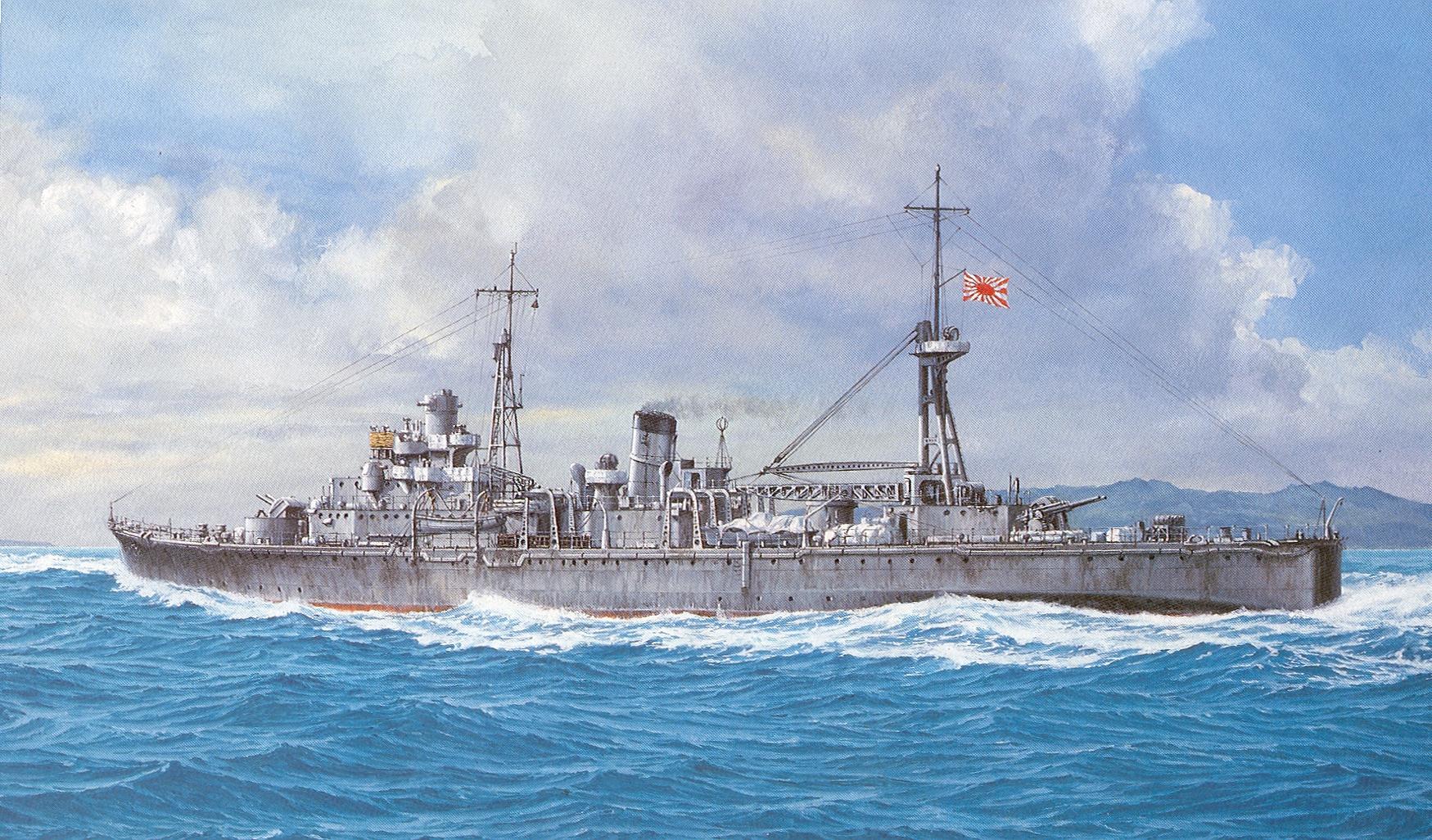
|
(TSUGARU by Takeshi Yuki scanned from "Color Paintings of
Japanese Warships")
IJN Minelayer AOTAKA:
Tabular Record of Movement
© 2008-2018 Bob Hackett, Sander Kingsepp and Peter Cundall
Revision 9
10 May 1939:
Aioi. Laid down at Harima Shipbuilding as minelayer No. 8.
23 December 1939:
Named AOTAKA.
23 January 1940:
Her call sign becomes JLHA under instruction No. 15.
3 February 1940:
Launched.
30 June 1940:
Completed and registered in the Maizuru Naval District.
15 November 1940:
Transferred to the 1st Base Force, Second Fleet. Cdr Nomi Minoru (43) is appointed CO.
1-6 February 1941:
The flag of the 1st Base Force is transferred from HAKUSAN MARU to AOTAKA.
15 February 1941:
Cdr Miyashita Yorinaga (44) assumes command.
23 March 1941:
Departs Tokuyama for central Chinese coast.
4 April 1941:
Arrives at Karatsu.
10 April 1941:
The 1st Base Force is reassigned to the Third Fleet.
10 June 1941:
Departs Sasebo for South Chinese coast.
7 September 1941:
Arrives at Maizuru.
12 September 1941:
Cdr Koyama Takeo (46) assumes command.
2 October 1941:
Departs Maizuru.
4 October 1941:
Arrives at Tachibana Bay, Kyushu; thereafter engages in training.
26 November 1941:
Assigned to Rear Admiral (later Vice Admiral) Kubo Kyuji's (38) (former CO of KAGA) Fourth Surprise Attack Unit. Departs the Terashima Strait, Japan.
27 November 1941:
Departs Terajima Strait off Kyushu.
1 December 1941:
AOTAKA is assigned to Vice Admiral Takahashi Ibo's (36) (former CO of YAMASHIRO) Third Fleet in Rear Admiral (later Vice Admiral) Kubo Kyuji's (38) (former CO of KAGA) 1st Base Force with minelayer SHIRATAKA, Gunboat Division 1 and Minesweeper Division 21.
Her call sign is changed to JUHA under instruction No. 369.
2 December 1941:
AOTAKA receives the signal "Niitakayama nobore (Climb Mt. Niitaka) 1208" from the Combined Fleet. This signifies that X-Day hostilities will commence on 8 December (Japan time).
4-8 December 1941: Operation "M" - The Attack on the Southern Philippines:
Rear Admiral Kubo's Fourth Surprise Attack Force's seven troop transports depart Palau with NAGARA (F), DesDiv 24's four destroyers and HAYATOMO and AOTAKA. Seaplane tenders CHITOSE and MIZUHO provide air cover. Enroute, the convoy’s destroyers refuel off Western Luzon, Philippines.
11-12 December 1941:
Covers the invasion of Legaspi. At 0400, A submarine is detected near the landing force. AOTAKA and patrol boat PB-34 are briefly detached for a depth-charge attack.
19 December 1941:
At 1755 (JST), departs Legaspi in company of destroyer YUKIKAZE and others.
22 December 1941:
Joins light cruiser NAGARA and other ships escorting the Lamon Bay landing force .
24 December 1941:
AOTAKA sets up an antisubmarine net at the mouth of Lamon Bay. The transports disembark troops at several points on SE Luzon.
26 December 1941:
At 0900 departs Lamon Bay in company of BUSHO, KEIKO and MYOGI MARUs and others, escorted by the 1st Gunboat Division and PatDiv 21. [1]
27 December 1941:
Meets up with transport IKUSHIMA MARU off Lamon Bay. The ships sail together for Palau.
31 December 1941:
At 0800 arrives at Palau. A cover sweep by vessels of No. 1 Gunboat Unit is carried out at the entrance to Palau to guard AOTAKA as the ship arrives.
3 January 1942:
At 0830 departs Palau accompanied by First Gunboat Fleet (EDO, FUKUYAMA and SAIKYO MARUs), that breaks off escort later that day.
5 January 1942:
At 1540 arrives at Davao, southeastern Mindanao, Philippines.
10 January 1942:
At 0800, departs Davao with minelayer SHIRATAKA. Arrives at Malalag Bay that same day.
12 January 1942:
NE edge of Menado, Celebes (now Sulawasi) Indonesia. Provides distant cover for Menado, Celebes (now Sulawasi) NEI Landing Force. Assists SHIRATAKA in setting up an antisubmarine net N of Banka.
21 January 1942:
Departs Banka with light cruiser NAGARA and DesDivs 15 and 16 and various other units. At 1936, destroyer KUROSHIO carries out a depth charge attack.
23 January 1942:
At 1230, DesDiv 15 carries out a depth charge attack. At 1508, minesweeper W-8 carries out a depth charge attack. She drops 7 depth charges. At 1830, AOTAKA carries out a depth charge attack.
24 January 1942:
At 0155, advances to the coast off Moeara Sampara Roadstead, Celebes (about 5 miles N of Kendari) and supports the landing of invasion forces. At 0430, landing of the invasion forces is successful. Arrives at Kendari later this day.
27 January 1942:
Departs Kendari for return to Banka in Invasion Convoy No. 1 consisting of NANKAI, KINAI, HOKUROKU, AMAGISAN and HAKUSAN MARUs also escorted by SHIRATAKA and Submarine Chaser No. 2 Division.
29 January 1942:
Arrives at Banka.
2 February 1942:
At 0710, departs Banka in Invasion Convoy No. 2 with survey ship TSUKUSHI, patrol boat PB-1, submarine chasers CH-3 and CH-14, PB-2, IKUSHIMA, MATSUE, MONTEVIDEO, SAN CLEMENTE and YAMASHIMO MARUs.
IKUSHIMA MARU carries 5th and 6th construction units.
3 February 1942:
Carries out a depth charge attack.
4 February 1942:
At 0716 arrives at Kendari.
5 February 1942:
At 1255 departs Kendari.
6 February 1942:
At 1537 arrives at Staring Bay, Kendari and departs later that day.
8 February 1942:
At 1149 arrives at Kendari.
9 February 1942:
At 2157 departs Kendari.
11-12 February 1942:
Supports the invasion of Macassar, Celebes. Assists survey ship TSUKUSHI.
16 February 1942:
At 0740 departs Macassar.
18 February 1942:
At 1050 arrives at Balikpapan and departs later that day at 1500.
19 February 1942:
At 0300 arrives back at Macassar.
20 February 1942:
At 1130 departs Macassar.
21 February 1942:
At 1800 arrives at Balikpapan.
22 February 1942:
At 0800 (JST), departs Balikpapan, Borneo, later supports the capture of Bali, Java. Conducts patrols of the Macassar Strait with TSUKUSHI.
23 February 1942:
At 1200 arrives at Balikpapan.
24 February 1942:
At 0700 departs Balikpapan with auxiliary gunboat MANYO MARU escorting oiler HAYATOMO.
25 February 1942:
At 1544 arrives at Macassar.
28 February 1942:
At 0005 departs Macassar.
10 March 1942:
The Third Fleet's First Base Force is deactivated. AOTAKA is reassigned to the Second Southern Expeditionary Fleet's 23 Special Base Force. Escorts convoys.
23 March 1942:
Departs Macassar.
25 March 1942:
Arrives at Surabaya.
28 March 1942:
Reassigned to East Indies Middle Area Guard Unit.
8-16 May 1942: Operation "S" – The Seizure of the Lesser Sunda's:
AOTAKA participates in a combined Army/Navy Operation to "sanitize" the local area that includes Lombok, Sumbawa, Flores and Bali Islands. No resistance by the Dutch is encountered.
15 May 1942:
Departs Reo, Flores with minesweepers from 12W unit escorting YOSHIDA MARU No. 3 and WAKATSU MARU.
17 May 1942:
Arrives at Kupang.
1 June 1942:
Arrives at Kupang.
13 June 1942:
Arrives at Seletar, Singapore.
15 June 1942:
Drydocked.
23 June 1942:
Undocked.
25 June 1942:
Departs Seletar.
30 June 1942:
Arrives at Surabaya. Assigned to escort convoys in that area.
14 July 1942:
Reassigned to the 23rd Special Base Force based at Macassar.
10 October 1942:
At 2300 departs Denpassar with auxiliary submarine chaser SHONAN MARU No. 1 escorting auxiliary gunboat OKUYO MARU.
12 October 1942:
At 0900 arrives at Macassar.
5 November 1942:
At 0900 departs Surabaya escorting a convoy.
8 November 1942:
At 1915 arrives at Kupang with submarine chaser CH-6 on an escort mission.
10 November 1942:
At 1300 AOTAKA and CH-6 depart Kupang.
11 November 1942:
At 0700 AOTAKA and CH-6 depart Waingapu on an escort mission.
14 November 1942:
At 1600 the ships arrive at Surabaya.
18 November 1942:
At 1200 AOTAKA departs Surabaya on an escort mission.
21 November 1942:
At 1500 AOTAKA and submarine chaser CH-2 arrive at Kupang on an escort mission.
23 November 1942:
At 0200 AOTAKA and submarine chaser CH-2 arrive at Dili on a transport mission.
25 November 1942:
At 1525 both ships departs Dili.
29 November 1942:
At 1000 AOTAKA arrives at Surabaya.
3 December 1942:
Departs Surabaya with submarine chaser CH-1 escorting a four ship convoy No.2 Jichuhei likely to Kupang.
18 December 1942:
Due to depart Surabaya with submarine chaser CH-1 escorting a four ship convoy No.3 Jichuhei likely to Kupang.
29 December 1942:
Arrives at Surabaya.
3 January 1943:
Drydocked.
9 January 1943:
Undocked.
15 January 1943:
At 1200 departs Surabaya.
19 January 1943:
Arrives at Ambon.
21 January 1943:
Ambon. Light cruiser NATORI is damaged by a near-miss starboard side by a 500-lb. bomb dropped by a Consolidated B-24 "Liberator" bomber of the 90th Bomb Group's 319th Bomb Squadron. At 1925 NATORI departs Ambon escorted by AOTAKA. At 2100 light cruiser KUMA follows.
23 January 1943:
Arrives at Macassar. NATORI undergoes temporary repairs. About 1012, AOTAKA directed by a floatplane from light cruiser KUMA, detects LtCdr (later Rear Admiral) William B. Sieglaff’s (USNA ’31) USS TAUTOG (SS-199) on her sixth patrol and attacks dropping 20 depth-charges. At 1930, AOTAKA returns to Macassar.
27 January 1943:
At 1800 departs Macassar still with NATORI.
31 January 1943:
At 1330 arrives at Singapore.
4 February 1943:
Departs Singapore.
10 February 1943:
Arrives at Macassar.
17 February 1943:
Conducts patrols near Macassar.
21 February 1943:
At 1505 USS THRESHER attacks No.1 Ji-Yuso Convoy consisting of KUWAYAMA, KUNITAMA, SHINSUI and TAITO MARUs escorted by CH-1 at 07-54S 119-13E and torpedoes and badly damages KUWAYAMA MARU. TAITO MARU and one other vessel rescues survivors. The wreck is left difting and is discovered and sunk by USS THRESHER the following day. The minelayer AOTAKA is sent from Macassar to assist the convoy.
22 February 1943:
At 1730 AOTAKA arrives at the disaster scene and begins hunting for the enemy submarine.
21 March 1943:
Departs Kaimana with one other unidentified escort (possibly minesweeper W-12) escorting PENANG and KYOKKO MARUs bound for Ambon. At 1000 at 04-09S 133-11E the convoy is attacked by 2 B-25s and PENANG MARU is near-missed off her port stern quarter and bow. At 1515 a B-24 attacks the convoy and near misses KYOKKO MARU stern. Neither ship is seriously damaged.
20 June 1943:
Arrives at Surabaya.
30 June 1943:
Drydocked.
7 July 1943:
Undocked.
9 July 1943:
Departs Surabaya.
10 July 1943:
Arrives at Macassar.
24 July 1943:
Departs Macassar.
28 July 1943:
Arrives at Kau Bay, Halmahera. Sets up antisubmarine nets at Halmahera.
30 July 1943:
Reassigned to the Southwest Area Fleet's Second Southern Expeditionary Fleet HQ.
1 August 1943:
Departs Kau Bay for Macassar
4 August 1943:
Arrives at Surabaya. Escorts convoys thereafter.
6 September 1943:
Reassigned to the Second Southern Expeditionary Fleet's 23rd Special Base Force.
16 October 1943:
At 0800, departs an unknown location (probably Surabaya) for Macassar escorting ENOSHIMA and SUITEN (ex Dutch SCHOUTEN) MARUs.
1 November 1943:
Reassigned to the Second Southern Expeditionary Fleet's 26th Special Base Force with the 18th Guard Unit.
20 November 1943:
Departs Macassar, later escorts convoys off Halmahera.
27 November 1943:
At 0730 arrives at Wasile, Halmahera escorting one unidentified Army merchant ship.
29 November 1943:
Departs Wasile escorting a convoy consisting of five unidentified Army merchant ships.
30 November 1943:
AOTAKA is reassigned to the Fourth Southern Expeditionary Fleet's 26th Special Base Force with ITSUKUSHIMA and others.
1 December 1943:
At 1030 (or 1600) arrives at Manokwari.
2 December 1943:
At 1130 (or 1700) departs Manokwari escorting RIZAN and TOTTORI MARUs.
5 December 1943:
At 2205 arrives at Kau.
12 December 1943:
At 1500 departs Kau escorting CHIYO MARU and one unidentified Naval merchant ship.
15 December 1943:
At 0500 arrives at "Ta-Ku-Ru"
16 December 1943:
At 1337 departs "Ta-Ku-Ru".
19 December 1943:
At 0300 arrives at Kau.
21 December 1943:
At 0936 departs Kau but returns shortly after at 1100.
23 December 1943:
At 0900 departs Kau. At 1320 arrives at Tobelo.
24 December 1943:
At 1600 departs Tobelo escorting two unidentified Naval merchant ships.
26 December 1943:
At 1600 arrives at Kau.
30 December 1943:
At 1700 departs Kau.
31 December 1943:
At 1300 arrives at Tobelo.
1 January 1944:
At 2000 arrives at Kau.
7 January 1944:
At 0900 departs Kau.
10 January 1944:
At 1140 arrives at Sarmi and departs there at 2210.
14 January 1944:
At 1706 arrives at Kau.
24 January 1944:
Departs Kau. Thereafter, escorts convoys.
27 January 1944:
At 0700 arrives at Maumere and departs at 1300.
28 January 1944:
At 0525 arrives at Sarmi. At 2150, convoy A departs Sarmi, New Guinea for Halmahera consisting of TAISOKU and NANKA MARUs, SHINSEI MARU No. 5 and SHINSEI MARU No. 17 escorted by auxiliary minesweeper Wa-10 and AOTAKA.
At some later point AOTAKA detaches to Sorong.
31 January 1944:
At 0700, AOTAKA departs Sorong with TACOMA MARU. At 1530, they join convoy A together with minelayer WAKATAKA.
1 February 1944:
At 0225, LtCdr John C. Broach's (USNA ’27) USS HAKE (SS-256) attacks the convoy as it nears Halmahera. USS HAKE torpedoes and sinks TACOMA (with two crewmen KIA) and NANKA MARUs (with 258 out of 815 Formosa Giyu Corps troops, 6 crewmen and one gunner KIA). The remaining ships arrive at Halmahera later that day.
2 February 1944:
At 0600 (or 1400) AOTAKA arrives at Kau.
6 February 1944:
At 0645 departs Kau escorting NORWAY MARU and SHINSEI MARU No. 17.
8 February 1944:
At 1820 arrives at Ambon.
9 February 1944:
At 1925 departs Ambon escorting YAMABUKI MARU.
15 February 1944:
At 1448 arrives at Surabaya.
17 February 1944:
Drydocked and overhauled by No. 102 Repair Unit. Conducts tests of a radar, but the tests are a failure.
29 February 1944:
Undocked.
8 March 1944:
Completes radar repairs and departs Surabaya.
9 March 1944:
Arrives at Macassar. Assigned to escort convoys in Ambon area.
11 March 1944:
Departs Macassar.
12 March 1944:
At 1700 arrives at Staring Bay.
13 March 1944:
At 0600 departs Staring Bay.
15 March 1944:
Arrives at Ambon,
17 March 1944:
Departs Ambon.
18 March 1944:
Arrives at Beo, north-north east of Menado.
23 March 1944:
Departs Beo.
25 March 1944:
Arrives at Wasile.
28 March 1944:
At 0030 departs Wasile with auxiliary NITTO MARU No. 18 escorting a convoy consisting of YAMAMIYA, FUYO, KACHOSAN, RYOCHI and SHINRYU MARUs bound for Ambon.
29 March 1944:
At 1830 AOTAKA detaches from convoy.
3 April 1944:
At 2000 arrives at Kendari.
6 April 1944:
At 0730 departs Kendari escorting convoy to Ambon. Assigned to escort convoys in Kendari area.
9 April 1944:
Arrives at Ambon.
14 April 1944:
Departs Ambon escorting two unidentified Navy merchant ships.
15 April 1944:
At 1900 arrives at Kendari.
16 April 1944:
Departs Kendari escorting an unidentified merchant shhip.
18 April 1944:
Returns to Kendari.
20 April 1944:
Departs Kendari.
22 April 1944:
Arrives at Ambon.
1 May 1944:
Cdr Ota Yoshiharu is appointed CO. Assigned to escort convoys in Kau Bay area, Halmahera.
16 May 1944:
Kau Bay. Suffers minor damage by after striking a mine in Kau Bay.
At 1635, USN codebreakers intercept and decrypt a message from the CO of Base Force No. 26: that reads: “At 1230 the AOTAKA struck a mine in the south of Kau Bay bearing [either 26 or 260 degrees] distant 3080 meters from Lolebata Cape. She can navigate, does not seem to be leaking at present and is now bending every effort in a sweep of the east channel for magnetic mines -----.”
31 May 1944:
Departs Wasile escorting a convoy consisting of TOUN, DAIYU, KURAMASAN, ROKKO and ETAJIMA MARUs and SHINSEI MARU No. 1 also escorted by minesweeper W-4.
2 June 1944:
At 1810 arrives at Zamboanga escorting the convoy.
5 June 1944:
At 0735 AOTAKA departs Zamboanga escorting convoy M-077.
6 June 1944:
S of Nishino-Torishima Island. 160 miles off Cape St. Jacques, Indochina. LtCdr (later Cdr) James W. Davis' (USNA ’30) USS RATON (SS-270) attacks the convoy. At 2225, Davis torpedoes and sinks CD-15 at 08-57N, 109-17E. CD-8 and CD-20 rescue 34 survivors. CD-1, CD-8 and CD-20 counterattack, dropping a total of 57 depth-charges. USS RATON is damaged, but remains on patrol.
8 June 1944:
At 1600 AOTAKA arrives at Manila.
14 June 1944:
At 0900 departs Manila escorting convoy HO-02 with kaibokan CD-1 and CD-20 consisting at this point of NASUSAN, TAMAHOKO, TAINAN (NB likely only joined at Kirun), KENNICHI, SHONAN, CELEBES, BIYO, TEIHOKU (ex French PERSEE), HIYORI (NICHIWA) and HIOKI MARUs and KONAN MARU No. 1, tanker HONAN MARU (ex British WAR SIRDAR) and four unidentified ships.
18 June 1944:
At 1105 arrives at Takao, Formosa.
20 June 1944:
At 0806 departs Takao.
21 June 1944:
Arrives and departs Kirun. Eight of the convoy's ships are detached and a further 11 join including probably TAINAN MARU, all unidentified. It is probable CD-20 is detached.
24 June 1944:
Koshiki Straits, 40 miles SW of Nagasaki, Kyushu. At 2350, LtCdr (later Rear Admiral-Ret) Richard H. O’Kane’s (USNA ’34) USS TANG (SS-306) attacks the convoy. At 2354, Kane torpedoes and sinks NASUSAN, TAMAHOKO, KENNICHI and TAINAN MARUs at 32-24N, 129-38E. NASUSAN MARU sinks with 11 crewmen KIA; KENNICHI MARU with two gunners and 34 crewmen KIA; and on TAINAN MARU 39 crewmen were killed together with an unknown number of the 454 repatriates from Formosa that were onboard. The whaling ship picks up some survivors from TAMAHOKO MARU, but 560 POWs are lost including 15 American soldiers and sailors and 33 of the Japanese crew as well as two ship's gunners. CD-1 attempts to counterattack, but is not fast enough to pursue USS TANG.
24 July 1944:
At 1953 arrives off Sakishima.
25 July 1944:
At 0800 departs Sakishima and at 1410 arrives at Sasebo.
26 July 1944:
At 1222 departs Sasebo.
27 July 1944:
At 1706 arrives at Maizuru Navy Yard. Drydocked.
14 August 1944:
Undocked. At 0800 departs Maizuru.
15 August 1944:
At 1700 arrives at Sasebo.
1 September 1944:
Mako. AOTAKA and minesweeper W-41 join the escort of convoy MI-17 consisting of tankers NITTETSU and SHIMOTSU MARUs and cargo ships BAIKAL, AMAHI, DAITEN, NORWAY, ARAOSAN, NICHIZUI, HOKUREI, and SORACHI MARUs and SHINYO MARU No. 8 and four unidentified ships escorted by destroyers SHIOKAZE, KURETAKE, kaibokan CD-18, minelayer YURIJIMA and minesweeper W-17.
4 September 1944:
At 1000, the convoy departs Mako for Manila.
6 September 1944:
At 1500, arrives at Aparri, Luzon. W-17 and W-20 are detached.
10 September 1944:
Arrives at Manila. YURIJIMA and CD-18 are detached.
21 September 1944:
About 200 aircraft of Vice Admiral (later Admiral) Marc A. Mitscher's (USNA ’10) Task Force 38 strike Manila throughout the day. Planes from TG 38.1, TG 38.2 and TG 38.3 sink destroyer SATSUKI taking down 52 of her crew. AOTAKA evades all attacks without sustaining any damage.
Vice Admiral Mikawa Gunichi, (38)(former CO of KIRISHIMA), CINC, Southwest Area Fleet, advises the Supreme Commander of Japanese Forces in the Southern Area, Field Marshal, Count, Terauchi Hisaichi, CINC, Southern Army, to transfer all supply ships from Manila to the relative security of Coron Bay off Palawan Island, Philippines. At 1715, Terauchi issues the order.
22 September 1944:
At 0300, AOTAKA and auxiliary subchasers SHONAN MARU No. 11 and HAKKO MARU, CHa-60 and CHa-61 depart Manila for Coron Bay, Calamian Islands escorting a refugee convoy consisting of CHINZEI, BAIKAL, TAIEI, AMAHI (TENHI), DAITEN, OLYMPIA, EKKAI (ex Panamanian MORAZAN) and KOGYO MARUs and food supply ship IRAKO carrying a deckload of reconnaissance floatplanes.
23 September 1944:
By 1400, all the ships in the convoy arrive at Coron Bay, Busuanga Island, Palawan.
24 September 1944:
At 0550, 96 Grumman F6F “Hellcat” fighters and 24 Curtiss SB2C “Helldiver” dive-bombers of Vice Admiral Mitscher’s (USNA ’10) Task Group 38.3’s Air Group 18 from USS INTREPID (CV-11), AG-31 from USS CABOT (CVL-28) and AG-19 based on Mitscher's flagship USS LEXINGTON (CV-16) take off to attack the anchorage at Coron Bay, 340 miles away.
Busuanga Island. At 0855, Air Group 31’s fighter-bombers start their attack on the convoy's ships dispersed around the island. They sink TAIEI (five crewmen, three gunners and three passengers KIA), OLYMPIA (14 crewmen, three gunners and two passengers KIA), EKKAI (44 crewmen and 15 passengers KIA) and KOGYO (39 crewmen KIA) MARUs and IRAKO (casualties unknown).
26 September 1944:
South China Sea. 90 km west of Northern Borneo. LtCdr (later Rear Admiral-Ret) David B. Bell’s (USNA ’37) USS PARGO (SS-264) torpedoes and sinks AOTAKA at 07-00N, 116-00E.
10 November 1944:
Removed from the Navy List.
Authors' Notes:
[1] According to some sources (Senshi Sosho, etc.) AOTAKA departed Lamon Bay on 27 Dec '41; however, this date is not confirmed by the 1st Base Force's DAR.
Thanks go to John Whitman of the USA for info on CNO intercepts of Japanese messages, to Mr. Gengoro Toda of Japan; Mr Matthew Jones for some CO information and Mr. Gilbert Casse of France for general assistance.
- Bob Hackett, Sander Kingsepp and Peter Cundall.
Back to
Minelayer Page

