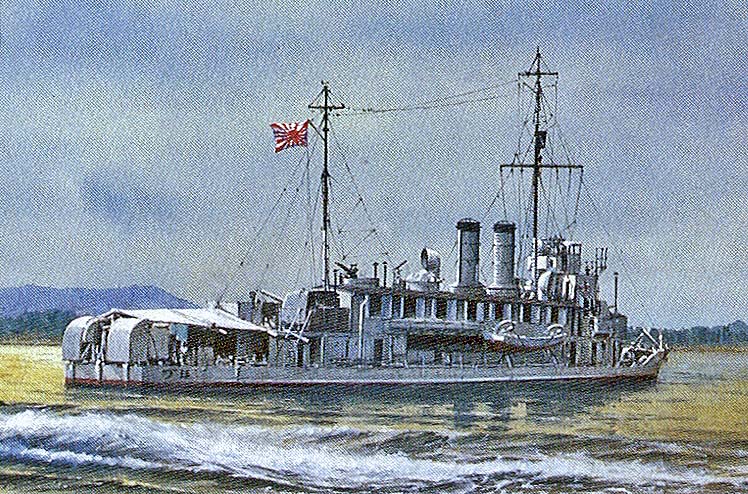
©2007-2015 Bob Hackett, Sander Kingsepp and Peter Cundall
Revision 4
June-August 1900: The Boxer Rebellion:
China. In defense of their foreign legations, about 20,000 Italian soldiers and troops of the United States, Great Britain, France, Austria-Hungary, Germany, Russia and Japan fight and win a campaign against the anti-foreign, anti-imperialist Boxers and Chinese Nationalist troops. Shortly thereafter, the majority of American, European and Japanese troops are withdrawn from China.
7 September 1901:
A peace treaty is signed between Empress Tsu Hsi and the colonial powers. The treaty gives Italy the right to occupy a portion of Tientsin and two commercial quarters in Peking (Beijing) and Shanghai. The Regia Marina Italiana’s presence in China begins with this treaty. [1]
22 May 1927:
Ancona, Italy. Gunboat RN LEPANTO is completed and enters Italian service in China.
1927:
China is in the midst of a civil war between the Kuomintang Party’s Generalissimo Chiang Kai-shek’s Nationalists and Mao Tse-Tung’s Communist Army. The goal of both the Nationalists and Communists is to rid China of foreigners who have usurped China.
1930:
Count Galeazzo Ciano, son-in-law of dictator Benito Mussolini, is appointed secretary at Peking's Italian legation. Soon thereafter, he is appointed Minister Plenipotentiary in Shanghai.
18 September 1931: The "Mukden Incident":
Liutiaohu, about 25 miles from Mukden (now Shenyang), the capital of Manchuria. Japanese soldiers detonate an explosive on the Japanese-owned Southern Manchurian Railway. Chinese soldiers retaliate with gunfire. The Japanese Kwantung Army reinforces their troops and attacks Mukden. The “Mukden Incident” is the beginning of the Pacific War. After the Mukden Incident, Chiang Kai Shek chooses Ciano as a go-between with the Japanese.
28 January 1932: The "First Shanghai Incident":
The 2,500-man Shanghai Special Naval Landing Force (SNLF) is dispatched to evict two divisions of the Chinese 19th Route Army from Shanghai. Later, the badly outnumbered SNLF is reinforced by 50,000 IJA troops who encircle the Chinese and force a truce.
That same day, in response to increased tensions in Shanghai, heavy cruiser TRENTO and destroyer ESPERO depart Italy. They cruise via the Suez Canal and call at Aden, Yemen, Colombo, Ceylon (now Sri Lanka) and Singapore.
4 March 1932:
TRENTO and ESPERO arrrive at Shanghai.
May 1932:
Shanghai. USS HOUSTON (CA-30) passes close by TRENTO and ESPERO. A USN intelligence officer photographs the Italian warships.
14 May 1932:
TRENTO and ESPERO depart Shanghai for La Spezia. Italy.
10 April 1937:
Arrives at Shanghai.
14 April 1937:
Departs Shanghai.
15 April 1937:
Arrives at Nanjing.
22 April 1937:
Departs Nanjing.
24 April 1937:
Arrives at Ki Chow.
26 April 1937:
Departs Ki Chow.
26 April 1937:
Arrives at Hankow.
2 May 1937:
Departs Hankow.
2 May 1937:
Arrives at Juijiang.
7 May 1937:
Arrives at Woosung.
9 May 1937:
Departs Woosung.
14 May 1937:
Arrives at Fuzhou.
17 May 1937:
Departs Fuzhou.
19 May 1937:
Arrives at Shanghai.
6 July 1937:
Departs Shanghai.
7 July 1937: The Marco Polo Bridge (The"First China Incident") Incident:
Hun River, Lukuokiao, China. Japanese troops at the bridge fire blank cartridges during night maneuvers. Chinese troops fire back. Later, the Japanese discover a soldier missing and demand entry to the Beijing suburb of Wanping to look for him, but the Chinese refuse. The Japanese shell the city and an undeclared war on China begins.
Cdr Bacigalupi, CO of LEPANTO, is in charge of the first Italian defense detachment, composed by part of LEPANTO's and gunboat CARLOTTO's crews. The Tientsin-based "Battaglione Italiano in Cina" soon joins these forces.
8 July 1937:
Arrives at Qingdao.
15 July 1937:
Departs Qingdao.
17 July 1937:
Arrives at Chingwantao.
10 August 1937:
Departs Chingwantao.
11 August 1937:
Arrives at Dalian.
13 August 1937:
Arrives at Weihai.
16 August 1937:
Departs Weihai.
17 August 1937:
Arrives at Qingdao.
20 August 1937:
Departs Qingdao.
22 August 1937:
Arrives at Shanghai.
25 August 1937:
Departs Shanghai.
27 August 1937:
The Italian Comando Supremo sends soldiers and light cruiser RAIMONDO MONTECUCCOLI from Naples to Tientsin.
15 September 1937:
MONTECUCCOLI arrives at Shanghai to coincide with the first Japanese bombings on the city. By then, at least 1,200 Italian Army and Navy troops are in China to defend the safety and interests of 500 to 600 resident Italians.
30 October 1937:
Arrives at Hong Kong, British Crown Colony.
11 November 1937:
Departs Hong Kong.
14 November 1937:
Arrives at Haiphong, French Indochina.
18 November 1937:
Arrives at Xiamen. Departs that same day.
29 November 1937:
Arrives at Shanghai.
12 December 1937: The"China Incident."
Yangtze River, above Nanking. LtCdr James J. Hughes' river gunboat USS PANAY (PR-5) is attacked and sunk by IJN aircraft. Three men are killed and 43 sailors and five passengers wounded.
23 December 1938:
Light cruiser BARTOLEMEO COLLEONI arrives at Shanghai to replace MONTECUCCOLI. While on "China Station", COLLEONI visits Tsingtao, Chefoo, Chingwantao, Dairen, Kobe, Yokohama, Nakasaki, Wei-Have, and Petaiho.
1 October 1939:
A month after the German invasion of Poland, Comando Supremo recalls COLLEONI. The headquarters of the Italian Naval Division in Far East (Comando Navale Estremo Oriente) is moved to LEPANTO.
10 June 1940-8 September 1943:
During Italy's participation in World War II, the Regia Marina Italiana’s presence in China consists of LEPANTO in Shanghai, CARLOTTO in Tientsin and some detachments of troops assigned to the defense of small Italian
commercial interests.
8 September 1943:
Rome. The Italian armistice is announced.
9 September 1943:
Shanghai. LtCdr Morante’s LEPANTO and Lt De Leonardis’ CARLOTTO are scuttled to prevent their capture. Their crews are interned by the Japanese.
February 1944:
LEPANTO is raised and salvaged by the Japanese. Undergoes repairs and reconstruction.
1 March 1944:
Renamed OKITSU and registered in the IJN in the Sasebo (or Yokosuka) Naval District. Lt (later LtCdr) Hamazaki Chotaro (61) (former CO of HAYABUSA) is the Commanding Officer. Assigned to the China Area Fleet’s Shanghai Area Base Force.
April 1944:
As a result of various regulation infringements, 12 Italian officers from LEPANTO and CARLOTTO are transferred to the Kiang Wang POW Camp near Shanghai. They remain there until the end of the war.
14 May 1944:
Begins training for escort duties.
4 June 1944:
Arrives in Shanghai after completing an anti submarine sweep.
6 June 1944:
OKITSU and UJI depart Shanghai escorting convoy TA-605.
9 June 1944:
OKITSU detaches and arrives at Kirun.
12 June 1944:
Departs Kirun with kaibokan KASADO, submarine chaser CH-58, auxiliary submarine chaser CHa-90 and auxiliary gunboat CHOHAKUSAN MARU escorting TAMO-20A convoy consisting of ten unidentified merchant ships.
14 June 1944:
OKITSU is detached from the convoy.
15 June 1944:
Arrives at Shanghai.
24 June 1944:
OKITSU, destroyer KURI and torpedo boat HATSUKARI escorts TA-406 convoy between Shanghai and Takao, Formosa. The convoy consists of GYOYU, GYOUN, NITTO MARUs and KYODO MARU No. 28 and carries troops of the 22nd Division.
30 June 1944:
Arrives at Takao.
3 July 1944:
At 1025, OKITSU departs Saei, Formosa with destroyer HASU escorting convoy 3311 (also called Shi-310) consisting of CHOHAKUSAN, KORYU, SETSUZAN, SHOZAN, DAIICHI, FUKUEI, KAIKO, NICHIZUI, PEKING, YOKO, DAIKYU and SHOHO MARUs and TOYO MARU No. 5.
4 July 1944:
At 0700, YOKO MARU detaches for Keelung. Later that day, SHOHO MARU develops engine trouble and falls behind.
6 July 1944:
At 0545, LtCdr (later Vice Admiral) Eli T. Reich's USS SEALION (SS-315) torpedoes and sinks SETSUZAN MARU at 29-57N, 122-51E. HASU and OKITSU undertake a hunt for the submarine.
9 July 1944:
Breaks off the submarine sweep and commences patrolling.
10 July 1944:
At 0130, Convoy 3311 anchors near Shanghai.
11 July 1944:
At 0600, Convoy 3311 departs the anchorage.
19 July 1944:
At 1040, Convoy 3311 arrives at Seito (Tsingtao).
20 July 1944:
At 1000, Convoy 3311 departs Seito. That same day OKITSU ceases patrolling and commences escort of convoy TA-101.
25 July 1944:
At 1700, Convoy 3311 arrives at Moji.
That samew day TA-101 arrives at Takao.
26 July 1944:
OKITSU departs Takao escorting convoy SHI-601 probably destined to Shanghai.
31 July 1944:
OKITSU is detached from the convoy and begins patrolling.
2 October 1944:
OKITSU arrives at Sasebo.
9 October 1944:
Lt Hamazaki is hospitalized due to unknown causes. In his absence, LtCdr Tadayoshi Sugiyama (61) (former CO of SATSUKI) assumes temporary command. Departs Sasebo.
10 October 1944:
OKITSU is reassigned to the 24th Gunboat Division.
13 October 1944:
Shanghai. Escorts an unidentifed medium-sized coastal convoy.
1 November 1944:
Lt Hamazaki resumes command. LtCdr Sugiyama is reassigned.
5 February 1945:
Lt Hamazaki is posted Chief Equipping Officer of KAKI.
13 February 1945:
LtCdr Hijioka Torajiro (former CO of KANJU) assumes command. Lt Hamazaki assumes full-time duty as Chief Equipping Officer of KAKI, and later becomes her first CO.
21 March 1945:
S China Sea, off Cape Hung Hua, Indochina. OKITSU is attacked and damaged by a formation of six 14th Air Force B-24 "Liberator" heavy bombers.
7 April 1945:
Departs Shanghai, but not escorting a convoy.
27 April 1945:
Arrives at Sasebo.
11 May 1945:
At 0500 OKITSU departs Sasebo transporting “Shinyo” (Ocean Shaker) explosive motor boat (EMB) crews to Shanghai, China. The crews are assigned to the 52nd Shinyo Unit deployed at the Zhoushan (Shushan) Islands in Hangzhou Bay and use EMBs built at Shanghai.
13 May 1945:
At 1920 arrives at Seito (Tsingtao).
14 May 1945:
At 0456 departs Seito to temporary anchorage.
15 May 1945:
At 0912 arrives back at Seito.
17 May 1945:
At 0553 departs Seito.
18 May 1945:
At 1715 arrives at Shanghai.
21 May 1945:
At 0626 departs Shanghai with subchaser CH-38 for Tsingtao escorting convoy SE-27 consisting of NEIHA (NINGPO), KOSHO (HSING CHANG) and KOA (HSING YA) MARUs.
22 May 1945:
At 2204 arrives at Seito (Tsingtao).
27 May 1945:
At 0530, OKITSU departs Tsingtao with subchaser CH-38 for Tsingtao escorting convoy SHI-103 consisting of NEIHA (NINGPO), KOSHO (HSING CHANG), CHOHEI and KOA (HSING YA) MARUs.
29 May 1945:
At 1315, arrives at Shanghai.
June 1945:
Shanghai. Undergoes repair and replenishment.
June-July 1945:
Escorts several unidentifed convoys between Shanghai and Tsingtao.
15 August 1945:
Chusan archipelgo. OKITSU’s crew receives notification of the termination of the war.
9 September 1945:
Japanese troops in China formally surrender. OKITSU is surrendered.
30 September 1945:
Removed from the Navy List.
1946:
Ceded to Nationalist China and renamed SIEN NING.
1949:
Captured by the Peoples’ Republic of China forces.
1956:
Scrapped.
Authors' Notes:
[1] RN = Regia Nautica, later Regia Marina, currently Marina Militare or Italian Navy.
Thanks go to Dr. Higuchi Tatsuhiro of Japan and Jerry Asher of California for help with Revision 1.
Thanks also go to Mattew Jones of Misssisppi for identiying COs in Revision 2 and to Gilbert Casse of France.
-Bob Hackett, Sander Kingsepp and Peter Cundall
Back to
Gunboat Page