©2007-2015 Bob Hackett, Sander Kingsepp and Peter Cundall
Revision 2
1932:
Shanghai, China. Laid down at the Kiangnan ship yard.
1933:
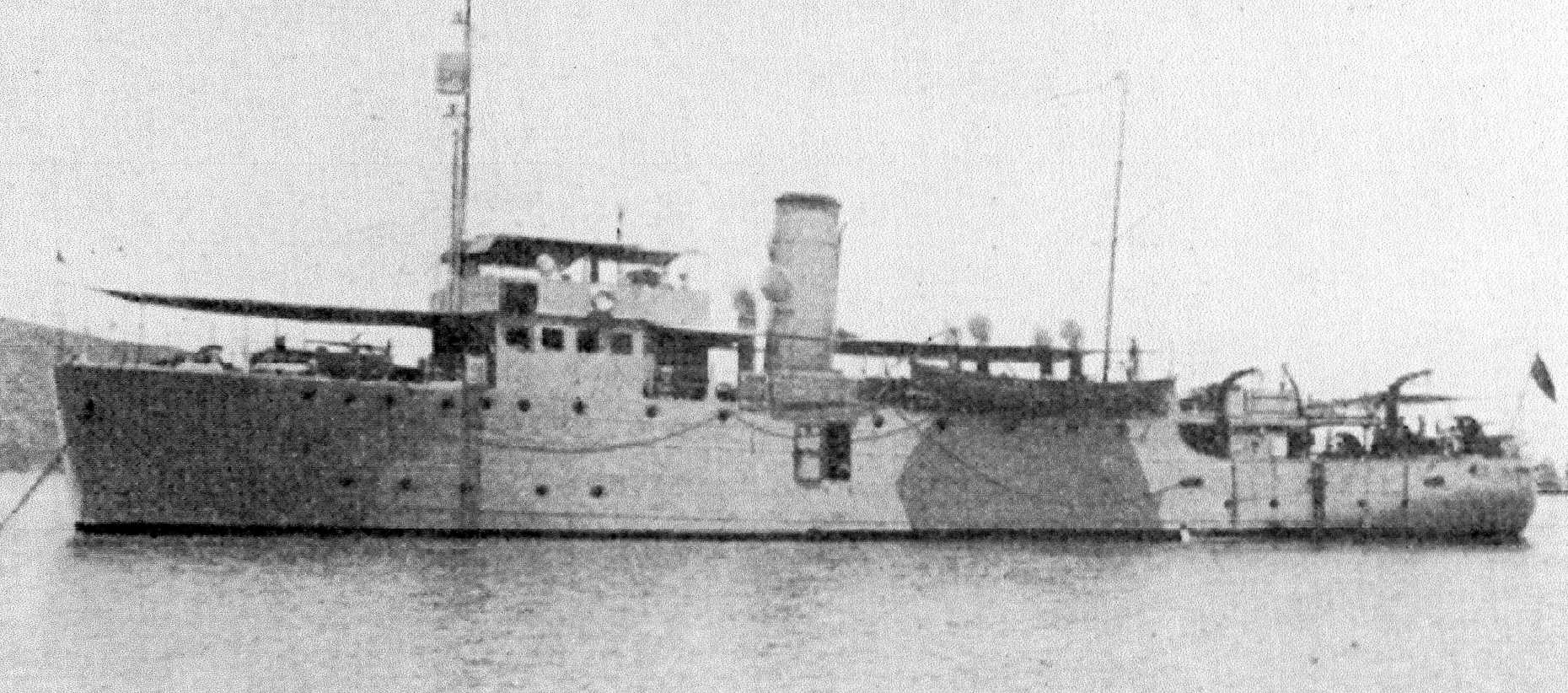
Completed and placed in service as Maritime Customs Cruiser TEH HSING.[1]
7 July 1937: The Marco Polo Bridge (The First "China") Incident:
Lugouqiao, China. Japanese troops conduct night maneuvers at the bridge. In the morning, they discover a soldier missing and demand entry to Beijing suburb to look for him, but the Chinese refuse. The Japanese then shell the city and an undeclared war on China begins.
9 October 1937: The Conquest of Shanghai:
The city falls to Japanese forces. At an earlier unknown date, TEH HSING escapes to the British Crown Colony of Hong Kong.
8 December 1941:
The Japanese open their offensive on Hong Kong by moving troops across the New Territories frontier and.attacking Kai Tak airport on Kowloon by air. At 2100, old British destroyers HMS THANET and HMS SCOUT clear Hong Kong and head for Singapore.
13 December 1941:
Major General Christopher M. Maltby, British Indian Army, orders the evacuation of Kowloon Peninsula. Auxiliary patrol boat TEH HSING, under the command of Hong Kong Royal Naval Volunteer Reserve LtCdr Bernard J. Morahan, probably assists in ferrying troops across the bay to Hong Kong Island. By 0930, all British and Commonwealth troops are evacuated from the Mainland to Hong Kong Island. In the meantime, Royal Engineers destroy anything useful on the north side.
25 December 1941: The Fall of Hong Kong:
Gen Maltby advises Governor Sir Mark A. Young to surrender the outnumbered garrison because of lack of food and water. At 1800, in Japanese headquarters in the Peninsula Hotel at Kowloon, Young surrenders the Colony to LtGen Sakai Takashi, CG, 23rd Army. That night, nearly 6,500 British and Commonwealth troops go into captivity.
Prior to this date TEH HSING is presumably scuttled at Hong Kong Island.
20 December 1942:
Reserve Lt Baba Katashi is appointed Chief Equipping Officer.
1 March 1943:
Hong Kong. TEH HSING is officially requisitioned by the IJN, registered as an auxiliary gunboat and attached to the Sasebo Naval District. Lt Baba is the Commanding Officer. Begins conversion to a gunboat at the IJN’s No. 2 Repair Facility. Assigned to Admiral Yoshida Zengo's (32)(former CO of MUTSU) China Area Fleet in Vice Admiral Hara Kiyoshi’s (38) (former CO of IWATE) Second China Expeditionary Fleet.
20 March 1943:
The conversion is completed. TEH HSING is renamed NANYO, call sign JFQQ. The ship remains at Hong Kong fitting out.
28 June 1943:
Departs Hong Kong.
29 June 1943:
Arrives at Amoy.
2 July 1943:
Departs Amoy.
5 July 1943:
Arrives at Amoy.
9 July 1943:
Departs Amoy.
11 July 1943:
Arrives at Chuan Shih Tao, near Foochow.
14 July 1943:
Departs Chuan Shih Tao escorting WUHU MARU.
15 July 1943:
Arrives at Mashi Tao (Mazu To or Matsu Island, a main anchorage point).
16 July 1943:
Departs Mashi Tsao.
17 July 1943:
Returns to Mashi Tao.
20 July 1943:
Departs Mashi Tao and later that day arrives at Niu Shan Tao.
21 July 1943:
Departs Niu Shan Tao and later that day arrives at Amoy.
27 July 1943:
Departs Amoy.
28 July 1943:
Arrives back at Amoy.
3 August 1943:
Arrives at Kirun.
5 August 1943:
Departs Kirun escorting a convoy consisting of SEIKYO and TOYO MARUs.
7 August 1943:
Arrives in Mashi Tao area.
13 August 1943:
At 1240 departs Amoy escorting a convoy consisting of TEIREN MARU (ex GOUVENEUR GENERAL A. VARENNE) and four unidentified merchant ships bound for Shanghai.
14 August 1943:
At 27N NANYO is detached.
17 August 1943:
Arrives at Mashi Tao. At 0800 departs Amoy escorting HAKUYO MARU for Hong Kong.
18 August 1943:
At 1930 NANYO is detached and returns to Mashi Tao area.
22 August 1943:
Departs Mashi Tao.
23 August 1943:
Arrives at Amoy.
3 September 1943:
At 1600 arrives at Kirun.
4 September 1943:
At 1700 departs Kirun.
6 September 1943:
At 1015 arrives in Mashi Tao area.
13 September 1943:
At 1810 departs Mashi Tao area.
17 September 1943:
At 1030 arrives at Mashi Tao.
22 September 1943:
At 1900 departs Mashi Tao.
23 September 1943:
At 1235 arrives at Amoy.
2 October 1943:
At 1247 departs Amoy but returns there at 1505.
3 October 1943:
At 0600 departs Amoy and at 1857 arrives at Nanao Tao.
4 October 1943:
At 0653 departs Nanao Tao and at 1200 arrives at Chuan Shih Tao.
5 October 1943:
At 1301 departs Chuan Shih Tao.
6 October 1943:
At 0413 arrives at Amoy.
7 October 1943:
At 1840 departs Amoy.
8 October 1943:
At 0500 arrives at unidentified location (ending in Chang) and departs there at 1400.
9 October 1943:
At 0720 arrives at Mako.
11 October 1943:
At 1800 departs Mako.
12 October 1943:
At 0940 arrives at Amoy.
22 October 1943:
At 1800 departs Amoy.
23 October 1943:
At 1320 arrives at Mashi Tao.
26 October 1943:
At 0900 departs Mashi Tao.
27 October 1943:
At 2000 arrives back at Mashi Tao.
22 November 1943:
Together with submarine chaser KAIKO (ex Chinese destroyer YUNG CHI) and auxiliary patrol boat NABURI MARU escorts KATSUURA MARU in Amoy area.
13 December 1943:
At 1350 departs Mashi Tao area.
14 December 1943:
At 0445 arrives at Kirun.
18 December 1943:
At 0900 departs Kirun and at 2140 arrives at Mashi Tao.
23 December 1943:
South China Sea. Mashi Tao (Matsu or Mazu) Island anchorage, off Foochow. MajGen Claire L. Chennault's 14th Air Force North American B-25 “Mitchell” medium bombers sink NANYO with unknown casualties at 26-10N, 119-55E.
5 February 1944:
Removed from the Navy List.
Authors' Notes:
[1] The Chinese Maritime Customs Marine Department, headquartered in Shanghai, was responsible for maintenance of lighthouses on the China coast, conservation of various rivers including the Yangtze and coastal patrols against smugglers. The Marine Department also provided pilots in certain ports. Customs’ large fleet was manned by Chinese and foreign nationals.
Various secondary sources also state NANYO (sometimes shown as NANYO MARU) was the ex-British Bangor Class Minesweeper LYEMUN seized while building at Hong Kong. It is believed this vessel (likeliest) or her sister ship LANTAN became GYOSHIN MARU that survived the war. Two other Bangors became IJN minesweepers W-101 and W-102. Several authorative records, including those at NARA and Gakken, list NANYO as ex-TEH HSING and we have made this assumption accordingly.
Special thanks go to Gilbert Casse of France, Gengoro S. Toda of Japan and Erich Muehlthaler of Germany for help with this TROM. Thanks also go to Dr. Higuchi Tatsuhiro of Japan and Mr. Matthew Jones of Ohio, USA.
Photo credit goes to Erich Muehlthaler.
-Bob Hackett, Sander Kingsepp and Peter Cundall
Back to
Gunboat Page